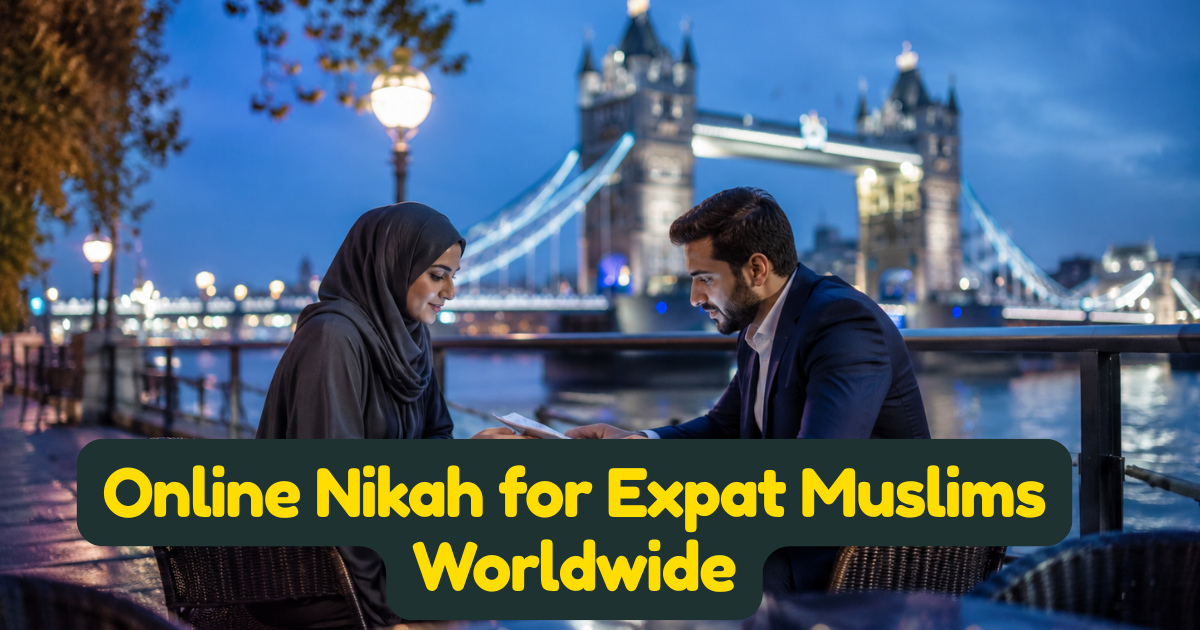
Online Nikah for Expat Muslims Worldwide: The Complete Guide
The global Muslim expat experience is one of the defining features of contemporary Islamic life. Pakistanis building careers in the Gulf. Indonesians working across East Asia. Bangladeshis in the Middle East and Southeast Asia. Moroccans and Algerians throughout Europe. Nigerians and Somalis in the United Kingdom and Scandinavia. Turks across Continental Europe. South Asian Muslims across the United States, Canada, Australia, and New Zealand. Taken together, these communities represent tens of millions of Muslims living and working in countries not their own — navigating professional ambition, immigration complexity, cultural distance, and the persistent, often urgent question of how to marry correctly when everything important is somewhere else.
The traditional nikah — both families physically present, a qualified local Qazi in attendance, witnesses gathered — assumes a geographic proximity that expat life systematically denies. The wali is in Lahore. The prospective bride is in Frankfurt. The groom is in Dubai. The witnesses are two Muslim friends in a city where the couple has lived for two years but where the family has never visited. Getting everyone into the same room is not a matter of planning. It is a matter of visas, flights, annual leave, and money that doesn't always exist.
Online nikah — conducted via a secure video call, with a qualified Qazi, a wali on screen from wherever he is, witnesses present or attending remotely, and every Islamic condition genuinely fulfilled — has become the answer that serves this global Muslim population. This guide covers it completely.
Who This Guide Serves
This guide is written for any Muslim living outside their country of origin who is navigating the question of nikah. That includes:
- Professionals working abroad in the Gulf, Southeast Asia, East Asia, Europe, or North America
- International students completing degrees far from their home countries
- Muslims who have permanently settled abroad but whose families and prospective spouses remain at home
- Couples where both partners are abroad — in the same country or in different countries from each other
- Muslim converts in non-Muslim-majority countries without Muslim family networks
- Second-generation Muslims in Western countries with prospective spouses abroad
- Muslims in countries where local Islamic marriage infrastructure is limited or unavailable
The Specific Challenges Expat Life Creates Around Nikah
The Wali Is in Another Country
For Muslim women living abroad, the wali question is the most practically significant challenge. The father — or the next eligible mahram — is typically in the home country. Arranging for him to travel, or for the nikah to take place where he is, involves visas, expense, and timing that can delay a marriage for months. Online nikah removes this barrier: the wali joins the video call from wherever he is and fulfils his role completely. For complex wali situations, the discussion is at online nikah without wali.
No Local Qazi
Muslim expat communities are concentrated in certain cities but spread across smaller towns and regions where Islamic institutional infrastructure is thin. A Pakistani engineer in rural Germany, a Bangladeshi nurse in a Norwegian coastal town, a Somali family in a mid-sized Swedish city — none of these Muslims may have realistic local access to a qualified Qazi. Online nikah dissolves this problem. Regional guides cover specific countries: Germany, Norway, Sweden, UAE, Australia, USA, UK, Canada, and others.
Partners in Different Countries
Expat marriages frequently involve partners in different countries — one abroad, one at home, or both abroad in different locations. The full guide for this specific scenario is at online nikah for couples in different countries.
Immigration and Visa Pressure
Work contract endings, residency changes, visa expirations, and spousal visa timelines all create urgency around marriage that traditional arrangements cannot always absorb. Same-day online nikah is available when all Islamic conditions are confirmed and all parties are present.
Financial Realities
Coordinating travel across multiple countries for a traditional nikah — flights, accommodation, visas — can cost more than the nikah ceremony itself warrants. The cost of an online nikah through a reputable service is a fraction of that. Pricing is covered at how much does online nikah cost.
Is Online Nikah Islamically Valid for Expats?
Yes — when every classical condition is genuinely fulfilled and a qualified Qazi oversees the process. Contemporary Islamic scholars who have engaged this question have affirmed online nikah's validity through two frameworks: that real-time audio-visual communication satisfies the effective witnessing condition, and that genuine necessity — of the kind diaspora distance creates — permits what convenience alone would not justify. The full scholarly discussion, covering different madhab positions honestly, is at Is Online Nikah Valid in Islam.
Online Nikah for Expats: Regional Overview
Gulf and Middle East
The Gulf states — UAE, Saudi Arabia, Qatar, Kuwait, Bahrain, Oman — host some of the world's largest Muslim expat populations. South Asian and Southeast Asian workers on time-limited employment visas frequently need to complete their nikah while their wali and bride's family remain in the home country. The UAE guide covers the specific context for Gulf-based expats.
Western Europe
Western Europe's Muslim expat and settled-immigrant communities represent millions of people navigating cross-border marriages. Country-specific guides are available for the UK, Germany, France, the Netherlands, Belgium, Sweden, Norway, Denmark, Austria, Switzerland, Italy, Spain, Greece, and Finland.
North America
The US and Canada host large, well-established Muslim communities with strong diaspora ties. Second-generation Muslims marrying partners from abroad — and navigating spousal immigration timelines — represent the dominant online nikah use case here. Guides for the USA and Canada provide country-specific detail.
Australia, Singapore, and the Pacific
Australian Muslim expats and settled immigrants face the additional challenge of geographic isolation from the Muslim world. The Australia guide and Singapore guide cover these regional contexts specifically.
Morocco and North Africa
Morocco is both a major source of emigration to Europe and a country with significant Muslim expat presence. The Morocco guide covers the relevant nikah considerations for families with one foot in North Africa and the other in Europe.
Mahr Across Borders
The mahr — the obligatory gift from groom to bride, belonging to her personally — requires practical thought in the expat context. Cultural expectations around mahr vary between communities. Currency and international transfer considerations matter when groom and bride are in different countries. The amount should be within the groom's genuine means, genuinely agreed, and declared explicitly during the ceremony. A deferred mahr — payable at a specified future time — is entirely valid and often practical for expat couples. The complete mahr guide is at what is mahr in nikah.
Civil Registration for Expat Couples
The Islamic nikah and civil marriage registration are two separate matters. An online nikah through InstantNikah.com establishes the Islamic marriage — validly, fully, with documentation. It does not in itself constitute civil registration under the law of any country.
For expat Muslim couples, this distinction has real practical consequences — particularly for spousal immigration sponsorship, which most Western countries require civil marriage documentation to support. Each country has its own civil marriage framework, and civil registration must be pursued through the relevant jurisdiction's legal process. A local solicitor or immigration lawyer in your country of residence can advise specifically. The nikah certificate's contents are explained at the online nikah certificate.
How InstantNikah.com Serves Expat Muslims
InstantNikah.com is a premium international online nikah service — not a matchmaking platform, not a rishta site. It facilitates Shariah-compliant nikah ceremonies for Muslim couples globally, with specific experience serving expat communities across every major Muslim diaspora region.
- Enquiry and consultation: Submit details. A representative contacts you, understands your expat situation — which countries, where the wali is, witness arrangements — and answers questions honestly.
- Condition verification: All Islamic conditions confirmed before scheduling — wali, witnesses, mahr, consent of both parties.
- Scheduling across time zones: The InstantNikah.com team coordinates across whatever time zones are involved — from Gulf evenings to North American mornings to Southeast Asian afternoons.
- The ceremony: Conducted live via secure video by a certified Shariah-qualified Qazi — complete, dignified, with every Islamic condition genuinely fulfilled.
- Nikah certificate: Issued after the ceremony, documenting both parties, Qazi, witnesses, and mahr.
Full process at InstantNikah.com/process. Reviews at InstantNikah.com/reviews. Gallery at InstantNikah.com/gallery. About the service: About Us. Terms: Terms & Conditions. Privacy: Privacy Policy. Questions: Contact. Ready to begin: Book your online nikah.
Admin User
Author