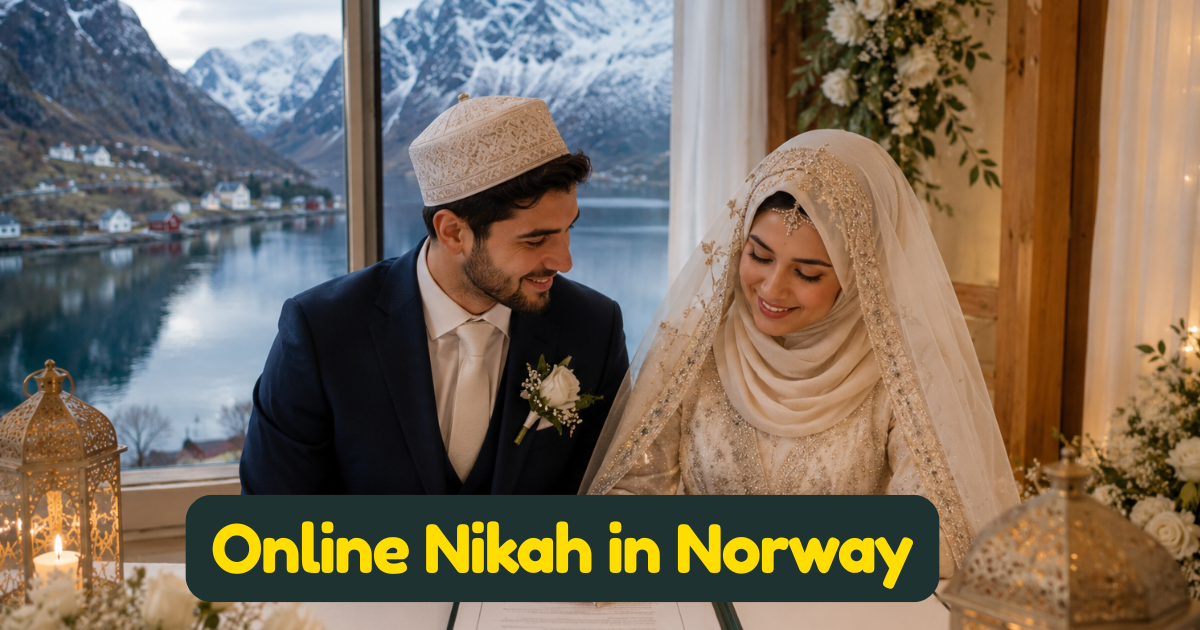
Norway occupies a legally distinctive position in Scandinavian Muslim marriage discourse — and it is a position that no English-language guide on online Nikah has ever explained accurately. Understanding it properly matters for the approximately 200,000 Muslims who call Norway home, and for the many diaspora Norwegians navigating marriage from abroad.
The Muslim communities of Norway — predominantly Pakistani families in Oslo who arrived during the 1970s labour migration, alongside Somali, Iraqi, Moroccan, Afghan, and Turkish communities, and a growing Norwegian convert population — have been building Islamic life in one of Europe's wealthiest and most egalitarian welfare states for over fifty years. Marriage sits at the intersection of that Islamic life and Norwegian civil law in ways that have generated genuine legal debate — and real consequences for Muslim women.
Norway's Unique Legal Position — No Law Against Nikah-Only Marriage
This is the fact that distinguishes Norway from every other Scandinavian country covered in this series — and the fact most guides ignore entirely.
There is no law in Norway that prohibits a Nikah-only marriage ceremony. Norwegian law treats religious marriage ceremonies as belonging to the realm of religion — a private matter between consenting adults and their faith community. Unlike France, which criminalises religious ceremonies conducted before civil marriage, Norway imposes no legal prohibition on an Imam conducting a Nikah without prior civil registration.
Research from OsloMet — Oslo Metropolitan University — confirms this directly in a study commissioned by the Norwegian Directorate for Children, Youth and Family Affairs: there is no law against Nikah-only marriage in Norway, as these are considered to belong to the realm of religion. The same research noted that the Norwegian County Governor's office (Statsforvalteren) had on some occasions issued written warnings to mosques for officiating unregistered Muslim marriages — but that these warnings rested on legally questionable grounds given that no Norwegian law actually prohibited the practice.
This legal reality does not mean that a Nikah-only ceremony is advisable in Norway — the civil consequences of an unregistered marriage fall hardest on women, as they do across Western Europe. But it does mean that Norwegian Muslims are in a legally distinct position from their counterparts in Denmark, France, and Germany when it comes to the sequencing of Islamic and civil ceremonies.
Civil Marriage in Norway — The Skatteetaten System
Norway's civil marriage system is administered through an institution that surprises most non-Norwegians: the Norwegian Tax Administration — Skatteetaten. Marriage registration in Norway falls under the Skatteetaten's management of the National Population Register (Folkeregisteret). This is unique among the countries covered in this series — in no other country does the tax authority administer marriage registration.
As the Norwegian Tax Administration's official guidance confirms, marriage can be entered into through a civil ceremony or through a religious ceremony conducted by an authorised officiant of a registered religious community. Both create a legally recognised marriage in Norway — provided the religious community is authorised and the officiant is registered with the Norwegian authorities.
This is a significant and practically important provision: in Norway, a Nikah conducted by an Imam who is registered as an authorised marriage officiant within a religious community that holds Norwegian marriage authority can simultaneously be both an Islamic marriage and a legally recognised Norwegian marriage. Both the Islamic and civil elements happen in a single ceremony — similar to how registered Catholic priests in Norway can conduct legally recognised church weddings.
The question is whether the specific Imam or mosque conducting the Nikah holds this Norwegian marriage authority. Not every Imam in Norway is a registered marriage officiant. Couples should verify this directly with their mosque before assuming that a Nikah conducted there creates a legally recognised marriage in Norway.
As the Norwegian government's official conditions for marriage state: a marriage may be entered into in a church or civil ceremony — and Norway extends this to registered religious communities of all faiths, including Islam.
For couples where the Imam is not a registered Norwegian marriage officiant, the civil ceremony pathway runs through the local municipality — either at the Statsforvalteren (County Governor's office) or, in Oslo, through the specific civil marriage office. Both parties must appear in person. Valid identification and documentation of civil status are required.
Why Nikah-Only Marriage Remains Problematic Despite Its Legality
The fact that there is no Norwegian law prohibiting a Nikah-only marriage does not mean that living with only a Nikah certificate in Norway carries no risks. The civil consequences remain entirely as they are in the rest of Western Europe.
A Norwegian Muslim wife with only a Nikah certificate — where the Nikah was not conducted by a registered officiant and was not registered in the Folkeregisteret — has no inheritance rights under Norwegian succession law, no automatic spousal support claim under Norwegian family law, and no legal standing in Norwegian family courts if the relationship ends. She is treated as a cohabitant, not a spouse — with considerably fewer protections than a legally registered wife.
Research commissioned by Norwegian authorities has consistently highlighted the vulnerability of Muslim women in unregistered marriages in Norway — particularly in communities where cultural pressure may make it difficult to insist on civil registration alongside the Nikah. A responsible Nikah service will always make this clear before the ceremony, not after.
Norway's Muslim Communities — Pakistani, Somali, and Beyond
Norway's Muslim population is concentrated primarily in Oslo — which is home to the vast majority of Norway's Muslims, making it proportionally one of the most Muslim cities in Scandinavia. Bergen, Stavanger, and Trondheim have smaller but established communities.
The Pakistani community — the largest and oldest, having arrived primarily through the 1970s labour migration — predominantly follows the Hanafi school. Many Pakistani-Norwegian families are now third generation, with strong transnational ties that make cross-border marriages a continuing reality. A Pakistani-Norwegian resident marrying a partner still in Lahore or Karachi faces Norwegian immigration requirements that make a properly documented marriage essential.
The Somali community — the second largest at around 40,000 — predominantly follows the Shafi'i school. Somali-Norwegian cross-border marriages are also common, often involving partners in Somalia, Kenya, or the wider Somali diaspora. For Shafi'i-following Norwegian Muslim women, the Wali requirement is a firm condition of the Nikah's validity.
Arab communities — Iraqi, Moroccan, Lebanese, and Palestinian — are present across Oslo and other cities, each bringing their own scholarly traditions. And Norway's convert Muslim community continues to grow — particularly among Norwegian women who have embraced Islam and who, without Muslim male relatives, need the Wali-e-Hakim pathway handled properly.
Norwegian Immigration — The UDI and Marriage Documentation
The Norwegian Directorate of Immigration — Utlendingsdirektoratet (UDI) — administers Norway's family immigration applications, including family reunification for spouses. UDI requires proof of a legally recognised marriage for spousal family reunification. A Nikah certificate from a ceremony conducted by a non-registered Imam, without corresponding Norwegian civil registration, does not constitute proof of a legally recognised marriage for UDI purposes.
For Norwegian Muslim couples where one partner is abroad — in Pakistan, Somalia, or elsewhere — the documentation of a legally recognised marriage is critical for UDI applications. The most reliable pathway is either a Norwegian civil ceremony or a marriage conducted in the overseas partner's home country that is legally registered there and recognised in Norway through overseas marriage recognition provisions. We strongly recommend consulting a Norwegian immigration lawyer before submitting any UDI application.
Where Online Nikah Serves Norwegian Muslim Couples
Given Norway's unique legal landscape — no prohibition on Nikah-only ceremony, but significant civil consequences if civil registration is not also completed — InstantNikah.com's role for Norwegian Muslim couples is specific and practically grounded.
Cross-Border Couples
A Norwegian-resident Muslim whose partner is still in Pakistan, Somalia, Iraq, or elsewhere can complete the Islamic marriage immediately through an online Nikah, making the relationship halal, while the Norwegian civil process and UDI immigration application proceed in parallel. Both partners join the live video call from their respective locations. The Islamic ceremony happens in real time.
Couples Outside Oslo
Norwegian Muslims in Bergen, Stavanger, Trondheim, Tromsø, and smaller Norwegian cities and towns may have significantly less access to a qualified Imam willing to conduct a Nikah at short notice than Muslims in Oslo. Norway's geography — spread across hundreds of kilometres with communities in remote locations — makes an online service genuinely more accessible than local alternatives for many couples.
Norwegian Muslim Converts
Norway has a growing convert Muslim community. Norwegian converts often have no established mosque connection and no Muslim male relatives to serve as Wali. An online Nikah handles the Wali-e-Hakim appointment as standard. Our complete guide to online Nikah for converts covers every scenario in detail.
Couples Wanting the Nikah Before Civil Registration
Unlike Denmark where most mosques require the civil certificate first, Norwegian law does not prohibit the Nikah before civil registration — and Norwegian Islamic practice is not uniformly civil-certificate-first. For couples who want to complete the Islamic marriage immediately for religious reasons, an online Nikah provides this without any Norwegian legal barrier. Civil registration at the Statsforvalteren or municipal office can follow at the couple's chosen time.
The Wali Situation for Norwegian Muslim Women
For Norwegian Muslim women whose Wali is in Pakistan, Somalia, Iraq, or elsewhere overseas, the online Nikah model is directly practical. The Wali joins the live video call from wherever he is. Norway is in the Central European time zone in summer and one hour ahead of the UK — manageable with Pakistan (four to five hours), Somalia (two hours), and Iraq (two hours).
For Norwegian convert women with non-Muslim families, the Wali-e-Hakim pathway applies — handled as standard at InstantNikah.com. Our guide on online Nikah without a Wali covers this fully.
Frequently Asked Questions
Is Nikah-only marriage legal in Norway?
Norwegian law does not prohibit a Nikah-only ceremony — it is considered a religious matter. However, a Nikah-only marriage that is not registered through the Folkeregisteret carries no civil legal weight. A wife with only a Nikah certificate in Norway has no inheritance rights, spousal support entitlement, or legal standing under Norwegian family law. Civil registration is essential for full legal protection.
Does Norway allow religious ceremonies to create legally recognised marriages?
Yes — under Norwegian law, a religious ceremony conducted by a registered officiant from an authorised religious community creates a legally recognised marriage. Some mosques and Imams in Norway hold this authorisation. If the Imam conducting the Nikah is registered as an authorised Norwegian marriage officiant, the Nikah simultaneously creates a legally registered marriage. Couples should verify their Imam's registration status with the relevant Norwegian authority before the ceremony.
How does marriage registration work through the Skatteetaten?
The Norwegian Tax Administration (Skatteetaten) manages the National Population Register (Folkeregisteret), which includes marriage registration. When a marriage is conducted by a registered civil or religious officiant, the marriage is registered in the Folkeregisteret automatically. Both parties' marital status is then updated in the national register. This system is unique among the countries in this series — in no other country does the tax authority administer marriage registration.
Can we do an online Nikah with one partner in Norway and one abroad?
Yes. An online Nikah through InstantNikah.com accommodates both partners from their respective locations simultaneously. The Wali can join from a third country. The ceremony is valid wherever the parties are located when all Islamic conditions are met. Norwegian civil registration follows separately when both parties are ready.
Does UDI recognise a Nikah certificate for family reunification applications?
UDI requires proof of a legally recognised marriage for family reunification. A Nikah certificate from a non-registered Imam without corresponding Norwegian civil registration is unlikely to satisfy UDI requirements on its own. A Norwegian civil marriage certificate, or a foreign marriage certificate from a country where the Nikah was legally registered, provides the strongest documentation for UDI applications. Consult a Norwegian immigration lawyer for guidance specific to your situation.
From Oslo to Tromsø — Your Nikah, Your Timeline
Norway's Muslim communities have spent fifty years building an Islamic life in one of the world's most secular and well-governed societies. The tension between Islamic religious practice and Norwegian civil law — around marriage, divorce, and family — is one that Norwegian scholars, policymakers, and Muslim communities have grappled with honestly and seriously. The legal reality that Nikah-only marriage is not prohibited in Norway is a recognition of religious freedom. The practical reality that civil registration is essential for a wife's legal protection is a recognition of family law. Both realities must be held together.
InstantNikah.com serves Muslim couples across all of Norway — Oslo, Bergen, Stavanger, Trondheim, Tromsø, and beyond. Qualified Imams. Verified witnesses. Complete Wali process. Same-day availability. Our pre-ceremony consultation advises you on the Norwegian civil registration steps relevant to your situation. Speak with our team or book your ceremony — no commitment required.
Admin User
Author