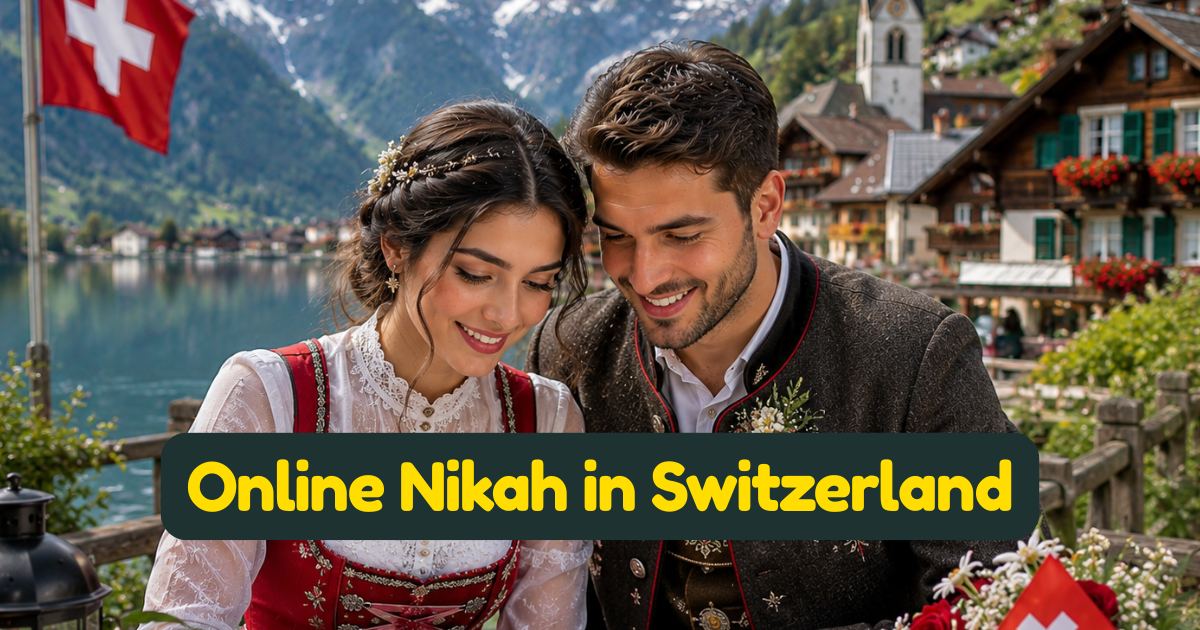
Switzerland is a country of layers. Four national languages. Twenty-six cantons with significant administrative autonomy. A federal civil marriage system that applies uniformly across all of them — but that most expatriate Muslims navigating it for the first time encounter without adequate guidance in English.
Around 400,000 Muslims live in Switzerland — making up approximately five percent of the population. The largest communities are Turkish and Kosovar Albanian, heavily concentrated in the German-speaking cantons of Zurich, Aargau, and Bern. Bosnian Muslims, many of whom arrived during the 1990s, form the second significant group. Arab communities — Moroccan, Lebanese, Syrian, and Egyptian — are prominent in Geneva and the French-speaking Romandy region. Pakistani and South Asian communities are smaller but established across Zurich and Basel. And Switzerland has a growing convert Muslim community spread across all language regions.
For all of them, getting married in Switzerland means navigating two processes: the Islamic Nikah and the Swiss civil marriage system. This guide explains both — clearly, accurately, and with the practical detail that actually helps.
The Swiss Civil Marriage System — What Every Muslim in Switzerland Must Know
Switzerland's position on religious ceremonies is unambiguous. The civil wedding at the local registry office is the only form of wedding legally recognised by the Swiss state. A Nikah — whether conducted in a mosque, at home, or via video call — does not create a legally valid civil marriage in Switzerland. Only the civil ceremony does that.
Crucially — and unlike France, which has a specific criminal law enforcing this — Switzerland's civil-first requirement is not backed by criminal penalties against religious officiants. Swiss law does not prohibit an Imam from conducting a Nikah before the civil ceremony. What it means is simply that the Nikah carries no civil legal weight without the corresponding civil registration. A wife with only a Nikah certificate in Switzerland has no inheritance rights, no spousal protections, and no legal standing under Swiss family law if anything goes wrong.
As the official Swiss government guidance on marriage makes clear: couples must submit an official application to the civil register office, which reviews the application and confirms authorisation for the ceremony. The processing period includes the publication of the banns — a ten-day period during which the intention to marry is publicly declared, allowing anyone with a legal objection to come forward.
The Zivilstandsamt Process — Step by Step
The Swiss civil marriage process takes place at the local civil register office — called the Zivilstandsamt in German-speaking cantons, the Office de l'état civil in French-speaking Romandy, and the Ufficio dello stato civile in Italian-speaking Ticino. Each canton administers its own civil register offices, but the federal marriage law applies uniformly across all twenty-six cantons.
The Application
Both partners submit a marriage application form together with required documents — typically including valid identity documents, residency certificates, and where applicable, a death certificate or divorce decree from any previous marriage. Foreign documents must be officially translated and authenticated. The application is submitted to the Zivilstandsamt in the canton where either partner is registered as a resident.
The Banns Publication
This is one of Switzerland's most distinctive civil marriage features — and one that catches many couples by surprise. After the application is submitted, Swiss law requires a ten-day public declaration period during which the intention to marry is posted — typically at the local registry office. This traditional formality allows anyone with knowledge of a legal impediment to the marriage to formally notify the registrar. Once the ten-day period passes without objection, the marriage can proceed.
Processing Time
As Expatica's detailed Swiss marriage guide confirms, the full civil application process typically takes around five weeks from submission to ceremony authorisation. Couples should factor this timeline into their planning — same-day or urgently arranged civil marriages are not possible in Switzerland. The Islamic Nikah, however, can be arranged at any time — including while the civil process is underway.
The Civil Ceremony
The civil ceremony itself takes place at the registry office, conducted by a civil registrar. It is brief and administrative — both parties declare their consent, the registrar records the marriage, and the Swiss marriage certificate is issued. The ceremony can take place at the couple's local Zivilstandsamt or, in some cantons, at an approved alternative venue. After the civil ceremony, the couple is free to have a Nikah — the Islamic ceremony — at any time and in any setting they choose.
Switzerland's Language Regions — Why This Matters for Muslim Couples
Switzerland's four official languages — German, French, Italian, and Romansh — mean that administrative interactions at the Zivilstandsamt take place in the language of the canton. This creates practical challenges for Muslim couples — particularly those from Arab backgrounds living in Geneva or Lausanne, and those from Turkish or Kosovar backgrounds in Zurich or Aargau — who may be more comfortable in their heritage language or in English than in the local Swiss official language.
The civil process can proceed with the help of an officially approved interpreter in most cantons. For the Nikah ceremony itself — conducted by InstantNikah.com's scholars via video call — English language support is provided throughout, with the Ijab and Qabul in Arabic as standard. Couples who need the ceremony conducted with Arabic, Urdu, Turkish, or other language support alongside the English explanation can request this during the pre-ceremony consultation.
Islamic Validity of Online Nikah for Swiss Muslims
Whether a Muslim is in Zurich, Geneva, Basel, or a smaller Swiss town, the Islamic validity of an online Nikah depends entirely on the conditions of the contract — not on Swiss civil law or the Zivilstandsamt system. A qualified Imam conducting the ceremony via secure live video call, with two adult Muslim witnesses, a proper Wali, a stated Mahr, and a complete Ijab and Qabul in a single live session fulfils every Islamic requirement for a valid Nikah.
For Swiss Muslims of Turkish heritage — predominantly Hanafi — and for Bosnian and Kosovar Muslims who follow a blend of Hanafi tradition with local scholarly guidance, the permissibility of online Nikah is confirmed. For Arab Swiss Muslims who predominantly follow Shafi'i or Maliki positions, the same scholarly consensus applies: IslamQA confirms that a Nikah via verified video call is permissible when identities are established and witnesses follow the ceremony in real time.
Why Swiss Muslims Choose Online Nikah
Switzerland's Muslim communities face specific practical challenges that online Nikah addresses directly.
Partner Still Overseas
Cross-border marriages are common across Swiss Muslim communities — a Swiss-resident Turkish Muslim marrying a partner still in Turkey, a Kosovar Swiss family where one partner is still in Kosovo, or a Moroccan Swiss resident marrying someone in Casablanca. Switzerland's family reunification visa process involves waiting periods. An online Nikah allows the Islamic marriage to be completed immediately — making the relationship halal — while the civil Zivilstandsamt process and Swiss immigration paperwork proceed in parallel.
Limited Mosque Infrastructure Outside Major Cities
While Zurich, Geneva, Basel, and Bern have established Muslim communities and mosque facilities, Muslims in smaller Swiss towns and rural cantons — in Graubünden, Valais, Appenzell, or the Jura — may have very limited access to a qualified Imam willing to conduct a Nikah at short notice. Switzerland's compact geography makes Zurich-based Imams accessible to many by train, but scheduling availability is not guaranteed. An online Nikah service removes this dependency entirely.
Cross-Canton Distance
A couple where one partner lives in Geneva and the other in Zurich — separated by three hours by train — faces logistical coordination challenges for an in-person Nikah ceremony. An online Nikah eliminates the travel requirement. Both partners join the live video call from their respective locations. The Wali joins from wherever he is — Switzerland or overseas. The ceremony happens in real time across all locations simultaneously.
Swiss Muslim Converts
Switzerland's convert Muslim community is growing — particularly among younger Swiss nationals who have embraced Islam independent of any family background. Converts typically have no established mosque connections and no Muslim male relatives to serve as Wali. The Wali-e-Hakim pathway — where a qualified Imam formally assumes the guardianship role — is handled as standard at InstantNikah.com with proper scholarly assessment and full documentation. Our guide to online Nikah for converts covers the full process.
The Wali Situation for Swiss Muslim Women
For Swiss Muslim women whose Wali is overseas — in Turkey, Kosovo, Morocco, Egypt, or elsewhere — the online Nikah model is directly practical. Switzerland is in the Central European time zone, making scheduling straightforward with most Muslim-majority countries. The Wali joins the live video call from wherever he is. His live participation fully satisfies the Islamic Wali condition regardless of geography.
For Swiss convert women whose families are non-Muslim, the Wali-e-Hakim pathway is the correct and established Islamic route — handled as standard by our scholars. Our dedicated guide on online Nikah without a Wali explains the full fiqh and the process in detail.
The Sequence That Works for Swiss Muslim Couples
Given Switzerland's five-week civil process timeline and the absence of a criminal law on ceremony sequencing, Swiss Muslim couples have genuine flexibility in how they arrange their Nikah and civil marriage.
Nikah first, civil ceremony after: The most common approach for couples who want to make the relationship halal immediately. The Nikah can be arranged within 24 hours through InstantNikah.com. The civil Zivilstandsamt process then runs alongside — typically taking five weeks to complete. Many Swiss Muslim couples follow this sequence without any difficulty.
Civil ceremony first, Nikah after: Some couples prefer to secure the civil marriage certificate first — particularly where immigration or visa processes are involved — and then conduct the Nikah as a separate Islamic ceremony. This is equally valid under Islamic law. The Nikah has no required relationship to the timing of civil registration.
Same-day ceremonies: In principle, both can happen on the same day — the civil ceremony at the Zivilstandsamt in the morning, the online Nikah via video call the same afternoon. This requires planning the civil process far enough in advance to have the date confirmed.
Overseas Marriage Recognition in Switzerland
Switzerland recognises marriages that were legally valid in the country where they were performed — provided they also comply with Swiss law and do not violate Swiss public policy. A Nikah conducted in Turkey, Morocco, Kosovo, Pakistan, or another country where Islamic marriages are legally registered — with proper documentation and authentication — can be recognised in Switzerland through the civil register system without a separate Swiss civil ceremony.
For cross-border couples, this opens a practical pathway: conduct the Nikah in a country where it is legally registered, authenticate the certificate, and have it recognised in Switzerland. Our guide on Nikah certificate international recognition covers the apostille and authentication process in detail.
Frequently Asked Questions
Is a Nikah legally recognised in Switzerland without civil registration?
No. Swiss law recognises only civil marriages conducted at the Zivilstandsamt as legally valid. A Nikah — whether in a mosque or online — is an Islamic marriage contract with full religious standing but no automatic civil legal weight in Switzerland. A wife with only a Nikah certificate in Switzerland has no inheritance rights, no spousal protections, and no legal standing under Swiss family law without civil registration.
How long does the Swiss civil marriage process take?
The full process typically takes approximately five weeks from application submission to ceremony authorisation. This includes the ten-day banns publication period and the processing time for document review and authorisation by the civil registrar. Couples should not plan for a Swiss civil marriage to happen at short notice — unlike the Islamic Nikah, which can be arranged within 24 hours through InstantNikah.com.
My partner is in Turkey or Kosovo. Can we do an online Nikah while the civil process runs?
Yes — this is one of the most practical applications of online Nikah for Swiss Muslim couples. The online Nikah can be completed immediately through InstantNikah.com, making the relationship halal. The Swiss Zivilstandsamt civil process then runs in parallel, completing typically five weeks later. Both processes are separate and one does not depend on the other being complete first.
What is the banns publication and does it affect the Nikah?
The banns publication is a Swiss civil marriage formality — a ten-day public declaration of the intention to marry at the local registry office. It is part of the civil process only and has no effect on the Islamic Nikah. The Nikah can be conducted at any time, independently of whether the banns period has started, is ongoing, or has been completed.
I am a Swiss convert with no Muslim male relatives. Can I have a valid Nikah?
Yes. The Wali-e-Hakim pathway applies — a qualified Imam formally assumes the guardianship role when no Muslim male guardian is available. This is the established Islamic pathway for converts and is handled as standard at InstantNikah.com with proper scholarly assessment and full documentation in your Nikah certificate.
Schweiz, Suisse, Svizzera — One Country, One Nikah Service
Whether you are in German-speaking Zurich, French-speaking Geneva, or Italian-speaking Lugano, the Islamic conditions of a valid Nikah are the same across all of Switzerland — and so is the civil marriage requirement at the local registry office. What changes by region is the language of the administrative process and the name of the office. What does not change is what your Nikah needs to be valid before Allah.
InstantNikah.com serves Muslim couples across all Swiss cantons and language regions — German, French, Italian, and beyond. Qualified Imams. Verified witnesses. Complete Wali process. Same-day Nikah availability. English-language support throughout. Speak with our team or book your ceremony — no commitment required until you are ready.
Admin User
Author