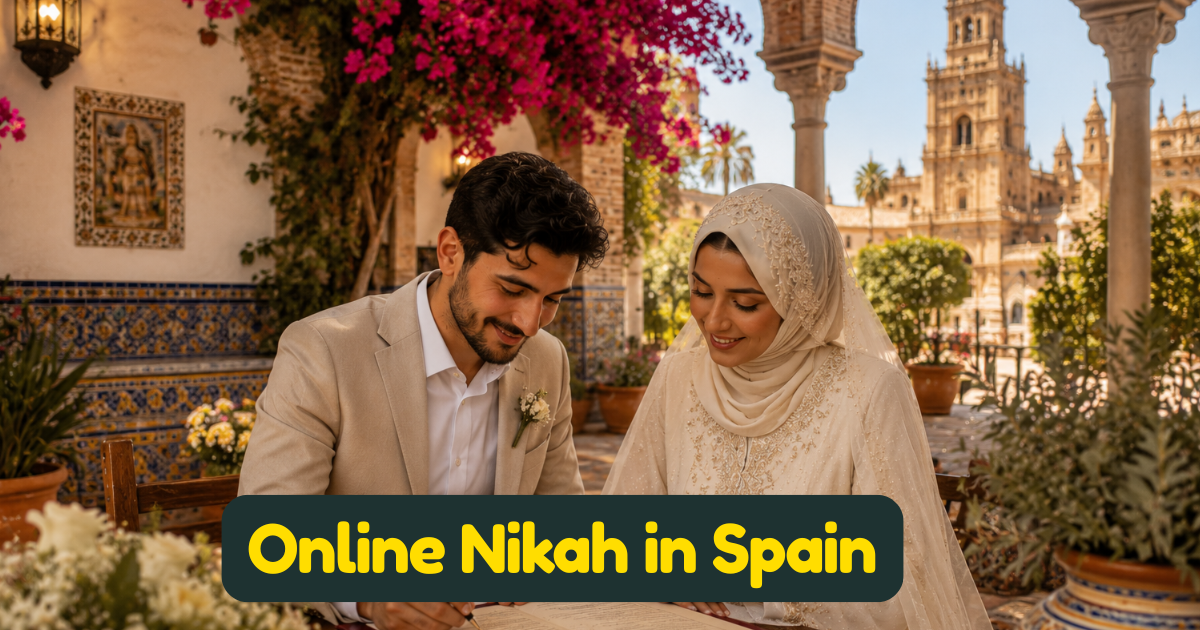
Of all the countries covered in this series, Spain occupies the most extraordinary legal position regarding Islamic marriage — and it is a position that most Muslims living in Spain have never been told about clearly.
Across Western Europe — Germany, France, the Netherlands, Belgium, Switzerland, Italy, Denmark, Norway — the consistent message is the same: the Islamic Nikah is a valid religious contract, but a separate civil ceremony is required for legal recognition. Spain breaks this pattern entirely. Under a formal cooperation agreement between the Spanish state and the Islamic Commission of Spain, a Nikah conducted by a properly registered Imam carries the same legal status as a civil marriage in Spain — no separate civil ceremony required.
This is not a minor administrative detail. It is one of the most significant pieces of Islamic family law in Western Europe — and it is almost entirely unknown to the Muslim community it was designed to serve.
Ley 26/1992 — Spain's Cooperation Agreement With Islam
On 10 November 1992, the Spanish state signed three cooperation agreements with recognised religious minorities — with the Federation of Jewish Communities of Spain, the Federation of Evangelical Religious Entities of Spain (FEREDE), and the Islamic Commission of Spain (Comisión Islámica de España, CIE). These agreements — passed as Laws 24, 25, and 26 of 1992 — gave each of these faith communities formal legal status and specific rights within the Spanish constitutional framework.
Law 26/1992 — the Cooperation Agreement with the Islamic Commission of Spain — is the most significant piece of Spanish legislation affecting Muslim life in the country. Among its provisions, Article 7 establishes that Islamic marriages celebrated by leaders of Islamic Communities registered with the Registro de Entidades Religiosas (Register of Religious Entities) shall produce civil legal effects — provided the preliminary matrimonial case file (expediente matrimonial previo) has been completed and the marriage is registered in the Registro Civil (Civil Registry) within the prescribed period.
As Spain's official Registro Civil guidance confirms: for the registration of Islamic marriages, a preliminary case file must be processed at the Registro Civil before the Nikah takes place. Once this file is completed and an authorisation certificate is issued, the marriage must be celebrated within a maximum period of six months. The Nikah certificate is then submitted to the Registro Civil for registration, which gives it full civil legal effect — the same as a civil marriage.
What This Means in Practice — A Step-by-Step Explanation
The Spanish system is genuinely distinctive — but it requires specific steps to activate its legal benefits. Understanding the process clearly is essential for any Muslim couple in Spain who wants their Nikah to carry full civil legal weight.
Step One — The Expediente Matrimonial Previo
Before the Nikah takes place, the couple must complete a preliminary matrimonial case file — the expediente matrimonial previo — at their local Registro Civil. This involves both parties appearing before the civil registrar, submitting identity documents, birth certificates, and certificates of civil status confirming both parties are free to marry. Foreign documents must be apostilled and translated into Spanish by a sworn translator. The registrar reviews the file and, if all requirements are met, issues an authorisation certificate confirming the couple's capacity to marry. This certificate is valid for six months.
Step Two — The Nikah With a Registered Imam
The Nikah must be conducted by a leader of an Islamic Community that is registered with Spain's Registro de Entidades Religiosas — the Register of Religious Entities maintained by the Ministry of Justice. Not every Imam in Spain holds this registration. The Islamic Community must be formally registered, and the Imam must be authorised by that registered community. This is the condition on which Ley 26/1992's civil recognition depends — an unregistered Imam conducting a Nikah does not activate the legal recognition provisions.
Step Three — Registration at the Registro Civil
After the Nikah, the Islamic marriage certificate must be submitted to the Registro Civil for registration within the prescribed period. Once registered, the couple receives a full Spanish civil marriage certificate — the Libro de Familia — and the marriage carries all the legal protections of a Spanish civil marriage: inheritance rights, property division, pension entitlements, and family law standing.
The Critical Limitation — Online Nikah and the Spanish System
Here is the important caveat that any honest guide must address directly.
The civil recognition under Ley 26/1992 requires the Nikah to be conducted by a registered Spanish Islamic Community leader. An online Nikah conducted by an international online service — where the officiating Imam is not a registered leader of a Spanish Islamic Community in the Registro de Entidades Religiosas — does not activate the Ley 26/1992 civil recognition provisions. The Nikah is fully valid under Islamic law. But it does not carry automatic Spanish civil legal recognition under this pathway.
For couples who want the combined Islamic and civil legal recognition that Ley 26/1992 provides, the ceremony must be conducted by a registered Spanish Islamic Community leader, after completing the expediente matrimonial previo. For couples who complete an online Nikah through InstantNikah.com, they can then separately register a civil marriage at the Registro Civil — following the standard civil marriage pathway — to obtain full legal standing alongside their valid Islamic certificate.
Both pathways are available. Both produce a valid Islamic marriage. The civil recognition pathway differs between them — and we say this clearly because honesty about what our service provides, and what it does not, is the only basis on which trust can be built.
Spain's Muslim Population — Nearly Two Million Muslims Across the Peninsula
Islam's history in Spain is ancient and deep. The Al-Andalus civilisation lasted from 711 to 1492 CE — nearly eight hundred years during which Islamic scholarship, architecture, philosophy, and culture shaped the entire Iberian Peninsula. The Alhambra in Granada, the Mezquita in Córdoba, the medinas of Seville — these are not merely tourist attractions. They are the surviving evidence of one of the most sophisticated Islamic civilisations in human history.
Modern Muslim Spain is a different story — largely a product of twentieth-century migration. Around 1.9 million Muslims live in Spain today, making up approximately four percent of the population. The Moroccan community is by far the largest — around 800,000 — concentrated in Catalonia, Madrid, Andalusia, and the autonomous cities of Ceuta and Melilla on the North African coast, where Morocco and Spain share a border. Pakistani communities in Barcelona and Madrid, Senegalese communities across Catalonia, Algerian and Tunisian communities in the east, and a growing convert population round out a community that is genuinely diverse.
Ceuta and Melilla hold a particularly unique position — Spanish sovereign territory on the African continent, with Muslim populations that in Ceuta represent approximately half the city's total population. The Islamic infrastructure in these cities is more developed than almost anywhere else in Spain.
Spanish Muslim Communities by Madhab and Their Nikah Approach
Spain's Moroccan majority means that the Maliki school is the dominant scholarly tradition among Spanish Muslims — reflecting North Africa's madhab heritage. For Maliki-following Muslims, the Wali requirement is a firm condition of the Nikah's validity, and the Wali-e-Hakim pathway applies where the guardian is unavailable or overseas.
Pakistani Muslims in Barcelona and Madrid follow the Hanafi school. Senegalese communities follow predominantly Maliki and Sufi traditions. Spanish converts — many of whom discovered Islam through Spain's own Al-Andalus heritage — are sometimes drawn to the Maliki school for the same reason, finding resonance in the scholarly tradition that once flourished on their own soil.
Where Online Nikah Serves Muslim Couples in Spain
Despite Spain's extraordinary Ley 26/1992 provision, there are specific and practically important situations where an external online Nikah service serves Spanish Muslim couples.
Cross-Border Couples — One Partner in Morocco, Pakistan, or Elsewhere
Cross-border marriages are very common in Spanish Muslim communities. A Moroccan-Spanish resident marrying a partner still in Casablanca, or a Pakistani community in Barcelona where one partner is still in Lahore, needs the Islamic marriage completed immediately — making the relationship halal — while the Spanish immigration (extranjería) process runs its longer course. An online Nikah provides the Islamic ceremony within 24 hours. The Spanish civil registration follows when both parties are ready.
Muslims in Areas With Limited Registered Islamic Infrastructure
While Madrid, Barcelona, Valencia, and Málaga have established Islamic communities with registered mosques, Muslims in smaller Spanish cities and rural areas — across Castilla-La Mancha, Extremadura, Galicia, Asturias, and the Canary Islands — may have very limited access to a registered Imam willing to conduct a Nikah at short notice. An online service removes this access barrier entirely.
Urgency and Same-Day Need
For Spanish Muslim couples who need a Nikah arranged urgently — visa deadlines, travel plans, medical situations, or simply a settled intention — an online Nikah can be arranged within 24 hours. The expediente matrimonial previo process at the Registro Civil takes considerably longer. A valid Islamic Nikah through InstantNikah.com can happen today.
Spanish Muslim Converts
Spain's convert Muslim community is distinctive — many converts are drawn to Islam through Spain's own Al-Andalus history and heritage, experiencing a sense of return to something that was always present in their landscape. Spanish converts typically have no established mosque connection and no Muslim male relatives to serve as Wali. The Wali-e-Hakim pathway is handled as standard at InstantNikah.com. Our complete guide to online Nikah for converts covers every scenario.
The Wali Situation for Spanish Muslim Women
For Spanish Muslim women whose Wali is in Morocco, Algeria, Pakistan, Senegal, or elsewhere overseas, the online Nikah model is directly practical. Spain is in the Central European time zone — the same as Morocco and one hour ahead of the UK, making scheduling with virtually all Muslim-majority countries straightforward. The Wali joins the live video call from wherever he is. His live participation fully satisfies the Wali condition.
For Spanish convert women with non-Muslim families, the Wali-e-Hakim pathway applies — a qualified Imam formally assumes the guardianship role with proper scholarly assessment. Our guide on online Nikah without a Wali covers this in full.
Spanish Immigration — Extranjería and Nikah Documentation
For Spanish-resident Muslims sponsoring a spouse from overseas through Spain's family reunification (reagrupación familiar) process, marriage documentation is essential. Spanish immigration authorities — the Oficina de Extranjería — require proof of a legally recognised marriage. A Nikah registered under Ley 26/1992's provisions through a registered Spanish Imam, or a civil marriage from the Registro Civil, satisfies this requirement. A Nikah certificate from an online service without corresponding Spanish civil or Registro Civil registration requires supplementary civil documentation. We strongly recommend consulting a Spanish immigration lawyer (abogado de extranjería) for guidance specific to your situation.
Frequently Asked Questions
Is an Islamic Nikah legally recognised in Spain?
Yes — under Ley 26/1992 (the Cooperation Agreement between Spain and the Islamic Commission of Spain), a Nikah conducted by a leader of a registered Spanish Islamic Community carries full civil legal effect in Spain, provided the expediente matrimonial previo has been completed at the Registro Civil beforehand and the marriage is registered within six months. This makes Spain unique in Western Europe — no other Western European country gives Islamic marriage the same automatic legal status as civil marriage.
Does an online Nikah qualify for Ley 26/1992 recognition in Spain?
Not automatically. Ley 26/1992's civil recognition requires the Nikah to be conducted by a leader of an Islamic Community registered in Spain's Registro de Entidades Religiosas. An online Nikah conducted by an international service whose Imam is not a registered Spanish Islamic Community leader does not activate this specific provision. The Nikah remains fully valid under Islamic law. For full civil legal recognition alongside it, either a registered Spanish Imam completes the ceremony, or a separate civil marriage at the Registro Civil is arranged.
What is the expediente matrimonial previo?
The expediente matrimonial previo is a preliminary matrimonial case file that must be completed at the Registro Civil before a Nikah can produce civil legal effects in Spain. Both parties appear before the civil registrar, submit their documents, and receive an authorisation certificate confirming their capacity to marry. This certificate is valid for six months — the Nikah must take place and be registered within this period for Ley 26/1992's civil recognition to apply.
My partner is in Morocco. Can we do an online Nikah while we arrange the Spanish civil process?
Yes. An online Nikah through InstantNikah.com can be arranged within 24 hours from wherever both parties are located — Spain and Morocco, or any other cross-border combination. The Islamic marriage is valid immediately. The Spanish civil registration process — whether through Ley 26/1992 or the standard civil marriage pathway — runs in parallel and follows at the couple's chosen time.
What is the Libro de Familia?
The Libro de Familia is Spain's official family record book — issued upon civil marriage registration and updated as family events occur (births, deaths, subsequent marriages). It is the primary Spanish documentation of a legally registered marriage. For Nikah marriages that activate Ley 26/1992 civil recognition, the Libro de Familia is issued after the Nikah certificate is registered at the Registro Civil.
Eight Centuries Later — Islam Still Shapes the Laws of Spain
It is not entirely fanciful to see in Ley 26/1992 a distant echo of the coexistence tradition that once defined Al-Andalus — a state formally recognising Islamic religious practice as having legal standing alongside other faith traditions. The context is entirely different, the legal framework is modern, and the political history is complex. But the fact that Spain is the only Western European country where a properly conducted Islamic Nikah carries the same legal weight as a civil marriage says something worth acknowledging about Spain's long and complicated relationship with Islam.
For Spanish Muslims today — in Madrid's Lavapiés neighbourhood, in Barcelona's Raval, in the medinas of Ceuta, across the Moroccan communities of Catalonia — marriage remains one of the most important religious and legal acts of life. The Islamic Nikah deserves to be conducted properly, by a qualified scholar, with verified witnesses, with a properly handled Wali process, and with complete documentation. Whether the civil recognition follows through Ley 26/1992 or through the Registro Civil pathway, the Islamic contract itself must be right.
InstantNikah.com serves Muslim couples across all of Spain — Madrid, Barcelona, Valencia, Seville, Málaga, Zaragoza, Bilbao, Ceuta, Melilla, and beyond. Qualified Imams. Verified witnesses. Complete Wali process. Same-day availability. Speak with our team or book your ceremony — no commitment required until you are ready.
Admin User
Author