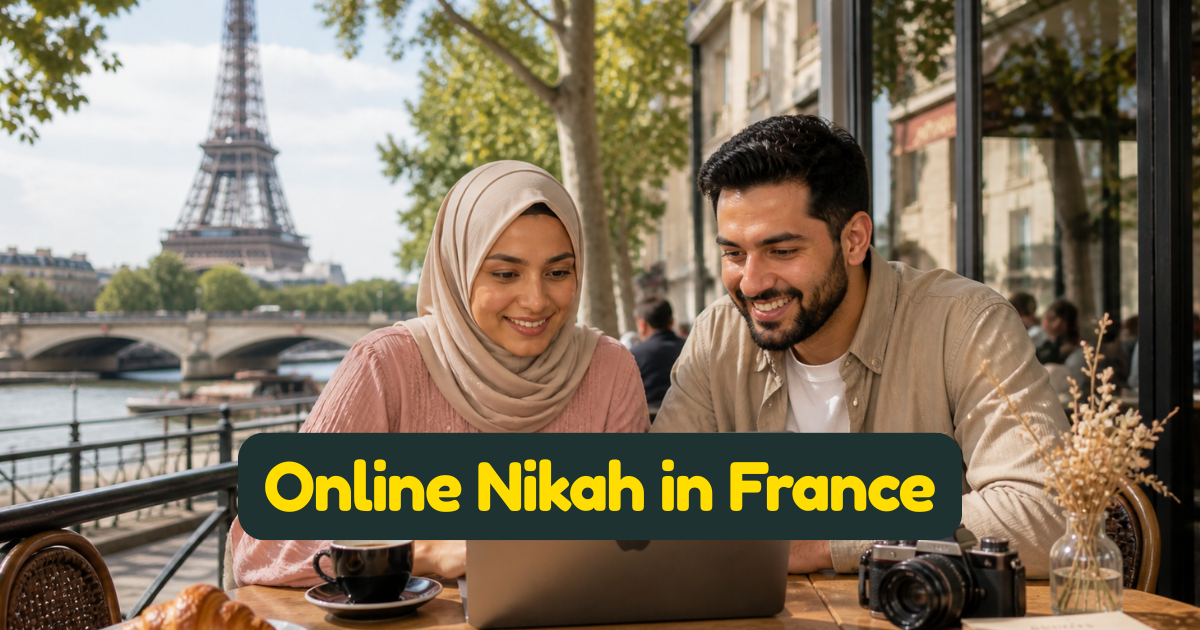
France is home to more than five million Muslims — the largest Muslim population in Western Europe. Algerian, Moroccan, and Tunisian heritage communities make up the majority, with Malian, Senegalese, Turkish, Pakistani, and convert communities alongside them. From the banlieues of Paris to the port city of Marseille, from Lyon's historic Muslim quarters to Strasbourg's Franco-German border communities, Islam is woven into the fabric of French life in ways that the country's official ideology of laïcité sometimes struggles to accommodate.
For Muslim couples in France, marriage sits precisely at this intersection — between Islamic law, which defines the Nikah as a sacred obligation, and French law, which enforces strict secularism with consequences that most couples are unaware of until it is too late.
This guide explains the full picture — how online Nikah works for Muslims in France, what the French legal framework actually requires, what the criminal law says about the order of ceremonies, and how an online Nikah service fits into the lives of French Muslim couples navigating this system.
The Legal Reality That Every Muslim in France Must Understand
France's approach to religious marriage is unlike that of any other country in this series. It is not simply that a Nikah is not automatically recognised as a civil marriage — that is true across all of Europe. What is unique to France is the specific criminal law that governs the order in which the ceremonies must take place.
Article 433-21 of the French Penal Code makes it a criminal offence for any minister of religion — including any Imam — to celebrate a religious marriage before the couple has already been married civilly at the mairie. The penalty for violating this rule is up to six months imprisonment and a fine of €7,500.
This law applies to every religion in France — Catholic priests, Protestant pastors, rabbis, and Imams alike. It is the legal expression of France's principle of laïcité: the state is the sole authority over civil life, including marriage. Religious ceremonies are, in French law, private spiritual events with no legal weight whatsoever — and the civil ceremony is not merely recommended before the religious one. Under Article 433-21, it is legally required.
The consequences for French Muslim couples are direct and practical:
- A Nikah conducted in France before the mairie ceremony is performed by an Imam who risks a criminal penalty — meaning many French Imams will not conduct a Nikah without first seeing the civil marriage certificate
- A Nikah conducted in France without any civil marriage carries no legal weight — the wife has no inheritance rights, no property claim, and no spousal protections under French family law
- The Islamic validity of the Nikah is entirely separate from these civil consequences — a Nikah conducted correctly is a valid Islamic marriage regardless of what French civil law says about it
Understanding these three realities — the criminal penalty, the civil consequence, and the Islamic independence — is the starting point for any Muslim couple in France planning their marriage.
Is Online Nikah Islamically Valid for Muslims in France?
Yes — without question. Islamic validity is determined by the conditions of the Nikah contract, not by the country where it takes place or by the requirements of any national civil law. A qualified Imam conducting the Nikah via secure live video call, with two adult Muslim witnesses present, proper Wali participation, a clearly stated Mahr, and a complete Ijab and Qabul in a single unbroken session fulfils every Islamic condition of a valid marriage — whether the bride is in Marseille and the groom is in Paris, or one partner is in France and the other is in Morocco.
IslamQA's fatwa on online Nikah via webcam confirms this directly. For the majority of French Muslims of North African heritage who predominantly follow the Maliki school — and for those of Turkish heritage who follow the Hanafi school — both madhab positions support the permissibility of online Nikah when all conditions are properly met.
How the French Civil Marriage Works — The Mairie Process
The civil marriage in France (mariage civil) must take place at the town hall (mairie) of the commune where either party is domiciled. It is conducted by the mayor or a designated deputy. The ceremony is brief and administrative — both parties declare their consent before the official, two witnesses sign the register, and the livret de famille (family record booklet) is issued.
Documents required for the mairie ceremony typically include valid identity documents for both parties, proof of domicile, birth certificates (translated and apostilled for foreign nationals), and a certificate of celibacy or previous divorce documentation where applicable. Foreign nationals may also need a certificat de coutume — a document confirming the marriage laws of their country of origin do not prohibit the marriage.
The mairie must be notified at least ten days before the intended ceremony date. Both parties must be physically present at the mairie — the civil ceremony cannot be conducted online or by proxy in France.
After the mairie ceremony is complete, the couple receives their civil marriage certificate. This certificate must be presented to the Imam before the Nikah can take place in France, as required by Article 433-21. The Imam does not register the marriage — the mairie does. The Imam's role is exclusively Islamic.
Where Online Nikah Fits Into the French Muslim Marriage Journey
Given France's strict civil-first requirement, an external online Nikah service is most useful for French Muslims in specific situations that the standard French process does not handle well.
Cross-Border Couples — One Partner in France, One Abroad
Cross-border marriages are extremely common in French Muslim communities — a French-resident partner marrying someone still in Algeria, Morocco, Tunisia, Turkey, Senegal, or Mali. The French family reunification visa process can take many months. During that waiting period, many couples want to formalise the Islamic marriage immediately — to make the relationship halal — while the civil and immigration paperwork proceeds in parallel.
For a Nikah conducted outside France — where neither party is physically in France at the time of the ceremony — Article 433-21 does not apply. The criminal law governs religious ceremonies conducted on French territory. An online Nikah conducted internationally, with both parties outside France, is not subject to French domestic marriage law. The Islamic marriage stands on its own religious validity. Civil registration can then be completed when both parties are together, either in France or in the overseas partner's home country.
French Muslims Living Abroad
A significant number of French Muslims live outside France — in Belgium, Switzerland, the UK, Germany, Canada, and across the globe. For French citizens living abroad who want a Nikah, InstantNikah.com provides the Islamic ceremony from wherever they are, with civil registration handled through the appropriate local authority or French consular services.
Privacy and Discretion
Some French Muslim couples — particularly those in professional environments, those navigating family situations that require discretion, or converts who prefer a focused private ceremony — choose an online Nikah for its intimacy and immediate availability. The civil ceremony at the mairie is completed separately. The Nikah is a personal religious event that belongs entirely to the couple.
Convert Muslims in France
France has a growing convert Muslim community — estimated at around 100,000 people. Converts often have no connection to a local mosque community and no Muslim male relatives to serve as Wali. An online Nikah service handles the Wali-e-Hakim appointment as standard, providing the full Islamic ceremony without requiring the convert to navigate an unfamiliar community structure. For the full explanation of how this works, our guide to online Nikah for converts covers every scenario.
France's Muslim Communities — Who This Guide Serves
France's five million Muslims are not one community. The Algerian and Moroccan diaspora communities — predominantly Maliki in madhab — are the largest. Turkish communities, primarily Hanafi, are concentrated in Alsace, Paris, and Lyon. Sub-Saharan African communities — Malian, Senegalese, Guinean — follow a mixture of Maliki and Sufi traditions. Pakistani and Bangladeshi communities are smaller but present in Paris and major cities.
Second and third-generation French Muslims — born and raised in France, French citizens by birth — increasingly navigate marriage in ways that blend French legal norms with Islamic religious requirements. Many are highly educated professionals for whom the discretion and efficiency of an online Nikah is genuinely appealing. Many are marrying partners from their parents' or grandparents' home countries, creating cross-border situations that French local mosque infrastructure handles poorly.
France's convert community brings its own specific needs — the Wali situation, the absence of community infrastructure, and the challenge of navigating Islamic marriage law without family guidance.
All of these communities are served by InstantNikah.com — through English, with scholars who understand the cross-cultural and cross-border dimensions that French Muslim couples navigate daily.
The Wali Situation for French Muslim Women
For French Muslim women whose Wali is in Algeria, Morocco, Tunisia, or elsewhere in North Africa — which describes the situation for a very large proportion of French Muslim women — the online Nikah model is directly practical. The Wali joins the live video call from wherever he is. France is one hour ahead of Morocco and Algeria, two hours ahead of Tunisia in summer. Scheduling across this time difference is simple.
For French convert women with no Muslim male relatives, the Wali-e-Hakim pathway applies — a qualified Imam formally assumes the guardianship role with proper scholarly assessment and complete documentation. Our guide on online Nikah without a Wali explains this in full.
Frequently Asked Questions
Can an Imam in France conduct a Nikah before the couple has been to the mairie?
No — not legally. Under Article 433-21 of the French Penal Code, any minister of religion who celebrates a religious marriage before the civil ceremony has taken place faces up to six months imprisonment and a €7,500 fine. Most French Imams will not conduct a Nikah without seeing the civil marriage certificate first. This rule applies to all religious marriages in France — Catholic, Protestant, Jewish, and Muslim alike.
Is the Nikah certificate legally recognised in France?
A Nikah certificate is a valid Islamic marriage document. It has no legal standing under French civil law on its own. For legal recognition in France, civil marriage at the mairie is required. The Nikah certificate and the civil marriage certificate are complementary — one establishes the Islamic validity, the other the civil legal standing.
My partner is in Algeria or Morocco. Can we do an online Nikah now?
Yes. An online Nikah accommodates both partners from their respective locations. France and North Africa are within one to two hours of each other in time zones — scheduling is straightforward. The Islamic marriage is valid wherever the parties are located. Civil registration can follow when both parties are together in France or through the relevant overseas process.
Does French immigration recognise an online Nikah for family reunification?
French family reunification (regroupement familial) and spouse visa applications require a legally recognised marriage. A Nikah certificate combined with civil registration — either in France or in a country where the marriage is legally recognised — supports a French visa application. A Nikah-only certificate without civil registration is unlikely to satisfy French immigration requirements on its own. Consult a French immigration lawyer for guidance specific to your situation.
I am a French convert with no Muslim male relatives. Who serves as my Wali?
When no Muslim male relative is available, a qualified Imam formally assumes the Wali-e-Hakim role — the established Islamic pathway for converts. This is handled as standard at InstantNikah.com with proper scholarly assessment and full documentation in your Nikah certificate. You do not need to find a Wali yourself.
Between Laïcité and Islamic Law — Two Systems, One Marriage
For French Muslims, marriage has always meant navigating two systems simultaneously. The French state is strict about its role — the mairie is the only authority that creates a legally recognised marriage, and French law protects this with criminal sanctions against those who try to bypass it. Islamic law is equally clear about the Nikah — it is the contract before Allah, and its conditions cannot be waived for administrative convenience.
These two systems are not in conflict when they are understood correctly. The mairie first, the Nikah after — or the Nikah conducted internationally for cross-border couples, with civil registration following. Both can be done properly. Both can be done with integrity. And when both are done, a French Muslim couple has a marriage that stands before Allah and before the French Republic.
InstantNikah.com serves Muslim couples across France — Paris, Marseille, Lyon, Toulouse, Nice, Strasbourg, Bordeaux, and beyond. Qualified Imams. Verified witnesses. Complete Wali process. Same-day availability across all time zones. Speak with our team before you book — no commitment, no pressure, just honest guidance on what your specific situation requires.
Admin User
Author