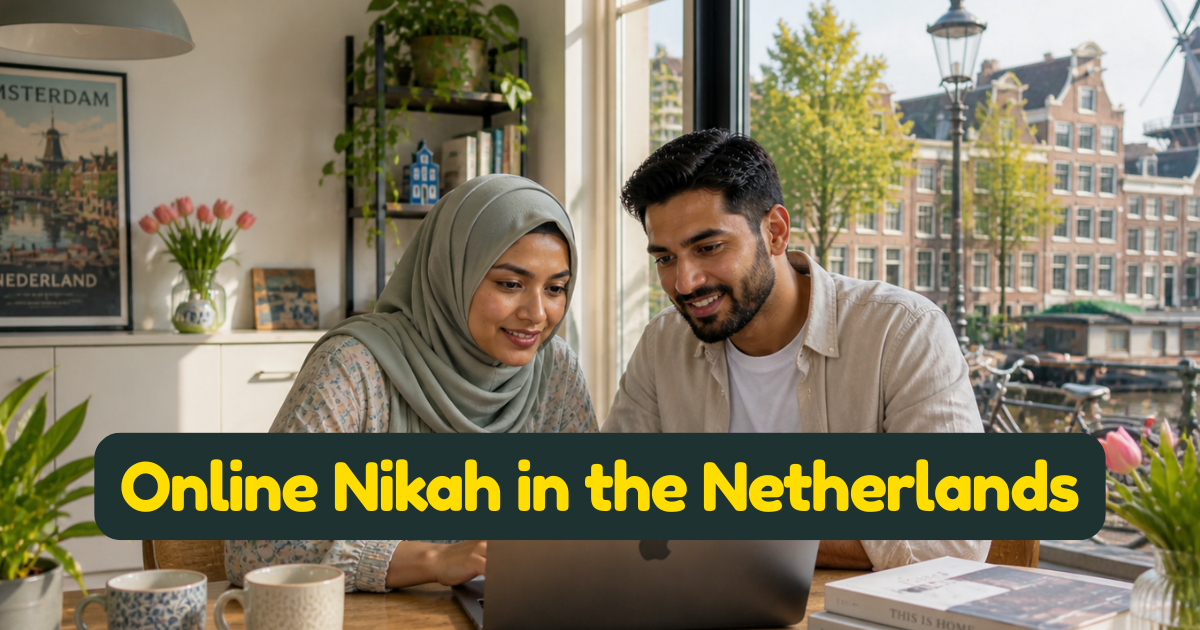
The Netherlands has one of the most digitally integrated civil marriage systems in Europe. It has a Muslim community that is one of the most diverse in the continent. And it has a gap — between the Islamic Nikah that Muslim couples need and the civil registration system that Dutch law requires — that most online Nikah guides never address with the precision that Dutch Muslims actually need.
With nearly one million Muslims living across Amsterdam, Rotterdam, The Hague, Utrecht, Eindhoven, and smaller cities and towns throughout the country, the Netherlands ranks among the most significant Muslim communities in Western Europe. Turkish families — many now in their third generation — and Moroccan communities make up the largest groups, with Surinamese Muslims, Somali communities, Pakistani and Bangladeshi families, and a growing number of Dutch converts alongside them.
This guide explains how online Nikah works for Muslims in the Netherlands, what Dutch civil law actually requires, what makes the Dutch system different from France and Germany, and where an external online Nikah service fits into the picture.
The Islamic Validity of Online Nikah — What Dutch Location Changes and What It Does Not
Islamic validity is determined by the conditions of the Nikah contract — not by the country where the ceremony takes place. A qualified Imam conducting the ceremony via secure live video call, with two adult Muslim witnesses present on the call, proper Wali participation, a clearly stated Mahr, and a complete Ijab and Qabul in a single unbroken session is a fully valid Islamic marriage. Being in Amsterdam, Rotterdam, or a smaller Dutch city changes none of this.
IslamQA confirms that a Nikah via verified video call is permissible when identities are established and witnesses follow the ceremony in real time. For Dutch Muslims of Turkish heritage — who predominantly follow the Hanafi school — and for those of Moroccan heritage following the Maliki school, both madhab positions support the permissibility of online Nikah when all conditions are properly fulfilled.
Dutch Civil Law — What the Netherlands Actually Requires
The Netherlands takes a different approach from France — and understanding this difference matters for Dutch Muslim couples.
Unlike France, the Netherlands does not have a criminal law requiring the civil ceremony to come before the religious one. There is no Dutch equivalent of Article 433-21. The Dutch system separates church and state — religious freedom is protected, and the sequencing of civil and religious ceremonies is not mandated by criminal law.
What Dutch law does require is that for a marriage to be legally recognised in the Netherlands, it must be conducted by an authorised civil registrar — the ambtenaar van de burgerlijke stand — at the municipality (gemeente). A Nikah conducted by an Imam, whether in a mosque or online, does not automatically create a legally recognised civil marriage under Dutch law.
As the Dutch government's official marriage guidance confirms: marriages in the Netherlands must be conducted by a civil registrar. A religious ceremony alone — including a Nikah — carries no civil legal weight. The Islamic and civil marriage processes are entirely separate in the Netherlands, and both are needed for full legal standing.
The Dutch Civil Marriage Process — Step by Step
The Dutch civil marriage process is relatively accessible and well-documented — and it has one feature that no other country in this series offers in quite the same way.
Who Can Marry Civilly in the Netherlands
At least one partner must be a Dutch national or resident in the Netherlands. Both parties must be 18 or older, not already married, and not closely related. Foreign nationals who are residents of the Netherlands can marry civilly, but non-residents generally cannot. Couples where one partner is abroad — still in Morocco, Turkey, Pakistan, or elsewhere — face specific documentary requirements.
The Intention to Marry — Melding van Voorgenomen Huwelijk
Before marrying civilly in the Netherlands, couples must register their intention to marry (melding van voorgenomen huwelijk) with the civil registrar at least two weeks before the intended ceremony date. As the City of Amsterdam's official guidance confirms, this notice must be submitted at least six weeks before the ceremony in Amsterdam — and both parties must provide witness names no later than two weeks before the ceremony.
The Digital Declaration Option
Here is the feature most Dutch Muslim couples do not know about. If both partners are Dutch nationals and both live in the Netherlands, most municipalities allow the intention to marry to be declared entirely online. The City of Amsterdam explicitly confirms this on its official website. This makes the Netherlands one of the most digitally accessible civil marriage systems in Europe — a meaningful practical advantage for Dutch Muslim couples who want to arrange both their civil and Islamic processes efficiently.
The Ceremony Itself
The civil ceremony takes place at the gemeente — city hall — conducted by the authorised civil registrar. Witnesses must be present. The ceremony is brief and administrative, typically lasting fifteen to twenty minutes. After the ceremony, the civil marriage is registered in the Personal Records Database (Basisregistratie Personen, BRP), and the couple receives a Dutch marriage certificate.
Property Implications — Limited Community of Property
One detail worth knowing: since 1 January 2018, marriages in the Netherlands are automatically subject to limited community of property rather than the old general community of property system. This means that property and debts acquired before the marriage remain separate, while those acquired during the marriage are shared. Couples who want different arrangements can agree to a marriage contract (huwelijkse voorwaarden) drawn up by a civil-law notary.
Overseas Marriage Recognition in the Netherlands
This is one of the most practically useful aspects of Dutch law for cross-border Muslim couples — and one that very few guides address.
The Netherlands recognises marriages that were legally valid in the country where they were performed, provided they are also lawful under Dutch law. A Nikah conducted in Morocco, Turkey, Pakistan, Indonesia, or another country where Islamic marriages are legally registered — and properly documented with an authenticated translated certificate — can be registered in the Dutch Personal Records Database (BRP) as a recognised marriage without a separate Dutch civil ceremony.
This opens a practical pathway for many Dutch Muslim couples with cross-border situations: conduct the Nikah in a country where it is legally recognised, authenticate the certificate for Dutch use, and register it in the BRP. For couples where one partner is still abroad, this can be significantly more practical than requiring both parties to be present in the Netherlands for the civil ceremony first.
Authentication requirements differ by country — some certificates need apostille, others require consular legalisation. Our complete guide to Nikah certificate uses and recognition covers the apostille and legalisation process in detail.
Why Dutch Muslims Choose Online Nikah
The situations are varied, and all of them are legitimate.
Partner Still in Morocco, Turkey, or Elsewhere
Cross-border marriages are extremely common across Dutch Muslim communities — a Dutch-resident partner marrying someone still in Morocco, Turkey, or Suriname. The Dutch family reunification visa process involves significant waiting times. Many couples want to complete the Islamic marriage immediately — to make the relationship halal — while the civil and immigration paperwork is arranged in parallel. An online Nikah provides the Islamic ceremony without either partner needing to travel.
Limited Access to Available Imams
While Amsterdam, Rotterdam, and The Hague have well-established mosque communities, Muslims in smaller Dutch cities — Eindhoven, Groningen, Tilburg, Breda, Nijmegen, Almere — may find access to a qualified Imam willing to conduct a Nikah at short notice more limited. An online service removes this entirely.
Dutch Convert Muslims
The Netherlands has a meaningful and growing convert Muslim community. Dutch converts often have no established mosque connections and no Muslim male relatives to serve as Wali. An online Nikah handles the entire process — qualified Imam, verified witnesses, Wali-e-Hakim for female converts with non-Muslim families. Our complete guide to online Nikah for converts covers every scenario specific to converts in detail.
Privacy and Same-Day Availability
Dutch Muslim professionals and couples navigating complicated family situations often prefer a focused, private Nikah ceremony. Same-day availability means the Islamic marriage can happen when the couple is ready — without depending on mosque schedules or Imam availability.
The Wali Situation for Dutch Muslim Women
For Dutch Muslim women whose Wali is in Morocco, Turkey, Suriname, or elsewhere — which describes a very large proportion of the Dutch Muslim community — the online Nikah model is directly practical. The Wali joins the live video call from wherever he is. The Netherlands is in the same or adjacent time zones to most Muslim-majority countries in the Middle East and North Africa, making scheduling straightforward.
For Dutch convert women with no Muslim male relatives, the Wali-e-Hakim pathway applies — a qualified Imam formally assumes the guardianship role with proper scholarly assessment and full documentation. Our guide on online Nikah without a Wali explains the full fiqh and process.
Dutch Muslim Communities — Moroccan, Turkish, Surinamese and Beyond
The Netherlands' Muslim communities carry distinct cultural and scholarly traditions that shape how Nikah is approached in practice.
Moroccan-Dutch Muslims — concentrated in Amsterdam, Rotterdam, and The Hague — predominantly follow the Maliki school, which requires the Wali as a condition of the Nikah's validity. The Wali-e-Hakim mechanism is therefore particularly relevant for Moroccan-Dutch women whose guardian is in Morocco.
Turkish-Dutch Muslims — the largest Muslim group in the Netherlands at around 400,000 — follow the Hanafi school, which holds a more flexible position on the Wali requirement. For Turkish-Dutch couples, the Hanafi position on online Nikah is confirmed by IslamWeb's Hanafi fatwa on cross-country Nikah.
Surinamese Muslims — many of whom follow the Shafi'i school, reflecting the South Asian scholarly traditions brought to Suriname — make up a smaller but established community, particularly in Amsterdam and Rotterdam. The Shafi'i school's requirement for a Wali is the same as the Maliki position, and the Wali-e-Hakim pathway applies equally.
Frequently Asked Questions
Is a Nikah legally recognised in the Netherlands without civil registration?
No. Under Dutch law, a marriage must be conducted by an authorised civil registrar at the municipality to be legally recognised. A Nikah — whether in a mosque or online — does not automatically create a civil marriage in the Netherlands. Civil registration is required for inheritance rights, spousal benefits, property protections, and legal standing under Dutch family law.
Can we declare our intention to marry online in the Netherlands?
Yes — if both partners are Dutch nationals living in the Netherlands, most municipalities allow the intention to marry to be declared online. The City of Amsterdam explicitly confirms this. The civil ceremony itself must take place in person at the gemeente with an authorised civil registrar.
My partner is in Morocco. Can we do an online Nikah now and complete civil registration later?
Yes. An online Nikah provides the Islamic marriage immediately. Dutch civil registration can follow when both parties are together in the Netherlands, or the Nikah can be conducted in Morocco — where Islamic marriages are legally registered — and the Moroccan marriage certificate can then be authenticated and registered in the Dutch BRP. Our team advises on the most practical pathway for your specific situation.
Does the Netherlands recognise an overseas Nikah without a separate Dutch civil ceremony?
Yes — if the Nikah was legally valid in the country where it was performed and complies with Dutch law, the Netherlands recognises it. The foreign marriage certificate must be authenticated and registered in the Basisregistratie Personen (BRP). The specific authentication requirements depend on the country of origin.
I am a Dutch convert with no Muslim male relatives. Can I have a valid Nikah?
Yes. The Wali-e-Hakim pathway applies — a qualified Imam formally assumes the guardianship role when no Muslim male guardian is available. This is the established Islamic pathway for converts and is handled as standard at InstantNikah.com with proper scholarly assessment and full documentation in your Nikah certificate.
Two Systems, One Marriage — Done Properly
For Dutch Muslims, a complete marriage means two things in place. An Islamic Nikah that fulfils every religious condition — qualified Imam, verified witnesses, proper Wali process, clearly stated Mahr. And civil registration with the gemeente that provides full legal standing under Dutch law. Neither replaces the other. Both protect the couple — one before Allah, one under Dutch law.
InstantNikah.com provides the Nikah — from anywhere in the Netherlands, covering all Dutch time zones, with same-day availability for urgent situations. Our pre-ceremony consultation advises on the civil registration pathway most relevant to your situation, including the overseas marriage recognition option for cross-border couples.
Speak with our team or book your ceremony — no commitment required until you are ready.
Admin User
Author