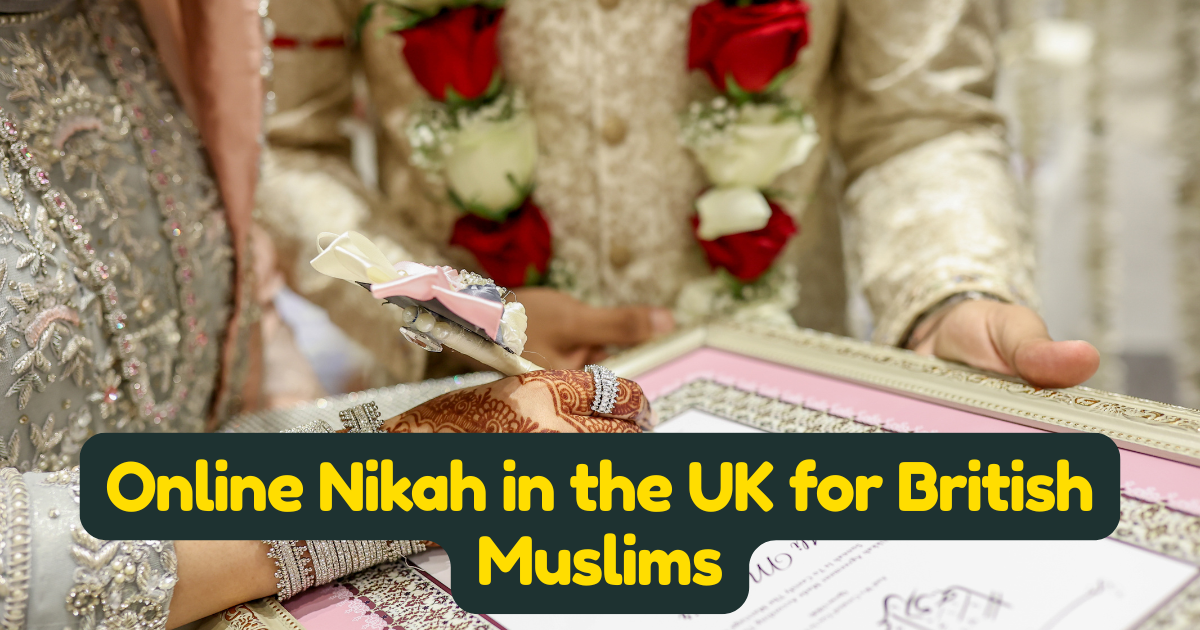
Britain is home to one of the largest and most established Muslim communities in the Western world. From London, Birmingham, and Manchester to Bradford, Leicester, and Glasgow, British Muslims represent one of the most diverse Muslim populations anywhere — South Asian, Arab, African, and convert communities living side by side, navigating both Islamic tradition and the realities of British life.
For many British Muslim couples, the question of how to arrange a proper nikah has become more complicated — not less — over the years. Local imams are not always available at short notice. Mosque schedules are full. One partner may be overseas. Family dynamics may make a large ceremony difficult. And underneath all of this, there is a legal question that far too many British Muslims have never had properly explained to them: what does UK law actually say about your nikah?
This guide covers all of it — how online nikah works for British Muslims, what Islamic conditions must be met, exactly what the UK legal position is, how civil registration works alongside your nikah, and what you need to know if a spouse visa is involved.
Is Online Nikah Islamically Valid for British Muslims?
Yes — completely. The Islamic validity of an online nikah has nothing to do with which country the parties are in. It depends entirely on the conditions of the contract being properly fulfilled.
IslamQA confirms that a nikah conducted via verified video call is permissible when identities are established and witnesses can clearly follow the Ijab and Qabul as it takes place. IslamWeb's Hanafi fatwa confirms that a nikah between parties in different locations using real-time communication is valid — critically important for the majority of British Muslims of South Asian heritage who follow the Hanafi school.
The conditions that determine validity are the same whether the ceremony takes place in a mosque in East London or over a secure video call from anywhere in the UK:
- Ijab and Qabul — a clear offer and acceptance in a single live session
- Two verified adult Muslim witnesses — present on the live call, attentive throughout
- Wali — the bride's guardian participating via video call, or a lawful Wali-e-Hakim where required
- Mahr — agreed, stated, and accepted during the ceremony
- Qualified Imam or Qazi — a credentialed scholar officiating the contract
- No Islamic impediment — both parties free to marry under Islamic law
Being in the UK changes nothing about these conditions. A correctly conducted online nikah from any UK city or town is a fully valid Islamic marriage.
What UK Law Actually Says About Nikah — The Honest Picture
This is the section most British Muslims have never had properly explained — and the gap between what couples assume and what UK law actually says has caused serious harm to real people, particularly women.
The House of Commons Library research briefing on Islamic marriage in England and Wales states it plainly: many Muslims in the UK have a nikah in an unregistered building and do not have an additional civil ceremony. This means their marriage is not legally recognised as valid under UK law. The law treats such couples as cohabitants, not spouses.
This is not a minor technicality. It has significant consequences for inheritance rights, financial claims on separation, pension entitlements, and the legal status of children. Switalskis Solicitors' detailed guide on Islamic marriages in the UK confirms that without civil registration, a spouse — most often the wife — may not be entitled to a fair share of assets or financial support if the relationship ends. The London Central Mosque and Islamic Cultural Centre explicitly states on its own website that an Islamic marriage conducted in the UK is not recognised as a legal marriage and strongly recommends civil registration for every couple.
When Is a Nikah Legally Recognised in the UK?
OTS Solicitors confirm the specific situations in which a nikah carries legal weight under UK law:
If the nikah took place in the UK with a civil ceremony — the civil ceremony is what creates the legal marriage. The nikah is the Islamic contract. Together they give the couple both religious and civil standing.
If the nikah took place overseas in a country where Islamic marriages are legally recognised — such as Pakistan, Bangladesh, Egypt, or Morocco — UK law recognises it through international legal principles. A marriage that was valid in the country where it was performed is generally valid in the UK, provided proper documentation is available including a translated certificate and where necessary diplomatic authentication.
If the nikah took place in the UK without a civil ceremony — it is not a legally recognised marriage under English and Welsh law. The couple are treated as cohabitants regardless of how long they have been together or how the nikah was conducted.
The Marriage Act 1949 and What It Means for British Muslims
Osbourne Pinner Solicitors confirm that under the Marriage Act 1949, for a marriage to be legally valid in England and Wales it must be conducted either in a registered place of worship licensed for civil marriages, or at a civil registry office or approved venue in the presence of a registrar. A nikah conducted in a home, an unlicensed mosque, or online does not automatically satisfy these requirements — regardless of how Islamically correct the ceremony is.
The practical implication is clear: for a British Muslim couple, the nikah and the civil registration are two separate steps — and both are important for different reasons. The nikah is your Islamic marriage. The civil registration is what gives you legal protection under UK law.
How to Combine an Online Nikah with UK Civil Registration
The good news is that combining an online nikah with civil registration is straightforward, and many British Muslim couples manage both in a practical and dignified way.
Option One — Nikah First, Civil Registration After
The most common approach for British Muslims who use an online nikah service is to complete the nikah as the Islamic ceremony, then attend a local register office for a civil ceremony within weeks or months of the nikah. The register office ceremony is simple, brief, and requires only two witnesses. It can be kept entirely private. Amaliah's guide to civil registration for British Muslims confirms that many couples complete the civil step quietly after their celebrations, treating it as a practical administrative step rather than a second ceremony.
Option Two — Civil Registration First, Nikah After
Some couples prefer to complete the civil registration first to establish immediate legal standing, then conduct the nikah as the Islamic formalisation of the marriage. Both orders are acceptable — the nikah has no prescribed relationship to the civil ceremony under Islamic law. What matters is that the nikah conditions are met properly, not whether it happens before or after the civil step.
Option Three — Licensed Mosque Ceremony
Some mosques in the UK are licensed as registered venues for civil marriages. When a nikah is conducted in one of these mosques, the civil ceremony and the Islamic ceremony happen simultaneously — a single event that satisfies both Islamic and civil requirements. However, this requires the specific mosque to be licensed, the correct documentation to be in order, and the ceremony to comply with both Islamic conditions and civil marriage law requirements. This option is only available for in-person ceremonies, not for online nikah.
Online Nikah and UK Spouse Visas
For British Muslims sponsoring a spouse from overseas — whether through the UK Spouse Visa or the Fiancé Visa — the marriage documentation question is critically important.
The UK Home Office requires that a marriage must be legally recognised for it to support a spouse visa application. A nikah-only ceremony conducted in the UK — whether in person or online — without civil registration is not recognised by the Home Office as a legal marriage for immigration purposes.
The pathway for most British Muslim couples using an online nikah in this context is: complete the nikah as the Islamic ceremony, then complete civil registration, and use both together to demonstrate a valid marriage to the Home Office. A nikah certificate from a qualified service plus a civil marriage certificate gives the couple everything needed for a spouse visa application.
If the nikah was conducted overseas in a country where Islamic marriages are legally recognised — and the couple has proper documentation including translation — the Home Office may recognise it directly. UK Visa Gateway's detailed guidance on proving religious marriages for spouse visas provides country-specific advice on documentation requirements. We strongly recommend consulting an immigration solicitor for guidance specific to your country of origin and your specific visa situation.
Why British Muslims Choose Online Nikah
The reasons are as diverse as the Muslim communities across the UK.
Partner Overseas or in a Different City
A British Muslim woman in Birmingham whose partner is in Leeds, or whose fiancé is still overseas awaiting a visa, does not need to wait or travel to complete her nikah. Both parties join the live video call from wherever they are. The Wali can join from Pakistan, Bangladesh, or anywhere else in the world. The ceremony happens in real time, and the certificate is issued the same day.
Availability and Scheduling
Local imams in major British cities are often heavily scheduled, particularly during popular wedding seasons. An online nikah service provides far greater scheduling flexibility — including same-day and next-day availability for couples who need to move quickly.
Privacy and Discretion
Some British Muslim couples — particularly those navigating complicated family situations, converts, or those who want a focused and intimate ceremony — prefer the privacy of an online nikah. The ceremony is real, valid, and properly documented. The social celebration, if desired, can happen separately.
Converts Without Community Access
British converts to Islam — a significant and growing demographic — often do not have established connections to local mosques or Islamic communities. Finding a qualified local Imam willing to conduct a nikah, handle the Wali-e-Hakim situation properly, and do so at short notice is genuinely difficult. An online service removes every one of those barriers.
The Wali Situation for British Muslim Women
For British Muslim women whose Wali is overseas — in South Asia, the Middle East, or Africa — the online nikah model is particularly practical. The Wali simply joins the video call from wherever he is. There is no need for him to travel to the UK. His participation is live, verified, and recorded in the ceremony.
For British converts with no Muslim male relatives, SeekersGuidance confirms that a qualified Imam can formally assume the Wali-e-Hakim role. This is the established and correct Islamic pathway for women with no available Muslim guardian, and it is handled as standard at InstantNikah.com with proper scholarly assessment and full documentation.
How the Process Works for UK-Based Couples
The process for British Muslim couples is the same as for any international couple — with the added clarity that UK-based couples typically have straightforward civil registration options available to them after the ceremony.
First, contact our team with both parties' names, the agreed Mahr, and the Wali situation. This can be done via our website, WhatsApp, or email — and for urgent situations, same-day scheduling is available.
Second, a brief pre-ceremony consultation with one of our scholars confirms eligibility, handles any Wali questions, and schedules the ceremony at a convenient time. All UK time zones are accommodated, including Scotland and Northern Ireland.
Third, the ceremony takes place via secure video call — typically 20 to 40 minutes — with the Imam, both parties, the Wali, and two verified Muslim witnesses present. The Ijab and Qabul take place in a single live session. The Mahr is stated and accepted. The ceremony concludes with du'a.
Fourth, the nikah certificate is issued digitally immediately after the ceremony and physically dispatched to your UK address. The certificate records both parties' details, the Mahr, the date, and the signatures of the Imam and witnesses.
You can review our complete ceremony process at InstantNikah.com/process or read reviews from couples across the UK who have used our service.
Frequently Asked Questions
Is an online nikah legally recognised in England and Wales?
An online nikah is a valid Islamic marriage. Under UK law — specifically the Marriage Act 1949 — a nikah conducted in an unregistered venue or online is not automatically recognised as a civil marriage in England and Wales. Civil registration via a register office is required for legal standing. This is the standard advice for all nikah ceremonies in the UK, whether conducted in person or online.
How do I register my online nikah civilly in the UK?
After your online nikah, you can attend your local register office to give notice of marriage and complete a civil ceremony. This requires 28 days notice, identity documents, proof of eligibility to marry in the UK, and payment of the registration fee. The civil ceremony itself is brief and can be kept entirely private. Many couples complete it weeks or months after their nikah.
Can my Wali join the online nikah from overseas?
Yes. Your Wali joins the live video call from wherever he is — Pakistan, Bangladesh, India, Egypt, or anywhere else. His live participation fully satisfies the Wali condition of the nikah. Geographic distance does not affect the validity of his role.
I am a British convert with no Muslim male relatives. Can I have a valid nikah?
Yes. When no Muslim male relative is available to serve as Wali, a qualified Imam formally assumes the Wali-e-Hakim role. This is the correct and established Islamic pathway for converts and is handled as standard at InstantNikah.com with proper scholarly assessment and full documentation in your nikah certificate.
Will my online nikah certificate support a UK spouse visa application?
The nikah certificate is a valid Islamic marriage document. For UK immigration purposes, the Home Office requires a legally recognised marriage. A nikah certificate combined with civil registration satisfies spouse visa requirements. We advise consulting an immigration solicitor for guidance specific to your situation and country of origin.
Is an online nikah valid in Scotland and Northern Ireland?
Islamically, yes — the validity of an online nikah does not depend on which part of the UK you are in. For civil recognition, Scotland and Northern Ireland have separate legal systems from England and Wales. In Scotland, the Marriage (Scotland) Act 1977 governs civil recognition. In Northern Ireland, the Marriage (Northern Ireland) Order 2003 applies. The same principle holds: civil registration alongside the nikah is the recommended path for full legal standing across all parts of the UK.
A Note on Protecting Yourself Under UK Law
Research consistently shows that a significant proportion of British Muslim wives have no legal protection in the event of divorce or the death of their husband — because their nikah was never civilly registered. This is not a judgment. It is a practical reality that affects real women across the UK.
An online nikah from InstantNikah.com gives you a fully valid Islamic marriage. Civil registration gives you the legal protection that goes alongside it. Both together give you everything — a marriage that is sound before Allah and protected under UK law.
InstantNikah.com serves British Muslim couples across England, Wales, Scotland, and Northern Ireland — as well as UK-based couples whose partner is still overseas. Qualified Imams. Verified witnesses. Wali support and Wali-e-Hakim for converts. Same-day availability. Complete documentation. Contact our team to discuss your situation or book your ceremony — no commitment required until you are ready.
Admin User
Author