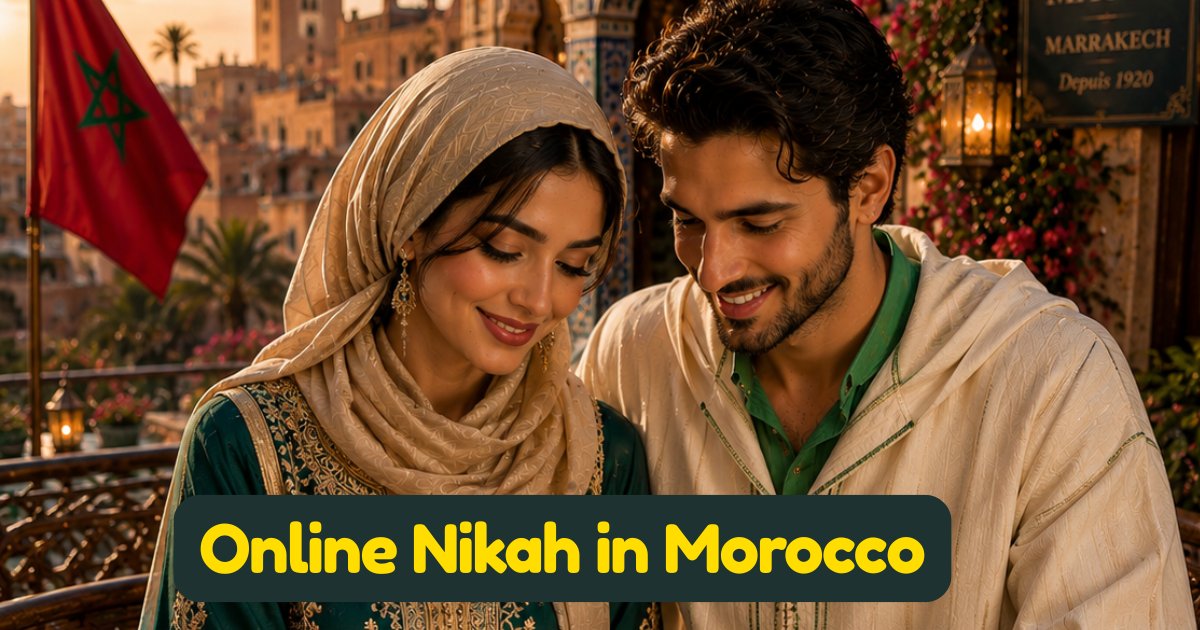
Morocco stands apart from every other country in this series. In Germany, France, the Netherlands, Belgium, Switzerland, and across Western Europe, the Islamic Nikah and the civil marriage are entirely separate processes — the Nikah establishes the religious union, and a separate civil ceremony at the relevant state office creates the legal marriage. Morocco does not work this way.
In Morocco, Islamic marriage is the legal marriage. The Moudawana — Morocco's Family Code, formally Law No. 70-03 — governs marriage, divorce, custody, inheritance, and personal status for all Moroccan Muslims. It integrates Islamic family law directly into the Moroccan legal system, administered through a network of specialised Family Justice Sections in courts across the country and through the unique institution of the Adoul: notaries of Islamic law who are the sole authorities authorised to draft and register marriage contracts.
Understanding this system is essential for Morocco-connected couples — whether they are marrying inside Morocco, whether they are Moroccans Residing Abroad trying to have their overseas marriage recognised in Morocco, or whether they are foreigners marrying Moroccan nationals.
The Moudawana — Morocco's Revolutionary Family Code
Morocco's Family Code — the Moudawana — was comprehensively reformed in 2004 following a historic legislative process initiated by King Mohammed VI. The reform was described at the time as a genuine legal and social revolution: a text aimed at balancing Morocco's Islamic identity with the imperatives of modernity, equality, and protection of women's rights.
Under the Moudawana, marriage in Morocco is defined as a pact based on mutual consent aimed at establishing a legal and lasting union between a man and a woman. The legal capacity to marry is set at 18 years for both parties. Consent — the exchange of Ijab and Qabul — must be sincere, decisive, and free from coercion. Polygamy is subject to strict prior judicial authorisation under conditions of demonstrated justice and equality. And critically, the presence of two Adouls is mandatory for the marriage to be legally registered.
The Moudawana governs all Moroccan citizens — including dual nationals and binational Moroccans — for any marriage involving at least one Moroccan party, regardless of where the marriage takes place.
The Adoul System — How Marriage Is Actually Conducted in Morocco
This is the institution that makes Morocco unique in this series — and the one most English-language guides never explain adequately.
The Adoul (عدول) is a notary specialising in Islamic law, appointed by the Moroccan Ministry of Justice. Unlike a civil registrar in Europe, the Adoul is specifically trained in Islamic family law and is the authorised person to draft the official marriage document — the 'aqd al-zawaj — in Morocco.
Moroccan law requires the presence of two Adouls at every marriage — not one. Both must be present to witness the consent, record the Mahr (called Sadaq in Moroccan legal terminology), verify the required documents, and draft the marriage act. This dual-Adoul requirement is unique to the Moroccan system and reflects the classical Islamic legal tradition of requiring two qualified Islamic witnesses to transactions of major legal significance.
As Moroccan family law specialists confirm: once the Adouls have recorded the marriage act, it is submitted to the Family Justice Section of the court of first instance. The judge approves the document, which is then transcribed in a special register. An extract is sent to the civil registrar of the place of birth of each spouse within 15 days. The marriage is simultaneously an Islamic contract and a legally registered Moroccan marriage — in a single process.
The Adoul's fee for drafting the marriage act is remarkably modest — around 150 Moroccan dirhams, roughly equivalent to $15 USD. The total administrative costs, including court processing, remain among the most affordable civil-religious marriage costs of any country in this series.
What Documents Are Required for Marriage in Morocco
Article 65 of the Moudawana requires a specific administrative file to be compiled before the Adouls can draft the marriage act. The core documents required are:
- A special application form for authorisation to execute the marriage act
- An extract of the birth certificate for each spouse
- A medical certificate attesting to the absence of contagious diseases
- A single-status certificate (certificat de célibat) confirming both parties are free to marry
- Authorization from the family court judge for special cases — including where one party is a foreign national
For foreign nationals marrying in Morocco, all non-Arabic documents must be translated into Arabic by a court-accredited sworn translator. Any translation error or discrepancy in the transcription of names can result in immediate rejection by the family court — making careful document preparation essential.
The "Fatiha Marriage" — What It Is and Why It Creates Serious Problems
This is a critical concept for Moroccan Muslim couples — and one that far too many families misunderstand until the consequences become real.
In Moroccan culture, a "Fatiha marriage" — named after the opening Surah of the Qur'an recited at traditional marriage gatherings — refers to an Islamic marriage ceremony conducted without the involvement of Adouls and without court registration. It is the Moroccan equivalent of what in other countries might be called a Nikah-only ceremony.
Under the Moudawana, a Fatiha marriage is not legally recognised in Morocco. This has severe practical consequences: children born of such a marriage have serious difficulties establishing Moroccan nationality and parentage, no inheritance rights under Moroccan law, and significant barriers to obtaining Moroccan passports. The wife has no legal recourse under Moroccan family law if the relationship ends. As Moroccan community members confirm, Moroccan courts have seen many cases where the consequences of unregistered Fatiha marriages fell hardest on women and children.
This does not mean the Fatiha marriage is Islamically invalid — the Islamic conditions of Ijab, Qabul, Wali, witnesses, and Mahr apply to it just as to any Nikah. But its legal non-recognition in Morocco creates real harm that the Moudawana was specifically designed to address. A responsible Islamic marriage service will always make this distinction clear.
Moroccans Residing Abroad (MRE) — The Three-Month Registration Rule
This is the most practically important provision for the enormous Moroccan diaspora — and the one that most diaspora Moroccans do not discover until they miss the deadline.
Article 15 of the Moudawana specifically addresses Moroccans Residing Abroad. It states that Moroccans who marry in another country according to the local formalities of that country must register the marriage with the Moroccan consular services within three months of the conclusion of the marriage deed. For this registration to succeed, the overseas marriage must meet the core conditions of the Moudawana: consent, legal capacity, and the presence of two Muslim witnesses.
The consequences of missing this three-month window are significant: the marriage becomes difficult to register in Morocco retrospectively, creating complications for establishing children's nationality, arranging inheritance under Moroccan law, and processing any legal matter involving the Moroccan spouse's personal status.
For Moroccan diaspora Muslims who have completed an online Nikah through InstantNikah.com — particularly those in France, Belgium, the Netherlands, Canada, or the UK — the Nikah certificate is the Islamic marriage document. Whether this certificate satisfies Article 15's registration requirements depends on whether the marriage also complies with the civil law of the country where it was conducted. Our team advises diaspora Moroccan couples on this during the pre-ceremony consultation — and strongly recommends consulting a Moroccan family law specialist or the relevant Moroccan consulate for guidance specific to their situation.
When Does an Online Nikah Service Serve Morocco-Connected Couples?
Given that Morocco has its own comprehensive and well-administered Islamic marriage system through the Adoul network, the question naturally arises: when does an external online Nikah service serve Morocco-connected couples?
Moroccan Diaspora Couples in Western Countries
The largest and most practically important audience is Moroccan Muslims living in France, Belgium, the Netherlands, Spain, Italy, Canada, and the UK — who want an Islamic Nikah conducted where they currently live rather than travelling to Morocco. For these couples, an online Nikah through InstantNikah.com provides the Islamic ceremony from their current country of residence. The subsequent Article 15 consular registration — where required — is a separate process our team advises on.
Cross-Border Couples — One Partner in Morocco, One Abroad
A Belgian-resident Moroccan marrying a partner still in Casablanca, or a French-Moroccan family where one partner is in Rabat and the other in Lyon — these cross-border situations benefit directly from an online Nikah. Both partners join the live video call from their respective locations. The Islamic ceremony happens in real time. The legal registration — whether through the Moroccan Adoul system, the Western country's civil marriage process, or both — follows afterward.
Foreigners Marrying Moroccan Nationals
Non-Moroccan Muslims marrying Moroccan nationals face specific requirements under the Moudawana — particularly the requirement for prior judicial authorisation from the family court judge before the Adouls can draft the marriage act. For some couples, conducting the Nikah through an international online service first — as an Islamic ceremony — while the Moroccan judicial authorisation process proceeds, is a practical interim step. The Moroccan legal registration then follows once authorisation is obtained.
Moroccan Converts Abroad
Moroccan nationals who have married non-Muslims abroad and whose partners have subsequently converted to Islam face a specific Moudawana requirement: conversion must be documented with a certificate from a recognised Islamic religious authority. For such couples, InstantNikah.com's scholars can provide guidance on the correct process and documentation requirements during the pre-ceremony consultation.
The Wali in Moroccan Marriage — Maliki Fiqh Applied
Morocco follows the Maliki school of jurisprudence — the dominant madhab across North Africa — which holds the Wali (guardian) as a condition of the Nikah's validity. The Moudawana reflects this: the bride's Wali must be present and participating in the marriage contract. For diaspora Moroccan women whose Wali is in Morocco, the online Nikah model is directly practical — the Wali joins the live video call from Morocco, participating in real time regardless of geographic distance.
For Moroccan women who are converts from non-Muslim families — a situation that does exist within Morocco's diaspora communities — the Wali-e-Hakim pathway applies. Our detailed guide on online Nikah without a Wali explains this in full.
Mixed Marriages — When One Partner Is Non-Muslim
The Moudawana is explicit on interfaith marriage: Article 60 prohibits the marriage of a Muslim Moroccan woman to a non-Muslim man. For a non-Muslim man to marry a Moroccan Muslim woman, conversion to Islam is mandatory under Moroccan law — and the conversion must be documented with a certificate from an Islamic notarial authority. A Muslim Moroccan man may marry a Christian or Jewish woman without her converting, in keeping with the classical Maliki position on Ahl al-Kitab.
For couples navigating this situation, our dedicated guides on Muslim women and non-Muslim men and non-Muslim women and Muslim men explain the full Islamic and legal picture.
Frequently Asked Questions
Is a Nikah conducted without Adouls legally recognised in Morocco?
No. A marriage in Morocco must be officiated by two Adouls and registered with the Family Justice Section of the court to be legally recognised. A Fatiha marriage — conducted without Adouls and court registration — is not legally valid in Morocco under the Moudawana, regardless of its Islamic validity. Children of unregistered marriages face serious complications with Moroccan nationality, inheritance, and documentation.
I am a Moroccan living in France. Must I register my French civil marriage in Morocco?
Yes — under Article 15 of the Moudawana, Moroccans Residing Abroad must register their overseas marriage with Moroccan consular services within three months of the marriage being concluded. The marriage must meet the core conditions of the Moudawana — consent, legal capacity, and two Muslim witnesses — to be eligible for registration. Missing the three-month deadline creates significant retrospective complications.
Can both partners join an online Nikah from Morocco and Belgium simultaneously?
Yes. An online Nikah through InstantNikah.com accommodates both partners joining from their respective locations — Morocco and Belgium, Morocco and France, or any other cross-border combination. Both join the live video call. The Wali can join from Morocco or anywhere else. The Islamic ceremony happens in real time across all locations simultaneously.
What is the Sadaq in Moroccan marriage law?
Sadaq is the Moroccan legal term for the Mahr — the mandatory gift from groom to bride that is an essential element of the Islamic marriage contract. Under the Moudawana, the Sadaq must be specified in the Adoul's marriage act. It can be prompt (paid at the time of the marriage) or deferred. The Adoul records its nature and amount as part of the official marriage documentation.
Does InstantNikah.com's Nikah certificate satisfy Article 15 registration requirements?
A Nikah certificate from InstantNikah.com is a valid Islamic marriage document. Whether it satisfies Article 15 registration requirements at the Moroccan consulate depends on whether the marriage was also registered civilly in the country where it was conducted, and whether it meets all Moudawana conditions. We advise diaspora Moroccan couples on this during the consultation and strongly recommend verifying specific documentation requirements with the relevant Moroccan consulate.
The Moudawana as a Model — Morocco's Islamic-Legal Integration
Morocco's Family Code is one of the most sophisticated examples anywhere in the world of a country integrating Islamic family law into a modern legal framework. The Adoul system — two trained Islamic law notaries, a family court judge, a specialised Justice Section — provides a level of Islamic legal accountability and documentation rigour that many Western Muslim communities can only aspire to replicate.
For Moroccan Muslims marrying inside Morocco, the system serves them directly. For the millions of Moroccans in the diaspora — navigating life between their country of residence and their country of origin — the intersection of the Moudawana and Western civil law creates specific questions that require careful, informed guidance.
InstantNikah.com serves Morocco-connected couples across the diaspora — in France, Belgium, the Netherlands, Spain, Italy, Canada, the UK, and beyond. Our pre-ceremony consultation addresses the Moudawana implications specific to your situation. Speak with our team before booking — no commitment required.
Admin User
Author