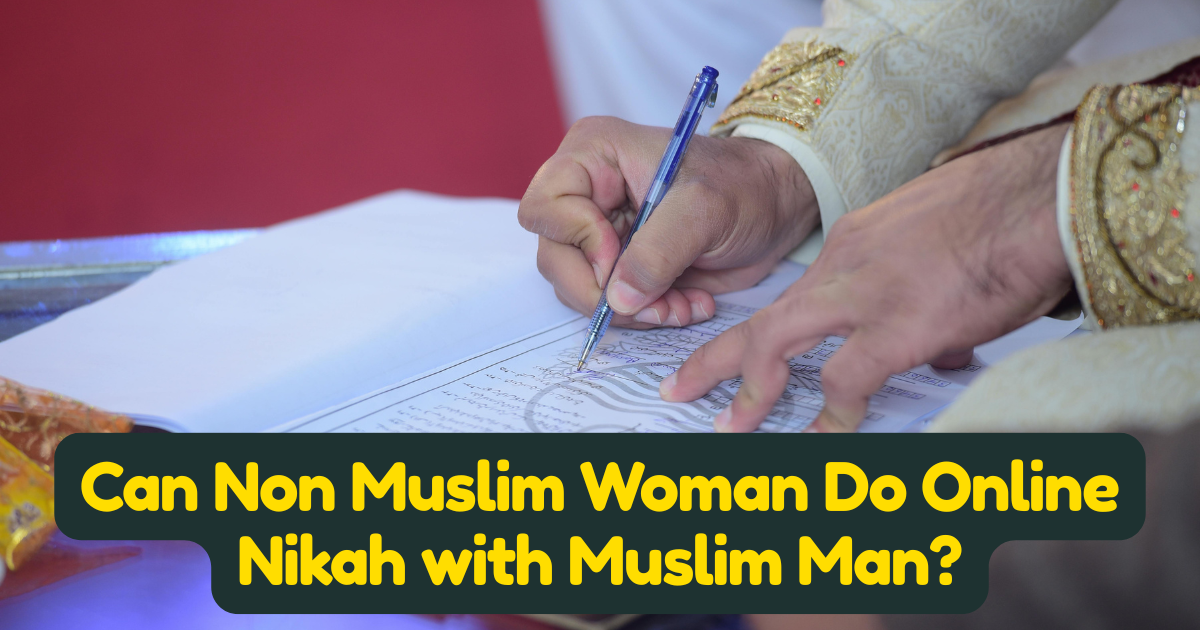
This is a question with a genuine answer rooted directly in the Qur'an — and that answer is more nuanced than most online sources present it.
Unlike the situation of a Muslim woman wishing to marry a non-Muslim man — where the scholarly consensus is a firm prohibition — the question of a Muslim man marrying a non-Muslim woman falls into a different category entirely. Islamic law makes a specific and explicit permission for this in Surah Al-Ma'idah. But that permission comes with real conditions, and understanding those conditions matters enormously before any nikah is arranged.
This guide explains the full picture — what Islam permits, what it prohibits, what conditions must be present, what the scholars say about interfaith marriages in Western countries today, and what a valid online nikah looks like in this situation.
The Qur'anic Permission — What It Says and What It Means
The permission for a Muslim man to marry a non-Muslim woman is found in Surah Al-Ma'idah, verse 5 — one of the last verses revealed and widely considered among the most comprehensive in Islamic family law:
"This day, all good things have been made lawful for you. The food of the People of the Scripture is lawful for you, and your food is lawful for them. And lawful in marriage are chaste women from among the believers and chaste women from among those who were given the Scripture before you, when you have given them their due bridal gift, desiring chastity, not unlawful sexual intercourse or taking secret lovers."
— Surah Al-Ma'idah, 5:5 (Sahih International)
This verse is explicit and direct. Muslim men are permitted to marry chaste women from the People of the Scripture — identified by classical and contemporary scholars as Christians and Jews. This is not inferred, not derived through analogy, and not disputed among the four major Sunni schools. Hadith of the Day's scholarly treatment confirms that it is the consensus (ijma') of Islamic jurists that Muslim men can marry Jewish and Christian women — citing historical examples from among the Companions of the Prophet ﷺ, including 'Uthman ibn 'Affan who married a Christian woman, and Talhah and Hudhayfah who married Jewish women.
The permission is real. But it is attached to specific conditions — and those conditions are where couples in this situation need the most careful guidance.
Who This Permission Applies To — And Who It Does Not
The single most important practical question about this ruling — particularly for Muslims in the West — is what "Christian" and "Jewish" actually means under Islamic law in this context.
The Qur'anic permission applies to women from the Ahl al-Kitab: those who were given a revealed scripture before Islam. Scholars understand this to mean genuinely practising Christians and Jews — women who hold sincere belief in the core tenets of their faith, including belief in God, in the prophets, in revealed scripture, and in the hereafter. The term muhsanat in the verse — meaning chaste, or free women of honour — adds another layer of condition beyond simply being a nominal member of a religious group.
Daruliftaa's detailed ruling makes a critical distinction that is particularly relevant for Muslims in the UK, USA, Canada, and Europe: women who describe themselves as Christian or Jewish in a cultural or nominal sense — without any actual belief or religious practice — cannot be considered Ahl al-Kitab under Islamic law. A woman who identifies as Christian by background but is effectively atheist in belief and practice does not qualify under the Qur'anic permission. IslamQA confirms that a Muslim man must first satisfy himself that the woman is truly a believing Christian or Jew before the nikah can be validly contracted.
This distinction matters practically in Western countries, where many people who culturally identify as Christian or Jewish have no active faith, do not practice, and do not hold the core beliefs of their stated religion. A scholar conducting a nikah in this situation should — and any responsible one will — ask about the woman's actual beliefs and practice before proceeding.
Who the Permission Does NOT Cover
The Qur'anic permission is limited and specific. It does not extend to:
- Hindu, Buddhist, Sikh, or Zoroastrian women — these faiths are not counted among the Ahl al-Kitab under classical Islamic jurisprudence
- Atheist or agnostic women — a woman who holds no sincere religious belief does not fall under the Ahl al-Kitab permission
- Polytheistic or idol-worshipping women — explicitly prohibited in Surah Al-Baqarah 2:221
- Women who are Christian or Jewish in name only without genuine belief or religious conviction
If the non-Muslim woman falls outside the category of genuine Ahl al-Kitab, the same path that applies in all other cases applies here: if she sincerely embraces Islam, the nikah can proceed on that basis. The conversion, as always, must be genuine rather than nominal.
The Conditions That Must Be Met
The Qur'anic permission is not unconditional. Several conditions are attached to it by classical and contemporary scholars — and a responsible Imam will ensure these are assessed before any ceremony proceeds.
She Must Be Genuinely Chaste (Muhsanat)
The Qur'anic verse uses the word muhsanat — chaste, free, honourable women. This condition exists equally for Muslim brides and non-Muslim brides from the Ahl al-Kitab. A woman who is not of upright character or who is known to engage in extramarital relations does not qualify under the permission of this verse.
She Must Be a Genuinely Believing Christian or Jew
As discussed above, cultural identification without sincere religious belief does not satisfy this condition. The woman should hold meaningful faith — belief in God, in her religion's prophets, in a revealed scripture, and in accountability in the hereafter. Scholars are clear that a woman who holds none of these beliefs is not Ahl al-Kitab in the sense the Qur'an intends.
She Must Be Free to Practice Her Religion
Islamic law is explicit that a non-Muslim wife in a nikah retains her right to practice her own religion. She may not be prevented from attending church, observing her religious obligations, or maintaining her faith. This is not a courtesy — it is a condition rooted in Islamic principles of religious freedom and justice within marriage. A Muslim husband who would prevent his Christian or Jewish wife from practicing her religion has stepped outside the bounds of what Islam permits in this arrangement.
The Mahr Must Be Given
The verse itself mentions "when you have given them their due bridal gift." The Mahr is not optional in a nikah with a non-Muslim woman any more than in a nikah with a Muslim woman. It must be agreed, stated, and accepted during the ceremony.
The Children Must Be Raised as Muslims
Scholarly consensus holds that children born of a marriage between a Muslim man and a non-Muslim woman are to be raised Muslim. This is a fundamental condition rooted in the Islamic responsibility of the father as the head of the household. Where this is unlikely to be achievable — where the couple's circumstances make Islamic upbringing of children practically impossible — many contemporary scholars advise strongly against contracting such a marriage at all.
What Scholars Say About This Ruling in Western Countries Today
The majority scholarly position is that the permission exists — but that it comes with serious practical cautions, particularly for Muslims living in non-Muslim majority countries.
Dar al-Ifta Egypt's ruling — one of the most authoritative Islamic legal institutions in the world — confirms the permissibility while noting explicitly that a Muslim man should work to bring his wife into Islam, that such a marriage is not viewed with favour despite being technically permitted, and that the children's Islamic upbringing must be secured.
Daruliftaa's comprehensive treatment adds that the meaning of the Qur'anic permission is specifically that the nikah contract, if performed, is valid — but that various hadith narrations establish the undesirability of such a marriage. The Prophet ﷺ encouraged Muslims to choose spouses who are fully practising Muslims for the sake of building an Islamic home and raising Muslim children. The permission and the recommendation are separate things.
A key concern scholars raise specifically about Western contexts is the practical reality of identifying a genuinely believing Christian or Jewish woman today. Many scholars — including those at major Hanafi institutions — note that in the contemporary West, the vast majority of people who identify as Christian or Jewish are effectively secular in their beliefs and practice. Contracting a nikah with such a woman on the assumption that she qualifies as Ahl al-Kitab is, in the view of many scholars, not sound. The question of whether she genuinely qualifies must be honestly assessed before the ceremony.
The Wali Question in an Interfaith Online Nikah
When the bride is a non-Muslim Christian or Jewish woman, the Wali question has a distinct character. Under Islamic law, a non-Muslim woman's marriage to a Muslim man does not require the same Wali framework as a Muslim woman's nikah — the Wali requirement under Islamic fiqh is specifically for Muslim brides. A non-Muslim woman's guardian does not serve in the Islamic Wali role.
However, her consent is entirely non-negotiable. A non-Muslim woman entering a nikah with a Muslim man must give her informed, free, and genuine consent to the marriage contract. An Imam conducting this ceremony will confirm her consent directly and clearly as part of the ceremony — just as he would for any bride.
Civil Recognition — What Interfaith Couples Need to Know
As with all online nikah ceremonies, the Islamic validity and the civil legal recognition are separate questions that must both be addressed.
A correctly conducted nikah between a Muslim man and a chaste Christian or Jewish woman, meeting all the conditions, is a valid Islamic marriage. In the USA, UK, Canada, and Europe, separate civil registration is typically required for the marriage to carry full domestic legal standing. This is the standard advice for all nikah ceremonies, interfaith or otherwise — and a credible provider will make this clear before the ceremony takes place rather than leaving couples to discover it later.
How InstantNikah.com Handles Interfaith Nikah Requests
At InstantNikah.com, interfaith nikah requests — where a Muslim man is seeking to marry a Christian or Jewish woman — begin with a proper pre-ceremony consultation with one of our scholars. This conversation matters. It is not a gatekeeping exercise — it is how we ensure the ceremony we conduct is genuinely valid under Islamic law.
Our scholars will ask about the bride's background, her actual beliefs, and her practice. They will confirm that she falls genuinely within the Ahl al-Kitab category under the conditions required — not simply that she identifies culturally as Christian or Jewish. They will confirm the Mahr, the bride's consent, the children's upbringing arrangements, and all other conditions before any ceremony is scheduled.
Where the conditions are properly met, we are glad to arrange the ceremony — a qualified Imam via secure video call, verified witnesses, complete documentation, and a signed nikah certificate. Where the conditions raise concerns, our scholars will discuss those honestly and advise the couple on the correct path forward.
You can learn more about our ceremony process at InstantNikah.com/process or speak with our scholars before making any decision.
Frequently Asked Questions
Can a Muslim man marry a Hindu, Buddhist, or Sikh woman?
No. The Qur'anic permission in Surah Al-Ma'idah 5:5 applies specifically to women from the Ahl al-Kitab — Christians and Jews. Women from Hindu, Buddhist, Sikh, Zoroastrian, or other non-Abrahamic faiths do not fall under this permission. A nikah with such a woman would not be valid under Islamic law unless she sincerely embraces Islam first.
What if the Christian or Jewish woman does not want to convert to Islam?
Under the traditional Islamic ruling, she is not required to convert for the nikah to be valid — provided she genuinely qualifies as Ahl al-Kitab and meets the other conditions. The nikah can proceed on the basis of her existing faith. However, she must retain the right to practice her own religion, and any children of the marriage are expected to be raised Muslim.
Does the non-Muslim bride need a Wali for the online nikah?
The Islamic Wali requirement under fiqh is specifically for Muslim brides. A non-Muslim bride does not have a Wali in the Islamic legal sense. However, her full informed consent is entirely essential — an Imam will confirm this directly with her during the ceremony.
How does an Imam assess whether a non-Muslim woman genuinely qualifies as Ahl al-Kitab?
Our scholars assess this through a pre-ceremony consultation. They will ask about the bride's actual beliefs — whether she believes in God, in the foundational tenets of her faith, and whether she has any active religious practice. Cultural identification without sincere belief does not qualify. The assessment is handled sensitively and respectfully — not as an interrogation, but as a necessary part of ensuring the ceremony is conducted on sound Islamic grounds.
Is an interfaith online nikah recognised civilly in the UK and USA?
The Islamic validity of the nikah stands on the conditions of the contract being met. For civil legal recognition in the UK, USA, Canada, and Europe, a separate civil registration is typically required. A good provider will advise you on the civil registration steps relevant to your country before the ceremony takes place.
Should a Muslim man marry a non-Muslim woman even if it is technically permitted?
The permission and the recommendation are different things. While the nikah is technically valid under the conditions described, scholars consistently advise that a Muslim man's ideal choice is a practising Muslim woman for the sake of shared faith, family harmony, and the Islamic upbringing of children. The permission exists for genuine circumstances where it applies — not as an encouragement to seek non-Muslim spouses as a preference.
A Clear Summary
A non-Muslim woman can do an online nikah with a Muslim man — but only if she is a genuinely believing Christian or Jewish woman who meets the conditions outlined in Surah Al-Ma'idah 5:5. The permission is real and Qur'anic. The conditions are equally real and equally non-negotiable.
In Western countries in particular, the question of whether a woman genuinely qualifies as Ahl al-Kitab must be honestly assessed — cultural identification is not enough. A Muslim man entering this kind of marriage carries real responsibilities: confirming the bride's genuine faith, ensuring her right to practice her religion, fulfilling the Mahr, and securing the Islamic upbringing of any children.
At InstantNikah.com, we take these assessments seriously because the validity of your nikah depends on them being done properly. If you have a specific situation you would like to discuss before booking, our scholars are available — no commitment required, no pressure, and no judgment. Speak with our team here.
Admin User
Author