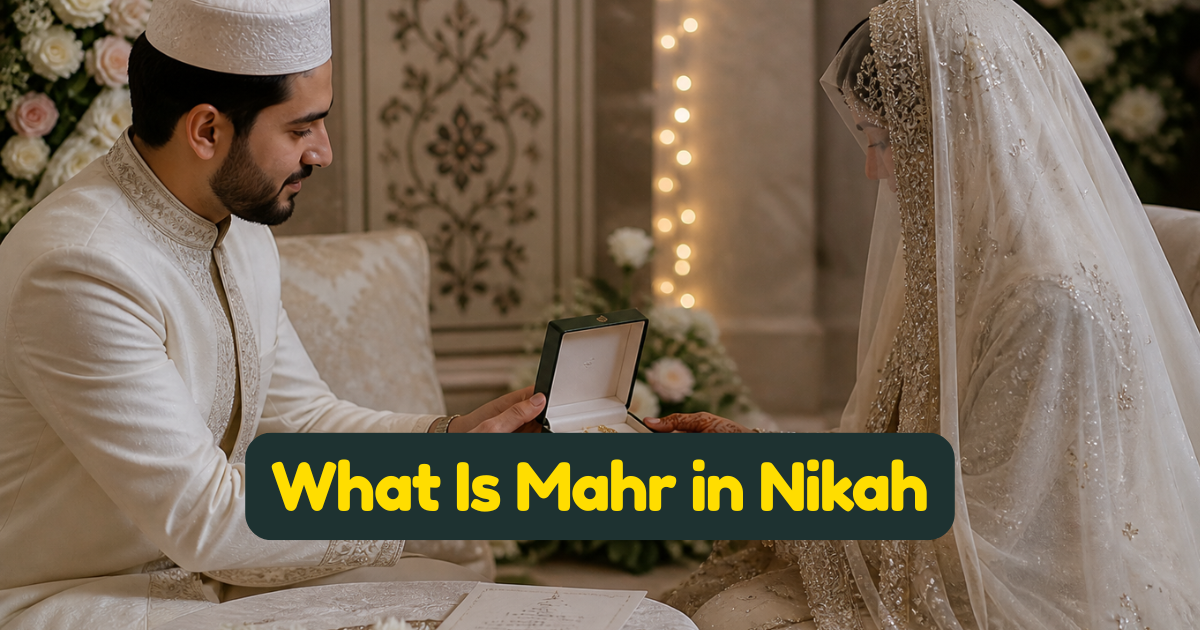
Few aspects of Islamic marriage generate as much confusion, cultural pressure, and genuine disagreement as the Mahr. For some couples, it is a source of real anxiety — the bride unsure how much to ask for, the groom unsure what he can reasonably offer, and the families sometimes making things harder rather than easier. For others, it becomes a negotiation shaped more by culture and pride than by anything Islam actually teaches.
It does not have to be this way. The Islamic position on Mahr is actually clear, balanced, and — when followed correctly — one of the most dignified provisions in the entire marriage framework. Understanding it properly resolves most of the confusion.
This guide covers what Mahr is, what the Qur'an and authentic Hadith say about it, the different types of Mahr, how the amount is decided, what happens when it goes unpaid, and what you need to have agreed before your Nikah ceremony takes place.
What Is Mahr?
Mahr (مهر) is the mandatory gift that a groom gives to his bride as an essential component of the Islamic marriage contract. It is a right that belongs exclusively to the bride — not to her family, not to her father, and not to her Wali. It becomes her property at the point the Nikah contract is concluded, and she may do with it as she chooses.
Mahr is not a bride price — a common and deeply inaccurate translation. A bride price, in anthropological usage, refers to payment made to the family of the bride. Mahr is paid directly to the bride herself. It is not payment for her. It is an obligation upon the husband that Islam imposes as an expression of his commitment, his respect, and his acceptance of responsibility toward the person he is marrying.
In the Qur'an, Mahr is called by three different names in different verses — each one revealing something distinct about its nature. It is called sadaqah (a sincere gift), nihlah (a generous offering given freely), and faridah (something obligatory and fixed). The word faridah is particularly significant. Allah ﷻ used it to indicate that the Mahr is not optional, not symbolic unless both parties agree, and not something that can simply be waived by the groom. It is an obligation.
The Qur'anic and Hadith Evidence
The primary Qur'anic command on Mahr is found in Surah An-Nisa (4:4):
"And give the women their bridal gifts graciously. But if they give up willingly to you anything of it, then take it in satisfaction and ease."
— Surah An-Nisa, 4:4 (Sahih International)
This verse does two things simultaneously. It makes the Mahr obligatory — the groom must give it — and it establishes that the bride has the right to waive part or all of it freely if she chooses. Both halves of this are important. The obligation is the groom's. The right to waive it is the bride's alone.
On the amount of Mahr, the Prophet ﷺ gave clear guidance that Islam does not endorse extravagance or competition. In Sahih al-Bukhari, he told a companion seeking to marry: "Go and look for something, even if it is a ring of iron." (Sahih al-Bukhari, 5029). The message is unmistakable — the Mahr should be within the groom's genuine means. A small Mahr given sincerely is far better than a large amount promised with no intention or ability to pay.
The Prophet ﷺ also said: "The best of dowers is the simplest." (Al-Hakim, Al-Bayhaqi, classed as Sahih). And separately: "The best woman is the one whose Mahr is the easiest to pay." These narrations together establish a consistent Prophetic encouragement toward simplicity, sincerity, and ease — not cultural competition or financial display.
Types of Mahr — Prompt and Deferred
In classical Islamic jurisprudence and in contemporary practice, Mahr is commonly divided into two parts. Understanding the distinction matters practically — particularly for what must be declared at the Nikah ceremony itself.
Prompt Mahr (Muqaddam or Mu'ajjal)
The prompt Mahr is the portion paid immediately — at or immediately after the Nikah ceremony. It is sometimes called the muqaddam. This is the part that must be declared during the ceremony itself. The Imam or Qazi will ask for the Mahr to be stated and accepted as part of the contract. The prompt Mahr becomes the bride's property at that moment.
Deferred Mahr (Mu'akhar or Mu'ajjal Deferred)
The deferred Mahr is a promised amount agreed at the time of the Nikah but paid at a later date — often at the time of divorce or the death of the husband. It serves as a form of financial security for the wife, ensuring that she has an enforceable right to material provision even if the marriage ends.
Many couples divide the Mahr between a prompt portion paid at the ceremony and a larger deferred portion payable in future. Both must be stated, agreed, and recorded in the Nikah ceremony and on the Nikah certificate. A deferred promise to pay does not make the obligation any less binding — the husband cannot later claim that because it was deferred it was not serious.
How Much Should the Mahr Be?
This is the question couples ask most often — and where cultural pressure frequently overrides Islamic guidance.
IslamQA's ruling on Mahr amount states it clearly: there is no set minimum or maximum amount under the majority scholarly position. The Mahr is whatever is agreed upon by the couple — or by the groom and the bride's Wali — and both small and large amounts are permissible.
The Hanafi school holds that the Mahr should not be less than ten dirhams (approximately ten US dollars at the symbolic minimum level). The Maliki school sets a minimum of three dirhams. These minimum amounts are deliberately small — they emphasise that the Mahr is about the principle and the obligation, not a specific financial threshold.
What the Prophet ﷺ consistently emphasised is that the Mahr should be proportionate to the groom's means and agreed sincerely — not inflated for social display, not set at an amount the groom has no intention of paying, and not so high that it prevents a lawful marriage from taking place. IslamOnline's detailed Mahr ruling confirms that it is haram for a groom to promise a Mahr he has no intention of paying — this is playing games with the rules of Allah.
Islamic Finance Guru's analysis of Mahr amounts offers a practical framework for contemporary Muslim couples: a Mahr proportionate to what the groom genuinely can afford, benchmarked against the standard of women of similar circumstances in the bride's family — the classical concept of Mahr al-Mithl. The article notes that the current crisis of inflated, unattainable Mahr demands in some Muslim communities is itself contributing to delayed marriages, avoidance of Nikah, and ultimately to sin and harm.
What Can Mahr Be?
Mahr does not have to be money. Islamic law permits a wide range of forms for the Mahr, provided it has genuine value or genuine benefit to the bride:
- Money — the most common form, stated as a specific amount in an agreed currency
- Gold or silver — physically given or specified as an amount by weight
- Jewellery — a specific item agreed upon between the couple
- Property — a portion of land, a house, or another asset
- Teaching — the Prophet ﷺ permitted a man to marry a woman with the Mahr being his teaching her Qur'an (Sahih al-Bukhari, 5030). This is a well-known and authentic narration.
- A ring of iron — as narrated in Sahih al-Bukhari — demonstrating that even a very small, inexpensive item satisfies the Mahr requirement if it is given sincerely
What cannot be used as Mahr is something that is itself impermissible under Islamic law — wine, pork, or anything haram. A Mahr agreed in an impermissible form is void, but the Nikah itself remains valid and the husband is required to pay a Mahr equivalent to that of similar women in the bride's family.
Who Decides the Mahr?
The short answer: the bride and the groom — with the bride's Wali consulted appropriately, and with the bride's interests protected.
The Mahr is the bride's right. She has every right to state what she wants, and the groom can offer what he is genuinely able to give. If there is a gap between what she asks and what he offers, the discussion should be between them — and ideally with the Wali's input. The Wali's role in the Mahr discussion is as an advisor and protector of the bride's interests, not as someone who determines the amount independently or who has any right to receive any portion of it.
Mathabah Institute Canada's Hanafi guidance notes that three parties have a stake in the Mahr amount being correct: Allah's right that it meets the minimum threshold, the guardian's role in ensuring it does not fall short of the family standard, and the bride's own right to set the amount she is comfortable accepting. The bride can accept less than the family standard if she and her Wali agree — what she cannot be pressured into is accepting a Mahr below what she genuinely consents to.
A particularly important point: the Mahr belongs only to the bride. Her parents have no claim to it. Her in-laws have no claim to it. Her brothers have no claim to it. Any cultural expectation that the Mahr is shared with the bride's family, or that the groom's family has a say in reducing it, has no basis in Islamic law.
Mahr al-Mithl — When No Amount Was Agreed
If a Nikah is conducted without a Mahr being specified — or if the agreed Mahr turns out to be void — the bride is entitled to what scholars call Mahr al-Mithl: the standard Mahr of women of similar standing in her family and social context.
This is typically determined by reference to what her sisters, cousins, or women of similar background and circumstances received as Mahr at the time of their marriages. If there is no such reference available, a qualified scholar or Islamic judge assesses a fair amount based on the bride's circumstances.
The important takeaway: the absence of a stated Mahr does not void the Nikah. But it does not eliminate the groom's obligation either. He is still required to pay — and the amount will be determined by scholars based on fair comparison.
Mahr Fatimi — The Prophetic Standard
One specific Mahr reference that is widely discussed among Muslims is Mahr Fatimi — named after Fatimah (may Allah be pleased with her), the daughter of the Prophet ﷺ, whose Mahr when she married Ali (may Allah be pleased with him) is historically recorded.
Amaliah's detailed Mahr guide notes the significance of this: Ali ibn Abi Talib — one of the earliest Muslims, someone the Prophet ﷺ considered like a brother — was still required to give Mahr to marry Fatimah, the Prophet's own daughter. The amount was relatively modest — around 480 dirhams of silver. The Prophet's daughter accepted it. This is the Prophetic model: a real, specified, honest amount agreed and paid, without cultural inflation or competitive display.
The Mahr Fatimi is sometimes used as a reference point — not a fixed required amount, but a historically grounded benchmark that reflects the Prophetic balance between obligation and simplicity.
What Happens If the Mahr Is Not Paid?
The Mahr is a debt. It does not disappear when ignored. If a husband has not paid the prompt portion of the Mahr, it remains an outstanding obligation. If he has not paid the deferred portion, it remains due at whatever point was agreed — and in the case of divorce or his death, it becomes immediately payable.
IslamOnline's Mahr ruling confirms that if a husband dies without having paid the Mahr, it is an outstanding debt on his estate. It must be paid from his estate before his inheritance is distributed among his heirs. The Mahr takes priority.
If divorce occurs before the marriage is consummated, the ruling is specific: half the agreed Mahr is due. The full Mahr becomes obligatory only upon consummation. This is established in the Qur'an in Surah Al-Baqarah (2:237) and has been the consistent position of all four major Sunni schools.
The wife can choose to waive part or all of the Mahr freely and at any point — but this must be her genuine, unconstrained choice. No pressure from the husband, his family, or anyone else can make her waiver valid. A wife coerced into waiving her Mahr has not validly waived it under Islamic law.
Mahr in an Online Nikah — What You Need to Agree Before the Ceremony
For couples booking an online Nikah, the Mahr must be agreed before the ceremony begins. The Imam will ask for the Mahr to be stated and formally accepted as part of the Nikah contract — this is not a step that can be skipped, deferred to later, or handled vaguely. A Nikah in which the Mahr is undefined or unaccepted is deficient.
Before your ceremony at InstantNikah.com, our scholars will confirm the following with you:
- The amount or nature of the Mahr — what it is, whether it is money, gold, or another agreed form
- Whether it is fully prompt or divided — how much is payable immediately and how much, if any, is deferred
- The deferred timeline — if any portion is deferred, what triggers payment
This is recorded in your Nikah certificate. Having it documented is not just good practice — it is the bride's protection and her record of a right she is owed.
If you have questions about what to agree for Mahr before your ceremony, or if you want guidance from one of our scholars on what is appropriate for your circumstances, speak with our team before booking. This is exactly the kind of guidance our pre-ceremony consultation is designed to provide.
Frequently Asked Questions
Is Mahr compulsory in Nikah?
Yes. Mahr is obligatory in every Islamic marriage under all four major Sunni schools of jurisprudence. It is established by the Qur'an in Surah An-Nisa 4:4 using the word faridah — meaning something fixed and compulsory. If the Nikah proceeds without an agreed Mahr, the husband is still obligated to pay Mahr al-Mithl — the standard Mahr of similar women — determined by scholarly assessment.
Is a Nikah valid without Mahr?
The Nikah contract itself is valid even if the Mahr was not specified. However, the obligation to pay Mahr does not disappear — the groom is required to pay Mahr al-Mithl. A Nikah without a stated Mahr is not a Nikah without Mahr. The obligation exists regardless of whether the amount was agreed at the ceremony.
Can the Mahr be a small symbolic amount?
Yes. The Prophet ﷺ himself encouraged simplicity and confirmed that even a ring of iron satisfies the Mahr obligation if given sincerely. The amount is not what determines the validity — the sincerity of the obligation and the bride's acceptance are what matter. A small Mahr agreed genuinely is entirely valid and in keeping with Prophetic guidance.
Who has the right to decide the Mahr amount?
The bride has every right to state the Mahr she wants. The groom offers what he can genuinely provide. The Wali's role is as an advisor in the bride's interests — not as someone who determines the amount unilaterally. The bride's family has no right to any portion of the Mahr, and their preferences cannot override the bride's own decision about what she is willing to accept.
What happens to the Mahr if there is a divorce?
If divorce occurs after consummation, the full agreed Mahr is due. If divorce occurs before consummation, half the agreed Mahr is due unless the wife waives it voluntarily. The deferred Mahr, if any, becomes immediately payable upon divorce or the death of the husband. The Mahr is a debt on the husband's estate if he dies without having paid it.
Can the Mahr be paid in instalments?
Yes. If both parties agree, the prompt portion can be paid at the Nikah and the remainder deferred or paid in instalments over an agreed timeline. What must happen at the ceremony is that the full Mahr — both prompt and deferred portions — is formally stated and accepted. The payment schedule is a separate arrangement between the couple.
Mahr Is a Right, Not a Transaction
When Mahr is understood correctly — as the Qur'an presents it and as the Prophet ﷺ modelled it — it is one of the most dignified provisions in Islamic marriage. It is a right that belongs exclusively to the wife. It is an obligation that reflects the groom's seriousness and commitment. It is a provision that, when paid sincerely, begins the marriage with honesty and mutual respect.
What it is not is a cultural competition, a financial barrier designed to prevent marriage, or an empty number on paper that no one intends to honour. The Prophet ﷺ addressed all of these distortions — and Islamic scholarship has consistently called Muslims back to the simplicity and sincerity that Mahr is meant to embody.
If you are preparing for a Nikah and have questions about Mahr — what is appropriate, what must be agreed before the ceremony, or how it is recorded on your certificate — our scholars at InstantNikah.com are available to guide you through this before you book. Speak with our team here. And when you are ready to proceed, book your ceremony here.
Admin User
Author