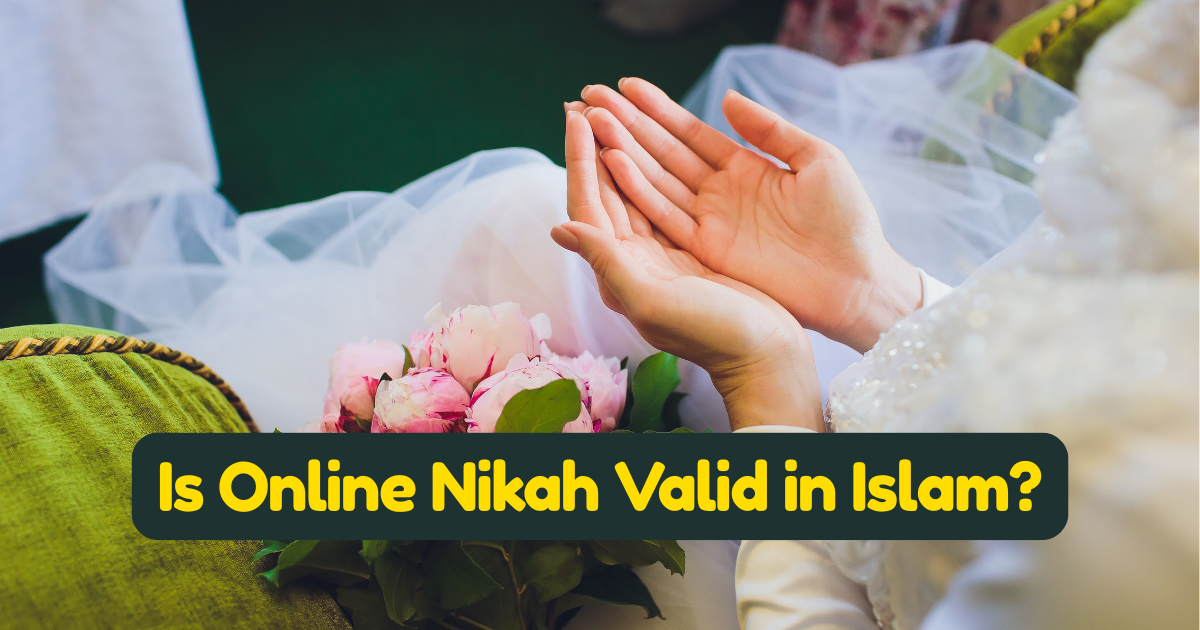
For any Muslim couple thinking about an online nikah, one question comes before everything else: is this genuinely valid in Islam?
It is the right question. A nikah is not a social formality — it is an 'aqd, a binding covenant entered before Allah, with real religious and moral consequences. No couple should go into it with unresolved doubt, and no honest service should ask them to.
The answer, stated plainly: yes, an online nikah is valid in Islam — provided every pillar and condition of the marriage contract is properly fulfilled. This is not a fringe position or a modern convenience fatwa. It is confirmed by multiple global Islamic authorities, grounded in classical fiqh principles, and supported by contemporary scholarly research.
Below is the full evidence.
What Islamic Law Judges — Conditions, Not Location
Classical fiqh has always evaluated the nikah through its pillars and conditions — not through geography or physical arrangement. The requirements identified across all four major Sunni schools are:
- Ijab and Qabul — a clear, unambiguous offer and acceptance
- Two adult Muslim witnesses (Shahidain) — present, attentive, and able to testify
- Wali — the bride's guardian, or a lawfully appointed substitute
- Identity certainty — all parties must be positively identified
- Lawful eligibility — both parties must be free to marry under Islamic law
- A single unbroken session — offer and acceptance cannot be meaningfully separated
The Fatwa Evidence — What Global Scholars Have Said
IslamQA — Online Nikah via Webcam
IslamQA's ruling on online marriage via webcam confirms that a nikah over a verified video connection is permissible when identities are established and witnesses can clearly follow the Ijab and Qabul in real time.
IslamWeb — Cross-Country Nikah Under Hanafi Fiqh
IslamWeb's fatwa on phone nikah under Hanafi fiqh confirms that nikah between parties in different countries using real-time communication is valid under Hanafi jurisprudence when the Shariah conditions are met.
MUIS Singapore — Official Institutional Advisory
MUIS — the Islamic Religious Council of Singapore — formally recognises online nikah ceremonies when the pillars of Islamic marriage are fulfilled. MUIS is a government-level authority, not a private fatwa platform.
Malaysian National Fatwa Council
Malaysia's National Fatwa Council has issued guidance permitting video akad nikah when informed consent is verified and the conditions of the marriage contract are in place.
North American Islamic Scholarship
Scholars at AboutIslam confirm that a Wali's consent given by phone or video call is religiously sound, and that an Imam may lawfully serve as Wali-e-Hakim where the criteria are met.
Academic Fiqh Research — Cardiff University
Research published through Cardiff University confirms that Islamic contracts, including nikah, may be validly concluded online when the legal and religious conditions of the contract are satisfied.
The Wali Question — and What Happens When a Guardian Is Absent or Refuses
The Prophet ﷺ stated, as recorded in Abu Dawood and Tirmidhi:
"If they dispute, then the ruler is the wali for the one who has no wali."
This is the basis of the Wali-e-Hakim. When a Wali is absent, unreachable, or unjustly preventing a lawful marriage, guardianship transfers to a qualified Qazi or Imam acting in that formal capacity. This is established fiqh, recognised across all four Sunni schools, applied by Muslim communities for over a thousand years. In online nikah, the Wali can join via video call from anywhere in the world. If this is not possible or the Wali refuses without legitimate grounds, a qualified scholar formally assumes the Wali-e-Hakim role with full documentation.
What Actually Makes an Online Nikah Invalid
Unverified or absent witnesses. Witnesses must be present on the live call, identifiable, and clearly following the proceedings.
An unqualified officiant. The Imam or Qazi must be a credentialed scholar — not simply someone with religious interest or basic Arabic.
A bypassed Wali requirement. Ignoring or omitting the Wali without a valid Wali-e-Hakim appointment puts the nikah's validity in serious question.
Non-real-time communication. Pre-recorded messages or asynchronous exchanges do not constitute a valid nikah session.
No Mahr agreement. The Mahr must be stated and accepted during the ceremony itself.
A Note on Civil Recognition
Islamic validity and civil legal recognition are separate. A correctly conducted online nikah is a valid Islamic marriage. In the USA, UK, Canada, and most of Europe, a separate civil registration is typically required for full domestic legal standing. A credible provider will be transparent about this distinction and advise on the relevant documentation steps for your country.
Frequently Asked Questions
Is online nikah permissible under Hanafi fiqh?
Yes. IslamWeb has explicitly confirmed nikah between parties in different countries via real-time communication is valid under Hanafi jurisprudence when all conditions are met.
Can witnesses be in a different location?
Yes, provided they are on the live video call, can clearly hear and see proceedings, and their identities are verified.
What if my Wali refuses?
Islamic law provides for the Wali-e-Hakim — a qualified Imam or Qazi who assumes the guardianship role when a Wali unjustly prevents a lawful marriage. This is established by hadith and affirmed across all four Sunni schools.
Which institutions have confirmed online nikah as valid?
IslamQA, IslamWeb, MUIS Singapore, the Malaysian National Fatwa Council, North American scholars via AboutIslam, and Cardiff University academic research — all confirm validity when proper conditions are in place.
The Bottom Line
Islamic law has never been about geography. It has always been about the conditions, intention, and integrity of the contract. The global fatwa evidence is consistent, the classical principles support it, and institutional Islamic authorities at the highest level have confirmed it.
An online nikah is valid in Islam — when it is conducted properly. At InstantNikah.com, every ceremony is built entirely around those conditions: a qualified Imam, verified witnesses, handled Wali process, stated Mahr, and a signed nikah certificate. Speak with one of our scholars before booking — no commitment required.
Admin User
Author