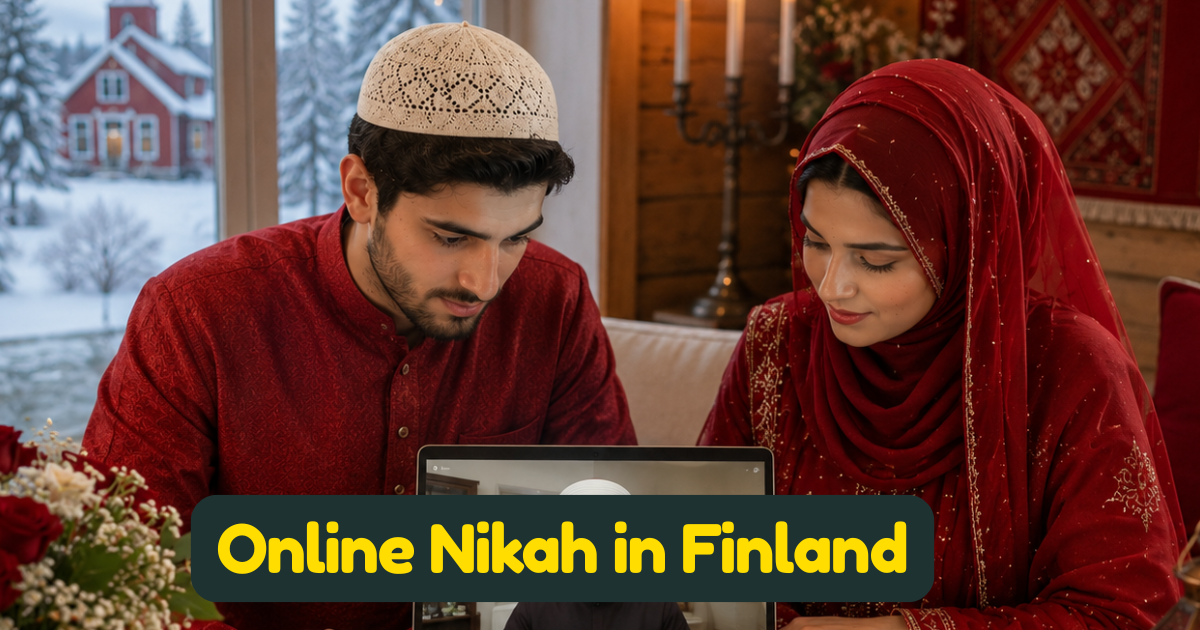
Finland is the quietest corner of Scandinavia when it comes to online Nikah guides — and that silence reflects a genuine gap in the English-language content available to Finland's Muslim community. Around 100,000 Muslims live in Finland today, making up roughly two percent of the population. It is a smaller Muslim community than Sweden, Norway, or Denmark — but it is a genuine, established, and growing one, with specific practical needs that deserve direct and accurate guidance.
The Somali community is the largest — concentrated primarily in Helsinki and its surrounding region, having arrived in significant numbers during the early 1990s following the collapse of the Somali state. Iraqi and Afghan communities followed through subsequent waves of asylum. Moroccan, Egyptian, Turkish, and Pakistani communities are smaller but established. And Finland has a meaningful convert Muslim population — Finnish nationals who have embraced Islam, often through intermarriage or independent religious journey.
For all of them, the question of how to arrange a proper Nikah in Finland has specific answers — some unique to Finland, and some common to the wider Scandinavian pattern.
Finland's Civil Marriage Gateway — The DVV and the Marriage Impediment Investigation
Finland's civil marriage system is administered by the DVV — the Digi- ja väestötietovirasto, or Digital and Population Data Services Agency. Like Sweden's Skatteverket system, Finland's DVV serves as the gateway through which all marriages — civil and religious — must pass before they can legally take place.
As the DVV's official guidance confirms: only after the examination of impediments to the marriage can a ceremony be performed. This examination — the avioliiton esteiden tutkinta in Finnish — checks that there are no legal impediments to the marriage: existing marriage, prohibited relationship, or other civil law barrier. The resulting certificate is valid for four months and must be presented to the officiant — whether civil or religious — before the ceremony can take place.
Finland's most practically distinctive feature in this series is that the entire impediment investigation can be completed online — provided both parties have Finnish BankID credentials. As the Rabita Association's official marriage guidance confirms, the application can be submitted through the DVV's online service using BankID, making Finland one of the most digitally accessible civil marriage systems in Europe.
The process may take several weeks. Couples should apply well in advance of their intended ceremony date.
The Rabita Association — Finland's Islamic Marriage Authority
The Rabita Association (Suomen Islamilainen Yhdyskunta — Rabita) is one of Finland's oldest and most established Islamic organisations, and the one most frequently used by Finnish Muslims for Nikah ceremonies. Rabita's published marriage guidance is unusually transparent about its requirements and approach — and what it says reveals a great deal about how Islamic marriage works in Finland.
Rabita conducts official Islamic marriage contracts — and does so only after the DVV marriage impediment investigation has been completed. The sequence is clear and firm: DVV permit first, then the Islamic contract. Rabita will not conduct an Islamic marriage contract without this permit, or without an official civil marriage certificate where a prior civil marriage has already taken place.
Once the DVV permit is in hand, couples book an appointment with Rabita. The association issues a marriage certificate in both Finnish and Arabic, recording the agreed Mahr. Additional contractual conditions — financial independence for both parties, property arrangements — can be attached to the contract in a signed document registered with the DVV as an avioehto (Finnish marital agreement).
Rabita's position on non-official Islamic contracts is stated plainly: it does not recommend conducting Islamic marriage contracts without completing official procedures first. The stated reason is practical and scholarly — without an Islamic judge registered in the Finnish system, there is no authority to rule in cases of dispute, divorce, or annulment. This reflects a genuine concern for the couple's religious and legal protection, not merely administrative bureaucracy.
When Does a Finnish Nikah Create a Legally Recognised Marriage?
This is the critical question — and Finland's system provides a clear answer.
As DVV's official ceremony guidance confirms: the DVV registers marriages conducted in registered religious communities based on notification made by the officiator. This means that if the Islamic community conducting the Nikah is registered with Finnish authorities as an authorised religious community, the Nikah creates a legally recognised Finnish marriage without a separate civil ceremony — provided the DVV impediment investigation certificate has been obtained first.
Rabita is among the registered religious communities in Finland that can conduct legally recognised marriages under this system. A Nikah at Rabita — after the DVV permit — is simultaneously an Islamic marriage and a legally registered Finnish marriage, recorded in the Finnish Population Information System (väestötietojärjestelmä).
For couples whose Nikah is conducted by an online service — where the officiating Imam is not a registered Finnish religious community leader — the Nikah provides Islamic validity but does not automatically create a legally registered Finnish marriage. Civil registration through the DVV then becomes a separate step.
DVV Civil Marriage — Practical Details
For couples arranging a civil marriage through the DVV directly — either instead of or alongside a Nikah — the process is streamlined and affordable. A civil marriage ceremony at a DVV service location during office hours (weekdays 9:00–16:15) is free of charge. A ceremony outside office hours costs €250, plus the officiator's travel expenses if the ceremony takes place at a venue other than the DVV office.
Both spouses must be physically present at the civil ceremony. Witnesses must be at least 15 years old — but do not need to be Finnish citizens or residents. Witnesses should bring identity documents. The ceremony itself takes only a couple of minutes — a brief, administrative process that creates the legal marriage.
For foreign nationals marrying in Finland, the marital status certificate from the home country must typically be legalised and translated into Finnish, Swedish, or English. Certificates from EU countries generally do not require legalisation if supplemented with the EU 2016/1191 standard form. Nordic country certificates do not require legalisation at all.
Islamic Validity — What Finnish Location Changes and What It Does Not
A Nikah's Islamic validity is determined by the conditions of the contract — not by Finnish civil registration requirements or DVV procedures. A qualified Imam conducting the ceremony via verified live video call, with two adult Muslim witnesses present, proper Wali participation, a clearly stated Mahr, and a complete Ijab and Qabul in a single live session is a fully valid Islamic marriage — whether the ceremony takes place at a mosque in Helsinki or via a secure video call from a home in Tampere.
For Finnish Muslims of Somali heritage following the Shafi'i school — and for those of Iraqi or Arab heritage following the Shafi'i or Hanafi positions — the permissibility of online Nikah is confirmed. IslamQA confirms that a Nikah via verified video call is permissible when identities are established and witnesses follow the ceremony in real time.
Where Online Nikah Serves Finnish Muslim Couples
Despite Finland's relatively well-organised Islamic marriage infrastructure through Rabita and PSIY, specific situations make an external online Nikah service the most practical option for Finnish Muslim couples.
Cross-Border Couples — One Partner Still Overseas
Cross-border marriages are very common across Finnish Muslim communities. A Finnish-resident Somali Muslim marrying a partner still in Mogadishu, or an Iraqi-Finnish family where one partner is still in Baghdad, needs the Islamic marriage completed immediately while Finnish immigration processes run alongside. An online Nikah through InstantNikah.com accommodates both partners joining the live video call from their respective locations. Finland's EET time zone — two hours ahead of the UK, one to two hours behind most Middle Eastern and African countries — makes scheduling manageable.
Muslims Outside Helsinki
While Helsinki has the strongest Islamic infrastructure, Finnish Muslims in Tampere, Turku, Oulu, Jyväskylä, Espoo, and Vantaa — and particularly in smaller Finnish cities across this vast, sparsely populated country — may find access to Rabita or PSIY services geographically challenging. Finland's distances are significant. An online service reaches any Muslim in Finland via video call, regardless of location.
Urgency — Before the DVV Process Is Complete
The DVV impediment investigation may take several weeks. For couples who want to make their relationship halal immediately — while the Finnish administrative process runs its course — an online Nikah provides the Islamic ceremony without delay. The DVV process and civil registration follow when the permit is ready. There is no Finnish law prohibiting a Nikah before the civil process is complete.
Finnish Muslim Converts
Finland's convert Muslim community is small but growing. Finnish converts typically have no established mosque connection and no Muslim male relatives to serve as Wali. The Wali-e-Hakim pathway — where a qualified Imam formally assumes the guardianship role — is handled as standard at InstantNikah.com with proper scholarly assessment. Our complete guide to online Nikah for converts covers every scenario in detail.
The Avioehto — Finland's Marital Contract Provision
Finland has a specific legal instrument that is worth knowing for Muslim couples: the avioehto, or Finnish marital property agreement. Under Finnish marriage law, spouses have reciprocal marital rights to each other's property by default — meaning each spouse has a claim on the other's property in the event of divorce or death. The avioehto is a contract that modifies or excludes this default arrangement.
For Muslim couples, the avioehto is a useful instrument. It can be used to establish financial independence for each spouse — aligning with Islamic principles around the wife's separate financial rights. Rabita specifically notes that contractual conditions including the Mahr and financial independence arrangements can be attached to the Islamic marriage contract and registered with the DVV as an avioehto. Both spouses must sign the avioehto in front of two witnesses, and it must be registered with the DVV to take effect.
Finnish Immigration — Migri and Nikah Documentation
Finland's immigration authority — the Finnish Immigration Service (Maahanmuuttovirasto, Migri) — administers family reunification applications including residence permits for spouses. Migri requires proof of a legally recognised marriage for spousal family reunification. A Nikah certificate from an online service, without corresponding Finnish civil registration, does not satisfy Migri requirements on its own.
The practical pathway for most Finnish Muslim couples is: complete the online Nikah as the Islamic ceremony, obtain the DVV impediment investigation certificate, then complete civil registration to obtain the Finnish marriage certificate for Migri. We strongly recommend consulting a Finnish immigration lawyer before submitting any Migri application.
Frequently Asked Questions
What is the DVV and why does it matter for Nikah in Finland?
The DVV — Digi- ja väestötietovirasto, or Digital and Population Data Services Agency — is the Finnish authority that administers civil registration including marriage. Before any marriage can take place in Finland, the DVV must conduct a marriage impediment investigation (avioliiton esteiden tutkinta). The resulting certificate is valid for four months and must be presented to the officiant before the ceremony. This process can be initiated online using Finnish BankID credentials.
Does the Rabita require civil registration before conducting a Nikah?
Yes — Rabita requires either the DVV marriage impediment investigation permit or an existing civil marriage certificate before conducting an Islamic marriage contract. Rabita does not recommend non-official Islamic contracts before completing official procedures, citing the absence of a registered Islamic judicial authority to handle disputes or divorce in Finland. This policy protects couples — particularly wives — from legal vulnerabilities in unregistered marriages.
Can a Nikah at Rabita create a legally recognised Finnish marriage?
Yes — Rabita is among the registered religious communities in Finland authorised to conduct legally recognised marriages. A Nikah at Rabita, after the DVV permit has been obtained, is registered in the Finnish Population Information System as a legal marriage. No separate civil ceremony is required. This is the most efficient pathway for Finnish Muslims who want both Islamic and civil legal recognition in a single process.
How much does a civil marriage cost at the DVV?
A civil marriage ceremony at a DVV service location during office hours (weekdays 9:00–16:15) is free of charge. A ceremony outside office hours costs €250, plus the officiator's travel expenses if the ceremony takes place at another venue. The DVV ceremony itself lasts only a couple of minutes.
My partner is in Somalia or Iraq. Can we do an online Nikah now?
Yes. An online Nikah through InstantNikah.com accommodates both partners from their respective locations. Finland is in the Eastern European Time zone — two hours ahead of the UK and manageable with most Muslim-majority countries. Both partners join the live video call. The Islamic marriage is valid immediately. The DVV process and Finnish civil registration follow in parallel.
From Helsinki to Rovaniemi — Your Nikah Does Not Have to Wait
Finland is a country of remarkable distances and remarkable digital infrastructure — a land where you can request the start of a marriage process on your phone from a reindeer farm north of the Arctic Circle, and where the tax authority and civil registry are part of the same integrated digital system. That digital accessibility is genuinely useful for Muslim couples navigating a marriage process across time zones and national borders.
An online Nikah through InstantNikah.com gives Finnish Muslim couples the Islamic ceremony immediately — on their timeline, in their language, with a qualified Imam, verified witnesses, and proper Wali process. The DVV and Migri processes follow at their own pace. The two are entirely compatible — and together they give you a marriage that is sound before Allah and registered in the Finnish Population Information System.
InstantNikah.com serves Muslim couples across all of Finland — Helsinki, Espoo, Vantaa, Tampere, Turku, Oulu, Jyväskylä, and beyond. Qualified Imams. Verified witnesses. Complete Wali process. Same-day availability. Speak with our team or book your ceremony — no commitment required until you are ready.
Admin User
Author