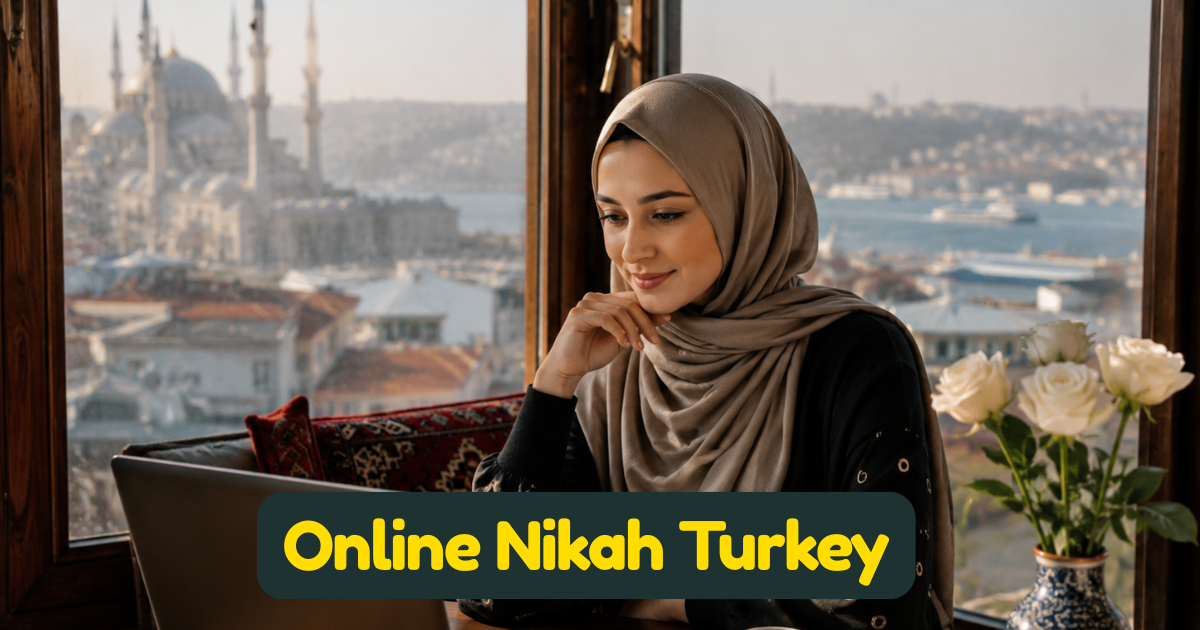
Online Nikah Turkey — Complete Guide for Muslims in Turkey and the Turkish Diaspora
Turkey is one of the most complex and fascinating countries in the world when it comes to the relationship between Islam and the state. It is a Muslim-majority country — over ninety-nine percent of its population identifies as Muslim — governed since the Kemalist reforms of the 1920s by a secular constitutional framework that formally separates civil marriage registration from religious ceremony. It is home to the Diyanet İşleri Başkanlığı — the Directorate of Religious Affairs — one of the largest state Islamic bureaucracies in the world, employing over seventy thousand imams and religious officials across Turkey and maintaining religious services for Turkish Muslim communities in over forty countries. And it is the origin country of one of the largest Muslim diaspora populations in the world — an estimated six to seven million Turkish Muslims living across Western Europe, with particularly large communities in Germany, the Netherlands, France, Belgium, Austria, and Switzerland.
For Turkish Muslims both within Turkey and across the global Turkish diaspora, the question of nikah — of conducting an Islamically valid, properly documented, Shariah-compliant marriage ceremony — sits at a fascinating and sometimes complicated intersection of civil law, religious authority, cultural tradition, and geographic reality. A Turkish Muslim couple in Istanbul must navigate the Turkish civil marriage registration requirement alongside any religious ceremony. A Turkish Muslim couple in Berlin must navigate German civil law, the availability of Diyanet-affiliated imams in Germany, and the Islamic conditions of the nikah itself. And a Turkish Muslim in a long-distance relationship — one partner in Ankara, one in Amsterdam — must find a solution that satisfies both the Islamic requirements and the civil legal frameworks of two different countries simultaneously.
This article provides the complete guide for all of these scenarios — covering the Islamic validity of online nikah for Turkish Muslims, Turkey's civil and religious marriage framework, the Diyanet's role and its diaspora operations, the wali and witness requirements as they apply to Turkish Muslim communities, diaspora-specific guidance across Europe and beyond, and how to proceed with a fully documented Shariah-compliant virtual nikah ceremony through InstantNikah.com.
Turkey's Unique Marriage Framework — Civil Law, Religious Ceremony, and the Diyanet
Understanding Turkey's marriage framework requires understanding the foundational Kemalist reform that has shaped Turkish civil life for a century: the adoption of the Swiss Civil Code in 1926, which established civil marriage registration as the only legally recognised form of marriage under Turkish law. This reform — part of the broader secularisation programme of the early Turkish Republic — created a system in which the nikah, as a religious ceremony, has no civil legal standing in Turkey. Only a civil marriage registered at the local nüfus müdürlüğü (civil registration office) or belediye (municipality) produces legal marriage recognition under Turkish law.
The Turkish Civil Code (Türk Medeni Kanunu — Law No. 4721) governs civil marriage in Turkey and specifies that a civil marriage must precede any religious ceremony. Article 143 of the Turkish Civil Code explicitly prohibits religious marriage ceremonies from being conducted before the civil marriage has been legally concluded. A religious officiant who conducts a religious ceremony before the civil marriage has been registered commits a criminal offence under Turkish law — and the couple who participate in a religious-only ceremony without prior civil registration are similarly in breach of Turkish civil law.
This means that for Turkish Muslims within Turkey, the sequence is legally mandated: civil registration at the nüfus müdürlüğü or belediye first, followed by any religious nikah ceremony. The civil marriage produces the legal standing; the nikah provides the Islamic validity and the religious dimension of the marriage.
The Diyanet İşleri Başkanlığı — established in 1924 and operating under the Turkish Prime Ministry — manages the religious dimensions of this framework within Turkey. Diyanet imams conduct the nikah ceremony after civil registration, following a standardised procedure that ensures the Islamic conditions of the nikah are met within the Hanafi tradition that dominates Turkish Muslim practice. The Diyanet's nikah procedure includes the recitation of the khutbah al-nikah, the confirmation of the wali's involvement, the specification of the mahr, the ijab and qabool conducted in the presence of two witnesses, and the du'a for the couple.
Is Online Nikah Islamically Valid for Turkish Muslims?
The Islamic validity of an online nikah — conducted through a live, simultaneous video call with all five conditions properly met — is determined by classical jurisprudence and is entirely independent of the Turkish civil law framework or the Diyanet's institutional procedures. A nikah conducted online is Islamically valid if and only if all five conditions are properly met — regardless of whether the ceremony was facilitated by a Diyanet imam, an independent scholar, or a qualified international Islamic service like InstantNikah.com.
The five universally recognised conditions of a valid nikah across all four major Sunni schools are:
- A willing bride whose consent is genuine, fully informed, and entirely free from any form of coercion.
- A willing groom whose consent is similarly genuine and freely given.
- The wali — the bride's guardian — who makes the offer (ijab) on her behalf, or whose properly appointed wakeel does so in his place.
- Two witnesses — adult Muslim males of sound character — present and aware of the ijab and qabool at the time they occur.
- The mahr — the mandatory financial gift from the groom to the bride — specific, agreed, and recorded in the nikah contract.
Turkish Muslim practice follows the Hanafi school of jurisprudence — the dominant madhhab of the Ottoman world and the tradition maintained by the Diyanet. Under Hanafi fiqh, the majority contemporary scholarly position holds that a live, simultaneous video connection satisfies the simultaneity requirement of the ijab and qabool, provided all parties can clearly see and hear each other in real time and all five conditions are properly met. This position is consistent with the broader contemporary scholarly consensus on video call nikah.
The comprehensive scholarly analysis of this ruling — including the Hanafi school's specific approach — is covered in the dedicated articles on whether online nikah is valid in Islam and whether nikah can be done over Zoom or video call.
When Do Turkish Muslims Need an Online Nikah Service?
Given Turkey's well-developed Diyanet network within the country, the most common scenarios in which Turkish Muslims seek an online nikah service through InstantNikah.com involve one or more of the following circumstances:
One or Both Parties Are in the Turkish Diaspora Abroad
The most common scenario. A Turkish Muslim in Germany, the Netherlands, France, Belgium, Austria, or Switzerland — in a long-distance relationship with a partner in Turkey or elsewhere — needs a properly conducted nikah that can be arranged without requiring both parties to travel to Turkey for the ceremony. The online nikah allows the ceremony to proceed with all parties connected through a live video call regardless of their physical locations.
Cross-Border Relationships Between Turkish and Non-Turkish Muslims
Turkish Muslims in relationships with partners from other Muslim communities — Arab, South Asian, Southeast Asian, or convert Muslims — frequently find that accessing a local imam in their European country of residence who speaks Turkish and understands Turkish Muslim cultural expectations is difficult. An internationally qualified online Islamic service bridges this gap — conducting the ceremony in a format that meets the Islamic conditions fully regardless of the cultural backgrounds of the parties involved.
Urgency — Same Day or Express Nikah Needed
Turkish Muslims in urgent circumstances — whether driven by health, travel, visa, or other pressing situations — may need a properly documented nikah arranged and conducted within hours rather than days. InstantNikah.com's Same Day Nikah and Instant Nikah packages provide exactly this — a fully valid, properly documented Shariah-compliant nikah conducted on the same day as booking.
Privacy and Discretion
Some Turkish Muslim couples — particularly those navigating family opposition, cultural pressures, or circumstances they wish to manage privately before announcing to their families — prefer a discreet online nikah conducted without the involvement of community networks or local mosque congregations. The online nikah provides this privacy while maintaining full Islamic validity and complete documentation. The dedicated article on private online nikah and discreet ceremony guidance addresses this scenario in full detail.
The Diyanet Abroad — Turkish Religious Services in the European Diaspora
The Diyanet İşleri Türk İslam Birliği — DITIB — is the primary organisation through which Turkey's Directorate of Religious Affairs manages religious services for Turkish Muslim communities in Germany and beyond. DITIB operates hundreds of mosques across Germany, the Netherlands, Belgium, France, Austria, and Switzerland — providing Friday prayers, religious education, and — importantly — nikah ceremony services for Turkish diaspora communities through its network of Diyanet-affiliated imams.
For Turkish Muslims in major European cities with established DITIB mosque networks, the DITIB imam provides the most institutionally familiar route for a nikah conducted within the Turkish Muslim tradition. However, the DITIB network has significant geographic limitations — it is strongest in cities with large established Turkish communities (Berlin, Hamburg, Cologne, Frankfurt, Amsterdam, Brussels, Vienna) and considerably thinner in cities with smaller Turkish populations or in countries with smaller Turkish diaspora communities.
For Turkish Muslims in European cities where DITIB coverage is limited, in countries with very small Turkish communities, in long-distance relationships that span multiple countries, or in situations requiring greater speed or privacy than a DITIB mosque arrangement allows, an online nikah service provides the most accessible and reliably documented alternative — conducting a ceremony that meets all the same Islamic conditions as a Diyanet-facilitated nikah through a qualified international Islamic scholar.
The Wali Requirement for Turkish Muslim Women
Turkish Muslim practice — rooted in the Hanafi school — takes a nuanced position on the wali requirement that differs from the strict validity condition position of the Shafi'i school. Under classical Hanafi fiqh, an adult Muslim woman of sound mind may — under certain scholarly positions — contract her own nikah without a wali, though the wali's involvement is strongly recommended and considered the preferred practice. The Diyanet's nikah procedure in Turkey incorporates the wali as part of the standard ceremony — reflecting the cultural importance of the wali even where Hanafi fiqh provides the theoretical flexibility of his absence.
For Turkish Muslim women seeking an online nikah, the wali's involvement is strongly encouraged and should be incorporated into the ceremony where possible — either through his physical presence at the bride's location during the video call, or through his participation directly in the video call from his own location. A Turkish father in Ankara, an uncle in Istanbul, or a brother in Frankfurt can all participate fully in the ceremony through the live video connection.
For Turkish Muslim women whose wali is genuinely unavailable — through death, incapacity, or genuine inability to contact — a wali hakim appointment through a qualified Islamic scholar provides the alternative pathway. The dedicated articles on online nikah without a wali and what happens if the wali refuses the nikah address these scenarios in full detail. The wakeel mechanism — appointing an authorised representative to make the ijab on the wali's behalf — is covered in the article on what a wakeel is in nikah and how to appoint one.
The Witness Requirement for Turkish Muslims
Two adult Muslim male witnesses of sound character are required for a valid nikah under all four major Sunni schools. For Turkish Muslims in Turkey or in European cities with large Turkish Muslim communities, finding two qualified Muslim male witnesses is generally straightforward. For Turkish Muslims in cities or countries with smaller Muslim communities — or in long-distance nikah scenarios where the witnesses need to connect remotely — the online format accommodates witnesses participating through the live video call from any location.
Witnesses can be physically present at the bride's or groom's location during the video call, or connected through the video call from their own locations — whether in Turkey, Germany, the Netherlands, or any other country. The important requirement is that they are genuinely present in the sense of being aware of the contract being formed and able to attest to it — which a live video connection satisfies. Questions about female witnesses and non-Muslim witnesses are addressed in the dedicated articles on whether a woman can be a witness at nikah in Islam and whether a non-Muslim can be a witness at nikah.
The Mahr in Turkish Muslim Culture and Islamic Law
Turkish Muslim culture has its own traditions surrounding the mahr — known in Turkish as mehr — that have evolved within the Hanafi tradition over centuries of Ottoman and Republican-era practice. The mehr in Turkish Muslim tradition is typically a specified amount of gold or currency — often quoted in terms of gold coins (altın) — agreed between the families and recorded in the nikah documentation. It is understood as the bride's exclusive financial entitlement — not a payment to the family, not a negotiated exchange, but the bride's right as established by Islamic law.
In the Diyanet's standard nikah procedure within Turkey, the mehr amount is recorded as part of the nikah documentation alongside the civil marriage registration. For Turkish Muslims conducting a nikah through InstantNikah.com, the mahr amount and its terms — both prompt and deferred components — are confirmed and documented as part of the nikah contract, ensuring the Islamic requirement is fully and clearly met regardless of the ceremony's format.
The comprehensive framework of mahr — including appropriate amounts, documentation, and consequences — is covered in the dedicated articles on what mahr is in nikah and how much mahr is enough in Islamic law.
Turkish Muslims in Europe — Country-Specific Guidance
Turkish Muslims in Germany
Germany is home to the largest Turkish Muslim diaspora community in the world — estimated at three to four million, making it the single largest Turkish Muslim community outside Turkey itself. DITIB operates hundreds of mosques across Germany and provides nikah ceremony services through its network of Diyanet-affiliated imams. For Turkish Muslims in major German cities — Berlin, Hamburg, Munich, Cologne, Frankfurt, Stuttgart, Dortmund — DITIB provides the most institutionally familiar route for a nikah conducted within the Turkish Muslim tradition.
For Turkish Muslims in smaller German cities, in urgent situations, in cross-border long-distance relationships, or seeking greater privacy than a mosque ceremony provides, an online nikah through InstantNikah.com provides a fully Shariah-compliant alternative. A German civil marriage registration is separately required for civil legal spousal rights in Germany — the nikah and the civil registration are parallel and complementary processes. The full guidance on online nikah in Germany covers the German civil law dimension in detail.
Turkish Muslims in the Netherlands
The Netherlands has one of the largest Turkish Muslim communities in Western Europe — estimated at four to five hundred thousand, concentrated primarily in Rotterdam, Amsterdam, The Hague, and Utrecht. DITIB-affiliated mosques operate across the Netherlands providing nikah services for the Turkish Muslim community. For Turkish Muslims in the Netherlands in long-distance relationships, urgent situations, or seeking online ceremony options, the dedicated article on online nikah in the Netherlands provides full civil law guidance, and InstantNikah.com's service is fully accessible from any location in the Netherlands.
Turkish Muslims in France
France has a Turkish Muslim community of approximately five hundred thousand — concentrated in Paris, Lyon, Strasbourg, and other major cities. The Turkish-French Muslim community is served by both DITIB-affiliated mosques and by the Millî Görüş network — another Turkish Islamic organisation with significant mosque presence across France. For Turkish Muslims in France navigating civil marriage alongside nikah, France's laïcité framework means that only a civil marriage at the mairie produces legal recognition — the nikah carries no civil legal weight. The dedicated article on online nikah in France covers the French civil law dimension.
Turkish Muslims in Belgium and Austria
Belgium and Austria each have significant Turkish Muslim communities — estimated at approximately two hundred and fifty thousand and three hundred thousand respectively — served by DITIB and related Turkish Islamic organisations. For Turkish Muslims in these countries, dedicated guidance is available through the articles on online nikah in Belgium and online nikah in Austria.
Turkish Muslims in the UK, USA, Canada, and Australia
Turkish Muslim communities in English-speaking countries — the United Kingdom, United States, Canada, and Australia — are smaller in absolute numbers than the continental European diaspora but represent a significant and growing presence. For Turkish Muslims in these countries, the DITIB network is less developed than in continental Europe, making an online nikah service a particularly relevant and practically accessible option. Dedicated civil law guidance is available through the articles on online nikah in the UK and online nikah in the USA.
Civil Marriage Registration for Turkish Muslims Abroad
For Turkish Muslims living abroad who wish their marriage to be recognised under Turkish civil law — which may be relevant for inheritance, property rights, and family law matters in Turkey — the marriage must either be conducted through civil registration in Turkey itself, or registered at the nearest Turkish consulate abroad if it was civilly conducted in the country of residence.
The Turkish consulate abroad can register a civil marriage conducted in the country of residence onto the Turkish civil register — provided the necessary documentation is submitted and the marriage complies with Turkish civil law requirements. Turkish nationals living abroad should contact their nearest Turkish consulate for the specific documentation requirements applicable to their situation and country of residence.
For the Islamic nikah specifically — as distinct from the civil marriage — a nikah conducted through InstantNikah.com produces an Islamic nikah certificate that documents the Islamic ceremony fully. This certificate can be presented to the Turkish consulate or to a Diyanet-affiliated institution as evidence of the Islamic ceremony alongside any civil marriage documentation, depending on the administrative requirements of the specific situation.
Turkish Muslim Converts and Non-Turkish Spouses
An increasingly common scenario for Turkish Muslims — particularly in the diaspora — involves marriage to a non-Turkish Muslim spouse, or to a non-Muslim who has taken their shahada and converted to Islam before the nikah. For Turkish Muslim men marrying Muslim women from other ethnic and national backgrounds, the online nikah provides a neutral, internationally qualified ceremony that accommodates both the Turkish Muslim husband's Hanafi tradition and the wife's own cultural and scholarly background.
For Turkish Muslim women marrying Muslim converts — a scenario that raises specific questions about the convert's wali, the appropriate school of fiqh to apply, and the documentation requirements — qualified scholarly guidance is essential. The dedicated article on how a Muslim convert can find a wali for nikah addresses the wali question for converts specifically. The article on online nikah for converts covers the broader framework for convert marriages.
Protecting Rights in the Nikah Contract — Guidance for Turkish Muslim Women
Turkish Muslim women — whether in Turkey or in the diaspora — have the full Islamic right to include binding protective conditions in their nikah contract. From a condition protecting against a second wife being taken without consent, to the delegated right of self-divorce through tafwid al-talaq, to conditions protecting the right to continue working or studying and preventing relocation without consent — these rights are fully available under Islamic law and can be incorporated into any nikah conducted through InstantNikah.com.
For Turkish Muslim women in diaspora countries where civil marriage is also registered, Turkish civil family law and the civil law of the country of residence provide additional frameworks of spousal financial rights enforceable through civil courts. The combination of Islamic contractual protection through the nikah contract and civil legal protection through the relevant country's civil marriage registration provides the strongest available legal framework.
The comprehensive guide on protective conditions in the nikah contract for Muslim women explains every available protective condition in detail. The article on financial protection before nikah provides broader context on the financial dimensions of pre-nikah planning.
Common Questions Turkish Muslims Ask About Online Nikah
Is an online nikah conducted through InstantNikah.com recognised by the Diyanet?
An online nikah conducted through InstantNikah.com is Islamically valid as a nikah contract — it meets all five classical conditions of a valid nikah under Hanafi fiqh. It is not a Diyanet-issued certificate and is not part of the Diyanet's institutional registration system. For Turkish Muslims within Turkey who wish their nikah to be registered through the Diyanet's system, the standard Diyanet procedure — following civil registration at the nüfus müdürlüğü — is the appropriate route. For Turkish Muslims abroad or in circumstances where the Diyanet procedure is inaccessible, the InstantNikah.com ceremony provides a fully documented alternative with complete scholarly oversight.
Does the civil marriage in Turkey need to happen before the online nikah?
Under Turkish law, the civil registration must precede any religious ceremony within Turkey. For Turkish Muslims conducting their nikah through an international online service while abroad — outside Turkish territory — this Turkish civil law requirement does not apply to the foreign ceremony itself. However, Turkish nationals who wish their marriage to be registered in Turkey should ensure they comply with the Turkish civil registration requirements applicable to their specific situation — either through a civil ceremony in Turkey or through registration at the Turkish consulate in their country of residence.
Can my wali participate from Turkey if I am abroad?
Yes — the wali participates in the online nikah ceremony through the live video call from Turkey while all other parties are connected from Europe or elsewhere. This arrangement is fully accommodated within every ceremony facilitated by InstantNikah.com and requires only a stable internet connection on the wali's end in Turkey.
How quickly can a ceremony be arranged?
Through InstantNikah.com's Same Day Nikah and Instant Nikah packages, a ceremony can be arranged and conducted within hours of booking. Turkey's time zone (TRT — UTC+3) is well-positioned for coordinating ceremonies with parties across Europe (one to three hours behind) and the Middle East (same or nearby zone) within practical hours for all participants.
What documentation will I receive?
Every nikah conducted through InstantNikah.com produces a fully documented Islamic nikah certificate recording all parties' details, the wali's involvement, the witnesses' confirmation, the mahr amount and terms, the date and format of the ceremony, and the officiating scholar's credentials. This certificate serves as evidence of the Islamically valid ceremony for community recognition, Islamic arbitration purposes, and as documentation that can be presented alongside civil marriage documentation in relevant administrative contexts.
Turkey's Ottoman Islamic Heritage and Contemporary Muslim Practice
Turkey's relationship with Islamic marriage is one of extraordinary historical depth. The Ottoman nikah tradition — refined over six centuries of Islamic jurisprudence, state administration, and cultural practice across a vast empire — produced some of the most sophisticated frameworks for Islamic family law, marriage documentation, and religious ceremony ever developed in the Muslim world. The Ottoman kadis who conducted nikah ceremonies across the empire from the fifteenth to the twentieth century were among the most rigorously trained Islamic legal scholars of their era — and the Hanafi tradition they maintained continues as the living Islamic heritage of Turkish Muslim communities today.
The Kemalist civil law reforms separated civil marriage registration from this religious tradition — but they did not eliminate it. The nikah continues to be conducted by Diyanet imams across Turkey and by Turkish Muslim religious leaders across the global diaspora as a living expression of the Ottoman Islamic heritage that shaped Turkish Muslim identity over centuries. Conducting a properly documented, Shariah-compliant nikah — whether in Istanbul, Berlin, Amsterdam, or through a live video call that connects parties across continents — is an act of participation in that living tradition.
How to Proceed With an Online Nikah Through InstantNikah.com
The process for Turkish Muslims conducting an online nikah through InstantNikah.com is fully guided from start to completion:
- Select your service package — choose between Instant Nikah, Express Nikah, Same Day Nikah, or Essential Nikah depending on your timeline and specific circumstances.
- Provide the required information — full names and identification details of both parties, wali details and his relationship to the bride, witness names and locations, and the agreed mahr amount with its prompt and deferred terms clearly specified.
- Schedule the ceremony — the InstantNikah.com team coordinates the live video call at a time that works for all parties across their respective locations. Turkey's time zone (TRT — UTC+3) facilitates scheduling with parties across Europe, the Middle East, and South Asia within practical hours for all participants.
- Attend the ceremony — a qualified Islamic scholar facilitates the full nikah ceremony over the live video call — delivering the khutbah al-nikah, verifying all five conditions, guiding the ijab and qabool, confirming the mahr terms, and leading the du'a for the couple.
- Receive your nikah certificate — the complete documentation is produced and provided to both parties following the ceremony.
You can review the full nikah process, read verified client reviews, or explore the gallery of ceremonies. To proceed, book your nikah directly through packages including Instant Nikah, Express Nikah, Same Day Nikah, and Essential Nikah. For specific questions — including wali arrangements, witness logistics, or documentation needs — the team is available to assist directly.
Admin User
Author