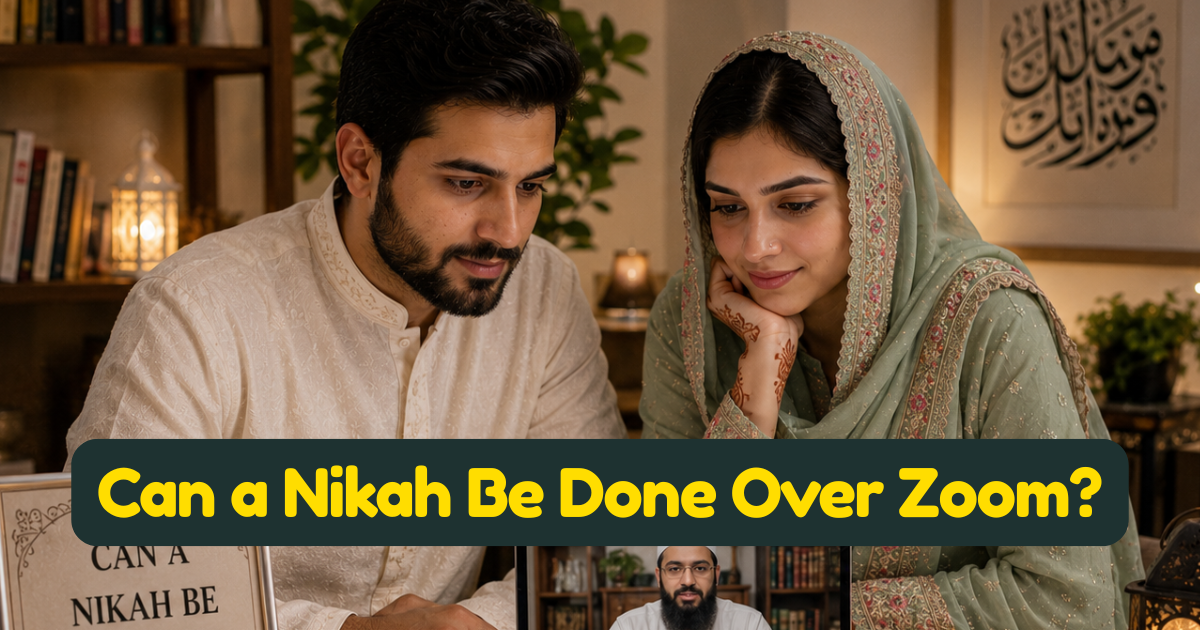
Can a Nikah Be Done Over Zoom? Islamic Rulings on Video Call Nikah and What Scholars Actually Say
Geography has always tested the boundaries of Islamic legal reasoning. A merchant in medieval Basra appointing a wakeel to marry on his behalf in distant Baghdad. A scholar ruling on a contract signed by letter and carried across desert trade routes. Islamic jurisprudence has never been static in the face of distance — it has always found principled ways to apply its foundational conditions to the realities of how people actually live.
Today, the question is different in technology but identical in spirit: can a nikah be conducted over Zoom, Google Meet, Microsoft Teams, or any other live video platform — and if so, is it genuinely valid in Islamic law?
This is not a fringe question. Millions of Muslims around the world live in countries different from their prospective spouses. Students in the United Kingdom, workers in Germany, professionals in the United States, families separated between Pakistan and Canada — for all of them, the video call nikah is not a theoretical curiosity. It is the most practical path to a lawful marriage. And the answer Islamic scholarship gives them matters enormously.
Starting From the Right Question
Most discussions of video call nikah begin in the wrong place — asking whether Zoom specifically is mentioned in Islamic sources, or whether the scholars of the past permitted it. Neither question is useful. Classical scholars could not have anticipated Zoom any more than they anticipated the telephone, the telegram, or the aeroplane.
The right question — the one that yields a principled, scholarly answer — is this: does a nikah conducted over live video satisfy the essential conditions that Islamic law has always required for a marriage to be valid? That question can be answered rigorously, because those conditions are clearly established, and because a video call's specific properties can be evaluated against each of them systematically.
The Essential Conditions of a Valid Nikah: A Precise Recap
Before evaluating whether Zoom satisfies these conditions, they must be stated precisely. Across all four major schools of Islamic jurisprudence, the following are the conditions a nikah must meet to be valid:
- Ijab and Qabool — a clear, unambiguous offer and acceptance, exchanged in a single continuous sitting without significant interruption
- Two qualified Muslim witnesses — adult, sane, Muslim, and able to hear and comprehend both the offer and the acceptance simultaneously
- The wali — the bride's guardian, whose involvement is required by the Shafi'i, Maliki, and Hanbali schools and strongly recommended in the Hanafi school
- Mahr — a defined gift from the groom to the bride, agreed upon as part of the contract
- The absence of legal impediments — no unexpired iddah, no impermissible degree of relation, no existing binding marriage that prohibits remarriage
These are the conditions against which the video call nikah must be evaluated. The question is not whether Zoom is modern or unusual. The question is whether a properly conducted video ceremony can satisfy each of these conditions in substance — not merely in form.
How Video Call Nikah Differs From Phone Nikah: A Legally Critical Distinction
Understanding why video call nikah is treated differently from phone nikah by many contemporary scholars is the first step to understanding the scholarly debate properly.
A telephone call is audio only. It cannot verify identity visually. Witnesses on one end of the call hear a voice they cannot confirm belongs to the person they believe they are witnessing. The unity of the gathering is purely auditory — fragile and unverifiable.
A live video call — Zoom, Google Meet, Skype, WhatsApp Video, FaceTime — is fundamentally different in three legally significant ways:
- Visual identity verification: All parties can see each other simultaneously. The bride is visible to the witnesses and the qazi. The groom is visible. Identity cannot be substituted without detection.
- Simultaneous audio-visual presence: All parties see and hear each other in real time. The ijab spoken by one party is heard and observed by all others simultaneously — including the witnesses — creating a shared experiential moment analogous to a shared physical space.
- Recordability and documentation: A video call can be recorded, timestamped, and preserved — providing documentary evidence of the ceremony that a phone call or in-person gathering without recording cannot always supply.
These three properties are not cosmetic differences. They address the two core objections scholars have always raised about remote ceremonies: identity uncertainty and witness limitation. A properly structured video nikah largely eliminates both.
What the Four Madhabs Say About Remote Presence
Classical scholars discussed the question of absent parties through the framework of the wakeel — the formally authorised representative who attends in person on behalf of an absent party. The possibility of a remote party directly participating in a contract was not a scenario they addressed. But their reasoning about what the witnessing and presence conditions are designed to achieve tells us a great deal about how those principles apply to live video.
The Hanafi School
The Hanafi school requires that the ijab and qabool occur in a single uninterrupted sitting — a majlis — with witnesses present and able to hear both clearly. The school's emphasis is on the unity and clarity of the exchange, and on the witnesses' ability to testify to what they directly perceived.
Contemporary Hanafi scholars who have addressed video nikah have generally reasoned that a live video call — where all parties can simultaneously see and hear each other — constitutes a constructive unity of session. The majlis, in this understanding, is defined by the shared, simultaneous engagement of the parties — not by their physical location in the same room. Some senior Hanafi scholars have accepted this reasoning. Others have maintained that physical co-location remains the ideal, though they have acknowledged the video ceremony as a reasonable accommodation in cases of genuine need.
The Shafi'i School
The Shafi'i school is generally stricter on presence requirements. It requires the witnesses to be physically present in the same gathering as the contracting parties and able to directly perceive the ijab and qabool. This stricter interpretation creates more tension with video nikah — because even on a video call, the witnesses and one of the parties are not physically co-located.
Some contemporary Shafi'i scholars have maintained that physical presence cannot be substituted by video presence and that the safest course remains appointing a wakeel who attends in person. Others, particularly those addressing the practical realities of Muslim minority communities in the West, have acknowledged that the maqasid — the higher objectives of Islamic law, including protecting the institution of marriage and preventing unlawful relationships — may support accommodating video ceremonies when all other conditions are strictly met.
The Maliki School
Maliki fiqh places strong emphasis on the public and non-secret character of the nikah, and on the wali's active role. Contemporary Maliki scholars addressing video nikah have generally focused on whether the visual and audio clarity of the call is sufficient to constitute genuine witnessing. Where the video quality is high, the parties are clearly identified, and the witnesses can see and hear everything without ambiguity, many Maliki scholars have been more open to accepting the video ceremony as valid. Their primary concern remains the deliberate concealment scenario — a properly structured video ceremony with qualified oversight is not concealment.
The Hanbali School
Hanbali scholars have generally approached modern technology questions through the lens of maslaha — public benefit and harm prevention. Where a video nikah prevents unlawful relationships, protects women's rights, and fulfils all conditions of the contract, Hanbali scholars have tended toward accommodation. The school's emphasis on preventing harm and preserving the institution of marriage supports a pragmatic approach to technology-mediated ceremonies when conducted under proper Islamic oversight.
What Major Global Scholarly Institutions Have Concluded
Dar al-Ifta al-Misriyyah — Egypt's official government fatwa authority — has addressed the question of video-mediated contracts and marriage ceremonies in the modern context. Their position acknowledges that live video communication, where both visual and audio channels function simultaneously and clearly, creates a qualitatively different situation from a phone call or written communication. While emphasising that all conditions of the nikah must be strictly met, Dar al-Ifta has noted that a properly conducted video ceremony supervised by a qualified scholar is far closer to the classical requirements than a phone-only ceremony — and that the conditions of certainty and witness verification are meaningfully addressed by live video in a way that audio-only communication cannot achieve.
Al-Azhar University, whose scholars are consulted on Islamic jurisprudential questions by Muslim communities across the world, has engaged with the question of modern technology and Islamic contracts. Al-Azhar's broader jurisprudential framework — rooted in the classical tradition but attentive to the maqasid al-Shariah — supports the view that technology which allows simultaneous, verified, audio-visual communication between all parties can satisfy the spirit and substance of the presence and witnessing conditions, particularly when qualified Islamic oversight is in place.
In the United Kingdom, the Muslim Council of Britain (MCB) has increasingly encountered the practical reality of British Muslims seeking to marry spouses in other countries, or to conduct ceremonies when key participants cannot travel. The MCB's guidance has evolved to acknowledge that qualified scholars and imams facilitating video-based nikah ceremonies — where conditions are carefully met and proper documentation is issued — represent a legitimate and Islamically grounded response to the realities of modern Muslim life in Britain and across Europe.
In the United States, the Islamic Society of North America (ISNA) has noted in its guidance for American Muslims that the increasing diversity of nikah arrangements — including those involving couples in different states or countries — requires qualified Islamic oversight and clear documentation regardless of the medium. ISNA scholars have emphasised that the conditions of the nikah are what determine validity, and that a video-facilitated ceremony supervised by a qualified scholar who ensures all conditions are met represents a sound approach for American Muslim couples in genuinely cross-border situations.
The Islamic Fiqh Academy of the Organisation of Islamic Cooperation (OIC) has addressed the general question of contracts conducted through modern communication technology in several of its resolutions. Their framework distinguishes between asynchronous communication — letters, recorded messages, emails — and synchronous live communication, where all parties engage simultaneously. The OIC Fiqh Academy's reasoning supports the view that synchronous, verified, live communication creates a qualitatively different contractual situation — one that more closely approximates the classical in-person contract than asynchronous alternatives.
In Germany, the Zentralrat der Muslime in Deutschland (Central Council of Muslims in Germany) — one of the leading representative bodies for Germany's approximately five million Muslims — has engaged with questions of Islamic marriage practice for German Muslims, many of whom face cross-border marriage situations involving spouses in Turkey, Arab countries, or South Asia. Their guidance has acknowledged the role of qualified online Islamic services in facilitating properly conducted ceremonies for German Muslims who cannot access traditional in-person arrangements.
The Conditions a Video Call Nikah Must Meet to Be Valid
For scholars and institutions who accept video nikah as valid — whether fully or conditionally — there is a consistent set of requirements that must be satisfied. These are not additions to the Islamic conditions of nikah. They are specifications of how those classical conditions must be fulfilled in a video-based ceremony to retain their legal substance.
1. Live, Simultaneous Connection
The video call must be live — not recorded and played back, not asynchronous, not split across separate calls at different times. All parties — both spouses, the wali, and the two witnesses — must be connected simultaneously in a single session. The unity of the majlis in a video nikah is defined by the live, shared, real-time nature of the session.
2. Clear Audio and Visual Quality
The connection must be sufficiently clear that the witnesses can see and hear both the ijab and the qabool without ambiguity. A pixelated, buffering, or intermittently disconnecting call does not meet this standard. The clarity of perception is directly tied to the quality of the witnesses' testimony — they must be able to say with certainty what they saw and heard.
3. Visual Identity Verification
All parties must be visually identified at the start of the session. The qazi or presiding scholar should confirm the identity of both the bride and groom — ideally through a combination of visual identification, name confirmation, and any documentation the service requires prior to the ceremony.
4. Qualified Islamic Oversight
A knowledgeable Muslim scholar — an online qazi or imam with the appropriate training — must preside over the ceremony. He must be present throughout, confirm all conditions are met, facilitate the ijab and qabool correctly, confirm the mahr, and oversee the witnesses' participation.
5. Two Qualified Witnesses Present and Engaged
Two adult, Muslim, sane witnesses must be present on the call and actively attentive throughout the ijab and qabool. They must be able to hear and see both parties clearly. They must not be distracted or absent during the exchange. Their presence and attention must be confirmed before the ceremony proceeds.
6. Wali Involvement
The bride's wali must be present and active in the ceremony — whether physically co-located with the bride or participating via the video call. His role must be properly fulfilled: he must speak on behalf of the bride, confirm her consent, and participate in the contract as the classical conditions of his school require.
7. Mahr Agreed and Recorded
The mahr must be clearly stated, agreed upon by both parties, and formally recorded in the nikah documentation. It must not be vague, deferred indefinitely without specification, or omitted.
8. Formal Documentation Issued
A nikah certificate recording the names of both parties, the witnesses, the wali, the mahr, the date, and the presiding scholar must be issued after the ceremony. This documentation is not merely bureaucratic. It is the evidence of the marriage's existence and the parties' rights.
What Happens If the Call Drops During the Nikah?
This is a practical concern that many couples raise — and it deserves a clear answer. If the video connection drops during the ijab and qabool — meaning the witnesses lose sight or sound of one of the parties during the actual exchange — the ceremony should be paused and restarted from the beginning once the connection is restored. The unity of the session requires that all parties be simultaneously connected throughout the entire exchange.
A connection drop before the ijab and qabool begins, or after it is complete, does not affect the ceremony's validity if everything else was properly conducted. But a drop mid-exchange creates genuine doubt about whether the conditions were fully met — and caution requires restarting rather than proceeding on the assumption that enough was heard and seen.
This is one of the reasons why using a professional online nikah service — rather than conducting a video nikah informally — provides an important layer of protection. A qualified qazi knows exactly when conditions have been met and when the ceremony must be paused, restarted, or restructured.
Is a Zoom Nikah Legally Recognised in Civil Law?
This is a separate question from Islamic validity — and it is equally important for couples to understand clearly.
In most Western jurisdictions, a religious ceremony conducted over video — like any religious ceremony — does not automatically carry civil legal standing. In England and Wales, the UK Government's official guidance on marriages and civil partnerships makes clear that religious ceremonies must be conducted in approved premises by an authorised person to be civilly registered — and video ceremonies do not currently meet those requirements under English law. The same general principle applies across most of Europe and North America.
This means that a video nikah may be fully valid in Islamic law while requiring a separate civil registration process to achieve legal recognition in the country where the couple resides. Whether civil registration is necessary depends on the couple's specific needs, their jurisdiction, and what legal protections they wish their marriage to carry.
Couples should be clearly informed of both layers — the Islamic validity of the ceremony and the civil registration question — so they can make fully informed decisions about what additional steps their situation requires.
The Practical Wisdom: Why Professional Islamic Oversight Matters
Even where video nikah is accepted as valid — and even where every condition is theoretically understood by the couple — the practical wisdom of having a qualified scholar preside cannot be overstated.
Couples who conduct video nikahs informally — without a qazi, without confirmed witnesses, without formal documentation — may believe they have fulfilled the conditions when they have not. The ijab and qabool may be worded ambiguously. The witnesses may not be paying full attention. The mahr may not be clearly specified. The wali may not have spoken his role correctly. These are not hypothetical errors. They are the mistakes that happen when people who care deeply about their marriage conduct it without the guidance of someone who knows exactly what is required.
A qualified online qazi's role is precisely to prevent these mistakes — to ensure that the conditions are not just present in theory but correctly executed in practice, and that the documentation that follows accurately reflects what occurred.
How InstantNikah.com Conducts Shariah-Compliant Video Nikah Ceremonies
At InstantNikah.com, every ceremony is conducted by a qualified online qazi through verified live video. The session is structured specifically to meet each of the conditions scholars have identified as essential for a valid video nikah: simultaneous live connection, visual identity verification, qualified Islamic oversight, confirmed witness presence, proper ijab and qabool, mahr agreement, and full formal documentation including a nikah certificate issued after the ceremony.
For couples in the UK, Germany, the USA, Canada, Australia, the UAE, and across the world who need a properly conducted, Islamically sound ceremony without the barrier of geography, InstantNikah provides the oversight, the structure, and the documentation that protects your marriage from every angle of doubt.
Explore the full process here, browse the available nikah packages, or read verified reviews from couples around the world who have already walked this path.
Admin User
Author