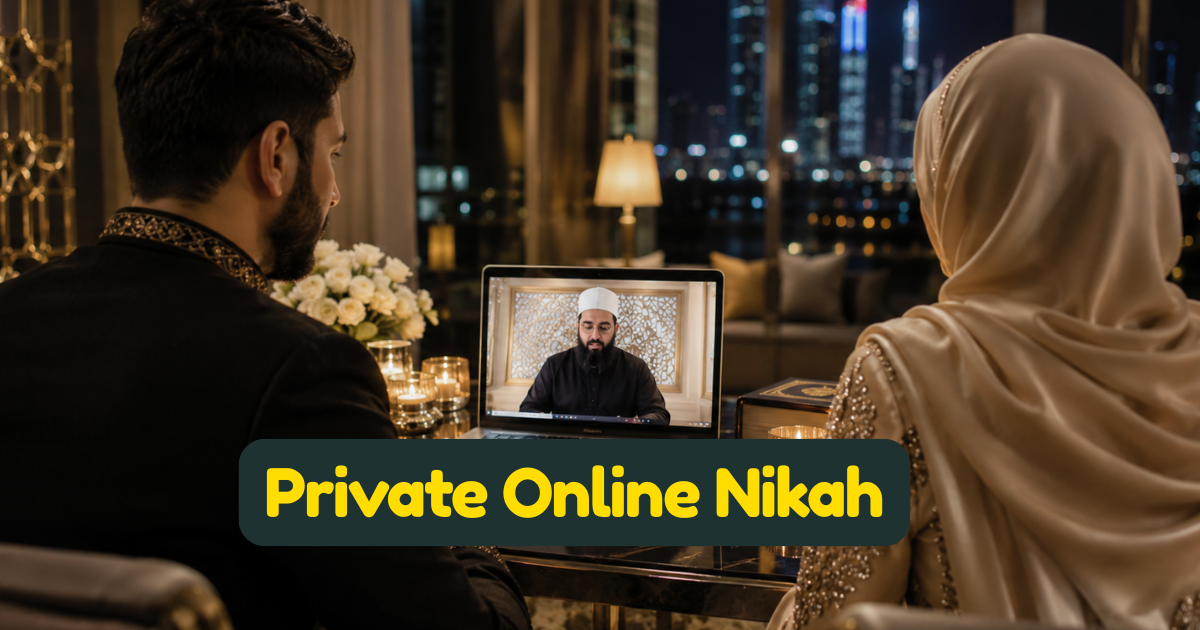
Private Online Nikah: The Complete Guide to a Discreet, Dignified Ceremony
There is a version of nikah that does not make it onto social media. No rented hall. No hundred guests. No elaborate outfit coordination or weeks of family negotiation. Just two people, their witnesses, a qazi, and the words that make it real.
This version of nikah is not lesser. In many ways, it is closer to what the Prophet ﷺ encouraged — something announced, yes, but not necessarily theatrical. The essence of the contract has always lived in the ijab and qubool, not in the size of the celebration around it.
For a growing number of Muslim couples worldwide, a private online nikah is not a compromise. It is a deliberate, thoughtful choice. And understanding how to do it properly — religiously, practically, and with full dignity — is exactly what this guide is for.
---Why Couples Choose a Private Nikah in the First Place
The reasons are more varied than most people assume. Some involve family dynamics. Others involve geography, timing, or personal circumstance. A few involve situations where privacy is not just a preference but a genuine necessity.
Among the most common reasons couples reach out to InstantNikah.com specifically requesting a discreet ceremony:
- Family opposition or complicated relationships — One or both families may be unsupportive, absent, or geographically unreachable. A couple may choose to proceed with their nikah quietly rather than delay an Islamically valid union indefinitely.
- Second marriages — Whether after divorce or the loss of a spouse, many individuals prefer to remarry privately, without the social weight of a public announcement during what is already an emotionally complex transition.
- Converts to Islam — A Muslim who has recently taken their shahada may not yet have family who understands or accepts the nikah process. A discreet ceremony allows them to fulfill their religious obligation with dignity.
- Long-distance and cross-border situations — Couples living in different countries who want to establish their nikah before immigration processes complete often prefer a quiet, legally structured virtual ceremony.
- Personal temperament — Some people simply are not oriented toward large ceremonies. They find meaning in intimacy, not performance. That is a legitimate and honorable position.
- Urgent circumstances — Medical situations, visa timelines, deployment, or unexpected life changes can make a fast and private nikah the only realistic option.
In every one of these situations, the Islamic validity of the nikah remains unchanged — provided the essential conditions are met. The size of the gathering is not among those conditions.
---What Islam Actually Requires for a Valid Nikah
Before discussing privacy, it is worth being precise about what makes a nikah Islamically valid in the first place. Scholars across the major madhabs — Hanafi, Shafi'i, Maliki, and Hanbali — agree on the foundational pillars:
1. The Offer and Acceptance (Ijab and Qubool)
The bride or her representative makes the offer, and the groom accepts — or vice versa, depending on the madhab. Both must be clear, unambiguous, and in the same sitting or its effective equivalent in contemporary digital contexts.
2. The Wali (Guardian)
For the majority of scholars, the bride's wali — her closest male Muslim relative — must be present or represented. This is a protective condition, not a diminishment of the bride's agency. In cases where a wali is unavailable, non-Muslim, abusive, or permanently absent, scholars have recognized that a qazi or Islamic authority can act in that capacity.
3. Two Muslim Witnesses
Two adult Muslim witnesses of sound mind must be present at the time of the ijab and qubool. This is a firm requirement across all major scholarly positions. "Present" in the context of a verified video call has been the subject of extensive contemporary fatwa discussion, and a number of respected scholars and institutions — including scholars affiliated with recognized Islamic bodies — have affirmed the validity of digital witnessing under specific conditions.
4. The Mahr (Bridal Gift)
A mahr must be agreed upon, even if not immediately paid. It can be anything of agreed monetary or symbolic value — it is the bride's right, not a negotiable formality.
5. Absence of Impediments
Neither party should be in an existing marriage that has not been dissolved. Neither should be within the prohibited degrees of relation. There should be no existing 'iddah period for the bride.
Notice what is not on this list: a large gathering, a public announcement, a banquet hall, or the presence of extended family. The announcement requirement (i'lan al-nikah) relates to making the marriage known so it is not treated as a secret affair, but scholars have clarified that this can be satisfied in modest and practical ways — including notifying close witnesses and keeping a proper record.
---Is a Private Nikah the Same as a Secret Nikah?
This distinction matters enormously, and it is one that most online content handles poorly.
A secret nikah — in the classical Islamic sense — refers to a marriage that is deliberately concealed from witnesses and the community, conducted in total secrecy with the intent of hiding its existence. This type of arrangement is generally considered problematic, particularly in the Maliki school, precisely because it removes the protective function of witnesses and public acknowledgement.
A private nikah, on the other hand, is a properly conducted ceremony with all required elements — wali, witnesses, mahr, ijab and qubool — that simply takes place in a smaller, more intimate setting. The witnesses know. The qazi knows. The marriage is documented. It is not hidden; it is simply not broadcast to the world.
This distinction is critical. A private online nikah performed through InstantNikah.com meets all validity requirements precisely because it is not secret — it is witnessed, conducted by a qualified qazi, and properly recorded. The couple simply chooses not to invite an audience.
---How a Private Online Nikah Actually Works
The process is more structured than many people expect, and that structure is what protects its validity.
Step One: Initial Consultation
Before any ceremony is scheduled, a qualified advisor at InstantNikah.com walks through the couple's specific situation. This includes confirming the presence of a wali, discussing the mahr, and understanding any particular considerations — whether the nikah involves parties from different countries, a convert, or a second marriage. Nothing is rushed. This stage is as much about clarity as it is about logistics.
Step Two: Document Preparation
Both parties provide basic identification and consent documentation. This is not bureaucracy for its own sake — it is a layer of verification that protects everyone involved and ensures the nikah is properly recorded.
Step Three: Witness Confirmation
Two Muslim witnesses must be confirmed. These can be people the couple trusts — family members or friends who agree to be present on the call. If the couple has difficulty arranging their own witnesses, InstantNikah.com can assist with trusted witness provision, which has been one of the more practically significant services for couples in genuinely isolated situations.
Step Four: The Ceremony
On the appointed date, the qazi opens the session, confirms the presence and identity of all parties, reviews the mahr, and proceeds through the ijab and qubool. The ceremony typically takes between fifteen and thirty minutes. It is quiet, focused, and — for most couples — unexpectedly moving. There is something clarifying about a ceremony stripped of performance. The words carry more weight when they are not competing with a room full of noise.
Step Five: Certificate and Documentation
Following the ceremony, an official nikah certificate is issued. This serves as the formal religious record of the marriage and can be used for further civil documentation processes depending on the couple's country of residence.
---The Question of Confidentiality
Couples who request private nikah services often have one concern that sits beneath all the others: who will know?
InstantNikah.com operates with strict confidentiality as a baseline standard. Information shared during consultation and ceremony is not disclosed externally. The nikah certificate is issued to the couple. Beyond the qazi, the witnesses, and the parties involved, no information is shared.
This is not an unusual professional standard — it mirrors the discretion expected of any religious official conducting a private ceremony. A private nikah is not a scandal to be managed. It is a personal matter to be handled with professionalism and respect.
That said, couples should be honest with themselves about whether they intend to eventually formalize or announce their marriage. A private nikah that remains permanently hidden from everyone — including parents, civil authorities, and society — carries its own long-term complications, both practically and in terms of the Islamic guidance around transparency in marriage.
---Wali Considerations in Private Nikah Situations
The wali question comes up in almost every private nikah inquiry, and it is worth addressing carefully rather than dismissively.
In the Hanafi school — followed by many South Asian and Turkish Muslims — the bride's wali is strongly recommended but the marriage can be valid without him in certain circumstances, particularly if the bride is of sound mind and mature age. In the Shafi'i and Hanbali schools, the wali is a condition of validity.
In practice, most private nikah situations fall into one of a few categories:
- The wali is supportive but simply unavailable to attend physically — In this case, he participates via video call, which resolves the situation cleanly.
- The wali is non-Muslim — If the bride's father or closest male relative is non-Muslim, he cannot serve as wali. The guardianship passes to the next eligible Muslim male relative, or to a qualified qazi in the absence of any such relative.
- The wali is abusive, absent, or has abandoned the family — Classical Islamic jurisprudence has addressed this. A judge or qazi may assume the role of wali in cases where the natural guardian is unfit or unreachable.
- The bride has no male Muslim relatives — This is particularly common for converts. In this case, scholarly consensus supports the qazi acting as wali.
InstantNikah.com assesses each situation individually. Scholars on the team understand the nuance here. The goal is always to facilitate a nikah that is both religiously defensible and practically executable — not to apply rigid formulas to genuinely complex situations.
---Emotional Dimensions of a Private Nikah
Something that SEO content rarely touches — and that couples navigating private nikah situations deeply need — is the emotional reality of this choice.
Choosing a private nikah can feel like grief and relief simultaneously. Grief, perhaps, because some part of you imagined a different kind of beginning. Relief, because the weight of complicated family dynamics or impossible timing is finally being resolved in a way that is both halal and honest.
These feelings are not contradictions. They are the natural texture of a meaningful decision made under real-world constraints.
Many couples who have gone through a private online nikah describe the ceremony itself as unexpectedly intimate. Without the social performance layer, there is often a quality of attention — to the words, to each other, to the gravity of the moment — that gets lost in larger gatherings. The qazi speaks. The words are spoken. The nikah is made.
That is, in its essence, everything it needs to be.
---Civil Registration: What Happens After a Private Online Nikah
The nikah itself is an Islamic contract. Its civil recognition depends entirely on the laws of the country where the couple resides. This is an area where confusion is common and where clarity genuinely matters.
In the UK, for example, an Islamic nikah ceremony — whether online or in-person — does not automatically carry legal force under civil law unless conducted under specific licensing conditions. Couples who want their marriage to be legally recognized in the UK must separately complete a civil registration. Similar frameworks exist in Canada, Australia, most of Europe, and the United States.
In Pakistan, the nikah is typically registered through the Union Council, and a nikah performed through an online service can be supported with a certificate for this purpose, though exact registration requirements vary by region.
The key point: a private online nikah is religiously valid as a completed Islamic marriage. Whether and how it translates into civil legal standing is a separate question, governed by local jurisdiction. Couples are strongly encouraged to take appropriate civil steps after their nikah, both for practical protection and for the longer-term stability of their union.
---Common Questions About Private Online Nikah
Can the nikah be done without telling anyone?
It can be done without announcing it publicly, but it cannot be done without witnesses. Two Muslim witnesses must be present at the ceremony. That is non-negotiable across all valid scholarly positions.
What if one party is not Muslim?
Islamic law permits a Muslim man to marry a woman from the People of the Book (Christian or Jewish). A Muslim woman may only marry a Muslim man. If a non-Muslim woman is intending to embrace Islam, the nikah should ideally follow the shahada. InstantNikah.com has supported this process for a number of couples.
Can a private nikah be done on the same day?
Same-day arrangements are possible in urgent circumstances, though some preparation steps must be completed first — including confirmation of witnesses and basic documentation. The same-day online nikah service at InstantNikah.com is designed for exactly these situations.
Will I receive official documentation?
Yes. Every nikah performed through InstantNikah.com is accompanied by an officially issued nikah certificate. This serves as the religious record of the marriage and can support subsequent civil processes.
What if my family finds out later?
A valid nikah, once performed, is not undone by family disapproval. However, couples should think carefully about their longer-term family communication strategy. A private start does not have to mean a permanently hidden marriage. Many couples plan to formalize or announce the marriage once circumstances allow. That is a personal decision, but it is worth making intentionally.
---Ready to Begin
If you are considering a private online nikah and want to understand your specific options — including wali arrangements, witness provision, and ceremony scheduling — the best first step is a consultation with the team at InstantNikah.com.
Every situation is different. What remains constant is the commitment to a ceremony that is Shariah-compliant, professionally conducted, and handled with the discretion your situation deserves.
You can learn more about the full process here, read real testimonials from couples who have used the service, or proceed directly to booking when you are ready. For questions specific to your situation, contact the team directly.
Your nikah does not need to be public to be real. It does not need to be grand to be meaningful. It needs to be right — and that is exactly what a properly conducted private online nikah can be.
Admin User
Author