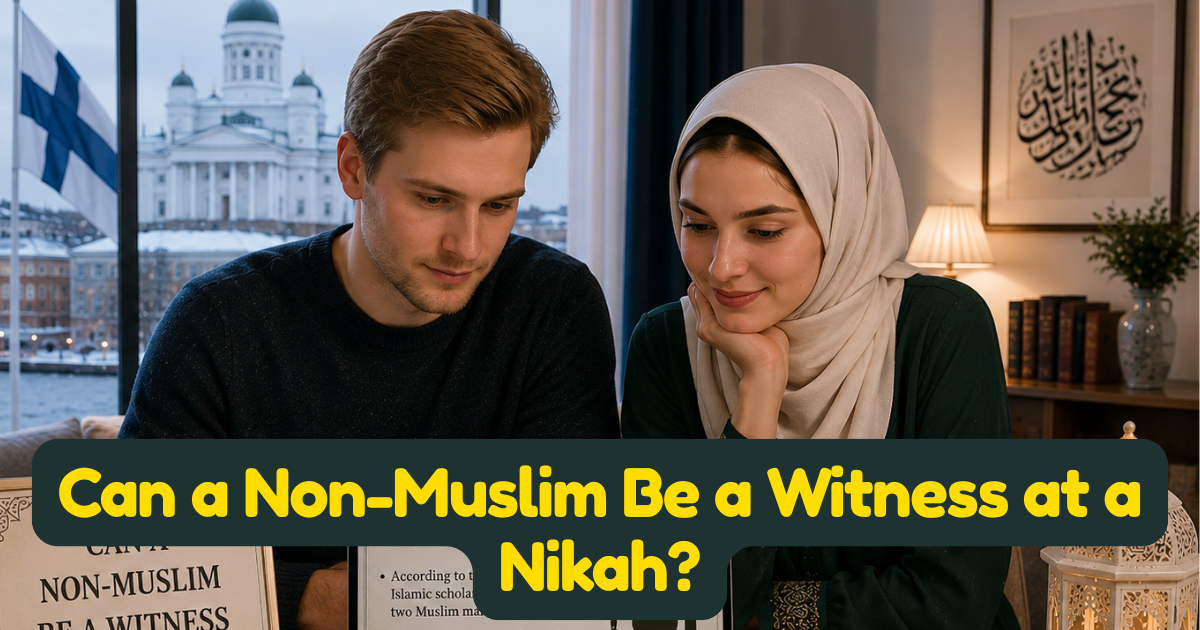
Can a Non-Muslim Be a Witness at a Nikah? What Islamic Law Actually Says and Why It Matters
It is a situation that arises quietly, and more often than many Muslims expect. A bride whose closest friend — the person who has stood by her through everything — is not Muslim. A groom whose only available family members in a foreign country are non-Muslim relatives. A convert to Islam with no Muslim family, whose entire support network consists of people who have not taken the shahada. Or simply a couple who want to honour a non-Muslim parent or sibling by giving them a meaningful role in the ceremony.
The question they all eventually ask is the same: can a non-Muslim be a witness at the nikah?
The answer Islamic scholarship gives is consistent, clearly reasoned, and worth understanding properly — not just as a yes or a no, but as a matter of what the witness condition in a nikah actually exists to achieve, and why that purpose shapes who can legitimately fulfil it.
Why the Witness Condition Exists in the First Place
Before asking who can be a witness, it is worth understanding what the witness is actually for. The two-witness requirement in a nikah is not a bureaucratic formality. It serves a specific set of purposes that classical scholars have articulated clearly across all madhabs.
First, the witnesses ensure the publicity of the marriage. Their presence means the nikah is not a secret arrangement — at minimum, two people beyond the immediate parties know that this marriage has taken place and can testify to it if it is ever disputed or denied.
Second, the witnesses provide verification. They confirm that the ijab and qabool — the offer and acceptance — were spoken clearly, freely, and without ambiguity. If the validity of the nikah is ever questioned, the witnesses are the people whose testimony establishes what occurred.
Third, the witnesses provide accountability. Their presence creates a social and legal record of the marriage that protects both parties — particularly the bride — against later denial or dispute.
These three purposes — publicity, verification, and accountability — are precisely what shapes the conditions a valid witness must meet. And they are why the question of a non-Muslim witness is not simply a question of inclusion or exclusion. It is a question of whether the witness can genuinely fulfil the legal function the Shariah assigns to them.
The Classical Position: Muslim Witnesses Are Required
The position of all four major schools of Islamic jurisprudence on this question is consistent: the witnesses at a nikah must be Muslim. This is not a disputed or contested position within mainstream classical fiqh. It is a point of agreement — one of the relatively few areas where all four madhabs align without significant internal dissent.
The Hanafi school — the most widely followed across South Asia, Turkey, and Central Asia — explicitly requires that the two witnesses be Muslim. The Maliki school, predominant across North and West Africa, shares this requirement. The Shafi'i school, followed widely across Southeast Asia and East Africa, is equally clear. The Hanbali school, prevalent in the Gulf region, holds the same position.
The reasoning behind this unanimous requirement is grounded in the nature of Islamic legal testimony. In Islamic jurisprudence, a witness who testifies in matters governed by Islamic law must themselves be bound by and accountable to that law. A non-Muslim is not subject to Islamic legal obligations in the same way a Muslim is — and therefore cannot fulfil the role of a witness in an Islamic contract in the way the Shariah requires.
This is not a statement about the character, trustworthiness, or moral integrity of any individual non-Muslim. It is a statement about the structure of Islamic legal testimony — about who is positioned, within the framework of Islamic law, to bear the specific witness the nikah contract requires.
Additional Conditions a Nikah Witness Must Meet
Being Muslim is a necessary condition for a nikah witness — but it is not the only condition. Classical scholars across all four madhabs have identified a set of requirements that a valid nikah witness must satisfy. Understanding the full list clarifies why the witness condition is so specific and why its requirements are taken seriously.
- Muslim: Both witnesses must be Muslim. A non-Muslim, regardless of their personal character or relationship to the couple, cannot fulfil this role in Islamic law.
- Adult: Both witnesses must have reached the age of maturity. A child — even an older teenager who has not yet reached the Islamic age of maturity — cannot serve as a valid nikah witness.
- Sane: Both witnesses must be of sound mind. Someone who lacks mental capacity at the time of the ceremony cannot fulfil the witness function.
- Male: The classical position across the Hanafi, Shafi'i, and Hanbali schools requires that both witnesses be male. The Hanafi school has a well-known internal discussion about whether two female witnesses can substitute for one male witness — but the majority classical position for the nikah specifically requires two male Muslim witnesses. The Maliki school has some internal variation on this point, though the majority position also favours male witnesses.
- Present and attentive: The witnesses must be physically or — in the case of a verified video ceremony — visually and audibly present throughout the ijab and qabool. A witness who is in the room but distracted, sleeping, or not paying attention does not fulfil the witnessing function.
- Able to hear and comprehend: The witnesses must be able to hear both the offer and the acceptance clearly and understand what is being said. A witness who cannot hear or does not understand the language of the exchange cannot testify to what occurred.
- Of upright character (according to some schools): The Shafi'i and Hanbali schools add a condition of adalah — basic uprightness of character — meaning the witnesses should not be known for serious moral failings that would disqualify their testimony in an Islamic legal setting. The Hanafi school does not add this as a formal validity condition, though it strongly encourages choosing witnesses of good character.
What About a Non-Muslim Who Converts Just Before the Nikah?
A question sometimes raised in this context is whether a non-Muslim friend or family member who takes the shahada — the declaration of faith — immediately before the nikah ceremony can then serve as a witness. This scenario is discussed in classical fiqh and among contemporary scholars.
The general scholarly position is that a person who sincerely accepts Islam becomes Muslim from the moment of their shahada. If that declaration is genuine — not a procedural gesture made purely to satisfy the witness requirement — and the individual meets the other conditions of a valid witness, there is no fundamental objection to their serving as a witness at a nikah conducted after their conversion.
The critical caveat is sincerity. A shahada made purely as a formality, with no genuine acceptance of Islam, is not a valid shahada — and a person who has not genuinely accepted Islam has not become Muslim in any meaningful sense, regardless of the words spoken. Scholars consistently caution against treating the shahada as an administrative procedure to satisfy a legal requirement.
If a non-Muslim friend or family member has a genuine interest in Islam and takes the shahada with sincerity — and then participates in the nikah as a witness — this is a different matter entirely from manufacturing a conversion for procedural purposes. The former is a blessing. The latter is a misuse of one of the most significant declarations a person can make.
What This Means for Muslims in the West and in Mixed-Faith Families
For Muslims living in the United Kingdom, the United States, Germany, France, Canada, Australia, and across the Western world, the witness requirement creates a practical challenge that is both real and worth addressing honestly.
Many Muslims in diaspora communities have deep, longstanding relationships with non-Muslim friends and colleagues. Some have non-Muslim parents who wish to be meaningfully involved in their child's wedding. Some are converts whose entire social network is non-Muslim. The requirement that the two formal Islamic witnesses be Muslim may mean that the people closest to the couple emotionally cannot fulfil the formal witnessing role.
This does not mean non-Muslim friends and family have no place in the ceremony. It means their place is not the specific formal witnessing role that Islamic law assigns to Muslim witnesses. Non-Muslim loved ones can attend the ceremony, celebrate with the couple, observe the nikah, and be honoured guests at the walima. What they cannot do — within the framework of Islamic law — is count as the two required Muslim witnesses whose testimony validates the contract.
For couples in this situation, the practical solution is straightforward: ensure that two qualified Muslim witnesses are present for the formal nikah, while welcoming non-Muslim family and friends to participate in the celebration in every other capacity. The two roles — formal Islamic witness and beloved family guest — are simply different, and keeping them distinct does not diminish the importance of anyone's presence.
What Happens to a Nikah If the Witnesses Were Non-Muslim?
This is the question that creates the most anxiety — and it deserves a direct answer. If a nikah was conducted with non-Muslim witnesses — knowingly or unknowingly — what is its status in Islamic law?
The majority classical scholarly position is that a nikah conducted without valid Muslim witnesses is either void or severely deficient — and in either case, should be corrected. Because the witness condition is among the essential conditions of the nikah contract, a ceremony that lacks valid witnesses has not fully met those conditions.
The practical resolution in such cases — which scholars have addressed consistently — is to conduct the nikah again, properly, with two qualified Muslim witnesses present, the wali involved, and the ijab and qabool spoken correctly. This is not a complex or shameful process. It is simply the correction of a ceremony that was conducted without all the necessary conditions being met. Many couples discover this situation and resolve it quietly through a properly conducted renewal of the nikah with full Islamic oversight.
This is also why the involvement of a qualified qazi or Islamic scholar matters so much — not only to facilitate the ceremony but to confirm, before it begins, that the witnesses present meet all the required conditions. A qualified scholar will identify a witness problem before it creates a validity problem.
What Major Global Scholarly Institutions Have Confirmed
Dar al-Ifta al-Misriyyah — Egypt's official government fatwa authority and one of the world's most respected Islamic legal institutions — has confirmed in multiple rulings that the witnesses at a nikah must be Muslim. Their position is consistent with the classical scholarly consensus: the witness condition exists to protect the integrity of the Islamic marriage contract, and non-Muslims cannot fulfil this specific legal function within an Islamic contract regardless of their personal character.
Al-Azhar University — the world's oldest and most globally recognised centre of Sunni Islamic scholarship — has consistently affirmed the requirement for Muslim witnesses in the nikah. Al-Azhar scholars have noted that this requirement reflects the nature of Islamic legal testimony, not a judgment on the character of non-Muslim individuals. Their guidance is clear that meeting this condition is an Islamic necessity, particularly for Muslim communities seeking to ensure the full validity of their marriage contracts.
In the United Kingdom, the Muslim Council of Britain (MCB) has specifically addressed the nikah witness question for British Muslims — many of whom have close non-Muslim friends and family members they wish to involve in their ceremonies. The MCB's guidance makes clear that the two formal Islamic witnesses must be Muslim, while encouraging couples to find ways to honour non-Muslim loved ones in other meaningful aspects of the wedding celebration.
In North America, the Islamic Society of North America (ISNA) has published marriage guidance confirming the Muslim witness requirement for American and Canadian Muslims. ISNA has specifically addressed the situation of Muslim converts whose families are non-Muslim, advising that two qualified Muslim witnesses must be present for the nikah — and that Islamic centres, mosques, and qualified scholars can assist couples in identifying suitable witnesses when their personal networks do not include available Muslim individuals.
The Islamic Fiqh Academy of the Organisation of Islamic Cooperation (OIC) has reaffirmed in its resolutions on Islamic family law that the conditions of the nikah contract — including the witness requirement — must be properly met regardless of the social or cultural context in which the marriage is conducted. Their framework does not accommodate the substitution of non-Muslim witnesses for Muslim ones as a matter of necessity or convenience.
In Germany, the Zentralrat der Muslime in Deutschland (Central Council of Muslims in Germany) has addressed the practical challenges facing German Muslims — many of whom live in communities where Muslim social networks are limited, and where non-Muslim family members are deeply involved in wedding celebrations. Their guidance maintains the Islamic requirement for Muslim witnesses while advising mosques and Islamic centres to actively support couples in identifying qualified witnesses when needed.
In France, the Conseil Français du Culte Musulman (CFCM — French Council of Muslim Worship) — the main representative body for France's approximately six million Muslims — has similarly confirmed the requirement for Muslim witnesses in nikah ceremonies conducted in France. The CFCM has encouraged French Muslim communities to maintain access to qualified Islamic witnesses as part of ensuring the religious validity of marriages within French Muslim communities.
Practical Solutions for Couples Who Lack Available Muslim Witnesses
For couples who genuinely struggle to identify two qualified Muslim witnesses — particularly converts, those with small Muslim social networks, or those marrying in areas with limited Muslim communities — the following practical pathways are available and fully legitimate.
Approach a Local Mosque or Islamic Centre
Most mosques and Islamic centres are accustomed to being asked to assist with nikah ceremonies, including providing witnesses when the couple does not have their own. The imam or mosque committee can typically arrange for two qualified Muslim members of the community to serve as witnesses. This is a well-established practice and couples should not feel hesitant to ask.
Use a Professional Online Nikah Service
For couples using a verified online nikah service — particularly for cross-border ceremonies — qualified Muslim witnesses can be provided as part of the service. A professional online qazi conducting the ceremony will ensure that the witnesses present meet all the required conditions, including being Muslim, adult, male, and attentive throughout the ceremony.
Connect With a Local Muslim Community
For Muslim converts with no Muslim family, connecting with a local Muslim community — through a mosque, Islamic society, convert support group, or Muslim Students' Association — can provide access to community members willing to serve as witnesses. Muslim communities have historically understood and supported this need, particularly for converts who are building their Muslim social networks from a small base.
Contact a Muslim Convert Support Organisation
Several organisations specifically support Muslim converts in navigating exactly these situations. In the UK, organisations like New Muslims Project UK provide practical guidance and community connection for converts — including assistance with the practical requirements of an Islamic nikah when the convert has no Muslim family network to draw on.
Honouring Non-Muslim Family Members Without Compromising the Nikah
One of the most sensitive dimensions of this question is the desire many couples have to honour non-Muslim parents or siblings who mean a great deal to them. The fact that a non-Muslim cannot serve as a formal Islamic witness does not mean they cannot be deeply and meaningfully involved in the wedding.
Non-Muslim family members can attend the nikah ceremony as honoured guests. They can be welcomed, introduced, and acknowledged during the ceremony by the presiding qazi or scholar. They can speak at the walima. They can give gifts and blessings. In many cultures, the nikah ceremony is followed by a separate civil or cultural celebration in which everyone — Muslim and non-Muslim alike — participates fully.
The formal witnessing role is a specific legal function within the Islamic contract. It is not the only way to be present, celebrated, and honoured in a marriage. Keeping these distinctions clear allows couples to fully honour their non-Muslim loved ones while ensuring the Islamic integrity of their marriage contract is protected.
The Deeper Principle: Why Conditions Cannot Be Traded for Convenience
It is tempting, in a world that rightly values inclusion and the honouring of relationships across faith lines, to look for flexibility in the conditions of the nikah. But Islamic law's insistence on Muslim witnesses is not rigidity for its own sake. It is a coherent part of a system designed to protect the marriage contract's integrity, the rights of both parties, and the legal standing of the relationship in the framework of Islamic law.
A nikah is not simply a celebration. It is a legal contract with profound religious, social, and practical implications. The conditions attached to it — including the witness condition — exist to ensure that when the contract is made, it is made correctly, verifiably, and with the protections the Shariah has designed for both parties. Softening those conditions for social convenience does not honour the spirit of inclusion. It introduces a legal vulnerability into the most important contract a Muslim will ever make.
The far more protective path is to ensure the conditions are met correctly — and then celebrate the marriage as fully and inclusively as the couple wishes, honouring every important relationship in their lives within the space the Islamic framework provides for that celebration.
How InstantNikah.com Ensures Your Witnesses Meet Every Condition
At InstantNikah.com, every nikah ceremony is conducted by a qualified online qazi who confirms — before the ceremony begins — that the witnesses present meet every required condition. Witnesses must be Muslim, adult, male, and attentive throughout the ijab and qabool. Where couples need assistance identifying suitable witnesses, InstantNikah can facilitate this as part of the service.
For couples who are converts, for those marrying across borders, and for those whose personal Muslim networks are limited, InstantNikah provides not just a ceremony but the qualified oversight that ensures every condition of the nikah is correctly met — so that the marriage is protected from every angle of doubt, and the nikah certificate issued afterwards accurately reflects a ceremony that was conducted in full compliance with Islamic requirements.
For couples who are Muslim converts seeking guidance on the full nikah process, the online nikah guide for converts provides detailed practical support. For those with questions about the wali and witness requirements, or those wondering about what happens when witnesses are absent or unqualified, InstantNikah's resources and qualified scholars are available to guide you through every question.
Explore the full nikah process here, read verified reviews from couples worldwide, or book your online nikah at a time that works for you.
Admin User
Author