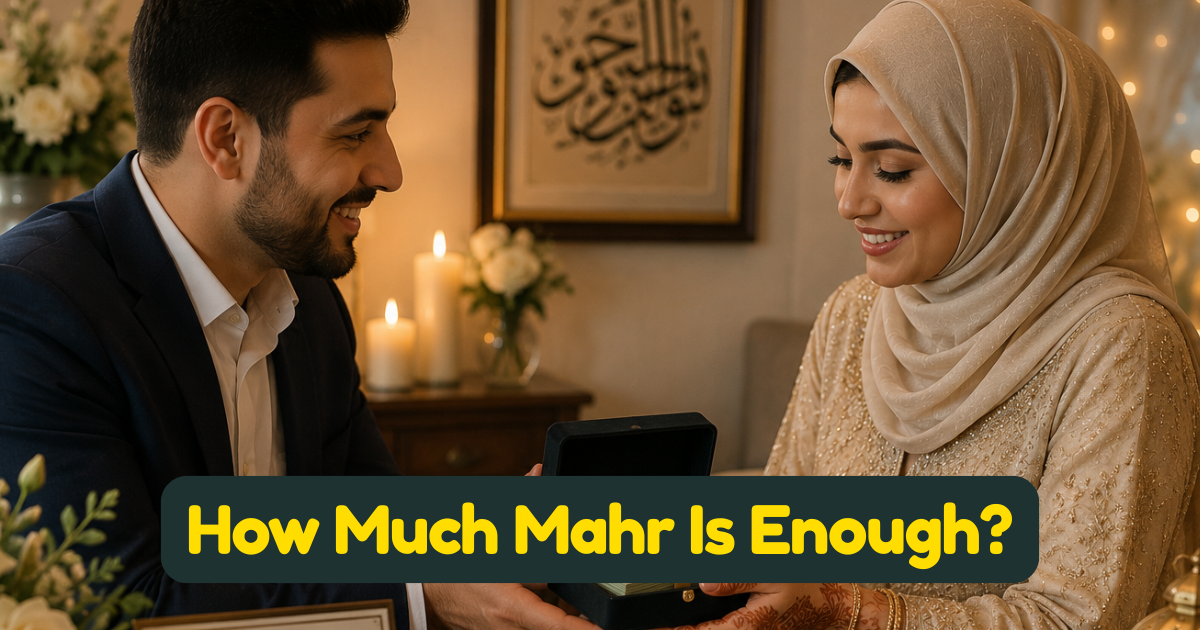
How Much Mahr Is Enough? — The Islamic Guidance on Setting a Fair and Realistic Amount
It is one of the most practically urgent questions in Islamic marriage — and one of the least honestly answered. When a nikah is being arranged and the mahr discussion arrives, something uncomfortable usually happens: the number gets negotiated downward, treated as a formality, set at whatever feels culturally acceptable in that particular family, and then written into the contract without anyone pausing to ask whether it actually reflects what the Shariah intended.
The result, across Muslim communities worldwide, is a spectrum that stretches from the genuinely absurd to the genuinely unjust. Mahrs of a single gold coin. Mahrs of a Qur'an and prayer mat. Mahrs of five hundred dollars set against a backdrop of weddings costing fifty thousand. And on the other end, mahrs deliberately inflated to astronomical figures with the mutual understanding that they will never be collected — functioning as deterrents rather than genuine financial commitments.
Neither extreme serves the woman the mahr was designed to protect. And neither reflects what Islamic scholarship — when examined carefully — actually says about what an appropriate mahr looks like.
Does Islam Set a Minimum Amount?
This is the first question most people ask — and the schools differ, which is itself an important piece of information.
The Hanafi Position
The Hanafi school — dominant across South Asia, Turkey, and parts of Central Asia — holds that there is a minimum mahr of ten dirhams of silver. A nikah contracted with a mahr below this threshold is technically deficient, and the minimum must be completed. The reasoning behind this threshold is that mahr should represent a meaningful financial commitment — something of genuine value, not a purely symbolic gesture.
Ten dirhams of silver in contemporary terms is approximately — depending on the current silver price — the equivalent of a modest but real sum. It is not a large amount by modern standards, but it establishes a floor below which the mahr cannot fall without the contract being considered deficient under Hanafi fiqh.
The Maliki Position
The Maliki school sets the minimum at three dirhams — a lower threshold, but one that nonetheless insists on genuine monetary value. The Malikis are particularly emphatic that mahr must have real financial meaning, and several Maliki scholars have written extensively against the practice of nominal mahrs that satisfy the letter of the requirement while evacuating its spirit entirely.
The Shafi'i and Hanbali Positions
Both the Shafi'i and Hanbali schools hold that there is no specific minimum amount — but that the mahr must be something of genuine value that could legally constitute property. A Shafi'i or Hanbali mahr of a single grain of rice, or a token with no monetary worth, would not satisfy this requirement. The principle is that mahr must be something a reasonable person would consider valuable — even if the specific monetary floor is not fixed.
The practical consequence of the Shafi'i and Hanbali positions is that they place the emphasis on genuine value rather than a numerical threshold — which in some ways sets a more demanding standard, not a lower one, because the evaluation is qualitative rather than quantitative.
Is There a Maximum?
Here, the scholarly consensus is clear and consistent: there is no upper limit on mahr in Islam. A woman may receive any amount as mahr, and the higher the amount — provided it is genuine and intended to be paid — the more her right is honoured. Allah says in Surah An-Nisa (4:20):
"...and you have given one of them a great amount [in gifts]..."
The Qur'an's reference to a "great amount" without any ceiling is taken by scholars across schools as confirmation that generosity in mahr is not only permitted but praised. The Prophet ﷺ did not cap mahr. No authentic hadith restricts it.
However — and this is a crucial nuance — several of the companions and early scholars expressed concern about the social effects of excessively large mahrs as a general cultural norm, on the grounds that they could discourage marriage among those of more modest means. Umar ibn al-Khattab (RA) initially attempted to limit mahr amounts, but withdrew his position after a woman cited the Qur'anic verse above. This narration — preserved in the classical collections — is itself one of the strongest testimonies to the wife's unqualified right to a large mahr: when Umar (RA) attempted to limit it, the Qur'an overruled him, and he acknowledged it.
The practical implication of the no-maximum rule is this: a large mahr is always valid. The problem is not largeness — it is insincerity. A mahr that is large but genuinely intended is a gift from Allah to the wife. A mahr that is large but universally understood to be a deterrent figure — never intended for actual payment — is a different matter, and it is to that specific distortion that the deeper scholarly concern applies.
What Did the Prophet ﷺ Set as Mahr for His Own Family?
The prophetic examples are the most direct guidance available on what a mahr might look like in practice — and they are worth examining with some care, because they are often cited selectively.
The Mahr of the Prophet's Wives
Aisha (RA) reported that her mahr was five hundred dirhams. This is narrated in Sahih Muslim (1426) and is among the most frequently cited examples in Islamic scholarship on mahr amounts. Five hundred dirhams of silver — at contemporary silver prices — is a meaningful sum, not a token. It was neither extravagant nor negligible by the standards of seventh-century Arabia.
Umm Habibah (RA), the Prophet's wife who was in Abyssinia, had her mahr paid on the Prophet's behalf by the Negus at four thousand dirhams — a considerably larger amount, reflecting different circumstances.
These examples establish something important: the prophetic practice did not settle on a single figure as universally ideal. The mahr varied by circumstance, by the woman's situation, and by the context of the marriage. What remained consistent was that the mahr was genuine, specified, and understood as a real financial right.
The Mahr of a Man Who Had Nothing
Among the most instructive hadith on mahr is the narration of the man who wished to marry and had nothing to offer. The Prophet ﷺ asked him repeatedly whether he had anything — any property, any silver, anything of value — and when the man confirmed he had nothing at all, the Prophet ﷺ eventually permitted the marriage with the man teaching the woman whatever he knew of the Qur'an as his mahr. (Sahih al-Bukhari, 5149; Sahih Muslim, 1425).
This narration is sometimes cited to argue that mahr can be anything, including intangible things like teaching. The scholarly position is more nuanced: most jurists treat this as an exceptional case permitted by the Prophet ﷺ due to genuine inability — not a general licence for men who have means to offer nominal or intangible mahrs as a matter of preference. The majority position across schools is that mahr should, wherever possible, be something of genuine monetary value.
The Mahr of Equivalence — What Mahr al-Mithl Means
When no mahr was specified in the nikah contract — or when the specified amount is disputed — Islamic law provides a fallback standard: mahr al-mithl, or the mahr of equivalence.
Mahr al-mithl is the amount that women of similar background, family status, age, education, and circumstances in the wife's family typically receive as mahr. It is calculated by looking at what paternal female relatives — sisters, aunts, cousins — received, and setting the wife's mahr at a comparable level.
The concept of mahr al-mithl is significant for several reasons. First, it establishes that Islamic law does not default to zero when mahr is unspecified — it defaults to a standard of fairness grounded in the wife's actual social and familial context. Second, it provides a benchmark for evaluating whether a specified mahr is genuinely fair or whether it falls egregiously short of what the wife's circumstances would suggest. Third, it gives Islamic courts a tool for determining mahr in disputes — a tool that explicitly anchors the amount to the wife's dignity rather than the husband's convenience.
The Symbolic Mahr Problem — Why "Just a Formality" Is Not Islamic
Across South Asian, Arab, and African Muslim communities, the practice of setting a purely nominal mahr — a prayer mat, a set of books, fifty dollars, a single dirham — while simultaneously expecting heavy dowry expenditure from the bride's family, has become widespread enough to be almost invisible. It is simply "how things are done."
Islamic scholarship does not support this practice. The Maliki school in particular — whose classical scholars were vocal on this point — holds that a mahr deliberately set below what the wife's circumstances warrant, with no intention of genuine financial provision, violates the spirit of the Qur'anic command even if it technically satisfies the form. Ibn Rushd al-Hafid, writing in the Bidayat al-Mujtahid, identifies the mahr's purpose as providing the wife with real financial security — a purpose that a nominal sum entirely fails to serve.
The harm of the symbolic mahr is not merely philosophical. As discussed in the analysis of mahr rights after divorce, a wife whose mahr was set at a negligible amount has almost no financial protection if the marriage ends. The mahr that was "just a formality" at nikah becomes a very real absence at divorce — leaving her with a contractual right worth effectively nothing.
The Inflated Mahr Problem — When the Number Is Never Meant to Be Paid
On the opposite end of the spectrum sits the inflated deterrent mahr — a large figure, sometimes in the hundreds of thousands, set with the mutual understanding that it functions as a social and financial deterrent to divorce rather than a genuine financial commitment. Both families know it will never be paid. The figure is designed to make the husband think twice before initiating talaq.
Scholars hold conflicting views on the permissibility of this practice. Some argue that if both parties genuinely agree to the amount and understand its deterrent purpose, the contract is valid even if the amount is large relative to the husband's means. Others — particularly in the Hanafi school — argue that a mahr the husband has no realistic capacity to pay introduces a form of deception into the contract that is problematic.
The more pressing practical concern is this: if the marriage does end in divorce or death, the deferred mahr becomes immediately payable in full — regardless of the original mutual understanding about its deterrent function. Courts — Islamic and civil — look at what the contract says, not at informal understandings. A husband who agreed to a deferred mahr of two hundred thousand dollars as a social gesture may find himself legally obligated to pay it. This is not a hypothetical — it has occurred in civil courts in the UK, Canada, and the United States.
The counsel of most contemporary Islamic scholars on this point is consistent: set a mahr that is both meaningful and realistic — one the husband genuinely intends and has the capacity to pay. Meaningful, because a token amount fails the wife. Realistic, because an amount the husband could never pay introduces problems of its own.
A Practical Framework for Setting Mahr
Drawing the classical scholarship into practical guidance, a mahr that genuinely honours Islamic intent would satisfy the following considerations:
- It should be something of real monetary value — not a symbolic object, not an intangible gift unless there is genuine inability to pay anything of monetary worth.
- It should reflect the wife's circumstances — her education, her family's background, and what women of comparable standing in her family have received. The mahr al-mithl standard provides a useful anchor.
- It should reflect the husband's genuine capacity — not what he could theoretically afford in the best-case scenario, but what he could realistically fulfil if the marriage ended tomorrow.
- It should be agreed upon with the wife's genuine input — not set unilaterally by families and presented to the couple as decided. The mahr is the wife's right; she should have real agency in determining its amount.
- It should be clearly documented — with the amount, type (prompt or deferred), and payment terms specified in writing in the nikah contract with no ambiguity.
- It should not be offset against dowry — as explored in the analysis of mahr versus dowry, the two obligations are entirely separate. The bride's family's jahez expenditure does not reduce the husband's mahr obligation by a single dirham.
Prompt vs Deferred — How the Split Affects the Amount Discussion
In many contemporary Muslim marriages, the mahr is split between a prompt portion — paid at or immediately after the nikah — and a deferred portion, payable upon divorce or death. The proportions of this split are not fixed by Islamic law; they are a matter of mutual agreement.
The split creates a practical question that couples often fail to think through: is the prompt portion actually meaningful, or is it merely a symbolic gesture while the real financial weight is deferred into an uncertain future? A prompt mahr of one hundred dollars against a deferred mahr of fifty thousand creates a situation where the wife's immediate financial right at nikah is almost negligible. If the marriage is short and ends before significant deferred mahr payment becomes realistically enforceable, she may find herself with very little.
Scholars generally recommend that the prompt mahr — the portion paid at or immediately after the nikah — be set at an amount that provides the wife with genuine financial standing from the outset of the marriage. The deferred portion is an additional protection, not a substitute for the prompt right.
What the Discussion of Mahr Amount Reveals About the Marriage
There is something that experienced Islamic marriage counsellors and scholars have noted across decades of working with Muslim couples: the way a mahr amount is determined before nikah is frequently predictive of how financial matters will be handled within the marriage itself.
A husband who engages with the mahr discussion generously, who asks the wife what she considers appropriate, who sets an amount that reflects genuine commitment rather than minimal compliance — that conversation reveals something about his character and his understanding of what marriage in Islam requires of him. A husband whose first instinct is to minimise the mahr, to treat it as a technicality, to pressure the bride's family into accepting a token — that conversation reveals something too.
The mahr is not merely a number in a contract. It is the first financial act of the marriage. How it is approached tells both parties something worth knowing.
For couples planning a nikah who want their mahr properly documented — with the amount, type, and payment terms written clearly into a Shariah-compliant contract — explore how InstantNikah.com structures every nikah ceremony, including meticulous contract documentation. You can also review our guidance on what mahr is and why it matters, or learn about what happens to mahr after divorce to understand exactly what this right protects.
Admin User
Author