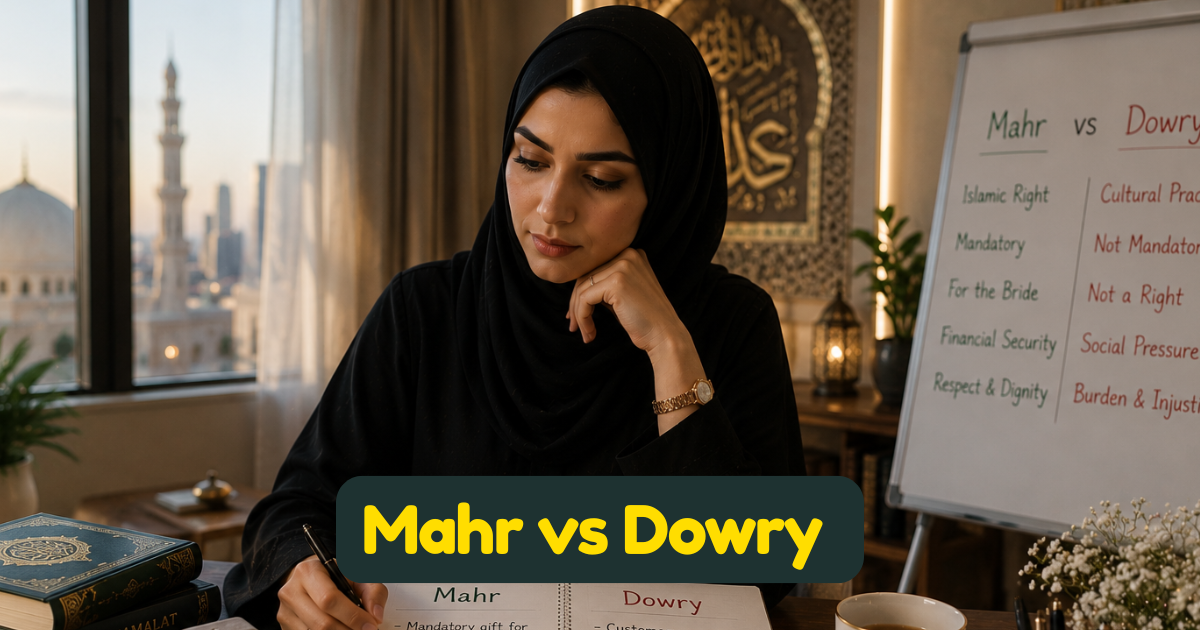
Mahr vs Dowry — Why Muslim Families Still Confuse the Two and Why It Matters
Walk into almost any wedding discussion in a South Asian Muslim household and you will hear the word mehr used in one breath and jahez — the dowry a bride's family provides — discussed in the next, as though they occupy the same moral and legal universe. They do not. One is a divine obligation placed on the groom. The other is a cultural practice with no Qur'anic basis — one that, in its more coercive forms, directly contradicts Islamic principles.
The confusion between the two is not innocent. It has real consequences for real women: wives who believe their mahr was "settled" because their family furnished a kitchen, mothers who drain savings to send their daughters into marriage with gold and appliances rather than insisting on a properly documented mahr, and young couples who enter the nikah with one party's most fundamental contractual right poorly understood by everyone in the room.
Getting this distinction right is not an academic exercise. It is a matter of financial justice, Islamic compliance, and — in the event of divorce or death — legal protection that cannot be reconstructed after the fact.
What Mahr Is — The Definition That Cannot Be Negotiated Away
Mahr is an obligatory gift given by the husband to the wife as a condition of the Islamic marriage contract. Its Arabic root — from the verb mahara — carries connotations of skilled craftsmanship, of something given with care and intentionality. The Qur'an refers to it using multiple terms: sadaq in Surah An-Nisa (4:4), where Allah commands:
"And give the women [upon marriage] their [bridal] gifts graciously. But if they give up willingly to you anything of it, then take it in satisfaction and ease."
The word sadaq — translated here as bridal gifts — comes from the root for truth and sincerity. Scholars note this deliberately: the mahr is not a transactional payment. It is an expression of genuine marital commitment, a concrete financial act that demonstrates the husband's sincerity in entering the covenant of marriage.
Several things about mahr are non-negotiable under Islamic law across all four Sunni schools:
- It flows from the husband to the wife — always, without exception.
- It belongs exclusively to the wife — not her father, not her mother, not her family collectively.
- It cannot be waived by anyone other than the wife herself, freely and without coercion.
- It is a condition of a valid nikah — a marriage without mahr is technically deficient, and a mahr must be assigned even if it was omitted from the original contract.
- It is a debt if unpaid — one that survives divorce and death, and must be settled from the husband's estate before heirs receive their inheritance shares.
None of this applies to dowry. Not a single element.
What Dowry Is — And What Islam Says About It
Dowry — known as jahez in Urdu, jihaz in Arabic, mahr al-ajil in some colloquial misusages, and by various names across different cultural communities — is the transfer of assets from the bride's family to the groom's household at the time of marriage. It typically takes the form of furniture, kitchen appliances, gold jewellery, cash, clothing, and household goods assembled and paid for by the bride's parents or family.
Its direction is the precise opposite of mahr: it flows from the wife's family toward the husband's household, not from the husband toward the wife.
Islam has no concept of dowry as an obligation. There is no Qur'anic verse requiring it. There is no authentic hadith prescribing it. When Fatimah, the daughter of the Prophet ﷺ, married Ali ibn Abi Talib, the Prophet arranged a modest set of household items for her — but this was a gift from a father to his daughter, not a dowry paid to the groom or his family, and it is not presented by any classical scholar as establishing an obligation on the bride's family. The confusion of this narration with a dowry obligation is itself part of how cultural distortion has accumulated around this topic.
In its most extreme forms — dowry demands, dowry-related harassment, and dowry deaths — this practice has been recognised as a serious human rights violation. India's Dowry Prohibition Act 1961 and Bangladesh's Dowry Prohibition Act 1980 reflect legislative attempts to address a practice that causes measurable, documented harm to women, including in Muslim communities where it has no scriptural foundation whatsoever.
Where the Confusion Comes From — A Historical and Cultural Mapping
The conflation of mahr and dowry did not emerge from ignorance alone. It has identifiable historical roots that explain — though they do not excuse — how the confusion became so entrenched.
Pre-Islamic Arab Custom and Its Distortion
In pre-Islamic Arabia, a form of bride-price existed in which the groom's family paid the bride's family — not the bride herself — for the right to marry her. Islam transformed this fundamentally: the payment was redirected to go directly to the woman as her personal property, with her family having no legal claim to it. This was a revolutionary women's economic right for its time. Over centuries, however, in certain communities, the cultural memory of family-to-family transactions persisted and gradually corrupted the Islamic concept — families began to treat the mahr as a negotiation between households rather than a right belonging to the woman herself.
South Asian Syncretic Practice
When Islam spread across the Indian subcontinent, it encountered deeply embedded Hindu dowry traditions in which the bride's family provided assets to the groom's household as a standard expectation of marriage. Rather than being displaced by Islamic practice, these traditions became layered alongside it. The result was a hybrid in which Muslim families performed the nikah, set a mahr (often nominal or symbolic), and simultaneously expected the bride's family to provide jahez — treating both as equally valid marital requirements when, in Islamic terms, only one of them is.
The Symbolic Mahr Problem
A particularly harmful pattern that emerged from this conflation is the practice of setting a very low or purely symbolic mahr — sometimes as little as one set of Islamic books, a prayer mat, or a token amount — while the real financial burden falls entirely on the bride's family through dowry provision. From the outside, the Islamic requirement appears to be technically satisfied. In reality, the wife's genuine financial right has been hollowed out while an obligation Islam never placed on her family has been substituted in its place.
This inversion — minimal mahr for the wife, maximum dowry from the wife's family — is arguably the precise opposite of what Islamic law intended.
The Seven Most Common Misconceptions
Misconception 1: "The jahez my family provided counts as the mahr."
No. Mahr and jahez are legally and religiously separate. Assets provided by the bride's family cannot constitute the husband's mahr obligation — they flow in the wrong direction and come from the wrong party. The husband's mahr obligation exists independently and cannot be satisfied by his wife's family's expenditure.
Misconception 2: "The mahr was settled because we agreed on a small amount."
A small mahr is valid — Islam sets no minimum amount that is universally binding, though scholars recommend it be something of genuine value. What is not valid is treating a token mahr as a formality while simultaneously placing a heavy financial burden on the bride's family through dowry expectations. The mahr reflects the husband's commitment; it should not be minimised simply because the bride's family is already spending heavily on jahez.
Misconception 3: "The bride's family is supposed to provide things for the home."
Under Islamic law, the husband is obligated to provide the marital home, its furnishings, and the wife's maintenance (nafaqa). The responsibility for establishing the household falls on him — not on her family. This is not a minor detail. It is a foundational principle of Islamic financial responsibility in marriage.
Misconception 4: "If the wife's family is wealthier, it makes sense for them to contribute more."
Relative wealth does not alter Islamic obligations. The mahr remains the husband's responsibility regardless of the financial positions of the families involved. A wealthy bride's family contributing lavishly to the household does not reduce the husband's obligation to pay a genuine mahr — it simply means the wife received gifts from her family in addition to her independent right from her husband.
Misconception 5: "Talking about mahr seriously is materialistic or inauspicious."
This cultural discomfort around discussing mahr seriously — or demanding a fair mahr — has no Islamic basis. The Prophet ﷺ himself negotiated mahr on behalf of women in his community. Aisha (RA) reported that her mahr was five hundred dirhams. The companions set mehar openly, discussed it clearly, and recorded it — there was nothing inauspicious about treating it as the serious financial right it is.
Misconception 6: "Deferred mahr is just a formality that no one actually pays."
As detailed in the scholarly position across all four schools: deferred mahr is a real financial obligation that becomes immediately payable upon divorce or death. The cultural understanding that it is merely a deterrent figure is not a legal defence in Islamic or, increasingly, civil courts. Treating it as a formality exposes husbands to an obligation they did not plan for and wives to rights they did not know to protect.
Misconception 7: "This is just how things are done in our community."
Community custom — urf — carries weight in Islamic jurisprudence, but only when it does not contradict a clear Qur'anic ruling. Where cultural practice directly contradicts a Qur'anic command — as dowry coercion directed at the bride's family does — the custom carries no legal weight. The Qur'an's directive is explicit: give women their mahr graciously. Community tradition cannot override divine instruction.
Why the Confusion Harms Women Concretely
The harm is not abstract. When mahr and dowry are conflated in practice, the consequences for Muslim women are specific and measurable.
Financial vulnerability at divorce: A wife whose mahr was nominal and whose family spent heavily on jahez enters divorce with almost no financial protection from the nikah contract. Her family's dowry expenditure benefits the marital household — and in many cases the husband's family — not her. At divorce, she may have no documented mahr claim of substance and no property in her own name.
Family financial strain: The bride's family — often middle-income or lower-income families in diaspora communities — bears a crushing financial burden that Islam never placed on them, while the groom's family faces a mahr obligation that has been minimised to near nothing. The financial architecture of the marriage is precisely inverted from the Islamic model.
Loss of rights through ignorance: Women who do not understand that their mahr is their exclusive, personal right — separate from any family contribution — cannot effectively assert or protect it. Ignorance of the distinction is itself a mechanism through which rights are lost.
Post-death vulnerability: As explored in detail regarding mahr and inheritance rights, a poorly documented or nominal mahr means a widow has little to assert as a creditor of her husband's estate — while potentially having no civil spousal recognition either if the nikah was not registered.
What a Correctly Understood Mahr Looks Like in Practice
A mahr that reflects Islamic intent is one that:
- Is agreed upon between the couple — with the wife (or her wali, if applicable) having genuine input into the amount.
- Reflects something of real value — not a token amount chosen purely to satisfy a technical requirement.
- Is clearly specified in the nikah contract — with the amount, type (prompt or deferred), and payment terms written in unambiguous language.
- Is understood by both parties — including the wife — to be her personal property, not a family asset, not a contribution to the household, and not something her family's jahez can substitute for.
- Is documented by a qualified officiant — in a properly conducted nikah through a certified service or scholar — so that it exists as a retrievable, verifiable record.
A nikah conducted through a structured, Shariah-compliant online nikah service produces exactly this documentation — a clearly written contract in which the mahr is specified, recorded, and signed, providing the wife with a document she can rely on for her Islamic rights and, where applicable, her civil legal protection.
A Note for Muslim Families Having This Conversation
The practical advice that flows from this analysis is simple, even if the cultural shift it requires is not. Before the next nikah in your family — whether it is your own, your child's, or a sibling's — have the mahr conversation clearly and seriously. Establish an amount that is genuine. Write it into the contract with specificity. Separate it entirely from any discussion of what the bride's family will or will not provide. And understand, collectively, that the jahez discussion — if it happens at all — is entirely separate from, and cannot substitute for, the husband's Islamic obligation.
These are not radical positions. They are precisely what Islam prescribed. The radical departure — the one that requires correction — is the cultural practice that displaced them.
To understand the full scope of what mahr is and what rights it creates, read our detailed guide on what mahr means in a nikah. If you are ready to plan a nikah where your mahr is properly documented from the outset, explore our online nikah packages or review the full nikah process at InstantNikah.com.
Admin User
Author