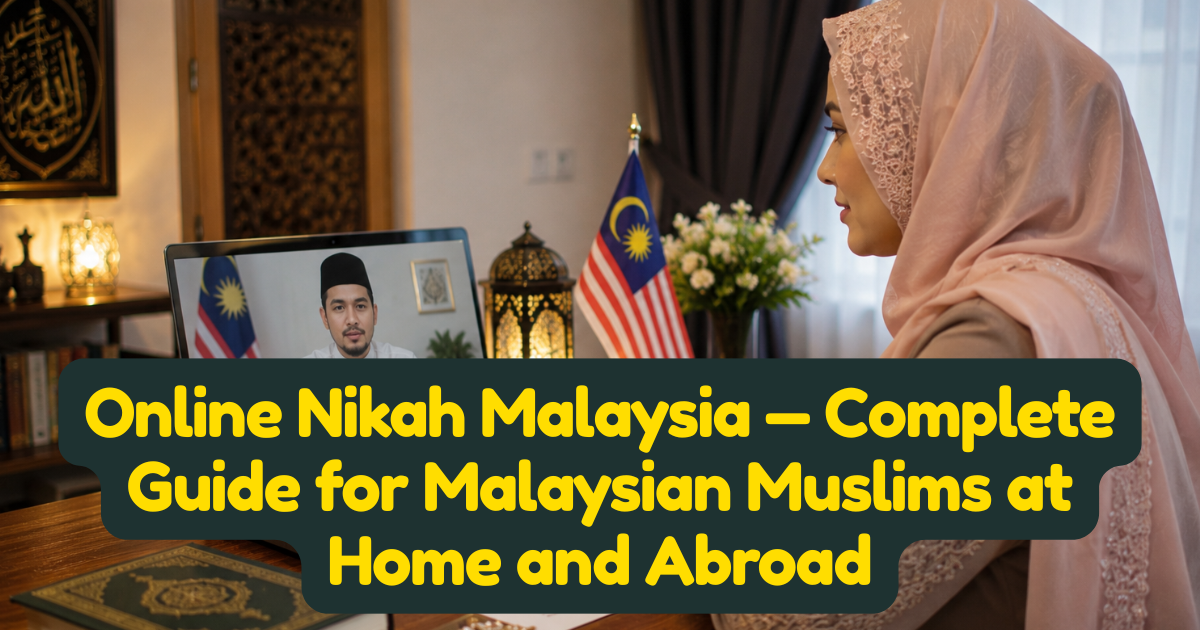
Online Nikah Malaysia — Complete Guide for Malaysian Muslims at Home and Abroad
Malaysia occupies a unique position in the global Muslim landscape. It is a Muslim-majority country with one of the most formally structured Islamic family law systems in the world — a system that operates through state-level Shariah courts, registered qadis, and detailed registration requirements that govern every aspect of Muslim marriage from the nikah itself to the documentation that follows. For Malaysian Muslims living within this system, the process of getting married is well-defined, if sometimes bureaucratically demanding.
But a significant and growing segment of Malaysian Muslims does not live within easy reach of that system. Malaysian students studying in the UK, Australia, the USA, or Europe. Malaysian professionals working in the Gulf, in Singapore, in Japan, or in countries with small Muslim communities. Malaysian Muslims in long-distance relationships with partners on different continents. And Malaysian Muslims within Malaysia itself who face delays, bureaucratic obstacles, or circumstances that make the standard Jabatan Agama Islam (JAI) registration process difficult to access quickly.
For all of these Malaysians, the question of online nikah — a Shariah-compliant nikah ceremony conducted remotely through a qualified Islamic scholar, properly witnessed, and fully documented — is not an abstract theological question. It is a practical one that deserves a complete, honest, and well-researched answer.
This article provides that answer — covering the Islamic validity of online nikah for Malaysian Muslims, how Malaysia's Shariah court system works and what it requires, what Malaysian Muslims abroad can and cannot do through an international online nikah service, the documentation considerations, and how to proceed with a properly conducted virtual nikah regardless of where in the world you are located.
Malaysia's Islamic Family Law System — An Overview
Understanding the Malaysian context requires understanding the structure of Islamic family law in Malaysia — because it is more decentralised and more formally regulated than the systems found in most other Muslim-majority countries.
Malaysia is a federation of thirteen states and three federal territories. Islamic law — including Islamic family law — is a state matter under the Malaysian Constitution. This means that each state has its own Islamic Family Law Enactment (or in the federal territories, the Islamic Family Law Act 1984), its own Jabatan Agama Islam, and its own Shariah court system. The rules governing Muslim marriage — including the conditions of a valid nikah, the registration requirements, the wali framework, and the documentation process — are broadly similar across all states but differ in specific procedural details.
For a Muslim marriage to be legally registered in Malaysia, it must generally be conducted by or in the presence of a registered qadi or his authorised representative, with both parties present, with the wali's involvement, and with the required documentation submitted to the relevant state Jabatan Agama Islam office within a specified timeframe after the ceremony. A nikah conducted outside these formal registration requirements — including one conducted entirely through an online platform — is Islamically valid as a contract if all conditions are met, but may not be automatically registerable within the Malaysian civil and Shariah court system without additional steps.
This distinction — between Islamic validity and Malaysian state registration — is the most important concept for Malaysian Muslims considering an online nikah to understand clearly.
Is Online Nikah Islamically Valid for Malaysian Muslims?
The Islamic validity of an online nikah — conducted over a live, simultaneous video call with all conditions properly met — does not depend on the Malaysian state registration system. It depends on classical Islamic jurisprudence, which is universal across all Muslim communities regardless of national law.
As established in the foundational article on whether online nikah is valid in Islam, the majority contemporary scholarly position holds that a nikah conducted over a live video call — where all parties can see and hear each other simultaneously, where the ijab and qabool are exchanged in real time, and where all five conditions of a valid nikah are properly met — is Islamically valid. The five conditions are:
- A willing bride whose consent is genuine and free from coercion.
- A willing groom whose consent is similarly genuine and freely given.
- The wali — the bride's guardian — who makes the offer on her behalf or whose consent is properly incorporated.
- Two witnesses — adult Muslim males of sound character — present at the time of the ijab and qabool.
- The mahr — the mandatory financial gift from the groom to the bride — specified and agreed upon.
None of these conditions requires physical presence in the same room. None requires registration with a Malaysian state authority. A live video call satisfies the simultaneity requirement of the ijab and qabool. The witnesses can be present physically with one party or connected through the same video call. The wali can make the offer in person or through a properly appointed wakeel. And a qualified Islamic scholar facilitating the ceremony remotely fulfils the same scholarly oversight function as an imam or qadi present in person.
The question of whether a nikah conducted by phone or video is valid has been specifically addressed by contemporary Islamic scholars including those on the Fatwa Committee of Malaysia's own Department of Islamic Development (JAKIM). While JAKIM has not issued a blanket approval for all online nikah arrangements, the scholarly discussion within Malaysia acknowledges the classical principle that what matters is the proper meeting of conditions — and that modern communication technology can, in appropriate circumstances, satisfy the simultaneity requirement.
The dedicated article on whether nikah can be done over Zoom or video call covers the detailed scholarly analysis of this question in full.
Malaysian Muslims Abroad — The Most Common Online Nikah Scenario
The most common situation in which Malaysian Muslims seek an online nikah service is when one or both parties are living abroad — studying, working, or residing in a country where accessing a Malaysian-registered qadi or JAI-affiliated imam is impossible or impractical.
Malaysia has one of the highest rates of outbound student migration in Southeast Asia. Tens of thousands of Malaysian students are enrolled at universities in the United Kingdom, Australia, the United States, Canada, Ireland, New Zealand, and across Europe at any given time. Many of these students are in their twenties — the most common age for Muslim marriage — and many are in relationships with partners who are either also abroad or back in Malaysia. The logistical and bureaucratic challenge of navigating the Malaysian JAI system from abroad, often with limited time and limited ability to return to Malaysia for the registration process, makes an internationally conducted online nikah an attractive and practically necessary option for many of them.
Similarly, Malaysian professionals working in the Gulf states — Qatar, Kuwait, Saudi Arabia, the UAE — or in non-Muslim-majority countries in Europe and East Asia frequently find themselves in long-distance relationships where the standard Malaysian nikah registration process is genuinely difficult to access without significant travel and logistical planning.
For all of these Malaysian Muslims, an online nikah conducted through a qualified Islamic service provides an Islamically valid marriage ceremony — properly witnessed, properly documented, and properly conducted with scholarly oversight — that fulfils the Islamic requirements of nikah regardless of where the parties are physically located.
The Wali Requirement for Malaysian Muslim Women
Malaysia's Islamic family law system follows the Shafi'i school of jurisprudence — which is the dominant madhhab across Malaysia, Brunei, Indonesia, and much of Southeast Asia. Under Shafi'i fiqh, the wali is a strict validity condition of the nikah. A Muslim woman's nikah is not valid under the Shafi'i school without the involvement of her wali — her father in the first instance, then her paternal grandfather, then her brother, then other male relatives in the established order of priority.
For Malaysian Muslim women seeking an online nikah, this means the wali must be part of the ceremony — either present with the bride at her location, or connected through the live video call. A wali who is in Malaysia while the bride is in the UK, for example, can participate in the ceremony through the video call — making the ijab on behalf of his daughter or other ward while the groom and witnesses are connected from their respective locations.
If the wali is unavailable — through death, through incapacity, through genuine absence that cannot be resolved, or through wrongful refusal (adhl) — the Shafi'i school provides for the appointment of a wali hakim — a judicial guardian who may be appointed by an Islamic court or qualified scholar to act in the wali's place. This mechanism is important for Malaysian Muslim women whose family circumstances make the standard wali chain unavailable or inaccessible.
The dedicated articles on online nikah without a wali and what happens if the wali refuses the nikah cover these scenarios in full scholarly detail.
The Witness Requirement — Who Can Witness an Online Nikah for Malaysian Muslims
Under Shafi'i fiqh — the school followed in Malaysian Islamic family law — two witnesses are required for a valid nikah. The witnesses must be adult Muslim males of sound character. They must be present at the time of the ijab and qabool — aware of what is occurring and able to attest to it.
For an online nikah, witnesses may be physically present with one of the parties — typically with the bride, with the groom, or split between both locations — or they may be connected through the live video call where the technology allows clear simultaneous visibility and audio. The important requirement is that the witnesses are genuinely present in the sense of being aware of the contract being formed and able to attest to it — which a live video connection satisfies.
Malaysian Muslim women sometimes ask whether a non-Muslim can witness a nikah — particularly in countries where Muslim male witnesses may be difficult to find. The Islamic ruling on this is covered in the dedicated article on whether a non-Muslim can be a witness at nikah, and on the question of female witnesses specifically in the article on whether a woman can be a witness at nikah in Islam.
The Mahr for Malaysian Muslims — Cultural Expectations and Islamic Requirements
Malaysian Muslim culture has developed its own traditions around mahr — the mandatory financial gift from the groom to the bride — that sometimes diverge from the classical Islamic framework in ways worth understanding clearly.
In many Malaysian communities, particularly in Peninsular Malaysia, the mahr is sometimes treated as a relatively nominal amount — a fixed sum set by tradition or by the state JAI authority — while the more substantial financial gifts exchanged between families are the hantaran (exchange gifts) that accompany the wedding celebration. The hantaran is a cultural tradition; the mahr is an Islamic legal obligation. They are not the same thing, and the Islamic validity of the nikah depends on the mahr — not on the hantaran.
Under Islamic law, the mahr must be specified — a real amount or item of genuine value, agreed by both parties and recorded in the nikah contract. It belongs exclusively to the bride. She may choose to give part or all of it back to the husband as a gift, but that choice must be genuinely free and cannot be pressured. The full framework of mahr — including what amount is appropriate, what happens to it after divorce or death, and how it is documented — is covered in the dedicated articles on what mahr is in nikah and how much mahr is enough in Islamic law.
For Malaysian Muslims conducting an online nikah through InstantNikah.com, the mahr amount and its terms are confirmed and documented as part of the nikah contract — ensuring that the Islamic requirement is properly met and that the bride's entitlement is clearly recorded.
Documentation — What Malaysian Muslims Get From an Online Nikah Service
When a Malaysian Muslim couple conducts an online nikah through InstantNikah.com, they receive a fully documented Islamic nikah certificate. This certificate records:
- The full names of both parties and their relevant identification details.
- The name of the wali and his relationship to the bride.
- The names of the two witnesses and their confirmation of the ceremony.
- The mahr amount and its terms — prompt and deferred portions specified clearly.
- The date, time, and method of the ceremony.
- The signature and credentials of the officiating Islamic scholar.
This documentation serves as evidence of the Islamically valid nikah and is useful for a range of practical purposes — including community recognition of the marriage, evidence in Islamic arbitration proceedings if required, and as part of the documentation package if the couple subsequently pursues formal registration through the Malaysian JAI system or another civil registration authority.
The article on what makes a nikah certificate Islamically and legally valid explains in full detail what a proper nikah certificate must contain and what it establishes.
Malaysian Muslims in the UK — Specific Guidance
For Malaysian students and professionals in the United Kingdom — the most common destination for Malaysian overseas students — an online nikah conducted through a qualified Islamic service is both Islamically valid and practically accessible. The UK has a significant Muslim community and several Islamic arbitration bodies, but Malaysian Muslims in the UK are not required to conduct their nikah through UK-based Islamic institutions. A ceremony conducted through a Malaysian or international Islamic scholar, accessible online, is equally valid Islamically.
Couples in the UK who wish their marriage to carry civil legal recognition should be aware that a religious-only nikah — whether conducted in person or online — does not automatically produce civil legal recognition in England and Wales. A separate civil marriage registration at a register office is required for civil legal spousal rights. The full guidance on online nikah in the UK covers this civil registration dimension in detail.
Malaysian Muslims in Australia — Specific Guidance
Australia is the second most common destination for Malaysian overseas students and has a growing Malaysian Muslim community. An online nikah conducted through a qualified international Islamic service is Islamically valid for Malaysian Muslims in Australia. As with the UK, a religious-only nikah in Australia does not produce civil legal recognition — civil marriage registration through the Australian civil registry is a separate process. The guidance on online nikah in Australia provides country-specific context for Malaysian Muslims based there.
Malaysian Muslims in Europe — Specific Guidance
Malaysian Muslims based in EU member states — Germany, France, the Netherlands, Sweden, and others — can access online nikah services with full Islamic validity through a qualified international Islamic service. The civil registration dimension applies equally across Europe — a religious-only nikah carries no civil legal recognition in any EU member state, and civil marriage registration must be pursued separately where civil spousal rights are desired. Country-specific guidance is available across this site for Europe broadly, Germany, France, and the Netherlands.
Long-Distance Nikah for Malaysian Couples — Bride in Malaysia, Groom Abroad
One of the most common scenarios for Malaysian Muslims seeking an online nikah is the long-distance situation — one party in Malaysia and one abroad. A Malaysian bride whose wali is with her in Malaysia, and whose groom is in the UK, Australia, or the USA, can conduct a fully valid online nikah through a live video call where all parties — bride, groom, wali, witnesses, and officiating scholar — are simultaneously connected.
This scenario is addressed directly in the dedicated article on online nikah for couples in different countries, which covers the specific requirements and considerations for cross-border nikah ceremonies in detail. For Malaysian couples specifically, the key considerations are ensuring the wali is properly involved from the Malaysian side, that the witnesses are appropriately positioned, and that the mahr is clearly agreed and documented before the ceremony proceeds.
Common Questions Malaysian Muslims Ask About Online Nikah
Is an online nikah recognised by Malaysia's Jabatan Agama Islam?
An online nikah conducted outside the formal Malaysian JAI registration system is Islamically valid but is not automatically registered within the Malaysian Shariah court system. Malaysian Muslims who wish their marriage to be formally registered with the JAI — which provides civil legal standing within Malaysia and is required for matters such as divorce through the Shariah court, inheritance claims, and children's registration — should take steps to pursue JAI registration after the nikah. This may involve presenting the nikah certificate from the online ceremony and engaging with the relevant state JAI office. Requirements vary by state and couples should contact their state JAI office for specific guidance.
Can a Malaysian Muslim woman conduct an online nikah without her wali being physically present?
Yes — the wali can participate in the online nikah ceremony through the live video call from any location, including from Malaysia while the bride is abroad. He makes the ijab through the video connection, which satisfies the requirement of his involvement under the majority contemporary scholarly position. If the wali is genuinely unavailable, a wali hakim can be appointed — subject to the specific circumstances and the school of fiqh being followed.
Is an online nikah valid under the Shafi'i school followed in Malaysia?
The Shafi'i school requires the simultaneous presence of the parties for the ijab and qabool — and the majority contemporary Shafi'i scholarly position holds that a live, simultaneous video connection satisfies this requirement where all conditions are properly met. This position is consistent with the broader contemporary scholarly consensus on video call nikah. The article on whether online nikah is valid in Islam covers the Shafi'i position in detail.
What documentation will I receive from an InstantNikah.com ceremony?
Every nikah conducted through InstantNikah.com produces a fully documented Islamic nikah certificate recording all parties, conditions, mahr terms, witness confirmations, and the officiating scholar's credentials. This documentation serves as evidence of the Islamically valid ceremony for community recognition, Islamic arbitration purposes, and as part of any subsequent registration process.
Can Malaysian Muslims use InstantNikah.com if both parties are in Malaysia?
Yes. Malaysian Muslims within Malaysia who wish to conduct a properly documented online nikah — whether for reasons of urgency, privacy, logistical convenience, or circumstances that make the standard JAI registration process difficult to access quickly — can use InstantNikah.com's services. The ceremony is Islamically valid regardless of whether both parties are in the same country. Couples should be aware of the JAI registration requirement for formal recognition within the Malaysian Shariah court system and take steps to pursue registration as appropriate to their circumstances.
How to Proceed With an Online Nikah Through InstantNikah.com
The process for Malaysian Muslims conducting an online nikah through InstantNikah.com is straightforward and fully guided by the InstantNikah.com team from start to finish. It involves:
- Booking your preferred service package — choosing between Instant Nikah, Express Nikah, Same Day Nikah, or Essential Nikah depending on your timeline and requirements.
- Providing the required information — names, identification details, wali information, witness details, and agreed mahr amount and terms.
- Scheduling the ceremony — the InstantNikah.com team coordinates the live video call at a time that works for all parties across their respective time zones.
- Conducting the ceremony — a qualified Islamic scholar facilitates the full nikah ceremony over the live video call, delivering the khutbah, verifying all conditions, guiding the ijab and qabool, and leading the du'a for the couple.
- Receiving your documentation — the nikah certificate is produced and provided to both parties following the ceremony.
You can review the full nikah process, read verified client reviews from couples who have used the service, or explore the gallery of ceremonies. To proceed, you can book your nikah directly through service packages including Instant Nikah, Express Nikah, Same Day Nikah, and Essential Nikah. For specific questions about your situation — including the wali arrangement, witness requirements, or documentation needs — the team is available to assist directly.
Admin User
Author