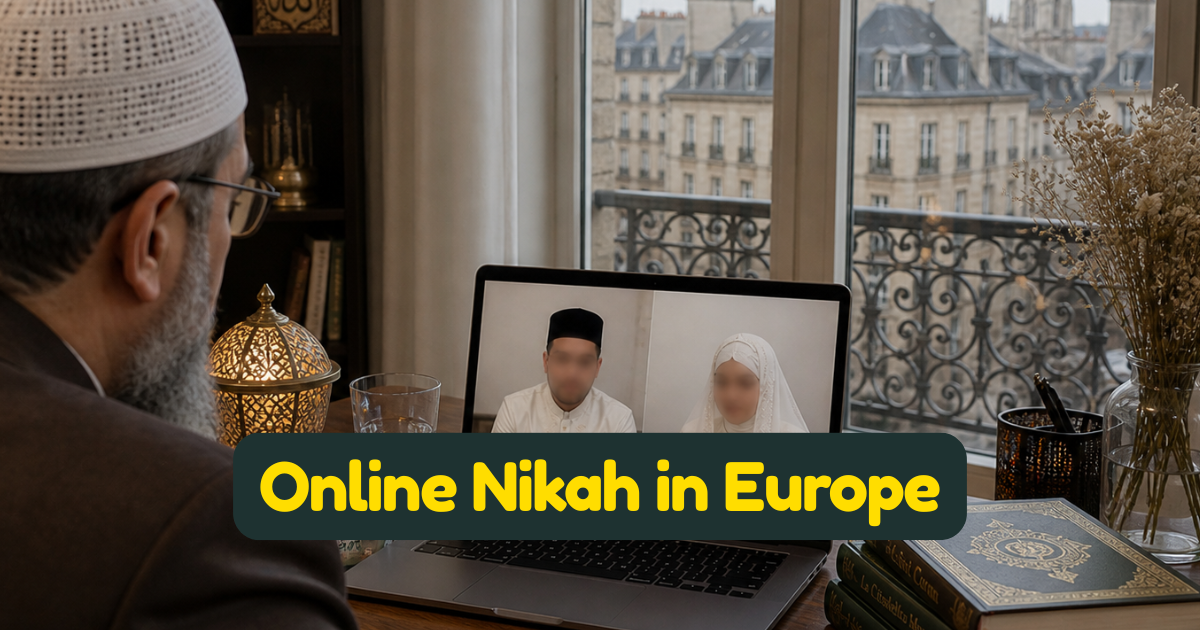
Europe is home to more than 25 million Muslims — a number that has grown steadily over decades of migration, settlement, and a flourishing community of converts. From the Turkish communities of Berlin and the Moroccan diaspora of Paris, to the Pakistani heritage families of the Netherlands and the Somali communities of Stockholm, European Muslims are one of the most diverse and geographically dispersed Muslim populations in the world.
What they often share, despite the diversity, is a common practical challenge: arranging a Nikah that is both Islamically valid and properly handled in the context of European civil law. Local Imams are not always available. Mosque appointments are oversubscribed. One partner may be in a different country. Family situations may be complicated. And the question of how a Nikah interacts with the civil law of Germany, France, the Netherlands, or wherever you happen to live — is one that few services explain honestly.
This guide covers all of it. How online Nikah works for European Muslims, what Islamic conditions must be met, how civil recognition works across key European countries, and how to arrange a ceremony from anywhere on the continent — quickly, properly, and with complete documentation.
Is Online Nikah Islamically Valid for Muslims in Europe?
Yes — completely. The Islamic validity of an online Nikah has nothing to do with which country the ceremony takes place in. It depends entirely on whether the conditions of the Nikah contract are properly fulfilled.
IslamQA confirms that a Nikah conducted via verified video call is permissible when identities are established and witnesses can clearly follow the Ijab and Qabul as it takes place. IslamWeb's Hanafi fatwa confirms that a Nikah between parties in different locations using real-time communication is valid when all Shariah conditions are fulfilled. For the majority of European Muslims of South Asian or Turkish heritage who follow the Hanafi school, this ruling applies without ambiguity.
The conditions of validity are the same whether the ceremony takes place in a mosque in Dearborn or over a video call in Düsseldorf:
- Ijab and Qabul — a clear offer and acceptance in a single live session
- Two adult Muslim witnesses (Shahidain) — present on the live call, attentive, and identifiable
- Wali — the bride's guardian participating via video call, or a lawful Wali-e-Hakim where required
- Mahr — agreed, stated, and accepted during the ceremony
- Qualified Imam or Qazi — a credentialed scholar officiating the contract
- No Islamic impediment — both parties free to marry under Islamic law
Living in Germany, France, the Netherlands, or anywhere else in Europe changes nothing about these conditions. A correctly conducted online Nikah from any European country is a fully valid Islamic marriage.
The Civil Law Reality — What European Muslims Must Understand
This is the section most guides either avoid or get wrong — and getting it wrong has serious consequences for real couples.
The Islamic validity of your Nikah and its civil legal recognition under European law are two entirely separate things.
As of 2026, no European country recognises a marriage conducted entirely online — with no in-person civil component — as a legally valid civil marriage. This applies equally to religious marriages conducted in an unregistered venue, which includes most private Nikah ceremonies. The European Commission confirms that civil marriage across all 27 EU member states requires physical attendance and identity verification as a protection against fraud and coercion.
What this means in practice: your online Nikah gives you a fully valid Islamic marriage from the moment the ceremony concludes. For civil legal recognition — inheritance rights, spousal protections, immigration status, and family law entitlements — a separate civil registration step is required in your country of residence.
This is not unique to online Nikah. It applies to virtually all Nikah ceremonies conducted in Europe, whether in a mosque, at home, or online. The civil and Islamic ceremonies are two separate steps, and both matter — for different but equally important reasons.
Country by Country — Civil Recognition Across Key European Nations
Germany
Germany has a mandatory civil marriage requirement. Under German law, only a civil ceremony (Standesamtliche Trauung) conducted at a civil registry office (Standesamt) creates a legally recognised marriage. A Nikah — whether performed in a mosque or online — does not constitute a legal marriage in Germany and carries no civil legal weight on its own.
For German Muslim couples, the standard approach is to complete the civil ceremony at the Standesamt and then perform the Nikah separately — either at a mosque, with a local Imam, or through an online service. The two ceremonies complement each other: one establishes the Islamic validity, the other the civil standing. Many couples complete the civil step first, then celebrate with the Nikah and a reception. The order is flexible under Islamic law.
For couples where one partner is overseas — still in Turkey, Pakistan, Morocco, or elsewhere — an online Nikah can provide the Islamic marriage immediately, while the civil step is arranged when both parties are together in Germany or in another jurisdiction that permits civil registration.
France
France operates a strict separation between civil and religious ceremonies under French law. The civil marriage (mariage civil) must always take place before or alongside the religious ceremony. French law explicitly prohibits officiating a religious ceremony before the civil marriage has been conducted — a rule that applies to all faiths, including Islam.
For French Muslims, this means the civil ceremony at the local town hall (mairie) must come first. The Nikah — whether in person or online — then follows as the Islamic formalisation of the marriage. A Nikah conducted without prior civil registration in France has no legal standing and, under French law, the Imam who conducts it can face legal consequences if the civil ceremony has not already taken place.
For French Muslims with one partner overseas, an online Nikah can serve as the Islamic ceremony — with civil registration then completed when both partners are present in France or in the partner's home country. Documentation from a qualified online Nikah service supports the civil registration process.
Netherlands
The Netherlands follows a similar civil-first approach. A civil marriage (huwelijk) at the municipality is required for legal recognition. Religious ceremonies — including Nikah — can take place before, during, or after the civil marriage, but carry no independent legal weight.
Dutch Muslim communities are well-established — with significant Moroccan, Turkish, and Surinamese Muslim populations — and local Imams are relatively accessible in major cities. However, for couples in smaller towns, for those whose partner is overseas, or for those needing a ceremony at short notice, an online Nikah combined with civil registration at the gemeentehuis is a practical and entirely valid approach.
Belgium, Sweden, Austria, and Switzerland
All four countries operate civil marriage systems where a state ceremony is required for legal recognition. Religious marriages — including Islamic Nikah — conducted without prior civil registration carry no legal weight. The approach is the same across all of them: civil ceremony first for legal standing, Nikah for Islamic validity. Both together give a couple full recognition under the law of Allah and the law of the land.
A Note on Overseas Nikah for European Residents
One practical pathway used by many European Muslims is to complete their Nikah in a country where Islamic marriages are legally recognised — such as Pakistan, Morocco, Turkey, or Egypt — and then have that marriage registered in their European country of residence. Most European countries will recognise a marriage that was valid under the laws of the country where it was performed, subject to proper documentation including a translated marriage certificate and, where required, apostille authentication or consular verification.
An online Nikah conducted through a reputable service — with a signed certificate from a qualified Imam — can serve as the Islamic marriage document in this process. However, couples pursuing this route should verify the specific documentation requirements with their country of residence and consult an immigration or family law solicitor for guidance on their particular situation.
Why European Muslims Choose Online Nikah
The reasons across Europe's diverse Muslim communities are as varied as the communities themselves.
Partner Still Overseas
A significant proportion of European Muslims are in cross-border relationships — one partner settled in Germany or France, the other still in Pakistan, Turkey, Morocco, or elsewhere, navigating the family reunification visa process. An online Nikah allows the couple to formalise the Islamic marriage immediately, without either partner needing to travel, while the civil and immigration paperwork is completed in parallel.
Limited Access to Qualified Scholars
While major European cities with large Muslim populations — Berlin, Paris, Amsterdam, Brussels, Stockholm — have established Islamic communities, Muslims in smaller cities, rural areas, and countries with smaller Muslim populations often cannot easily access a qualified Imam willing to conduct a Nikah at short notice. An online service removes that barrier entirely, bringing a credentialed scholar to any European location via video call.
Converts Across Europe
Europe has a significant and growing convert Muslim population — estimated in the hundreds of thousands across the continent. Converts often have no established connection to local Islamic communities and may not know any Muslim scholars personally. An online Nikah service handles everything — the Imam, the witnesses, the Wali-e-Hakim for female converts with non-Muslim families — without requiring the convert to navigate an unfamiliar community structure.
Privacy and Discretion
For some European Muslim couples, particularly those navigating complicated family situations, professional environments, or personal circumstances that require discretion, an online Nikah provides a dignified and focused ceremony without the coordination of a large community event. The Nikah is real, valid, and properly documented — and entirely on the couple's terms.
Urgency
Visa deadlines, travel plans, medical situations, or simply the settled intention to make the relationship halal without delay — same-day online Nikah serves European Muslims who cannot afford to wait for an available local appointment.
The Wali Situation for European Muslim Women
For European Muslim women whose Wali is overseas — in Pakistan, Turkey, Morocco, Algeria, or anywhere else — the online Nikah model is particularly practical. The Wali simply joins the live video call from wherever he is in the world. His participation is live, verified, and recorded as part of the ceremony. No travel, no delay, no geographical barrier.
For European Muslim converts with no Muslim male relatives — which describes the standard situation for most female converts across France, Germany, the Netherlands, and beyond — AboutIslam's scholarly guidance confirms that a qualified Imam can formally assume the Wali-e-Hakim role. At InstantNikah.com, this is handled as standard — with proper scholarly assessment and full documentation in the Nikah certificate.
For a deeper understanding of the Wali-e-Hakim principle and when it applies, our dedicated guide at Online Nikah Without a Wali covers this in full detail.
How the Process Works for European Couples
The process at InstantNikah.com works identically for European couples as for anyone else — with the practical note that all major European time zones are accommodated.
First, contact our team with both parties' names, the agreed Mahr, and the Wali situation. This can be done via our website, WhatsApp, or email — and for urgent situations, same-day scheduling is available across all European time zones.
Second, a brief pre-ceremony consultation with one of our scholars confirms eligibility, addresses any Wali questions, and schedules the ceremony at a time that works for all parties — whether the bride is in Amsterdam, the groom is in Berlin, and the Wali is in Karachi.
Third, the ceremony takes place via secure video call — typically 20 to 40 minutes — with the Imam, both parties, the Wali, and two verified Muslim witnesses all present on the live call. The Ijab and Qabul take place in a single unbroken exchange. The Mahr is stated and accepted. The ceremony concludes with du'a.
Fourth, the Nikah certificate is issued digitally immediately after the ceremony. A physical copy is dispatched to your European address where required. The certificate records both parties' names, the Mahr, the date, and the signatures of the Imam and witnesses.
For European couples who also need civil registration guidance, our team advises on the documentation steps relevant to your specific country during the initial consultation. You can review our full ceremony process at InstantNikah.com/process or read reviews from couples we have served across Europe and worldwide.
Frequently Asked Questions
Is an online Nikah legally recognised in Germany, France, or the Netherlands?
An online Nikah is a fully valid Islamic marriage. For civil legal recognition in Germany, France, the Netherlands, and all EU member states, a separate civil ceremony at the relevant civil registry is required. No EU country currently recognises a marriage conducted entirely online without an in-person civil component as legally binding under domestic civil law. A Nikah combined with civil registration gives a couple both Islamic validity and full civil legal standing.
My Wali is in Morocco / Turkey / Pakistan. Can he join the online Nikah?
Yes. Your Wali joins the live video call from wherever he is in the world. Whether he is in Casablanca, Istanbul, or Lahore, his live participation fully satisfies the Wali condition of the Nikah. Geographic distance creates no barrier. We accommodate all time zones across Europe and internationally.
I am a convert living in Europe with no Muslim male relatives. Can I have a valid Nikah?
Yes. When no Muslim male relative is available to serve as Wali, a qualified Imam formally assumes the Wali-e-Hakim role. This is the correct and established Islamic pathway for converts and is handled as standard at InstantNikah.com with proper scholarly assessment and full documentation in your Nikah certificate.
Can the Nikah certificate from InstantNikah.com be used for civil registration in Europe?
The Nikah certificate is a valid Islamic marriage document issued by a qualified Imam. Its use in European civil registration processes depends on the specific country and the couple's circumstances. In most cases, civil registration requires its own separate ceremony at the civil registry — the Nikah certificate does not replace this step. Our team advises you on the documentation requirements relevant to your country during the initial consultation.
How quickly can an online Nikah be arranged for a couple based in Europe?
Same-day and next-day ceremonies are available for couples with their documentation ready. We cover all European time zones and can accommodate urgent bookings across Germany, France, the Netherlands, Belgium, Sweden, Austria, Switzerland, and beyond. Contact our team and we will confirm availability immediately.
Can both the bride in Germany and groom in the UK do an online Nikah?
Yes. An online Nikah is specifically designed for exactly this kind of cross-border situation. Both parties join the live video call from their respective locations. The Wali can join from a third country. The witnesses are provided by our service. The ceremony happens in real time across all locations simultaneously — and the Nikah certificate is valid regardless of which countries the parties are physically in.
Europe Is Not One Community — But the Nikah Conditions Are Universal
European Muslims are not a single community. A Pakistani heritage family in Bradford has a different cultural context from a Moroccan family in Marseille, from a Turkish family in Berlin, from a Somali family in Stockholm, from a French convert in Lyon. The languages are different, the community structures are different, the local Islamic infrastructure is different.
But the conditions of a valid Nikah are the same for all of them. The Imam, the witnesses, the Wali, the Mahr, the Ijab and Qabul — these cross every cultural boundary because they come not from culture but from Islamic law itself.
An online Nikah service serves every one of these communities equally — without requiring them to navigate each other's cultural infrastructure, without depending on a local appointment that may not exist, and without asking them to compromise on the religious standards that Islamic law requires.
InstantNikah.com serves Muslim couples across all of Europe — Germany, France, the Netherlands, Belgium, Sweden, Austria, Switzerland, Ireland, Norway, Italy, Spain, and beyond. Qualified Imams. Verified witnesses. Wali support and Wali-e-Hakim for converts. Same-day availability. Complete documentation. Contact our team to discuss your situation or book your ceremony directly — no commitment required until you are ready.
Admin User
Author