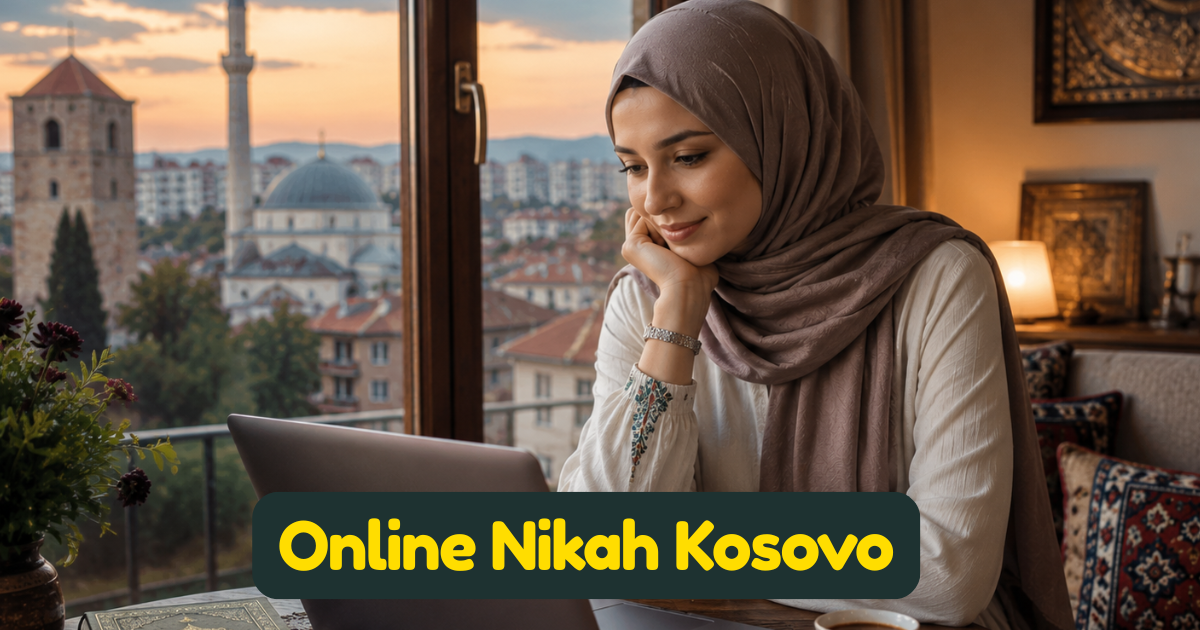
Online Nikah Kosovo — Complete Guide for Muslims in Kosovo and the Kosovar Diaspora
Kosovo declared independence from Serbia in February 2008 — making it one of the newest sovereign states in the world. Yet its Muslim identity is anything but new. The Albanian Muslim population of Kosovo traces its Islamic heritage back to the Ottoman period of the fourteenth and fifteenth centuries — a heritage that shaped the landscape, the culture, the architecture, and the social fabric of Kosovo in ways that are still visible in every city and village across the country today. The Sinan Pasha Mosque in Prizren, the Bajrakli Mosque in Pristina, the tekkes of the Bektashi and Naqshbandi Sufi orders that operate throughout Kosovo — these are the living architectural expressions of an Islamic tradition that has been woven into Kosovar Albanian identity for over six centuries.
Today Kosovo is one of the most Muslim countries in Europe by population percentage — over ninety percent of Kosovo's approximately two million residents identify as Muslim. The Islamic Community of Kosovo (Bashkësia Islame e Kosovës) — headquartered in Pristina and led by the Grand Mufti (Kryemyfti) — serves as the primary institutional authority for Islamic religious affairs across the country, maintaining a network of mosques, medrese, and Islamic educational institutions that represents one of the most active Islamic community structures among European Muslim majority populations.
Yet Kosovo's story cannot be told without acknowledging the war of 1998-1999, the NATO intervention that ended Serbian state violence against Kosovo's Albanian population, and the mass displacement that preceded and followed that conflict. The Kosovar diaspora — which today numbers somewhere between eight hundred thousand and one million people, representing a staggering proportion of Kosovo's total population — was shaped primarily by this conflict and by the subsequent labour migration of Kosovars seeking economic opportunities abroad. Switzerland, Germany, Austria, Sweden, the United Kingdom, and the United States are home to the largest Kosovar diaspora communities, and the ties between these diaspora communities and Kosovo itself remain among the most intense of any diaspora-homeland relationship in Europe.
For Muslims in Kosovo and across this vast and geographically dispersed diaspora, the question of conducting a properly documented, Shariah-compliant nikah raises both universal Islamic jurisprudence questions and specific Kosovar community realities that this article addresses completely. It covers the Islamic validity of online nikah, Kosovo's civil and religious marriage framework, the Islamic Community of Kosovo's role and reach, the wali and witness requirements within the Kosovar Albanian Muslim tradition, diaspora-specific guidance across Europe and beyond, and how to proceed with a fully documented Shariah-compliant virtual nikah ceremony through InstantNikah.com.
Kosovo's Marriage Framework — Civil Registration and the Islamic Community
Kosovo's legal framework — developed since the 2008 declaration of independence and still maturing in several areas — governs civil marriage through the Law on Family (Ligji mbi familjen) administered at the municipal level through the Zyrja e Gjendjes Civile (Civil Status Office) present in every Kosovo municipality. Civil marriage registration in Kosovo requires both parties to appear before the civil status officer, produce valid identification documents, submit birth certificates, and declare their consent to the marriage before the official and two adult witnesses. The civil marriage produces full legal recognition under Kosovo law including all civil spousal rights — property entitlements, inheritance rights, and maintenance claims enforceable through Kosovo civil courts.
The Islamic nikah — conducted within the framework of the Islamic Community of Kosovo — exists as a separate religious ceremony alongside and complementary to the civil registration. Kosovo's legal framework, like Bosnia's and unlike Turkey's, does not require civil registration to precede the religious nikah ceremony — the two processes can occur in either order or simultaneously, giving Muslim couples in Kosovo the flexibility to manage the civil and religious dimensions of their marriage according to their own circumstances and preferences.
The Islamic Community of Kosovo conducts nikah ceremonies through its network of imams across the country — with the nikah registered in the Islamic Community's own marriage register and a nikah certificate (çertifikata e martesës fetare) issued to the couple as evidence of the Islamic ceremony. This certificate is separate from the civil marriage certificate issued by the Zyrja e Gjendjes Civile and carries weight within the Kosovo Muslim community and within the Islamic Community's administrative framework.
The Islamic Community of Kosovo — Its Role and Institutional Reach
The Bashkësia Islame e Kosovës — the Islamic Community of Kosovo — is one of the most active Islamic institutional presences in the Western Balkans. Its roots go back to the Ottoman period, and its post-war reconstruction after the 1999 conflict involved significant institutional rebuilding supported by the international Muslim community. Today it operates hundreds of mosques across Kosovo, maintains Islamic educational institutions including the Medresa Alauddin in Pristina, and coordinates Islamic affairs across Kosovo's eight regions through a network of regional muftis and local imams.
For Muslim couples within Kosovo — particularly in cities and towns with established mosque networks — the local imam of the Islamic Community provides the most institutionally familiar and community-recognised route for conducting and documenting a nikah. The imam verifies the conditions of the nikah, guides the ijab and qabool in accordance with the Hanafi tradition that dominates Kosovar Albanian Muslim practice, records the mahr, and issues the nikah certificate within the Islamic Community's registration system.
For Muslims outside Kosovo — in the diaspora in Switzerland, Germany, Austria, Sweden, and beyond — the Islamic Community maintains some diaspora connections through Kosovar imams in diaspora communities and through the Kosovar Islamic cultural associations that operate in major diaspora cities. However, these diaspora structures are considerably less developed and less uniformly accessible than Kosovo's domestic network — and for Kosovar Muslims in diaspora cities without a local Kosovar imam, or in long-distance relationships spanning multiple countries, an online nikah through InstantNikah.com provides the most reliably documented and Islamic-condition-satisfying alternative.
Is Online Nikah Islamically Valid for Muslims in Kosovo?
The Islamic validity of an online nikah is determined by classical jurisprudence — not by Kosovar civil law, not by the Islamic Community's institutional procedures, and not by the geographic accessibility of a local imam. An online nikah conducted through a live, simultaneous video call in which all five conditions of a valid nikah are properly met is Islamically valid regardless of whether the parties are in Pristina, Prizren, Peja, Gjakova, or anywhere across the Kosovar diaspora in Europe and beyond.
Kosovo's Kosovar Albanian Muslim population follows the Hanafi school of jurisprudence — the dominant madhhab of the Ottoman world and the tradition maintained by the Islamic Community of Kosovo through its centuries of scholarly development within the Albanian Islamic tradition. Under Hanafi fiqh, the majority contemporary scholarly position holds that a live, simultaneous video connection satisfies the simultaneity requirement of the ijab and qabool, provided all parties can clearly see and hear each other in real time and all five conditions are properly fulfilled.
The five universally recognised conditions of a valid nikah under Hanafi fiqh — and across all four major Sunni schools — are:
- A willing bride whose consent is genuine, fully informed, and entirely free from any form of coercion or social pressure.
- A willing groom whose consent is similarly genuine and freely given.
- The wali — the bride's guardian — who makes the offer (ijab) on her behalf, or whose properly appointed wakeel does so in his place. Under Hanafi fiqh, the wali's involvement is strongly recommended and culturally important within the Kosovar Albanian tradition, even where the school's technical position provides some flexibility for adult women of sound mind.
- Two witnesses — adult Muslim males of sound character — present and genuinely aware of the ijab and qabool at the time they are exchanged.
- The mahr — the mandatory financial gift from the groom to the bride — specific, mutually agreed, and clearly recorded in the nikah contract.
The comprehensive scholarly analysis of the online nikah ruling — including the Hanafi school's specific approach to remote ceremonies — is covered in the dedicated articles on whether online nikah is valid in Islam and whether nikah can be done over Zoom or video call.
The Wali Requirement Within the Kosovar Albanian Muslim Tradition
The wali requirement occupies a culturally important position within Kosovar Albanian Muslim marriage practice — reflecting not only the Hanafi fiqh tradition but also the deep-rooted Kosovar Albanian cultural emphasis on family honour, paternal authority, and communal participation in marriage decisions. In traditional Kosovar Muslim communities, the father's role as wali is not merely a technical Islamic legal requirement but a central feature of the marriage ceremony that carries profound social and familial significance.
Under Hanafi fiqh — as noted in the dedicated Bosnia and Turkey articles — an adult Muslim woman of sound mind has a degree of capacity to contract her own nikah, distinguishing the Hanafi position from the Shafi'i school's strict wali requirement. The Islamic Community of Kosovo's standard nikah procedure incorporates the wali as part of the recommended and customary practice, reflecting the cultural centrality of the wali within Kosovar Muslim family life.
For Kosovar Muslim women seeking an online nikah — whether in Kosovo or in the diaspora — the wali's involvement is strongly encouraged and should be incorporated into the ceremony wherever possible. The wali participates through the live video call from his location — making the ijab while all other parties are connected from their respective locations. A father in Pristina, a brother in Zurich, or an uncle in Stuttgart can all participate fully in the ceremony through the live video connection regardless of the geographic distance between the parties.
For Kosovar Muslim women whose wali situation is complicated by the war displacement and losses of the 1998-1999 conflict — similar to the Bosniak situation addressed in the Bosnia and Herzegovina article — the Hanafi school's flexibility and the wali hakim mechanism provide the established Islamic pathways. The detailed framework is addressed in the dedicated articles on online nikah without a wali and what happens if the wali refuses the nikah. The wakeel appointment mechanism is covered in the article on what a wakeel is in nikah and how to appoint one.
The Witness Requirement for Muslims in Kosovo and the Diaspora
Two adult Muslim male witnesses of sound character are required for a valid nikah across all four major Sunni schools. For Muslims in Kosovo — where the overwhelming majority of the population is Muslim and mosque communities are active across the country — finding two qualified Muslim male witnesses is generally straightforward within the local community context.
For Kosovar Muslims in the diaspora — in Swiss, German, Austrian, Swedish, or British cities — the Muslim community is generally accessible enough that two qualified Muslim male witnesses can be arranged in most diaspora cities with significant Kosovar communities. For Kosovars in smaller cities or towns with limited Muslim community presence, witnesses can participate through the live video call from any location — including from Kosovo, from another European country, or from wherever qualified Muslim male witnesses are accessible.
The specific Islamic rulings on female witnesses and non-Muslim witnesses are addressed in the dedicated articles on whether a woman can be a witness at nikah in Islam and whether a non-Muslim can be a witness at nikah.
The Mahr in the Kosovar Albanian Muslim Tradition
The mahr — known in the Kosovar Albanian context as mehr — is the mandatory financial gift from the groom to the bride that forms a non-negotiable condition of every valid nikah. Within Kosovar Albanian Muslim culture, the mehr has historically been expressed in forms that reflect both the Ottoman Islamic tradition and the specific Albanian cultural context — often specified as a gold amount or a combination of gold and currency, reflecting the traditional Balkan Muslim practice of expressing mahr in tangible precious metal terms.
Regardless of its cultural form, the Islamic requirement is consistent: the mahr must be real, specific, genuinely agreed by both parties, documented in the nikah contract, and belonging exclusively to the bride from the moment the nikah is contracted. The Islamic Community of Kosovo's standard nikah documentation records the mehr as part of the nikah contract — reflecting the Ottoman-derived administrative tradition that has been maintained in Kosovar Islamic practice.
For Kosovar Muslims conducting a nikah through InstantNikah.com, the mahr amount and its terms — both prompt and deferred portions — are confirmed and documented as part of the nikah contract. The comprehensive framework of mahr is covered in the dedicated articles on what mahr is in nikah and how much mahr is enough in Islamic law.
When Do Muslims in Kosovo and the Kosovar Diaspora Need an Online Nikah Service?
The most common scenarios in which Kosovar Muslims seek an online nikah service through InstantNikah.com reflect the specific realities of Kosovo's diaspora-homeland dynamic:
One or Both Parties Are in the Kosovar Diaspora Abroad
This is by far the most common scenario. The Kosovar diaspora — dispersed across Switzerland, Germany, Austria, Sweden, the UK, and the USA — is extraordinarily large relative to Kosovo's total population. A Kosovar Muslim in Zurich in a long-distance relationship with a partner in Pristina, or two Kosovar Muslims in Stuttgart and Vienna respectively, face genuine logistical challenges in arranging a traditionally conducted nikah without requiring significant travel. The online nikah resolves this directly — with all parties connecting through the live video call from their respective locations.
Cross-Border Relationships Between Kosovar and Non-Kosovar Muslims
Kosovar Muslims in the diaspora — particularly younger generations who have grown up in Switzerland, Germany, Austria, and Sweden — increasingly enter relationships with Muslims from other communities. An internationally qualified online Islamic service that conducts the nikah meeting all Islamic conditions regardless of the cultural backgrounds of the parties provides a more inclusive and practically accessible ceremonial experience than navigating any single community's institutional nikah process.
Urgency — Same Day or Express Nikah Needed
Kosovar Muslims in urgent circumstances — health situations, travel requirements, visa considerations, or other pressing needs — can access a properly documented nikah arranged and conducted within hours through InstantNikah.com's Same Day Nikah and Instant Nikah packages, without requiring travel to Kosovo or to a local mosque.
Privacy and Family Opposition
Within Kosovar Albanian Muslim culture — where family honour and communal marriage customs carry significant social weight — some Muslim couples seek a private nikah conducted discreetly before any public family celebration or announcement. The online format provides this privacy while maintaining full Islamic validity and complete documentation. The dedicated article on private online nikah and discreet ceremony guidance addresses this scenario in full detail.
The Kosovar Diaspora — Country-Specific Guidance
Kosovar Muslims in Switzerland
Switzerland has the largest Kosovar diaspora community in the world outside Kosovo itself — estimated at between one hundred and fifty thousand and two hundred thousand, representing an extraordinary concentration given Switzerland's total population of approximately nine million. Kosovar Muslims are concentrated in Zurich, Basel, Bern, Lucerne, Geneva, and across the German-speaking Swiss cantons. Kosovar Islamic cultural associations and Albanian-language mosque communities operate in several Swiss cities, providing some community religious services.
For Kosovar Muslims in Switzerland who need an online nikah — whether for long-distance relationship logistics, urgency, or cross-cultural marriage circumstances — the service is fully accessible from any Swiss location. Swiss civil marriage law requires registration at the Zivilstandsamt for legal recognition, and this should be pursued separately alongside the nikah. The dedicated article on online nikah in Switzerland provides full civil law guidance for Switzerland.
Kosovar Muslims in Germany
Germany has the second-largest Kosovar diaspora community — estimated at between one hundred thousand and one hundred and fifty thousand — concentrated in Stuttgart, Frankfurt, Cologne, Hamburg, Munich, and Berlin. Albanian-language Muslim community organisations operate in several German cities alongside the broader DITIB and DITIB-adjacent Turkish mosque networks that many Kosovar Muslims also access. For Kosovar Muslims in Germany seeking an online nikah, the service is fully accessible from any German location, with the wali connecting from Kosovo or elsewhere and witnesses joining from wherever they are located. The dedicated article on online nikah in Germany provides full civil law guidance.
Kosovar Muslims in Austria
Austria — particularly Vienna and Graz — has a significant Kosovar Albanian Muslim community. Vienna's Islamic community includes a visible Kosovar Albanian presence, with Albanian-language mosque communities providing religious services for Kosovo-origin Muslims in the Austrian capital. For Kosovar Muslims in Austria seeking an online nikah, the service is fully accessible from any Austrian location. The dedicated article on online nikah in Austria provides the relevant civil law context.
Kosovar Muslims in Sweden
Sweden accepted significant numbers of Kosovar Albanian refugees during and after the 1998-1999 war and has an established Kosovar Muslim community — concentrated in Malmö, Stockholm, Gothenburg, and other Swedish cities. For Kosovar Muslims in Sweden seeking an online nikah, the service is fully accessible from any Swedish location. The dedicated article on online nikah in Sweden provides relevant civil law context.
Kosovar Muslims in the United Kingdom
The UK has a smaller but established Kosovar Muslim community — concentrated primarily in London, Birmingham, and other major British cities — shaped by both war-period refugee arrivals and subsequent labour migration. For Kosovar Muslims in the UK seeking an online nikah, the service is fully accessible from any UK location. The dedicated article on online nikah in the UK provides the full civil law context relevant to Kosovar Muslims in England and Wales.
Kosovar Muslims in the United States
The United States has a significant Kosovar Albanian Muslim community — concentrated in New York, New Jersey, Connecticut, Michigan, and other states — shaped primarily by the 1990s refugee resettlement programmes and subsequent chain migration. For Kosovar Muslims in the USA seeking an online nikah, the service is fully accessible from any US location. The dedicated article on online nikah in the USA provides the relevant civil law context and guidance for American jurisdictions.
The War Displacement Factor — A Unique Kosovar Context
Like the Bosniak community, the Kosovar Albanian Muslim community carries the specific and profound consequences of wartime displacement that affect the nikah landscape in ways unique to their community. The 1998-1999 conflict — which resulted in the displacement of over eight hundred thousand Kosovars at its peak and the deaths of thousands of civilians — disrupted family structures, killed fathers and brothers who would ordinarily serve as walis, and scattered extended families across multiple countries and continents in ways that continue to affect family reunification and marriage arrangements decades later.
For Kosovar Muslim women whose fathers were killed during the war, whose families were scattered across Switzerland, Germany, Kosovo, and the USA in ways that make gathering all parties in one location for a traditional nikah logistically impossible, or whose wali situation is genuinely complicated by the war's demographic consequences — the Hanafi school's flexibility on the wali question and the wali hakim mechanism are not merely academic provisions. They are practically essential Islamic legal tools that acknowledge the specific historical reality of the Kosovar community.
An online nikah service that can accommodate the wali in Kosovo, the bride in Switzerland, the groom in Germany, and the witnesses in Austria — all simultaneously connected through a live video call, with a qualified Islamic scholar guiding the ceremony to ensure all conditions are properly met — is precisely the kind of practically adapted Islamic solution that serves the Kosovar community's real needs in the twenty-first century.
The Albanian Muslim Identity — Islam, Culture, and Kosovar National Identity
The relationship between Islam and Kosovar Albanian identity is complex and deeply intertwined in ways that distinguish the Kosovar Muslim community from many other European Muslim populations. During the communist period of Yugoslavia — when Kosovo was an autonomous province under the Socialist Federal Republic of Yugoslavia — religious practice was severely restricted and officially discouraged. Islam persisted in Kosovar Albanian communities as much as a cultural identity marker as a theological commitment — a dimension of Albanian distinctiveness that differentiated Kosovar Albanians from their Orthodox Serbian neighbours and that survived the communist period's systematic campaign against religious observance.
Post-independence Kosovo has seen a significant revival of Islamic practice and institution-building — with the Islamic Community of Kosovo expanding its educational, social, and mosque programmes substantially since 2008. This revival reflects both genuine religious commitment and the role of Islamic identity in the broader project of Kosovar national self-definition in the post-independence period.
For Kosovar Muslims in the diaspora — particularly those who grew up in Western European countries during or after the war — the relationship between Islamic practice, Kosovar Albanian identity, and diaspora social life is a nuanced and personally significant one. Conducting a properly documented, Shariah-compliant nikah — one that meets the full conditions of Islamic jurisprudence and produces a complete nikah certificate — is for many Kosovar Muslims not merely a religious obligation but an affirmation of their Islamic and Albanian identity that connects them to six centuries of Kosovar Islamic tradition.
Protecting Rights in the Nikah Contract — Guidance for Kosovar Muslim Women
Kosovar Muslim women — whether in Kosovo or in the diaspora — have the full Islamic right to include binding protective conditions in their nikah contract. These conditions can include the right to continue working or studying after marriage, geographic restrictions on relocation without consent, housing arrangements, conditions protecting against a second wife being taken without consent, and the delegated right of self-divorce through tafwid al-talaq.
Within Kosovar Albanian Muslim culture — where traditional gender expectations around marriage and family roles remain culturally significant in some communities — understanding and actively exercising the right to include protective nikah contract conditions is of genuine practical importance for Kosovar Muslim women who wish to establish clear contractual protections from the outset of their marriage. Islamic law fully supports these rights — and knowing about them before the nikah is signed is the only way to ensure they are incorporated.
For Kosovar Muslim women in diaspora countries who are also civilly married, the civil family law of their country of residence — Swiss, German, Austrian, Swedish, or UK law as applicable — provides an additional framework of spousal financial rights enforceable through civil courts. The combination of Islamic contractual protection through the nikah contract and civil legal protection through civil marriage registration provides the strongest available legal framework.
The comprehensive guide on protective conditions in the nikah contract for Muslim women explains every available protective condition in detail. The article on financial protection before nikah provides broader context on the financial dimensions of pre-nikah planning.
Common Questions Muslims in Kosovo and the Kosovar Diaspora Ask About Online Nikah
Is an online nikah conducted through InstantNikah.com recognised by the Islamic Community of Kosovo?
An online nikah conducted through InstantNikah.com is Islamically valid as a nikah contract under the Hanafi conditions that the Islamic Community of Kosovo upholds. It is not issued or registered through the Islamic Community's own institutional registration system — it is an independent Islamic ceremony with full scholarly oversight and complete documentation. For Kosovar Muslims who wish their nikah to be registered within the Islamic Community's institutional register — which carries community recognition weight within Kosovo — the standard process through a local imam of the Islamic Community remains the preferred route where accessible. For those for whom that route is not accessible, the InstantNikah.com ceremony provides a fully documented and Islamically valid alternative.
Does civil marriage need to happen before the nikah in Kosovo?
No — unlike Turkey, Kosovar civil law does not require civil registration to precede the religious nikah ceremony. The nikah and the civil registration at the Zyrja e Gjendjes Civile can occur in either order or simultaneously. For full civil legal spousal rights in Kosovo, civil registration is required separately from the Islamic ceremony. Both processes should be pursued by couples who wish their marriage to carry both Islamic validity and Kosovar civil legal recognition.
Can my wali participate from Kosovo if I am in Switzerland or Germany?
Yes — the wali participates through the live video call from Kosovo while the groom and other parties are connected from Switzerland, Germany, Austria, or wherever they are located. This arrangement is fully accommodated within every ceremony facilitated by InstantNikah.com and requires only a stable internet connection on the wali's end. Kosovo's Central European Time zone (CET — UTC+1, CEST — UTC+2 in summer) is identical to Germany, Austria, and Switzerland — making time zone coordination between Kosovo and these diaspora countries completely seamless.
What if my wali is unavailable due to war displacement or family loss?
The Hanafi school's flexibility on the wali and the wali hakim mechanism — whereby a qualified Islamic scholar appoints a substitute guardian for a woman whose biological wali chain is genuinely unavailable — provides the established Islamic pathway for this situation. The InstantNikah.com team can advise on the appropriate approach based on your specific circumstances. The dedicated articles on online nikah without a wali provide the full framework.
How quickly can a ceremony be arranged?
Through InstantNikah.com's Same Day Nikah and Instant Nikah packages, a ceremony can be arranged and conducted within hours of booking. Kosovo's Central European Time zone facilitates seamless coordination with all major Kosovar diaspora countries — Switzerland, Germany, Austria, Sweden — within the same time zone or with a difference of only one hour.
What documentation will I receive?
Every nikah conducted through InstantNikah.com produces a fully documented Islamic nikah certificate recording all parties' details, the wali's involvement, the witnesses' confirmation, the mahr amount and terms, the date and format of the ceremony, and the officiating scholar's credentials. This certificate serves as evidence of the Islamically valid ceremony for community recognition, Islamic arbitration purposes, and as supporting documentation alongside any civil registration process.
Prizren — Kosovo's Islamic Cultural Heart
No article on Islam in Kosovo can pass without acknowledging Prizren — the ancient city in southern Kosovo that serves as the cultural and historical heart of Albanian Islamic civilisation in the region. Prizren's old city contains some of the finest surviving examples of Ottoman Islamic architecture in the Western Balkans — the Sinan Pasha Mosque (built 1615), the Gazi Mehmed Pasha Mosque, the historic hammam, the Ottoman bridge over the Bistrica River, and the tekkes of multiple Sufi orders that continue to operate in the city today.
Prizren was also the site of devastating destruction during the 1999 war — including the burning of Serbian Orthodox churches by Albanian mobs in the aftermath of the NATO intervention, a painful chapter in Kosovo's complex post-war reality. Yet the city's Islamic heritage survived and continues to be actively maintained — the restoration of the Sinan Pasha Mosque, supported by the Turkish Cooperation and Coordination Agency (TİKA), stands as one of the most significant examples of Islamic architectural heritage restoration in post-war Europe.
For Muslims in Kosovo and across the Kosovar diaspora who conduct a nikah — whether in Prizren's shadow or through a live video call from Zurich, Stuttgart, or New York — they are connecting to a tradition of Islamic practice that Prizren and Kosovo have sustained for six centuries. A properly documented, Shariah-compliant nikah, conducted with full scholarly oversight and complete documentation, is an expression of that living tradition — as meaningful in the twenty-first century as it was in the Ottoman period when Kosovo's Islamic institutional life first took root.
How to Proceed With an Online Nikah in Kosovo Through InstantNikah.com
The process for Muslims in Kosovo and the Kosovar diaspora conducting an online nikah through InstantNikah.com is fully guided from start to completion:
- Select your service package — choose between Instant Nikah, Express Nikah, Same Day Nikah, or Essential Nikah depending on your timeline and specific circumstances.
- Provide the required information — full names and identification details of both parties, wali details and his relationship to the bride, witness names and locations, and the agreed mahr amount with its prompt and deferred terms clearly specified.
- Schedule the ceremony — the InstantNikah.com team coordinates the live video call at a time that works for all parties. Kosovo operates on Central European Time (CET — UTC+1, CEST — UTC+2 in summer) — the same time zone as Germany, Austria, Switzerland, and most of the Kosovar diaspora's primary host countries — making scheduling coordination between Kosovo-based and diaspora parties entirely seamless without any time zone complexity.
- Attend the ceremony — a qualified Islamic scholar facilitates the full nikah ceremony over the live video call — delivering the khutbah al-nikah, verifying all five conditions, guiding the ijab and qabool, confirming the mahr terms, and leading the du'a for the couple.
- Receive your nikah certificate — the complete documentation is produced and provided to both parties following the ceremony, recording all conditions, all parties, and the officiating scholar's credentials in full.
You can review the full nikah process, read verified client reviews, or explore the gallery of ceremonies. To proceed, book your nikah directly through packages including Instant Nikah, Express Nikah, Same Day Nikah, and Essential Nikah. For specific questions about your circumstances — including wali arrangements across diaspora locations, witness logistics, or documentation requirements — the team is available to assist directly.
Admin User
Author