Our Journal
Insights, updates, and guidance on your journey to a blessed union.
Online Nikah in Saudi Arabia for Expats: What the Najiz System Cannot Do and How to Marry Islamically When Your Partner Is Abroad
Saudi Arabia offers Muslim expats a digital marriage registration pathway through the Najiz portal, but this only works when both parties hold a valid iqama and Absher account inside the Kingdom. For the millions of expats whose fiancée is abroad, on a visit visa, or from a different country's legal system, the Saudi court route simply does not apply. This guide explains where the Saudi system ends, how a Shariah-compliant online nikah fills the gap, what documents expats need, and who this solution is built for — from Bangladeshi workers in Riyadh to Pakistani professionals in Jeddah waiting on a fiancée still in Lahore.

Online Nikah in Hong Kong: A Practical Islamic Marriage Guide for Expats, Domestic Workers, and Long-Distance Muslim Couples
Hong Kong is home to roughly 300,000 Muslims — 4.1 percent of the city's population — including large Pakistani, Indonesian, and South Asian communities whose family and wali are rarely within reach. The city's civil Marriage Ordinance requires a 15-day notice period and in-person attendance at a registry, but gives the nikah no legal standing of its own. This guide explains how a Shariah-compliant online nikah works in Hong Kong, what the civil registration process involves, and which situations — domestic workers, professionals, long-distance couples, and converts — it is best suited to serve.
Online Nikah in Qatar for Muslim Expats: Why the Family Court Cannot Help When Your Fiancée Is Abroad
Qatar's Family Court (formerly the Shariah Court) requires both parties to hold valid residency permits, a wali to be physically present, two Qatar-resident Muslim witnesses, and a pre-marital medical certificate — making it inaccessible to the majority of Muslim expats whose fiancée or guardian is still in their home country. With migrant workers forming over 91 percent of Qatar's population, this gap is enormous. This guide explains exactly where the Qatari court system stops, how a Shariah-compliant online nikah fills that gap, and what couples need to do for civil recognition of their marriage.
Online Nikah in Kuwait for Muslim Expats: The Shariah Court Gap, the Wali Problem, and How to Marry Islamically When Your Family Is Abroad
Kuwait's Shariah court requires the wali to attend in person, two Kuwait-resident Muslim witnesses, a valid Civil ID for both parties, and a premarital medical certificate — leaving the majority of Muslim expat workers whose fiancée and guardian are abroad with no court route whatsoever. With expatriates making up nearly 70 percent of Kuwait's 4.9 million population and Kuwait having not signed the Hague Apostille Convention, the civil documentation burden is unusually heavy. This guide explains exactly where the Kuwaiti system stops, how a Shariah-compliant online nikah fills the gap, and how to complete the civil registration afterwards.
Online Nikah in Bahrain for Muslim Expats: Sunni and Jafari Courts, Residency Requirements, and Why Most Couples Still Need a Remote Ceremony
Bahrain is the only Gulf state with two parallel Shariah court systems — Sunni and Ja'fari — each with its own personal status law governing Muslim marriage. Yet for the majority of Muslim expats whose fiancée or wali is abroad, neither court is accessible without valid Bahraini residency and a physically present guardian. With expatriates making up over 52 percent of Bahrain's 1.5 million population, and the Indian and Pakistani communities forming the largest foreign groups, the gap between who needs a nikah and who can access the courts is wide. This guide explains Bahrain's marriage framework, where it stops for expats with family abroad, and how a Shariah-compliant online nikah fills that gap.
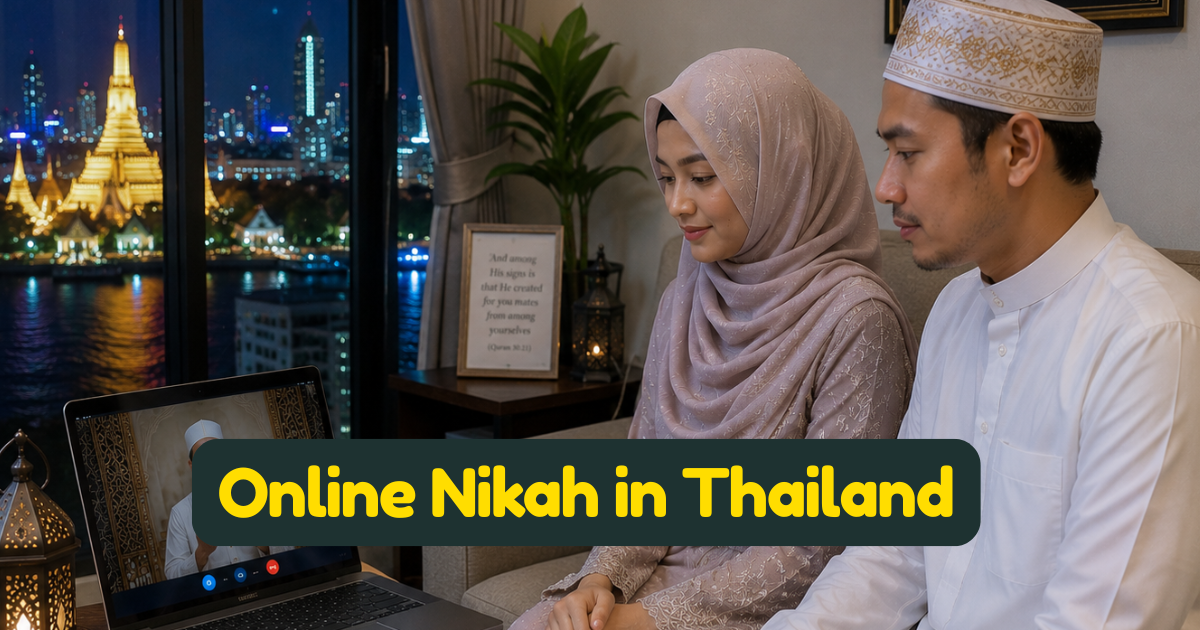
Online Nikah in Thailand: Islamic Marriage in a Buddhist-Majority Country, the Southern Province Shariah Framework, and Remote Ceremonies for Muslim Expats and Visitors
Thailand is a Buddhist-majority country that nonetheless operates a statutory Islamic family law framework in its four southern provinces — one of the most unusual legal arrangements for Muslim personal affairs anywhere in the world. Outside those provinces, a nikah has no independent civil standing unless separately registered. For Muslim tourists, expats, and long-distance couples whose wali and family are abroad, the system creates real gaps. This guide explains Thailand's dual-track marriage framework, how a Shariah-compliant online nikah works in this context, and what registration steps follow for full civil recognition.