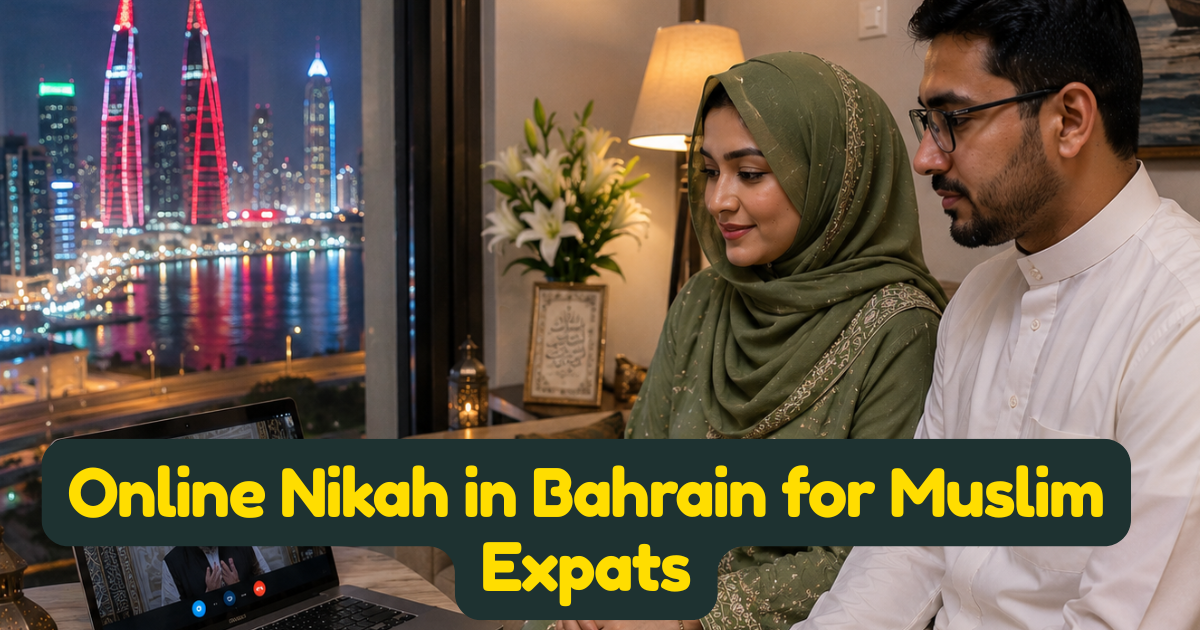
Online Nikah in Bahrain for Muslim Expats: Sunni and Ja'fari Courts, Residency Requirements, and Why Most Couples Still Need a Remote Ceremony
Bahrain occupies a curious position among the Gulf Cooperation Council states. It is smaller than most of its neighbours, more cosmopolitan in character, and — uniquely in the region — operates two entirely separate Shariah court systems for Muslim personal affairs: one for Sunni Muslims and one for Ja'fari (Shia) Muslims. Every Muslim marriage in Bahrain is governed by one or the other, and which court applies depends entirely on the religious denomination of the parties involved. It is a legal arrangement found nowhere else in the Gulf, and it matters for expat couples because it means getting married through the Bahraini system is not simply a question of presenting documents — it is a question of presenting the right documents to the right court under the right personal status law.
And for the majority of Muslim expats living in Bahrain, none of that complexity is even reached. Because the courts have a prior requirement that most working expatriates cannot meet: at least one party must hold official Bahraini residency, the bride's wali must be physically present in the kingdom, and two male Muslim witnesses over the age of 21 must attend in person. According to Bahrain Moments, expatriates made up over 52.6 percent of Bahrain's total population of just over 1.5 million in 2024 — the Indian and Pakistani communities leading among Asian nationalities, supported by significant Bangladeshi, Filipino, and Egyptian communities. Most of these workers arrived without their families. Most of them need to marry without their families present in Bahrain. And most of them cannot use the Bahraini Shariah courts to do so.
Understanding Bahrain's Two-Track Shariah System
Bahrain's Personal Status Law governs all Muslim marriages, but it operates through two court tracks that apply different jurisprudence to different communities.
The Sunni Personal Status Courts apply Hanbali and Shafi'i principles and handle marriages for Sunni Muslim couples. This is the route used by the vast majority of South Asian and Egyptian Muslim expats — Bangladeshis, Pakistanis, Indians who are Muslim, and Arab workers from predominantly Sunni countries.
The Ja'fari Personal Status Courts apply Shia jurisprudence and handle marriages for Shia Muslim couples. This is relevant primarily for Iranian, Iraqi, and Lebanese Shia communities in Bahrain, as well as Bahraini nationals who follow Ja'fari madhab.
Both court tracks sit under the jurisdiction of the Ministry of Justice, Islamic Affairs and Waqf of Bahrain. As confirmed by Expat.com's Bahrain marriage guide, the Ministry oversees all marriage procedures for both locals and foreigners, and the process involves verifying religious status, confirming the school of jurisprudence applicable to the parties, and ensuring compliance with that school's specific personal status provisions — including different rules on mahr computation and divorce rights between the Sunni and Ja'fari systems.
The practical takeaway for couples is this: whichever court track applies to you, both systems share the same core requirements for the ceremony itself — requirements that close the court door for most expat couples whose family is abroad.
What Both Courts Require — and Where the Gap Begins
The official Bahrain.bh government services portal sets out the requirements for marriage registration under the Ministry of Justice, Islamic Affairs and Endowments. They are as follows:
- Valid passports and Bahraini ID cards (CPR cards) for both parties. At least one party must hold valid Bahraini residency — a visit visa does not qualify.
- Physical presence of the bride's wali at the ceremony. Under both Sunni and Ja'fari personal status law, the wali's role is not something that can be delegated to a court official as a matter of course — his presence is a condition of the ceremony proceeding.
- Two male Muslim witnesses over the age of 21, present in person and presenting valid identification at the time of the ceremony.
- A premarital medical examination certificate from an accredited Bahraini hospital, required before the mazoon (marriage officiant) can proceed.
- Proof of current or previous marital status — a certificate of single status or, if previously married, a divorce or death certificate — from the home country, translated into Arabic and attested.
- A No Objection Certificate (NOC) from the relevant home-country embassy in Bahrain, confirming the parties are legally free to marry.
The marriage guidance published by wedding resource Lotus Wedding notes an additional practical constraint: for marriages between a Bahraini national and a foreigner, or between two foreigners where one has a Bahraini connection, a specialised judge — not a regular mazoon — must conduct the ceremony. This creates further procedural complexity for cross-national couples beyond the standard document requirements.
Bahrain's Unique Digital Option — and Its Limits
Bahrain has made one notable concession to digital access that sets it slightly apart from Kuwait and Qatar: the Ministry of Justice accepts applications to accredit foreign marriage certificates — marriages contracted abroad — through an email submission process to the Sharia Procedures Department, as documented on the official Bahrain government services portal. Couples submit a completed application form and supporting documents in PDF format; the department schedules an appointment by SMS once documents are verified.
This is genuinely useful — but only for couples who have already married abroad through a recognised Islamic ceremony and need Bahrain to acknowledge that marriage for civil purposes. It does not help the couple who has not yet married and whose fiancée is in Bangladesh. It does not replace the court ceremony. It is an accreditation route, not an alternative to the nikah itself.
For the worker in Manama whose intended is still in Lahore, whose father-in-law is still in Faisalabad, and who cannot take three weeks of leave plus afford flights and hotel for the wali, the bride, and two attending witnesses — Bahrain's digital option offers nothing. The need for an online nikah conducted properly before the civil registration is exactly as acute as it is in Kuwait and Qatar.
The Islamic Conditions That Need No Court Building
Bahraini personal status law is derived from Islamic jurisprudence. Its requirements for a valid nikah — the wali, the witnesses, the mahr, the consent — are Islamic in origin, not Bahraini inventions. This distinction matters because Islamic conditions do not change with geography and can be fulfilled over a properly managed video ceremony.
The wali's consent is required because the Prophet (peace be upon him) said, "There is no marriage without a guardian" — a hadith narrated by Abu Dawud and Ibn Majah and graded authentic by al-Albani. He does not need to be in Bahrain to give that consent; he needs to hear the contract and confirm his agreement. Two witnesses need to genuinely hear the offer (ijab) and acceptance (qabul); their location at the time of hearing is a secondary concern compared to the quality of their hearing. Mahr belongs to the bride as her right the moment it is agreed — the agreement is Islamic, not administrative.
A properly structured online nikah fulfils every one of these conditions. Our guide on the video-call nikah ruling documents the scholarly basis in detail. The specific question of witness attendance remotely is addressed in our analysis of whether nikah witnesses can be appointed remotely.
How InstantNikah.com Serves Muslim Expats in Bahrain
InstantNikah.com conducts Shariah-compliant online nikah ceremonies through a secure live video connection. A qualified qazi or scholar officiates. The bride's wali joins from wherever he is — Dhaka, Karachi, Cairo, Manila. Two qualified Muslim witnesses confirm on the call that they have heard the offer and acceptance. The mahr is agreed and documented. A nikah certificate is issued after the ceremony for use in subsequent civil registration.
Once the nikah is complete, couples can pursue the civil route that fits their situation — registering the marriage in the home country and then submitting the attested certificate to Bahrain's Sharia Procedures Department by email for recognition within the kingdom, or registering at their home country embassy in Bahrain where the service is available. The Bahrain.bh government portal's email accreditation service then becomes genuinely useful: the online nikah certificate provides the Islamic foundation, and the accreditation service handles the civil recognition in Bahrain.
For couples unsure how the civil registration sequence works across different nationalities, our comprehensive country guide on registering a nikah civilly after the Islamic ceremony gives a step-by-step framework. The question of when a wakeel — a proxy — can represent the wali is covered in our piece on how to appoint a wakeel in nikah.
Who This Particularly Serves in Bahrain
- Indian and Pakistani Muslim professionals in Manama's banking and finance sectors whose intended spouse has not yet been sponsored on a family visa and whose wali is in Lahore or Mumbai.
- Bangladeshi construction and service workers whose fiancée holds no Bahraini residency and whose family's travel to Bahrain for a court ceremony is financially out of reach.
- Shia Muslim expats — particularly Iranian or Iraqi workers — who must navigate the Ja'fari court track with its additional requirements, and for whom an online nikah conducted under Ja'fari principles by a qualified scholar provides a valid Islamic marriage before the court process is pursued.
- Muslim converts with no Muslim guardian. A revert in Bahrain whose family is non-Muslim has no natural wali. A qualified imam or Islamic authority can fill that role, a provision our guide on how a convert finds a wali for nikah addresses directly.
Quick Answers for Muslim Expats in Bahrain
Do I need to specify whether my marriage follows Sunni or Ja'fari jurisprudence? Yes, for the Bahraini court registration. The court track — and the specific personal status rules applied to your marriage, including mahr calculation and divorce provisions — depends on your madhab. For the online nikah itself, InstantNikah.com's scholars are qualified across both traditions.
Is an online nikah valid from Bahrain? Islamically, yes — when the wali participates, two witnesses genuinely hear the contract, mahr is agreed, and consent is free. Bahrain's court requirements are administrative, not a redefinition of Islamic validity.
Can I use Bahrain's email accreditation service after an online nikah? Yes. Once the nikah has been conducted and a certificate issued, and after the marriage has been registered in your home country, the Bahrain Ministry of Justice's Sharia Procedures Department can accredit that foreign marriage certificate for recognition within Bahrain through its email submission process.
What if my fiancée has no Bahraini residency? She cannot be a party to the Bahraini court ceremony directly. The practical route is to complete the nikah online now, register the marriage in your home country, and seek Bahraini accreditation of that certificate once it is issued.
Two Courts, One Gap, One Solution
Bahrain's dual Shariah court system is a genuine legal achievement — a recognition that the Muslim community is not monolithic and that Sunni and Ja'fari Muslims have distinct personal status rights deserving of distinct judicial frameworks. But institutional sophistication on the religious side does not close the distance between a Pakistani engineer in Manama and his fiancée's father in Rawalpindi. That distance is not a legal problem; it is a human one, and the solution is not a better court system — it is a properly conducted ceremony that carries the Islamic contract across every time zone and border in the world. InstantNikah.com provides exactly that. When you are ready, book your online nikah and let our team guide you through both the ceremony and the civil path that follows.
Admin User
Author