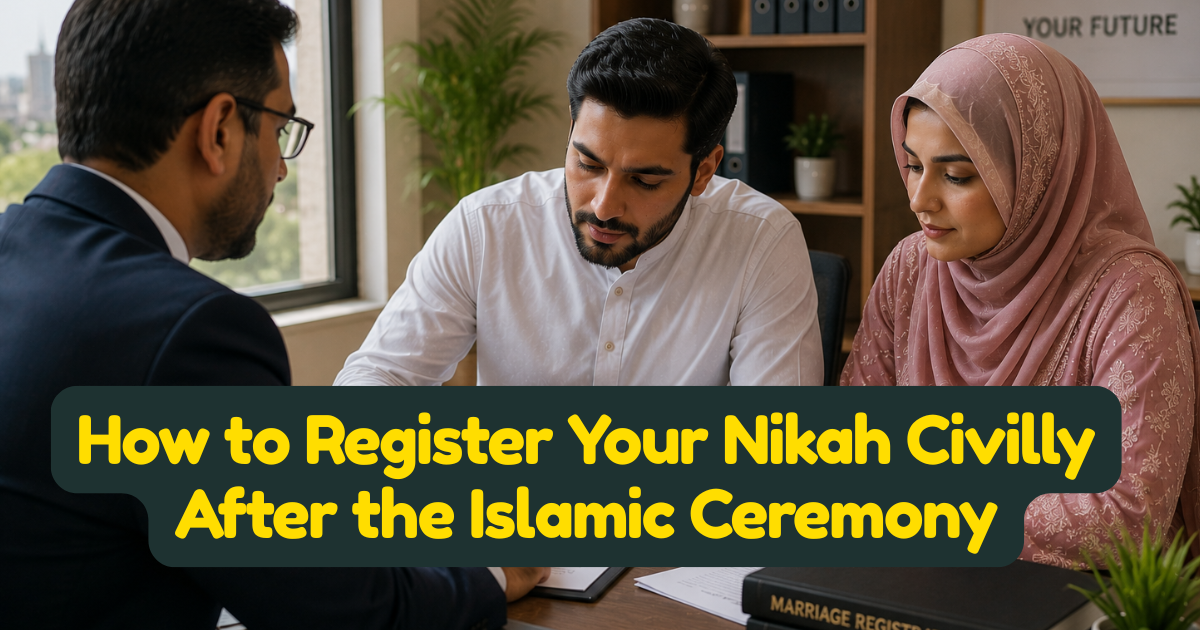
How to Register Your Nikah Civilly After the Islamic Ceremony — Country-by-Country Guide
There is a gap that runs through Muslim communities in almost every Western country — a gap between Islamic validity and legal recognition. A couple can have a beautifully conducted, fully Shariah-compliant nikah, with a qualified qazi, proper witnesses, an agreed mahr, and a signed nikah certificate, and still have no legal standing as a married couple under the law of their country. The nikah made them married in the sight of Allah and in the eyes of their faith and community. Civil registration makes them married in the eyes of the state, the courts, and the practical institutions of modern life.
Both matter. And this guide is for the growing number of Muslim couples — particularly those who completed their nikah online, in another country, or in circumstances where civil registration was not arranged simultaneously — who need to understand how to complete the process of legal recognition in the country where they live.
This is not a purely legal document. It is also a guide grounded in the Islamic understanding of why civil registration aligns with Islamic values — and why the scholars recommend it as strongly as they do.
The Islamic Case for Civil Registration
Before the country-by-country details, the Islamic reasoning deserves to be stated clearly, because some Muslim couples wonder whether involving the civil state in their marriage somehow compromises the Islamic nature of the ceremony or creates a parallel obligation that Islamic law does not require.
It does not. The Islamic scholarly consensus on this is well-established and practical. As the IslamOnline Fiqh resource on Islamic marriage and legal registration explains: "Islam allows for the nikah to be a private and sacred contract, but in non-Muslim countries, it is highly recommended that couples also register their marriage with the local authorities. This ensures that both partners are protected under the law, especially in cases of disputes, inheritance, and divorce."
The Deputy Chairman of the European Council for Fatwa and Research (ECFR), Sheikh Faysal Mawlawi, stated: "The legal marriage which is done in European countries is regarded as a valid marriage in the Shari'ah as long as there is no legal reason in the Shari'ah against it." This ruling confirms that civil marriage registration does not replace or compromise the nikah — it complements it, providing the couple with both religious and civil validity simultaneously.
Critically, the Islamic principle of maslaha — public interest and the protection of rights — strongly supports civil registration. A nikah without civil recognition leaves the wife particularly vulnerable: she may have no enforceable right to financial provision, inheritance, property, or civil divorce if the marriage breaks down. This vulnerability is directly contrary to the Islamic principle that marriage must protect both parties. As the UK House of Commons Library's research briefing on Islamic marriage and divorce in England and Wales documents, approximately 61% of British Muslims believed their nikah automatically guaranteed legal recognition — a misconception that has caused serious harm to women in particular when marriages dissolved without civil protection.
The Prophet Muhammad (peace be upon him) also directed Muslims to follow the laws of the land they live in, provided those laws do not contradict Islamic principles. Civil marriage registration does not contradict Islamic principles — it reinforces them by providing legal backing to the protections Islam already mandates.
The Two Things Civil Registration Gives You That Your Nikah Certificate Alone Cannot
Before the country-by-country breakdown, it helps to understand clearly what civil registration achieves that an Islamic nikah certificate — however professionally produced and widely accepted by Islamic institutions — cannot provide in Western legal systems:
- Legal rights in divorce — without civil registration, courts in the UK, USA, Canada, and Australia treat the couple as cohabiting partners rather than married spouses. This means no entitlement to financial orders, property division, or formal divorce proceedings. The wife cannot seek maintenance through a civil court. Inheritance rights are significantly reduced or absent.
- Spousal visa and immigration recognition — immigration authorities in Western countries require a civil marriage certificate to recognise a spousal visa application. A nikah certificate alone, even from a highly reputable Islamic institution, is generally not accepted as proof of marriage for immigration purposes unless it was issued in a country where religious marriages have legal standing under state law.
These two areas alone are sufficient reason for any Muslim couple in a Western country to prioritise civil registration — ideally before or simultaneously with the nikah, but if not, as soon as possible afterwards.
United Kingdom: What You Need to Do
The United Kingdom has one of the most significant gaps between religious and civil marriage recognition among Western nations. A nikah conducted at an unlicensed venue — including most mosques, private homes, and online ceremonies — has no legal standing under English law. The couple is treated as cohabiting partners, not as married spouses, regardless of how valid the nikah is under Islamic law.
As confirmed by the thorough legal analysis at Connaught Law's guide to Islamic marriage UK law: "A nikah ceremony on its own is not considered a legal marriage unless it complies with the Marriage Act 1949." The practical consequence is stark — without civil registration, a wife has no civil right to financial provision, no right to a civil divorce, and potentially no inheritance entitlement under UK intestacy law.
How to register your nikah civilly in the UK:
- Step 1: Give notice — both parties must give notice at their local register office (or the register office covering the district where the ceremony will take place). Notice must be given at least 28 days before the ceremony. This involves completing a form in person and paying a fee.
- Step 2: Choose your approach — couples can either: (a) have their nikah conducted at a licensed mosque or place of worship approved under the Marriage Act, in which case the imam who conducts the ceremony can simultaneously register it civilly; or (b) have a separate civil ceremony at a register office before or after the nikah.
- Step 3: Attend the civil ceremony — a civil ceremony at a register office is straightforward, takes under 30 minutes, requires two witnesses, and produces a legal marriage certificate. Many couples dress casually for this and reserve formal ceremony for the nikah itself.
- Step 4: Receive your marriage certificate — the register office issues a civil marriage certificate which serves as legal proof of marriage in the UK and is widely accepted internationally.
For UK couples who completed their nikah without civil registration, the process is the same — simply attend the register office to give notice and arrange the civil ceremony. There is no time limit on doing this after the nikah. The civil registration does not replace or re-do the nikah; it adds a separate layer of legal recognition alongside it.
Couples can also explore whether their mosque is registered for civil marriages. Some UK mosques hold a licence under the Marriage Act 1949 that allows an authorised person at the mosque to register marriages simultaneously with the religious ceremony. The Amaliah guide to civil registration for UK Muslims provides a clear walkthrough of this process.
United States: A State-by-State Reality
The United States has no single federal marriage law. Marriage is governed entirely by individual states, which means the process and requirements for civil recognition vary across all 50 states. However, the basic framework is consistent: a marriage license must be obtained before any ceremony, and the officiant must be legally authorised to perform marriages in that state.
As established in the guidance from Islamic Wills Trust Services USA: "A nikah contract alone is not legally binding in most U.S. states. The couple must also obtain a state-issued marriage license. U.S. states do not automatically recognize religious marriages unless registered through civil procedures."
The standard US process:
- Step 1: Obtain a marriage license — apply at the county clerk's office in the county where the ceremony will take place. Both parties must appear in person, provide identification, and pay a fee. Most states issue the license immediately; some require a waiting period of one to five days.
- Step 2: Ensure your imam is legally authorised — for the nikah to simultaneously serve as the legal marriage ceremony, the imam or officiant must be legally authorised to solemnise marriages in that state. Most imams serving Muslim communities in the US are registered as marriage officiants. Confirm this before the ceremony.
- Step 3: Complete the marriage license at the ceremony — the imam signs the marriage license during or after the ceremony, along with both parties and two witnesses. This document is then submitted to the county clerk's office.
- Step 4: Obtain the marriage certificate — after submission, the county clerk processes the registration and issues an official marriage certificate, typically within a few weeks.
For couples who completed their nikah without a marriage license — particularly online nikah ceremonies conducted from overseas — the process for achieving US civil recognition involves completing a civil ceremony in their state of residence with a licensed officiant. Many American Islamic centres, such as the Orange County Islamic Foundation and IMAN Center Washington, provide structured guidance for couples navigating both Islamic and civil requirements simultaneously.
An important note for US immigration: as confirmed by Qazi Law Offices' guidance on nikah and US immigration, USCIS may not recognise a US-performed nikah as a valid marriage for immigration purposes if it was not registered with a civil marriage license. Couples applying for spousal visas must present civil documentation.
Canada: Province-by-Province Process
Canada's marriage law is also provincially governed, with each province and territory setting its own requirements. The general framework across Canada requires a marriage license, an authorised officiant, and registration with the provincial authorities.
The Islamic Society of North America Canada (ISNA Canada) provides clear guidance on the process: couples must obtain a marriage license from the city hall of their municipality before the nikah, bring the marriage certificate application form to the imam in advance, and provide two pieces of identification. After the ceremony, the completed marriage certificate is submitted and processed through Service Ontario (for Ontario residents) or the equivalent provincial authority.
Key requirements across Canadian provinces:
- Marriage license — obtained from the municipal authority in the province where the marriage will take place. Most provinces issue licenses valid for 90 days.
- Authorised officiant — the imam or marriage official must be registered with the provincial authority to solemnise marriages. ISNA Canada and many mosque imams across the country hold this authorisation.
- Two witnesses — both witnesses must be adults present at the ceremony and must sign the marriage certificate.
- Registration — after the ceremony, the completed certificate is submitted to the provincial registry. Ontario couples can apply for their official marriage certificate through Service Ontario approximately six to eight weeks after submission.
Couples who completed their nikah in Canada without obtaining a marriage license must complete a civil ceremony to achieve legal recognition. Unlike some countries, Canada does not have a retroactive registration process for unregistered religious ceremonies.
Australia: The Notice of Intended Marriage Process
Australia operates under the Marriage Act 1961 (Cth), a federal law that governs all marriages nationwide regardless of state or territory. A nikah performed by an Islamic imam in Australia is not automatically recognised as a civil marriage unless the imam is registered as an authorised marriage celebrant under the Act.
As confirmed by Warragul Mosque's guidance on nikah in Australia: "A nikah performed by an Islamic imam is not automatically recognised as a civil marriage under Australian law — unless the imam is registered as a civil marriage celebrant."
The Australian civil registration process:
- Step 1: Lodge a Notice of Intended Marriage (NOIM) — this form must be submitted to an authorised marriage celebrant at least one month (and no more than 18 months) before the ceremony. This is a legal requirement that cannot be waived. The form requires proof of identity, date of birth, and marital status.
- Step 2: Choose an authorised celebrant — either a registered civil celebrant or an Islamic imam who is also registered as an authorised celebrant under the Marriage Act. The Board of Imams Victoria (BOIV) and similar bodies provide imams who hold dual authorisation, allowing them to conduct both the nikah and the civil marriage in a single ceremony.
- Step 3: Conduct the ceremony — the ceremony must include the specific civil marriage vows required under the Marriage Act alongside the nikah. The celebrant signs the official marriage certificate, which is then submitted to the state or territory Registry of Births, Deaths and Marriages.
- Step 4: Receive the marriage certificate — the registry processes the registration and issues an official Australian marriage certificate, which is the legal document recognised for all purposes including immigration, inheritance, and property law.
For couples who completed their nikah in Australia without civil registration, the retroactive option is to complete a separate civil ceremony with a registered celebrant. As noted in the guidance from Lyons Law Group Australia: unregistered religious marriages in Australia are treated as de facto relationships under Australian law, not as legal marriages.
Europe: The Civil-First Principle
Most European countries operate on a principle that is distinctly different from the UK, US, Canada, and Australia: many require the civil marriage to take place before any religious ceremony, and some will not permit religious ceremonies to proceed without prior civil registration.
As the Courtly Muslim marriage guide notes: "Places like France, Turkey, and several Central Asian states only recognize civil marriage. The Muslim marriage ceremony can be done, but only after or in addition to a state marriage."
Key European country frameworks:
France
France has one of the strictest civil-first marriage systems in the world. Under French law, a religious ceremony cannot legally precede a civil marriage. The civil marriage must be conducted at the local mairie (town hall) first. Religious or Islamic ceremonies conducted before the civil marriage have no legal standing. Muslim couples in France must therefore complete their civil marriage at the town hall before or on the same day as their nikah. The civil ceremony is simple, requires two witnesses and identity documents, and produces a livret de famille (family booklet) which serves as proof of marriage.
Germany
Germany similarly requires civil registration (standesamtliche Trauung) at the Standesamt (registry office) as the only legally recognised form of marriage. Religious ceremonies, including nikah, have no legal standing on their own. German law specifically states that conducting a religious ceremony before a civil marriage can, in some circumstances, be a criminal offence. Muslim couples in Germany must register civilly at the Standesamt first and may then conduct their nikah separately as a religious ceremony. Required documents typically include birth certificates, passports or ID cards, and proof of address.
Netherlands
The Netherlands follows the same civil-first principle as France and Germany. The civil ceremony at the gemeente (municipality) is the legal marriage; any religious ceremony is entirely separate and has no legal effect on its own. Dutch Muslim couples typically complete the civil ceremony at the town hall with minimal formality and then conduct their nikah ceremony separately.
Belgium, Sweden, Denmark, Norway, and Other EU Countries
Most EU member states follow similar frameworks. Civil marriage registration with the municipal authority is required for legal recognition. Religious ceremonies may precede or follow civil registration depending on the country. Couples should check the specific requirements of their country of residence, as the paperwork and waiting periods vary between jurisdictions.
What Happens to an Online Nikah Certificate in Civil Proceedings?
A question that arises specifically for couples who conducted their nikah through an online service is whether the nikah certificate they received can help with civil registration.
The honest answer is: it depends on the country and the specific situation. In most Western countries, a nikah certificate — even from a reputable Islamic institution — is not a substitute for civil registration. However, it can serve as supporting evidence in several contexts:
- Immigration applications — a professionally issued nikah certificate, combined with evidence of the relationship (communication records, joint arrangements, etc.) may support a visa application, though it should always be accompanied by civil documentation where possible
- Islamic legal proceedings — sharia councils and Islamic courts in countries like the UK accept nikah certificates as proof of Islamic marriage for purposes of Islamic divorce proceedings
- Community and cultural recognition — the nikah certificate establishes Islamic legitimacy of the marriage within the Muslim community, for mosque records, and for purposes of Islamic inheritance under a properly written Islamic will
For a detailed analysis of what a nikah certificate does and does not certify, see the guide at What Makes a Nikah Certificate Islamically and Legally Valid.
Islamic Rulings on Registering Marriage: What Scholars Advise
The scholarly position on civil registration of Islamic marriages in non-Muslim countries has become increasingly clear and uniform across major institutions. The reasoning draws on multiple Islamic principles simultaneously:
Protection of rights (hifz al-huquq) — Islamic law places enormous emphasis on protecting the rights of spouses, especially wives. Civil registration provides legal enforcement mechanisms for those rights that do not exist without it. Scholars who have examined the statistics of unregistered marriages and their impact on Muslim women — particularly in the UK — have been emphatic that registration is a matter of Islamic obligation in those circumstances, not merely a legal formality.
Following the law of the land — the Prophetic principle of following the lawful regulations of the country one lives in applies directly here. Civil marriage registration is a legal requirement or strong recommendation in virtually every Western country. Ignoring it places the Muslim community in a position of unnecessarily operating outside legal structures that protect them.
Avoiding harm (dar' al-mafsada) — the principle of preventing harm is one of the foundational objectives of Islamic law. An unregistered marriage exposes both spouses — and any children — to significant practical harm if the marriage dissolves or a spouse dies without a will. This harm is avoidable and should therefore be avoided.
As academic research published by MDPI's Religions journal on secret and unregistered marriages in Islamic law concludes: "In the modern world, not only does the marriage require witnesses, but it should also be recognized by the official authorities to prevent secret marriages and violations of rights for both the parties and the children."
A Practical Timeline for Couples Who Completed Their Nikah First
For couples who conducted their nikah — including an online nikah — without simultaneous civil registration, here is the practical sequence to follow:
- Immediately: Confirm you have your nikah certificate from a reputable service. This is your Islamic record of the marriage. If you do not have a properly issued certificate, contact the service through which your nikah was conducted.
- Within weeks: Research the civil registration requirements for your country and local authority. Confirm whether you need to give advance notice (as in the UK and Australia) or can proceed more immediately (as in some US states).
- Gather documents: Passports or national ID, birth certificates, and — if either party was previously married — civil divorce certificates or death certificates as applicable.
- Complete the process: Follow the country-specific steps outlined above. In most cases, civil registration after the fact requires the same steps as registration before — there is no specific "retrospective" process, simply the standard civil marriage registration procedure.
- Protect yourselves further: Consider drafting Islamic wills that recognise your marriage and protect inheritance rights under Islamic law in parallel with civil legal protection. For guidance, see the guide to writing an Islamic will for Muslims in the UK, USA, and Europe.
How InstantNikah.com Supports Couples Through the Full Process
InstantNikah.com provides a premium Shariah-compliant online nikah service that issues properly documented nikah certificates accepted by Islamic institutions and sharia councils worldwide. Every certificate records the names of both parties, witnesses, wali, agreed mahr, and the conditions of the ceremony.
For couples who are also seeking civil registration, the team at InstantNikah.com can advise on the specific requirements in your country of residence and how your nikah certificate can best support that process. The service is used by Muslim couples across the UK, USA, Canada, Europe, Australia, and beyond — and the team understands the different civil law frameworks these couples navigate. Reviews from couples who have been through this full process can be found at the reviews page.
To book your nikah ceremony, visit the process page for a full overview, then choose from Instant Nikah, Same Day Nikah, Express Nikah, or Essential Nikah. For questions about civil registration in your specific country or situation, reach the team through the contact page.
Admin User
Author