Online Nikah in Saudi Arabia for Expats: What the Najiz System Cannot Do and How to Marry Islamically When Your Partner Is Abroad
There is something quietly extraordinary about Saudi Arabia as a place for Muslim marriage. The Kingdom is, after all, the cradle of Islam — the land where the Prophet (peace be upon him) lived, where Masjid al-Haram stands, and where Islamic law has governed personal affairs for centuries without interruption. A Muslim expat arriving from Bangladesh, Pakistan, or Indonesia might reasonably assume that getting a nikah done here should be the simplest thing in the world.
In certain circumstances, it is. Saudi Arabia's Ministry of Justice has even built a digital marriage registration platform — the Najiz portal, linked to the Absher identity system — allowing Muslim expatriates to register a marriage contract with a licensed ma'zoun (marriage officiant) without visiting a court in person. That is a genuinely modern convenience and, when it applies, it works well.
But it applies in a narrower set of circumstances than most people realise. And for the largest single category of Muslim expat couples — those where one or both partners are not yet in the Kingdom, or where the bride's wali is in another country, or where the fiancée has not yet obtained her iqama — the Saudi system simply cannot be used. That is the gap this article addresses, and the situation InstantNikah.com is built to serve.
Who Is Actually Living in Saudi Arabia as a Muslim Expat?
Saudi Arabia's 2022 national census placed the total population at approximately 32.2 million, of whom some 13.4 million — around 41.6 percent — were foreign nationals, as reported by The New Arab. The overwhelming majority of those expats are Muslim. Bangladeshi nationals form the largest single expat community, followed closely by Indians and Pakistanis — communities that are almost entirely Muslim — with Filipinos, Egyptians, Yemenis, and Indonesians also present in large numbers, according to demographic analysis published by Moveandstay.
These are working people — in construction, healthcare, logistics, domestic work, and professional services. Many of them are men who arrived alone on a labour visa, whose intended spouse is still in Dhaka, Lahore, Karachi, or Jakarta. Some have been in the Kingdom for years and now wish to marry properly before the next home visit, or before sponsoring their wife's entry. For them, the Saudi civil system and the Islamic requirement for a nikah run on completely separate tracks.
What the Najiz Portal Actually Offers — and Where It Stops
Saudi Arabia's Najiz digital platform is a real, functioning facility. Muslim expatriates who hold a valid iqama (residency permit) and an active Absher account can use it to initiate a marriage application, select a licensed ma'zoun, upload documents, and attend the contract ceremony via video conferencing. After the ceremony, a digital marriage certificate is issued through the portal. For international recognition, the certificate then requires attestation by the Ministry of Justice, then the Ministry of Foreign Affairs (MOFA), and finally the couple's own embassy — a triple-attestation chain detailed by legal commentators at Wirestork.
The Saudi Ministry of Justice has clarified that the husband and the bride's father (as wali) must both be registered residents in the Kingdom for the Najiz process to proceed fully, according to reporting in Gulf News. Couples arriving on visit or transit visas can in some cases have the contract authenticated via Najiz, but all parties must be registered on Absher for the process to be completed.
This is the wall. If the bride is in Pakistan. If the wali is in Bangladesh. If the fiancée has not yet entered the Kingdom. If she holds a visit visa but is not on the Absher system. If either party is from a nationality whose embassy does not readily facilitate marriage registration in Riyadh. In any of these scenarios — which together represent the majority of Muslim expat marriages — the Najiz route is unavailable.
The Islamic Requirements That Never Change — Regardless of Which Country You Are In
What does change with geography is bureaucracy. What does not change is Islam. The conditions for a valid nikah are the same whether you are in Riyadh, Rotterdam, or Rawalpindi:
- A wali for the bride, from her male Muslim family line, or — where none is available or accessible — a qualified imam or Muslim authority acting in that role with the court's permission.
- Two adult Muslim witnesses who genuinely hear and understand the offer (ijab) and acceptance (qabul) as they are spoken.
- Free and voluntary consent from both the bride and groom, without coercion.
- An agreed mahr, settled and ideally written, belonging exclusively to the wife as her right.
- A qualified officiant — a ma'zoun, imam, or qazi — who conducts the contract properly.
None of these require a Saudi court stamp to become Islamically binding. The court stamp makes the marriage recognisable to the Saudi state; the conditions above make it recognisable to Allah. Both matter, but they are not the same thing, and conflating them is the source of a great deal of unnecessary anxiety among Muslim expats.
How an Online Nikah Works for Saudi-Based Expats
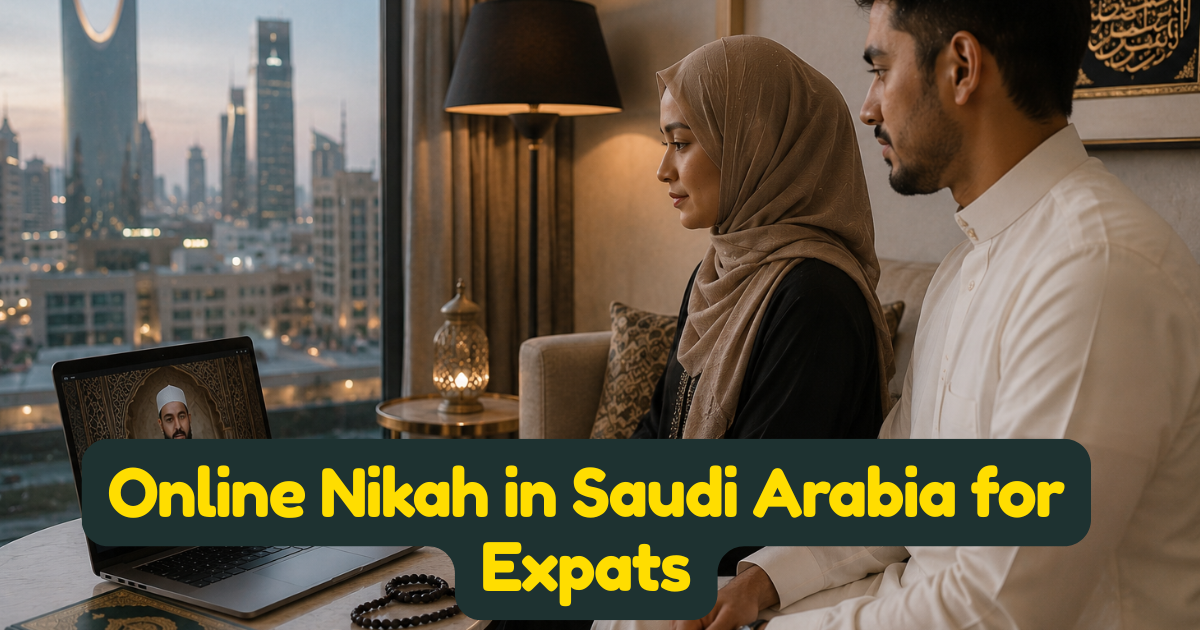
An online nikah conducted through InstantNikah.com is a real Shariah contract performed over a secure, live video connection. The officiant is a qualified scholar or licensed qazi. The bride's wali participates — joining from Pakistan, Bangladesh, or wherever he is — or, where genuinely unavailable, a suitable alternative is arranged through recognised scholarly guidance. Two Muslim witnesses are present on the call and explicitly confirm they have heard the offer and acceptance. The mahr is agreed and stated. A nikah certificate is issued following the ceremony.
For the groom in Jeddah whose bride is still in Karachi, this is not a workaround — it is the only available path to marrying her Islamically before she arrives, or before his next home leave. For the couple who have both been in Riyadh for three years but whose wali is in Lahore and will not travel, it is a solution the scholarly record supports. For detailed coverage of the video-call ruling across the major madhabs, our explainer on nikah over a video call covers the fiqh positions directly.
After the Nikah: The Civil Documentation Path
Once the nikah is conducted, couples typically pursue one of the following civil documentation routes depending on their circumstances.
If both parties are in Saudi Arabia with valid iqama
They may subsequently register the marriage through the Najiz portal or directly through the marriage court (Mahkama Tankeeh), as the process described on Expat.com outlines — with iqamas, two witnesses who are also legal residents, and details of the mahr presented to the qazi. The nikah certificate from InstantNikah.com serves as supporting evidence of the Islamic contract.
If one partner is abroad
The civil registration will typically occur in the bride's home country after she arrives in Saudi Arabia on a family visa, or in the groom's home country during home leave. Each country has its own marriage registration procedure. Our guide to registering a nikah civilly after the Islamic ceremony covers the major country-by-country procedures.
For the nikah certificate itself
For international use — visa sponsorship, residence applications, embassy submissions — the nikah certificate issued after the ceremony may need attestation. The Saudi Ministry of Justice → MOFA → embassy chain described above applies when certificates originate from within the Kingdom. Where the nikah certificate is issued by InstantNikah.com from outside Saudi Arabia, couples present it at their home-country embassy in Saudi Arabia for local attestation. Legal advice specific to nationality and visa type is always recommended for the civil layer.
Common Scenarios Among Expats in Saudi Arabia
The Bangladeshi worker whose fiancée is still in Dhaka. His iqama is valid, his Absher is active, but she has no Saudi residency and her father is in Sylhet. The Najiz system cannot process this. An online nikah gives them a valid Islamic marriage contract now, with civil registration in Bangladesh following on his next home visit.
The Pakistani engineer in Riyadh whose bride has a visit visa. She has arrived; the wali is in Islamabad. If the wali cannot travel, he may appoint a wakeel — a proxy — to stand in his place during the ceremony. Our guide on how to appoint a wakeel in nikah covers this arrangement in detail.
The Indonesian couple both holding iqamas but from different cities. A remote ceremony is more practical than coordinating two schedules and two cross-city journeys to a court unfamiliar with their documents.
The Muslim convert expat with no Muslim family. A professional who took shahada in Saudi Arabia but whose entire family is non-Muslim has no natural wali. This is one of the most common convert scenarios globally, and appointing a qualified alternative is a long-established scholarly provision. Our guide on how a convert finds a wali for nikah addresses this directly.
What Saudi Arabia Does Not Offer Non-Muslim or Mixed-Faith Couples
It is worth being clear: the Saudi court system is exclusively for Muslim marriages. Non-Muslim expatriates cannot access the Shariah court system online or in person, as confirmed by multiple legal guides covering the Kingdom's marriage framework. Non-Muslim couples or mixed-faith couples who are not converting to Islam can only marry through their respective embassies, and not all embassies offer this service in Riyadh. For the Muslim expat audience this article addresses, that exclusivity is an advantage — the Saudi court, when accessible, aligns with Islamic requirements by design. When it is not accessible, the Islamic requirements can still be met through a properly conducted remote nikah.
Quick Answers for Muslim Expats in Saudi Arabia
Can I use the Najiz portal if my fiancée is abroad? No. The Saudi Ministry of Justice has confirmed that the husband and the bride's wali must both be registered Saudi residents for the Najiz process to complete. If she is abroad, you need an alternative route for the Islamic contract.
Is an online nikah Islamically valid? Yes, when the essential conditions are met — a wali, two witnesses who genuinely hear the offer and acceptance, agreed mahr, and free consent. The contract's validity rests on these conditions, not on the medium used to fulfil them.
Will my home country recognise the nikah certificate? This depends on your nationality. Most Muslim-majority countries recognise Islamic marriage certificates when properly issued, but civil registration in your home country is usually also required for full legal recognition. Always verify with your home embassy in Riyadh.
What if I have no Muslim wali? A convert or a woman whose male Muslim family members are deceased or unreachable may have a qualified imam or Islamic authority act as her wali. This is a mainstream scholarly provision, not a fringe position.
Marrying Islamically — From Wherever You Are in the Kingdom
Saudi Arabia may be the spiritual heart of Islam, but being physically present here does not automatically resolve the practical challenges of contracting a nikah when family is on the other side of the world. The iqama requirement, the Absher dependency, the wali's physical location — these are real constraints that the Kingdom's own digital system was not built to solve. InstantNikah.com was. We bring a qualified officiant, valid witnesses, wali participation or appointment, and formal documentation to any screen, in any time zone, for Muslim expats whose situation does not fit the Najiz model. When you are ready, book your online nikah and let our team advise you on the path that fits your exact circumstances.
Admin User
Author