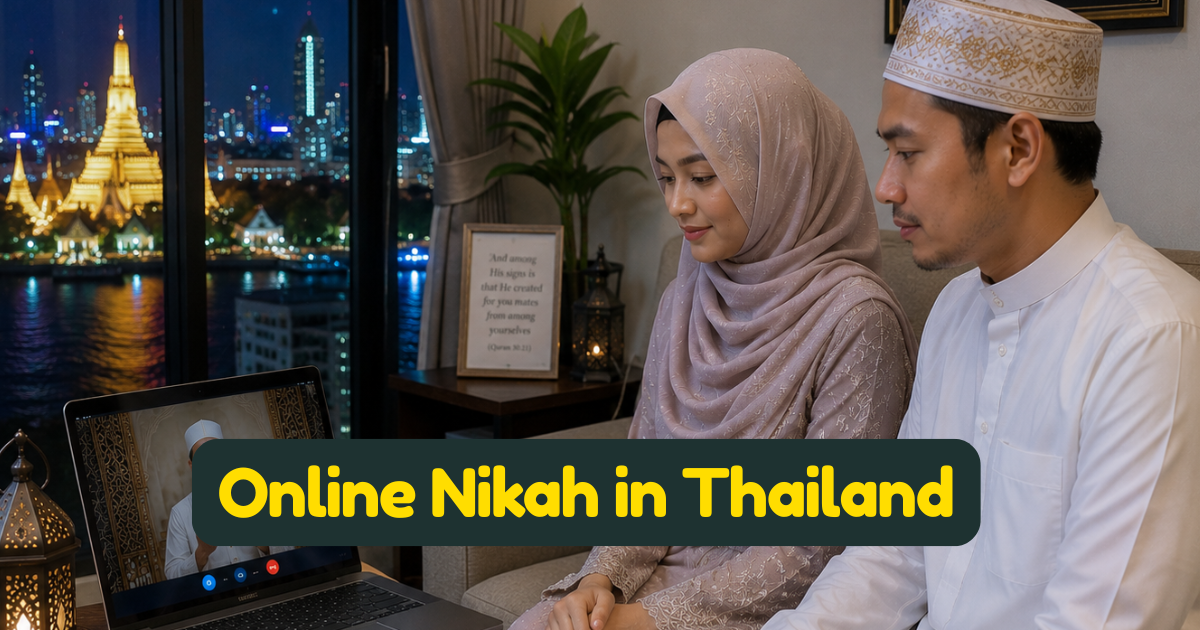
Online Nikah in Thailand: Islamic Marriage in a Buddhist-Majority Country, the Southern Province Shariah Framework, and Remote Ceremonies for Muslim Expats and Visitors
Most countries in the world are either predominantly Muslim — in which case Islamic family law is woven into the civil order — or predominantly non-Muslim, in which case the nikah is a private religious act with no legal standing of its own. Thailand belongs to neither category. It is a Theravada Buddhist nation where the reigning monarch is constitutionally required to be Buddhist, where approximately 87 percent of citizens practise Buddhism, and where the Supreme Patriarch and the Sangha Council hold significant national cultural authority. And yet, in its four southernmost provinces, it operates a fully statutory Islamic family law system — the only country in mainland Southeast Asia to do so — under the Act on the Application of Islamic Law B.E. 2489, passed in 1946 and still in force today.
According to the 2022 census data cited by the Melbourne Asia Review, Thai Muslims make up approximately 12 percent of the national population — roughly 7.5 million people. The southern provinces of Pattani, Yala, Narathiwat, and Satun are home to the overwhelming majority of the country's ethnic Malay Muslims, where the Muslim population exceeds 65 to 85 percent of local residents. In Bangkok, Phuket, and Chiang Mai, sizeable Muslim communities also exist — Malay Thais, South Asian migrants, Cham Muslims, and a growing population of Muslim tourists and expat professionals who live and work here without access to the formal Islamic court structures of the south.
Understanding how marriage works for Muslims in this layered environment — and where the gaps for an online nikah arise — requires knowing precisely what the 1946 Act provides, what CICOT offers nationwide, and what civil registration demands beyond both.
Thailand's Unique Dual-Track Islamic Marriage Framework
No other country in this series has a legal arrangement quite like Thailand's. The framework has two distinct tracks that apply in different parts of the country.
Track One: The Southern Province Islamic Courts
In the four southern provinces of Pattani, Yala, Narathiwat, and Satun, the 1946 Act creates a parallel judicial system for Muslim personal affairs. Shariah courts — presided over by a Kadi, a judge qualified in Islamic jurisprudence — have exclusive jurisdiction over marriage, divorce, inheritance, and waqf for Muslims who choose to use them. The Thai Laws resource confirms that the Kadi applies Shafi'i principles, which is the dominant madhab among Thai Malay Muslims — not Hanafi, which is more common among South Asian communities. A nikah conducted and registered through the provincial Islamic Committee in these provinces carries direct legal effect under Thai law without the need for separate civil registration at the district office (Amphur).
Minority Rights Group International notes in its profile of Patani Malay Muslims that the Patani Muslim community forms over 70 percent of the three southernmost provinces and close to 90 percent within Pattani province itself — a deep-rooted community with a distinct Malay language (Patani Malay/Yawi), a separate cultural identity from mainstream Thai society, and a history as a sovereign Malay sultanate until annexation by Siam in 1902.
Track Two: CICOT and Nationwide Islamic Registration
Outside the southern provinces — in Bangkok, Phuket, Chiang Mai, and everywhere else — Muslim marriages fall under the general framework of the Central Islamic Council of Thailand (CICOT) and its provincial counterparts. As documented by legal practices including Bangkok Lawyers and Phuket lawyers, CICOT and provincial Islamic committees can conduct a nikah, issue a nikah certificate, and register the marriage in their records. However, in these regions a CICOT-registered nikah does not automatically create civil law effects — the couple must additionally register the marriage at the local district office (Amphur) to achieve full national legal recognition for immigration, property, inheritance, and child registration purposes. A religious nikah alone, without Amphur registration, leaves the marriage legally invisible to the Thai civil state outside the southern provinces.
What Any Valid Nikah Requires — Regardless of Province or Platform
Whether conducted in Pattani's Islamic court, at Bangkok's Central Islamic Council, or through a secure online ceremony, a valid nikah needs the same essential elements under Islam:
- A wali — the bride's male Muslim guardian — whose consent is a condition of the contract. In southern Thailand this is enforced through the Kadi. Nationwide through CICOT, it is equally required. Remotely through an online ceremony, it remains equally required.
- Two Muslim witnesses who genuinely hear the offer (ijab) and acceptance (qabul) as they are stated.
- An agreed mahr, stated as the bride's exclusive right.
- Free consent from both parties without coercion.
What neither the Kadi nor CICOT can supply for a Muslim expat in Bangkok whose fiancée is in Kuala Lumpur — or a Muslim tourist whose wali is in Cairo — is logistics. The wali must somehow be present or represented. The witnesses must somehow be arranged. And the couple must be capable of appearing in person before whoever officiates. For many couples in Thailand's Muslim communities, particularly those living outside the southern provinces or visiting the country on tourist visas, this is genuinely impossible.
Where the Gap Opens: Muslim Expats and Visitors in Thailand
Thailand receives millions of Muslim tourists and hosts a diverse Muslim expat population across Bangkok, Phuket, and Chiang Mai — workers from South Asia and the Middle East, long-term residents, retirees, and digital nomads. This community is served religiously by mosques and CICOT offices across the country, but it sits outside the southern province Islamic court system entirely. Their marriages follow the Bangkok track: CICOT registration plus Amphur civil registration.
The practical barriers become clear quickly. A Muslim professional in Bangkok whose fiancée is in Jakarta and whose future father-in-law is in Surabaya cannot easily bring both of them to Thailand for a CICOT-registered nikah. A Muslim tourist on a thirty-day visa who has found a spouse and wants to marry properly before returning home faces a document chain — freedom-to-marry certificates from embassies, translations, Amphur appointments — that takes longer than his visa allows. A Thai Muslim woman in Bangkok whose wali lives in the deep south cannot always coordinate his travel to the capital for a registration appointment.
An online nikah, properly structured, resolves every one of these scenarios without shortcutting any Islamic requirement.
How an Online Nikah Works in the Thai Context
InstantNikah.com conducts Shariah-compliant online nikah ceremonies over a secure live video connection. A qualified qazi or recognised Islamic scholar officiates — under Shafi'i principles where applicable, which is the dominant school among Thai Malay Muslims. The bride's wali participates remotely from wherever he is located — Surabaya, Karachi, Cairo, or the deep south. Two qualified Muslim witnesses confirm on the call that they have clearly heard the offer and acceptance. The mahr is agreed, stated, and recorded. A nikah certificate is issued after the ceremony.
For those uncertain about whether witnesses can attend a nikah remotely, our dedicated guide on whether nikah witnesses can be appointed remotely covers the scholarly reasoning. The broader question of video-call ceremony validity across the major madhabs is addressed in our explainer on the video-call nikah ruling.
After the Nikah: Civil Recognition in Thailand
An online nikah gives you a valid Islamic marriage contract and a nikah certificate. For full civil recognition in Thailand — relevant for visa sponsorship, property rights, and child registration — the following steps apply depending on your situation.
For couples inside Thailand
The nikah certificate from InstantNikah.com supports the downstream civil registration process. As confirmed by Siam Legal, one of Thailand's established international law firms, foreign nationals registering a Muslim marriage need a freedom-to-marry certificate from their embassy in Bangkok, passport copies, and the nikah certificate, all translated and legalised where required, before presenting at CICOT or the local Amphur. The CICOT office can also issue the marriage certificate in English and Arabic, which facilitates recognition in home countries.
For couples who married abroad and are in Thailand
Foreign marriage certificates can be recognised in Thailand after attestation by the Thai Ministry of Foreign Affairs. Our guide on registering a nikah civilly after the Islamic ceremony covers the attestation chain for major nationalities.
Who an Online Nikah Particularly Serves in Thailand
- Muslim professionals and expats in Bangkok, Phuket, and Chiang Mai whose fiancée and wali are abroad and who need a properly conducted nikah before the civil registration paperwork is assembled.
- Muslim tourists on short-term visas whose visa timeline does not allow the full document chain required for a CICOT or Amphur registration.
- Thai Muslim women in Bangkok whose wali is in the deep south and cannot always travel to the capital for a ceremony appointment.
- Long-distance couples where one partner is in Thailand and the other is abroad — the ceremony happens remotely and the civil registration follows at a convenient time.
- Muslim converts whose family is non-Muslim and who need a qualified wali arranged. Our guide on how a convert finds a wali for nikah addresses this directly.
A Note on the Southern Province Shafi'i Framework
Couples who are Thai Muslims from the deep south should be aware that the Shafi'i school — as applied by the Kadi in the southern province Islamic courts — is more stringent on the wali requirement than the Hanafi school followed by most South Asian Muslims. Under the Shafi'i view, the wali is an absolute condition of a valid nikah; no contract is valid without him. This makes it especially important that any online ceremony for a southern Thai Muslim bride is conducted with a clearly identified, properly participating wali — not as a procedural point but as a condition of the Islamic contract itself. InstantNikah.com's scholars are familiar with the Shafi'i requirements applicable to this community and conduct ceremonies accordingly.
Quick Answers for Muslims in Thailand
Is a nikah in Bangkok at CICOT legally recognised across Thailand? A CICOT-registered nikah has Islamic validity and community recognition. For full civil legal effect across Thailand — including immigration and property purposes — you must also register at the local Amphur (district office).
Is an online nikah Islamically valid from Thailand? Yes, when the wali participates, two witnesses genuinely hear the contract, mahr is agreed, and consent is free. The location does not affect the Islamic validity of the contract.
Does the southern province Islamic court system apply if I live in Bangkok? No. The 1946 Act and its Kadi courts apply only in Pattani, Yala, Narathiwat, and Satun. Muslims elsewhere follow the CICOT and Amphur route for registration.
What if my wali is in Malaysia or Indonesia? He can participate in the online ceremony from wherever he is, or appoint a wakeel — a proxy. Our guide on appointing a wakeel in nikah explains the process clearly.
A Buddhist Kingdom With an Islamic Heart in Its South
Thailand's approach to its Muslim minority is imperfect but historically unusual — a Buddhist constitutional monarchy that nevertheless encoded Islamic family law into its statutes in 1946 and has maintained that commitment through every change of government since. The southern Malay Muslims of Pattani, Yala, Narathiwat, and Satun have their own courts, their own Kadi, and their own legally recognised path to a valid nikah. The millions of Thai Muslims living elsewhere, and the Muslim visitors and expats scattered across Bangkok and the resort towns, do not. For all of them, the Islamic conditions for a valid marriage remain constant — a wali, two witnesses who genuinely hear the words, an agreed mahr, and free consent. Those conditions travel wherever the couple is. InstantNikah.com ensures they are fulfilled correctly. When you are ready, book your online nikah and speak with our team about your specific circumstances in Thailand.
Admin User
Author