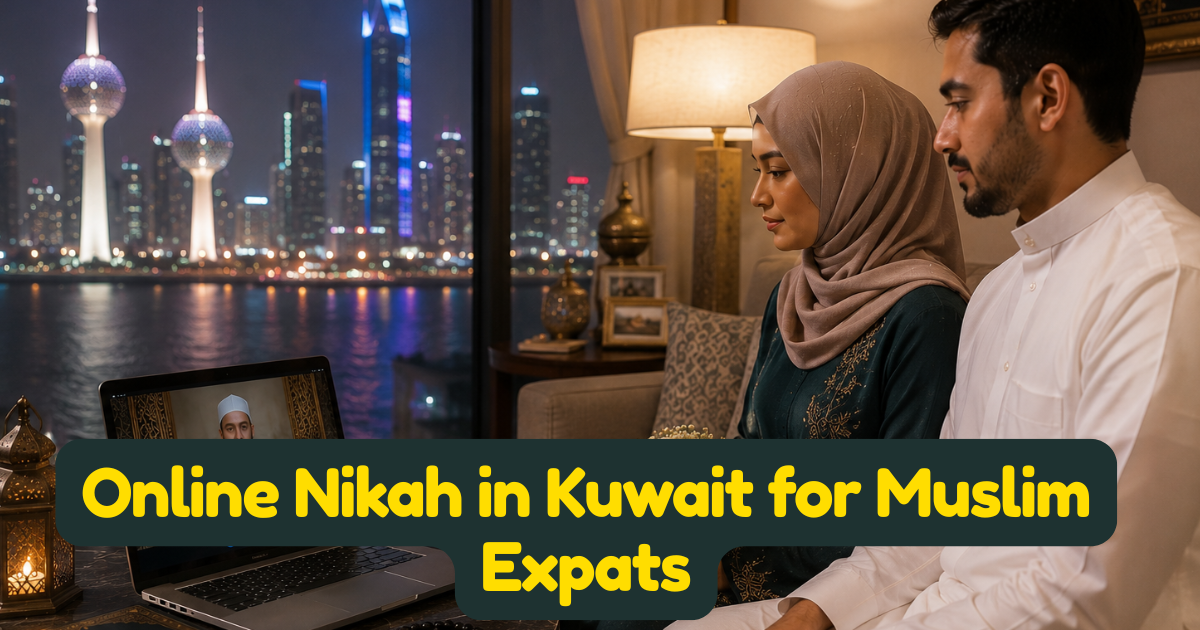
Online Nikah in Kuwait for Muslim Expats: The Shariah Court Gap, the Wali Problem, and How to Marry Islamically When Your Family Is Abroad
Kuwait is one of the wealthiest countries on earth per capita, and one of the most demographically unusual. According to official data from Kuwait's Public Authority for Civil Information (PACI), the country's total population at the end of 2024 stood at approximately 4,987,826 — of whom nearly 3.42 million, about 68.6 percent, were foreign nationals, as reported by Zawya. Indians form the single largest expatriate community at over one million, followed by Egyptians, Bangladeshis, Filipinos, Pakistanis, Nepalis, and Sri Lankans. The overwhelming majority of these communities are Muslim.
Most of them arrived as working-age adults, typically men, on employment contracts that do not automatically entitle them to bring family members. The average expatriate family in Kuwait consists of just two members per household, according to Arab Times Online, reflecting how many workers live and work here while their spouse or future spouse remains in the home country. For these men — and for the smaller but significant number of Muslim women among Kuwait's expatriate workforce — getting married Islamically without being able to transport their family to Kuwait City is a problem the Shariah court was not built to solve.
What Kuwait's Shariah Court Requires — and Why It Is Out of Reach for Most Expat Couples
All Muslim marriages in Kuwait are conducted through the Shariah courts, specifically the courts at Riggae and Ahmadi. There is no secular civil marriage for Muslims, no embassy route for Islamic contracts, and no digital platform equivalent to Saudi Arabia's Najiz portal. The court is the only path. And the court's requirements, as documented by the Czech Republic Embassy in Kuwait and confirmed by Kuwaiti legal resource Commoner Law, are as follows:
- Valid Kuwait Civil ID (Civil Number) for both the bride and groom. A visitor or tourist visa does not qualify.
- Physical presence of the bride's wali — her father, or in his absence, the next closest male Muslim guardian. No remote attendance is permitted under the court's standard procedure.
- Two male Muslim witnesses who are residents of Kuwait, present in person at the court on the day of the ceremony.
- A premarital medical fitness certificate from a Kuwaiti government hospital, obtained before the ceremony date is scheduled.
- A Certificate of No Impediment (CNI), obtained in person from the couple's home-country embassy in Kuwait, confirming they are free to marry.
- Fully attested, Arabic-translated documents — passports, birth certificates, and proof of marital status from the home country — legalised through both the home-country foreign affairs ministry and Kuwait's Ministry of Foreign Affairs (MOFA).
As the wedding planning resource Lotus Wedding notes in its Kuwait expat marriage guide, one additional complication sets Kuwait apart from its Gulf neighbours: Kuwait has not signed or ratified the Hague Apostille Convention. This means that document legalisation cannot be completed through a single apostille stamp — every document must be individually legalised through a multi-step chain involving the Ministry of Justice, the Ministry of Foreign Affairs, and the relevant embassies, adding weeks to an already complex process.
Even setting aside the non-Apostille issue, the wall is clear. A Bangladeshi worker in Salmiya whose fiancée is in Sylhet has no path to the Shariah court. She holds no Kuwait Civil ID. Her father, the wali, is also in Sylhet. The court cannot process their marriage. The legal door is simply closed.
The Islamic Conditions That Remain Constant — and Fully Achievable Online
The Shariah court's requirements reflect a combination of Islamic law and Kuwaiti administrative procedure. It is essential to distinguish between the two, because one set of requirements can be met online, and the other — the Kuwaiti administrative layer — is what creates the barrier for expat couples.
Islam's conditions for a valid nikah are the same whether the court is in Kuwait City or the ceremony is conducted over a video call from Doha and Dhaka simultaneously:
- A wali whose consent gives the contract its validity. He must be a male Muslim guardian, present and willing — remote participation fulfils this requirement in the view of the majority of contemporary scholars when the conditions of the contract are otherwise met.
- Two Muslim witnesses who genuinely hear the offer (ijab) and acceptance (qabul). Their role is to hear and testify — not to hold a specific civil document.
- Agreed mahr — the bride's exclusive right, stated and documented.
- Free consent from both parties, given without coercion.
As the Kuwait Times notes in its reporting on Kuwaiti marriage law, "for a woman to get married, she needs the consent of her guardian" — a requirement that is Islamically grounded and not a Kuwaiti invention. What the court requires additionally — the physical presence, the Civil ID, the medical certificate — are administrative layers on top of the Islamic core. Remove those layers, and the Islamic requirements remain fully satisfiable in a properly conducted online ceremony. For a detailed treatment of the scholarly positions on remote nikah, our guide on video-call nikah rulings addresses each school directly.
How an Online Nikah Works for Couples in Kuwait
InstantNikah.com conducts Shariah-compliant online nikah ceremonies over a secure live video connection. A qualified qazi or recognised scholar officiates. The bride's wali joins from his location — whether Karachi, Cairo, or Colombo. Two Muslim witnesses are confirmed on the call and explicitly state they have heard the offer and acceptance. The mahr is agreed and recorded. A nikah certificate is issued following the ceremony.
For the Bangladeshi worker in Salmiya this means the Islamic marriage happens now, cleanly and properly, rather than waiting for his fiancée to obtain Kuwait residency. For the Pakistani engineer in Kuwait City whose bride's father cannot travel, it means the wali remains in Lahore and participates fully without a single flight being booked. For the Muslim convert among Kuwait's expatriate community who has no Muslim guardian, a qualified imam can be arranged to serve in that role — a long-established scholarly provision addressed in our guide on how a convert finds a wali for nikah.
Couples uncertain about whether the wali should attend in person or can appoint a proxy should read our article on how to appoint a wakeel in nikah, which explains when and how a proxy can represent the guardian in a ceremony.
After the Nikah: Completing the Civil Documentation for Kuwait
An online nikah gives you a valid Islamic marriage. For the Kuwaiti state to recognise the marriage — which matters for dependent visa sponsorship, inheritance rights, and any future dealings with the Kuwaiti court system — the marriage must be entered into the civil record. There are two practical routes for expats in Kuwait.
Registering the marriage in the home country first
The most common and practical path for most expat couples is to register the marriage in the bride's or groom's home country during the next home visit. Once registered and certified in the home country, the marriage certificate must be legalised through the home country's foreign affairs ministry, then attested at Kuwait's MOFA, and finally submitted to the Personal Status Department or Kuwait Court for recognition within Kuwait. As the U.S. Embassy in Kuwait's guidance confirms through the U.S. Embassy Kuwait marriage page, a marriage registered under Kuwaiti law or through a Kuwaiti court order is the standard recognised for immigration and legal purposes. The nikah certificate from InstantNikah.com serves as supporting evidence of the Islamic contract throughout this process.
Registering at the home-country embassy in Kuwait
Some nationalities — Indian, Pakistani, Egyptian, Filipino among them — can register a marriage at their own embassy in Kuwait City, which then forwards it to the home country's civil registry. Check with your specific embassy in Kuwait, as procedures and eligibility vary by nationality. Our comprehensive guide on registering a nikah civilly after the Islamic ceremony covers the step-by-step process for major nationalities.
Scenarios That an Online Nikah Resolves for Kuwait-Based Expats
- The Indian or Bangladeshi worker whose fiancée has no Kuwait Civil ID. Without residency in Kuwait, she cannot appear before the Shariah court. The online nikah completes the Islamic contract; civil registration follows in the home country.
- The Muslim professional whose wali is abroad and cannot travel. The bride's father participates in the ceremony remotely, or appoints a proxy (wakeel). The Islamic contract is fully valid either way.
- The couple whose document legalisation is still in progress. Kuwait's non-Apostille status means the full attestation chain takes weeks. An online nikah ensures the Islamic marriage happens while the civil paperwork is being prepared — so the relationship is halal from the start.
- The Muslim student or professional who has recently converted and has no Muslim family. Covered by the scholarly provision for an appointed wali, making the nikah accessible regardless of family background.
Quick Answers for Muslim Expats in Kuwait
Can I use Kuwait's Shariah court if my fiancée has no Kuwait Civil ID? No. The court requires valid Kuwaiti residency for both parties. Without her Civil ID, the court process cannot proceed.
Is an online nikah Islamically valid from Kuwait? Yes, when the wali participates, two witnesses genuinely hear the contract, mahr is agreed, and both parties consent freely. Kuwait's civil requirements do not affect the Islamic validity of the contract.
Kuwait has not signed the Apostille Convention — does this affect my nikah certificate? It affects the civil attestation chain for your marriage certificate, not the Islamic validity of the nikah itself. Your home-country registration and the subsequent Kuwait MOFA attestation remain the civil route regardless.
Can my fiancée's father join the ceremony from abroad? Yes. He participates in the online ceremony as the wali from wherever he is located — this is one of the primary advantages of a properly conducted remote ceremony.
One of the Gulf's Largest Expat Populations — and a Gap the Court System Was Never Built to Close
Kuwait's demographic reality — nearly 70 percent of the country is foreign-born, the vast majority Muslim, working without their families nearby — sits in direct tension with a Shariah court system that assumes all the necessary parties are within driving distance of Kuwait City. For the millions of workers this describes, the Shariah court is not a practical option. A properly conducted online nikah is. It fulfils every Islamic condition while the civil documentation follows its own separate path. InstantNikah.com has the qualified officiants, the verified witnesses, and the framework to make this happen correctly for you — wherever in Kuwait you are, and wherever your family and future spouse may be. When you are ready, book your online nikah and our team will guide you through every step.
Admin User
Author