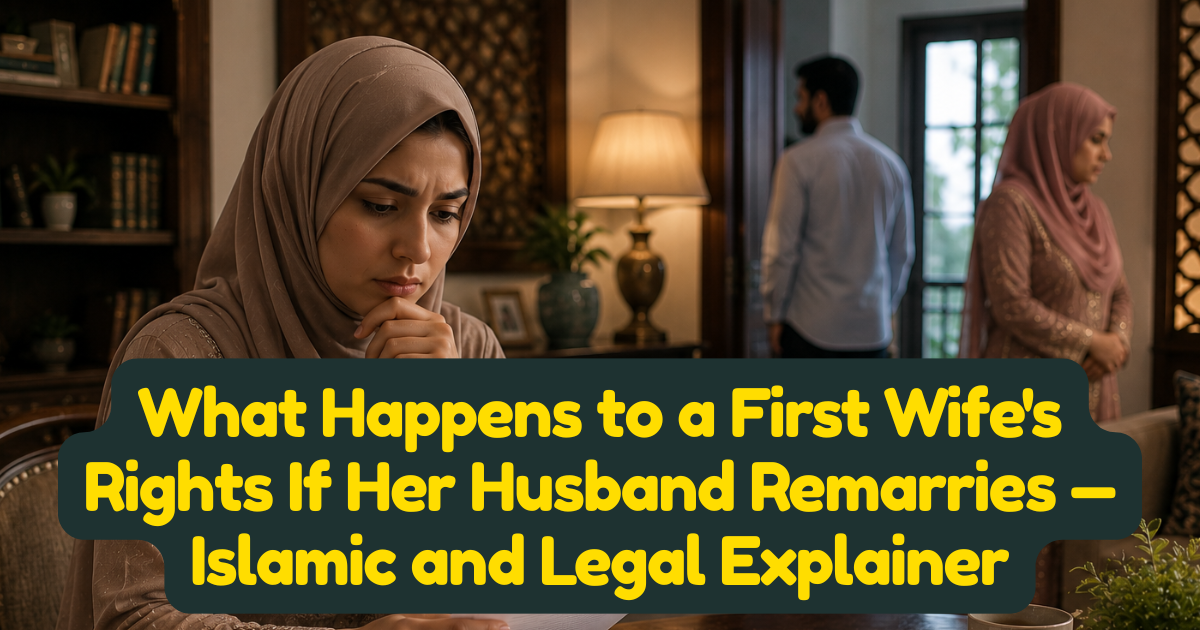
What Happens to a First Wife's Rights If Her Husband Remarries — Islamic and Legal Explainer
The moment a Muslim husband takes a second wife, the first wife's legal and moral position within the marriage changes — not because her rights are reduced, but because the obligations owed to her must now be actively maintained alongside a new and competing set of marital responsibilities. The shift is significant. What was implicit in a monogamous household becomes explicit, measurable, and enforceable.
Many first wives — and indeed many husbands — do not know what Islamic law actually requires when polygyny is practised. The conversation around second marriages in Muslim communities tends to focus on whether the husband has the right to remarry. Far less attention is given to the detailed framework of obligations that right comes packaged with, and what happens to the first wife when those obligations are not met.
This article addresses that gap directly. It explains what the first wife is entitled to the moment a second nikah is contracted, how those entitlements are measured and enforced under Islamic jurisprudence, what additional rights she acquires if her nikah contract contained protective conditions, and how the civil legal systems of the UK, USA, Pakistan, and Europe interact with her Islamic rights in practice.
The Starting Point: Her Rights Do Not Diminish When He Remarries
This is the principle that Islamic law establishes before anything else, and it is stated with clarity across all four major Sunni schools of jurisprudence. A husband's right to take a second wife does not come with any corresponding reduction in his obligations to the first. She is entitled to the same level of provision, the same quality of treatment, and the same access to her husband that she held before the second marriage. Nothing is diminished by the addition of a second wife — only the husband's time and resources are now subject to division rather than entirely directed toward one household.
In practical terms, this means the first wife's rights must be maintained in full while simultaneously being duplicated for the second. This is precisely why the Qur'an attaches the condition of justice so firmly to the permission for polygyny — because without strict enforcement of that condition, the first wife inevitably absorbs the harm of the second marriage through reduced attention, reduced resources, and reduced time with her husband.
The Right to Equal Division of Nights — Al-Qasm
The most structured and most precisely defined of the first wife's rights in a polygynous household is the right to an equal share of the husband's nights. This right — known in Islamic jurisprudence as al-qasm — is not a vague recommendation toward fairness. It is a binding fiqh obligation with documented rulings in every major school of Islamic law.
The Prophet Muhammad ﷺ himself observed this obligation with extraordinary care. Sayyidah Aisha reported that when he was ill and could not move freely between his wives' households, he asked for their permission to spend his illness in her quarters — demonstrating that even in illness, the principle of equal division was so embedded in his practice that he sought consent rather than simply exercising authority. This prophetic example is cited by Ibn Kathir, Al-Nawawi, and Ibn Qudamah as a standard of conduct in polygynous households.
Under Hanafi, Maliki, Shafi'i, and Hanbali fiqh, the husband is obligated to maintain a regular rotation between wives — typically in units of one night each, though the scholars differ on the precise structure when there are more than two wives. A new wife is entitled to a consecutive period of seven nights if she is a virgin, or three nights if she is previously married — after which the regular rotation resumes. The first wife's regular rotation rights resume fully after this introductory period for the new wife.
If the husband consistently spends more nights with the second wife, the first wife has a documented Islamic right to raise this as a violation of the qasm obligation — either through direct discussion, through family mediation, or through formal Islamic arbitration if the pattern is persistent.
The Right to Equal Financial Provision — Nafaqa
The husband's obligation of nafaqa — financial maintenance covering food, clothing, housing, and reasonable household needs — does not decrease for the first wife when he takes a second. Each wife is entitled to nafaqa appropriate to the husband's financial means and her own established standard of living within the marriage.
Scholars differ slightly on the precise standard of equality required. The majority position, shared across all four schools, holds that the husband must provide equivalent maintenance to both wives — meaning he cannot lavish one with luxury while leaving the other in deprivation. The Maliki school in particular emphasises that the standard of provision is set by the husband's financial capacity, and both wives are entitled to a proportionate share of that capacity.
A husband who reduces the first wife's financial provision — whether formally or gradually — after contracting a second marriage is in direct violation of the nafaqa obligation. This violation gives the first wife grounds to demand restoration of her maintenance through Islamic arbitration, and in many jurisdictions through civil family courts as well. The detailed framework of these financial rights is covered in the dedicated article on nafaqa in Islam and financial support rights.
The Right to Separate, Appropriate Housing
This is an area where Islamic law is particularly clear and where cultural practice often falls dramatically short. Each wife in a polygynous marriage is entitled to her own separate, private accommodation. The husband cannot house two wives together — in the same apartment, the same household, or the same dwelling — without the genuine, freely given consent of both wives.
The scholarly basis for this is well established. Ibn Qudamah states explicitly in Al-Mughni that a wife is entitled to private housing where she is not forced to share with a co-wife or the husband's other family members against her will. Al-Nawawi affirms the same position in Al-Majmu', citing the principle that a wife is entitled to a space where she can live with dignity and privacy.
If the husband attempts to house his wives together without consent — often framed as a financial necessity — the first wife has the right to refuse and to demand separate accommodation. Her refusal in this situation does not constitute nushuz (disobedience) under Islamic law, because she is asserting a right that the law explicitly grants her. A sustained denial of separate housing is a form of darar — harm — that gives rise to dissolution rights if it is not remedied.
The Right to Emotional Dignity and Non-Humiliation
Beyond the measurable material rights, Islamic law places a moral obligation on the husband that is harder to quantify but no less real: the obligation to treat the first wife with dignity and kindness — mu'ashara bil-ma'ruf — even as he maintains a second marriage. This Qur'anic command, found in Surah An-Nisa (4:19), applies to each wife individually and cannot be diluted by the demands of a polygynous household.
Practically, this means the husband is not permitted to demean, belittle, or consistently neglect the first wife emotionally as a consequence of the second marriage. A pattern of humiliation, public comparison between wives, or deliberate emotional cruelty constitutes a violation of the mu'ashara bil-ma'ruf obligation — and in serious cases, it crosses into the territory of darar (harm) that gives the first wife grounds to seek dissolution.
The connection between emotional harm within marriage and the Islamic right to seek relief is explored in depth in the article on what darar means in Islamic marriage law.
What If the First Wife's Nikah Contract Contained a Condition Against a Second Wife?
This is where the first wife's position shifts from a holder of ongoing rights to a holder of an active exit right — one of the most significant distinctions in Islamic family law as it applies to polygyny.
If the first wife stipulated at the time of her nikah — as a binding contractual condition — that the husband would not take a second wife without her consent, then his remarriage constitutes a clear violation of that contract. Under Hanbali and Maliki fiqh, she has valid grounds to seek faskh (judicial annulment) of her own nikah based on that breach. She is not obligated to accept the situation, negotiate new terms, or remain in the marriage — the contractual breach gives her an Islamic exit right she did not have before.
This right does not affect the validity of the second nikah — the second wife remains a legitimate wife in Islamic law. But it gives the first wife a remedy that classical fiqh would not otherwise grant simply on the basis of her unhappiness with the situation. The comprehensive guide on protective conditions in the nikah contract for Muslim women explains how to include and enforce such conditions from the outset — before the marriage begins rather than after the harm has occurred.
What If No Condition Was Stipulated? Her Remedies When Rights Are Violated
If the first wife's nikah contract contained no protective condition regarding a second marriage, she cannot use the remarriage itself as grounds for faskh under classical Islamic law — because the husband's right to remarry is Islamically permitted. However, the absence of a contractual condition does not leave her without recourse. She retains powerful remedies when her rights within the polygynous household are violated.
Demanding Restoration of Rights Through Islamic Arbitration
When the husband is failing to maintain equal division of nights, adequate nafaqa, or separate housing, the first wife may raise these violations with a qualified Islamic scholar, qadi, or recognised Islamic arbitration body. The obligation of justice in polygyny is not aspirational — it is an enforceable fiqh duty, and its violation is recognised as a legitimate basis for Islamic intervention.
Seeking Khul' — Dissolution in Exchange for Mahr Return
A first wife who chooses not to remain in the marriage after her husband remarries may seek khul' — requesting that the husband agree to a divorce in exchange for her returning the mahr. This requires the husband's agreement, but a qadi may compel the dissolution if the husband refuses unreasonably, particularly where the wife's continued presence in the marriage is causing her demonstrable harm.
Pursuing Faskh on Grounds of Darar
If the husband's conduct in the polygynous household produces sustained, demonstrable harm to the first wife — through financial neglect, denial of housing rights, consistent failure to observe the qasm rotation, or emotional abuse — she may present evidence of that darar to an Islamic arbitration body and seek faskh on those grounds, independent of whether she had a contractual condition in place. The detailed framework of khul' and faskh under Islamic law is covered comprehensively on this site.
Exercising Tafwid Al-Talaq if Previously Delegated
If tafwid al-talaq — the delegated right of self-divorce — was included in the first wife's nikah contract, either absolutely or conditionally upon the husband taking a second wife, she may exercise that right directly without needing to pursue a third-party faskh process. This is one of the most practically powerful tools available to a Muslim woman, and its inclusion in the nikah contract from the outset transforms her position entirely if this situation arises. The full framework of tafwid al-talaq and divorce rights in the nikah contract is detailed in a dedicated article on this site.
The Mahr: Does the First Wife Lose Any Part of It When Her Husband Remarries?
No. The first wife's mahr — both prompt and deferred portions — is entirely unaffected by the husband's second marriage. It was agreed as part of her nikah contract and remains an obligation the husband owes her regardless of how many subsequent marriages he contracts. If the deferred mahr was to become payable upon divorce or death, those conditions remain in force exactly as agreed.
A husband who attempts to use the second wife's mahr as justification for reducing or renegotiating the first wife's deferred mahr is making a claim that has no Islamic legal basis. Each mahr obligation is independent. The full framework of mahr — including what happens to it after divorce and what happens if the husband dies — is covered in the articles on what mahr is in nikah, what happens to mahr after divorce, and whether a husband can refuse deferred mahr after divorce.
Civil Legal Protections for First Wives in Muslim-Minority Countries
For Muslim women living in the West, the civil legal framework operates independently of Islamic law — and in some respects provides more immediate and enforceable protections than an Islamic arbitration process alone.
United Kingdom
If the first wife's marriage to her husband was civilly registered in the UK — either as a civil ceremony or as a religiously solemnised marriage that meets civil registration requirements — she holds full legal spousal rights under English family law. These include rights to financial provision, property settlement, spousal maintenance, and a share of matrimonial assets in the event of divorce. Her husband's subsequent religious nikah with a second wife carries no civil legal status in the UK and does not affect the first wife's civil entitlements in any way. She remains his sole legal spouse for all purposes of English law. Muslims navigating nikah and civil law in the UK should review the guidance on online nikah in the UK for fuller context on how Islamic and civil frameworks interact.
United States
In the United States, the first wife — if civilly married — retains full legal spousal status across all fifty states regardless of any subsequent religious nikah her husband contracts. She is entitled to community property rights, spousal support, inheritance rights under intestacy laws, and full legal recognition as the sole legal wife. A religious-only second nikah produces no legal consequences for the first wife's civil status. For context on how nikah operates legally in the US, the article on online nikah in the USA provides relevant background.
Pakistan
Pakistan's Muslim Family Laws Ordinance 1961 provides the first wife with some of the most direct statutory protections of any Muslim-majority country. If the husband contracts a second marriage without notifying the Union Council and the existing wife, he commits a criminal offence punishable by fines and imprisonment. The first wife may also apply for dissolution of her own marriage on this basis — a civil dissolution right that exists alongside her Islamic fiqh options. This legal framework is one of the most practically important pieces of legislation affecting Pakistani Muslim women in polygynous situations, and it applies to Pakistani nationals both within Pakistan and — in some circumstances — in relation to marriages contracted abroad.
Europe — Germany, France, the Netherlands, and Beyond
Across EU member states, polygamous marriages are not legally recognised, and the first civilly married wife remains the sole legal spouse under national civil law. Her entitlements under national family law — property rights, maintenance, pension sharing, inheritance — are entirely unaffected by any subsequent Islamic nikah her husband contracts. Country-specific guidance is available across this site for Germany, France, the Netherlands, and Europe broadly.
The Spiritual Accountability Dimension — What the Husband Carries
Beyond every legal framework and every scholarly ruling, Islamic tradition places the ultimate accountability for justice in a polygynous household directly on the husband's conscience and his relationship with Allah. The Prophet ﷺ said: "Whoever has two wives and inclines toward one of them unjustly will come on the Day of Resurrection with one of his sides drooping." — Recorded by Abu Dawud and At-Tirmidhi.
This hadith is not describing a theoretical risk. It is describing a consequence attached to a specific pattern of behaviour — consistent, deliberate partiality toward one wife over another — that Islamic law treats as a serious injustice. The first wife, in this framework, is not simply a claimant in a legal dispute. She is a rights-holder whose claim is recognised before Allah independently of whether she ever pursues it through any earthly forum.
The Islamic vision of marriage — described in Surah Ar-Rum (30:21) as a relationship of mawaddah (love) and rahmah (mercy) — does not cease to apply to the first wife when the husband remarries. If anything, the standard becomes more demanding, because the husband must now sustain those qualities simultaneously across two households. The first wife is entitled to expect that her husband will meet that standard, and Islamic law gives her meaningful tools when he does not.
A Practical Summary: What the First Wife Retains and What She Gains
- She retains her full mahr — both prompt and deferred — entirely unaffected by the second marriage.
- She retains her full nafaqa entitlement — financial provision at the standard established during the marriage, not reduced by the addition of a second wife.
- She retains her right to equal division of nights — the qasm obligation applies from the moment the second nikah is contracted, subject only to the introductory period for the new wife.
- She retains her right to separate, private accommodation — the husband cannot house both wives together without her genuine and freely given consent.
- She retains her right to dignified, kind treatment — mu'ashara bil-ma'ruf remains obligatory regardless of the second marriage.
- She gains the right to demand enforcement of qasm, nafaqa, and housing — obligations that, in a monogamous household, are often implicit, become measurable and enforceable against a specific standard once polygyny is practised.
- If her nikah contract contained a condition against a second wife — she gains an active exit right through faskh on the basis of the contractual breach.
- If her nikah contract contained tafwid al-talaq — she gains the right to exercise self-dissolution without requiring a third-party process.
- If she is civilly married — in the UK, USA, Europe, or Australia — her civil legal status as the sole legal spouse is unaffected by any subsequent religious nikah, and she retains all civil family law entitlements in full.
The first wife in a polygynous household is not, in Islamic law, a diminished party. She is a rights-holder whose position is — if anything — more precisely defined after the second marriage than before it. The challenge is not a shortage of rights. It is the knowledge of those rights, and the access to scholarly and legal guidance that makes them enforceable in practice.
The full framework of a Muslim wife's rights in Islamic marriage is covered in the comprehensive guide on the rights of a Muslim wife in Islamic marriage. For those considering a properly documented, Shariah-compliant nikah — whether a first marriage or a subsequent one — InstantNikah.com provides transparent, scholarly-supervised online nikah services with full contractual documentation. You can review the full nikah process, explore verified client reviews, or book your nikah through packages including Instant Nikah, Same Day Nikah, and Essential Nikah.
Admin User
Author