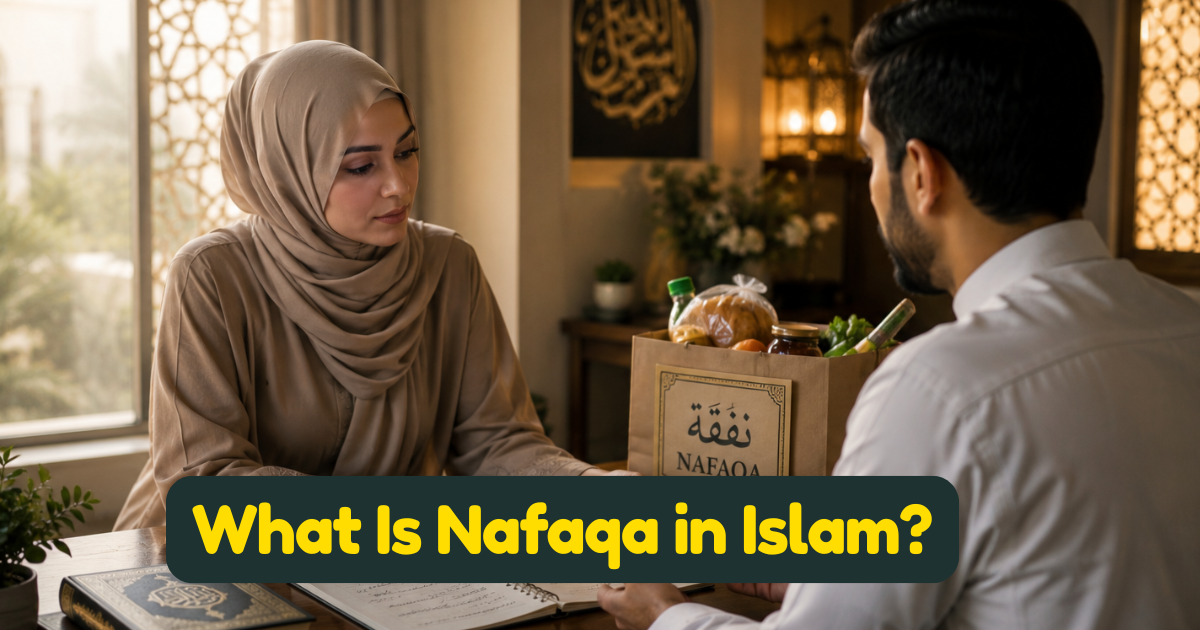
What Is Nafaqa in Islam — A Divorced Woman's Right to Financial Support
There is a particular silence that follows many Muslim divorces — not the silence of resolution, but the silence that falls when a woman who has just left her marriage realizes that no one around her is going to volunteer information about her financial rights. Family members assume someone else will explain it. Former husbands rarely bring it up. And the community, which had plenty to say about preserving the marriage, becomes remarkably quiet about what she is owed now that it has ended.
Nafaqa — financial maintenance — is not a courtesy that a former husband may extend if he is feeling generous. Under Islamic law, it is an obligation. It is Qur'anically established, jurisprudentially detailed across all four major schools of fiqh, and repeatedly emphasized in authentic hadith. A divorced Muslim woman's right to financial support is real, specific, and enforceable — and the fact that it is so frequently withheld in practice does not diminish it by a single dirham in religious or legal terms.
This article explains what nafaqa is, what it covers after divorce, how long it lasts, where the schools agree and disagree, what a pregnant divorced woman is entitled to, and what options exist when a former husband refuses to pay what Islamic law requires him to pay.
The Arabic Term and Its Scope
The word nafaqa derives from the Arabic root n-f-q, which carries the meaning of spending, providing, and sustaining. In Islamic jurisprudence, nafaqa refers to the financial provision a husband is obligated to make for those under his care — including his wife, his children, and in certain circumstances, other dependants.
In the context of divorce, nafaqa specifically refers to the maintenance a man owes his former wife during the iddah period — and, in some circumstances and schools, beyond it. It is not a single payment. It is an ongoing obligation covering the essential costs of living: food, clothing, accommodation, and other basic necessities appropriate to the woman's social standing and the couple's standard of living during marriage.
The scope of nafaqa is not determined by what the former husband considers adequate. Classical scholars across the schools established that nafaqa must be proportionate — calibrated to both the husband's financial capacity and the wife's accustomed standard of living. A woman who lived comfortably during her marriage cannot be reduced to subsistence provision during her iddah on the basis that her former husband claims financial difficulty without evidence.
The Qur'anic Basis — Not Advisory, But Obligatory
Nafaqa during and after divorce is not a scholarly invention. It is grounded directly in Qur'anic text — text that uses the language of obligation, not recommendation.
Surah Al-Baqarah (2:241) states plainly: "And for divorced women is a provision according to what is acceptable — a duty upon the righteous." The phrase used — haqqan 'ala al-muttaqin, a right upon the God-fearing — frames nafaqa not as charity but as a moral and legal debt. The use of haqq (right, due) is legally significant across all schools of Islamic jurisprudence: it establishes nafaqa as something owed, not gifted.
Surah Al-Talaq (65:6) provides additional detail: "Lodge them where you dwell, out of your means, and do not harm them in order to oppress them. And if they are pregnant, spend on them until they give birth." This verse addresses accommodation specifically — establishing that a man is obligated to provide housing for his former wife during her iddah, and that a pregnant divorced woman's maintenance extends through the entire pregnancy until delivery.
Surah Al-Talaq (65:7) follows with: "Let a man of wealth spend from his wealth, and he whose provision is restricted — let him spend from what Allah has given him. Allah does not burden a soul beyond what He has given it." This verse establishes the proportionality principle — nafaqa is calibrated to capacity, but the obligation itself does not disappear because a man claims limited means.
Three verses. Three dimensions of nafaqa: the general obligation, the housing provision, and the proportionality principle. Together they form one of the most complete Qur'anic frameworks for any single financial obligation in Islamic law.
What Nafaqa Covers — The Components
Classical Islamic jurisprudence breaks down nafaqa into identifiable components, each with its own scholarly discussion around scope and adequacy. For a divorced woman during her iddah, nafaqa covers the following:
Accommodation
The former husband is obligated to provide suitable housing for his divorced wife throughout her iddah. This is directly established in Surah Al-Talaq (65:6) and affirmed across all four schools. The standard of accommodation should be reasonable and appropriate — not a deliberate downgrade intended to pressure or humiliate.
In practice, this typically means the woman continues to reside in the marital home, or the husband provides alternative accommodation of comparable standard. Classical scholars are clear that he may not remove her from the marital home during the iddah of a revocable divorce — Surah Al-Talaq (65:1) explicitly prohibits this.
Food and Basic Sustenance
The obligation to provide food and basic daily sustenance is affirmed across all four schools for the duration of the iddah. The standard is adequacy relative to what the woman was accustomed to during marriage — not bare survival.
Clothing
Clothing appropriate to the woman's needs and accustomed standard is included in nafaqa during iddah according to the majority scholarly position. The Hanafi and Maliki schools are explicit on this. The Shafi'i school includes clothing in nafaqa with some nuance around the type of divorce, as discussed below.
Medical Care
Contemporary Islamic scholars, drawing on the principles of nafaqa and the general obligation of harm prevention, have extended the concept of necessary provision to include medical care. Classical fiqh did not address modern healthcare directly, but the underlying principle — that a man is obligated to sustain his former wife's wellbeing during iddah — supports the inclusion of necessary medical expenses within the scope of nafaqa in contemporary applications.
How Long Does Nafaqa Last — School by School
This is where the four schools diverge most significantly — and where a divorced woman's madhab has the most direct practical consequence for what she is entitled to claim.
The Hanafi Position — The Most Comprehensive Entitlement
The Hanafi school provides the broadest nafaqa entitlement for divorced women. Under Hanafi fiqh, a woman is entitled to full nafaqa — accommodation, food, clothing, and basic provision — throughout her entire iddah, regardless of the type of divorce.
This means that whether the divorce is revocable (first or second talaq), irrevocable (third talaq or talaq ba'in), or concluded through khul', the Hanafi school holds that the former husband's nafaqa obligation runs through the complete iddah period. The woman's entitlement does not diminish based on the type of divorce she received.
This is the most protective position for divorced women and represents the dominant ruling followed across South Asia, large parts of the Arab world, Turkey, and Central Asian Muslim communities.
The Maliki Position — Full Nafaqa for Revocable Divorce, Limited for Irrevocable
The Maliki school provides full nafaqa — including accommodation, food, and clothing — during the iddah of a revocable divorce (first or second talaq). For an irrevocable divorce (third talaq or talaq ba'in), the Maliki position maintains the accommodation obligation but reduces the maintenance entitlement. The reasoning is that in an irrevocable divorce, the husband's marital relationship with the woman has fully terminated, diminishing the basis for full ongoing maintenance.
However, Maliki scholars maintain that if the woman is pregnant, full nafaqa — accommodation, food, and clothing — continues without reduction through the entire pregnancy and until delivery, regardless of the type of divorce.
The Hanbali Position — Accommodation Only for Irrevocable Divorce
The Hanbali school parallels the Maliki position in broad structure: full nafaqa during the iddah of a revocable divorce, and reduced provision — specifically accommodation only, without full maintenance — during the iddah of an irrevocable divorce. The Hanbali school's reasoning similarly rests on the severed marital tie in an irrevocable divorce.
As with the Maliki school, the Hanbali position maintains full nafaqa obligations for a pregnant divorced woman, extending through delivery regardless of the divorce type.
The Shafi'i Position — The Most Restrictive on Irrevocable Divorce
The Shafi'i school takes the most restrictive position regarding nafaqa in irrevocable divorce. According to the predominant Shafi'i ruling, a woman in the iddah of a talaq ba'in (irrevocable divorce) is entitled only to accommodation — food, clothing, and general maintenance are not obligatory beyond the housing provision.
The exception that all Shafi'i scholars affirm without reservation: a pregnant woman in the iddah of any divorce — revocable or irrevocable — is entitled to full nafaqa through delivery. Pregnancy supersedes the type of divorce in every school's calculation of maintenance.
For women following the Shafi'i school in the context of an irrevocable divorce, this distinction is significant. It underscores why knowing one's madhab — and having access to a qualified Qazi or Islamic scholar for consultation — is practically important when navigating post-divorce financial entitlements.
Nafaqa for Pregnant Divorced Women — The Universal Obligation
Across all four schools, without exception, a pregnant divorced woman's nafaqa entitlement is the most protected category of post-divorce maintenance in Islamic law. The Qur'anic text of Surah Al-Talaq (65:6) — "if they are pregnant, spend on them until they give birth" — is accepted as a binding obligation that overrides the distinctions between revocable and irrevocable divorce that create differences elsewhere.
What this means practically is clear: a man who divorces his pregnant wife is obligated to provide full financial maintenance — accommodation, food, clothing, and basic provision — from the moment of divorce until the moment she delivers. If the pregnancy lasts nine months after the divorce, he owes nine months of full nafaqa. If she delivers two weeks after the divorce, his pregnancy-based nafaqa obligation concludes at delivery, after which the standard iddah nafaqa rules apply — though in this case, delivery also concludes the iddah itself.
After delivery, if the former wife breastfeeds the child, a separate financial obligation — ujrat al-rada'a, compensation for breastfeeding — arises under Islamic law. This is distinct from iddah nafaqa but equally established in Surah Al-Talaq (65:6): "And if they breastfeed for you, give them their compensation." The obligation to compensate a divorced mother for breastfeeding the couple's child is unambiguous across the schools.
What Happens When a Former Husband Refuses to Pay Nafaqa
The gap between what Islamic law requires and what divorced women actually receive in practice is, frankly, wide. Many former husbands simply do not pay. Some argue financial hardship. Some claim the divorce type exempts them. Some rely on the woman's lack of knowledge about her rights. And in communities without functioning Islamic arbitration mechanisms, enforcement is genuinely difficult.
What Islamic jurisprudence says about this is worth stating plainly. A former husband who refuses to pay the nafaqa he owes is not simply acting ungenerously — he is withholding a financial debt. Classical scholars across all four schools treated unpaid nafaqa as a debt that accumulates, is legally claimable, and remains the woman's right regardless of how much time passes before she pursues it.
Imam al-Kasani in Bada'i al-Sana'i, the foundational Hanafi jurisprudence text, explicitly held that unpaid nafaqa becomes a financial debt (dayn) that the woman may claim through a Qazi or Islamic court. The passage of time does not extinguish the debt — it accumulates until paid.
In jurisdictions with functioning Islamic family courts — Pakistan, Malaysia, Egypt, and others — a divorced woman may bring a claim for unpaid iddah nafaqa directly before the court and have it enforced. In Western countries and Muslim-minority contexts without access to Islamic courts, the options are more limited but not absent: many Muslim arbitration bodies and community mediation services handle nafaqa disputes, and in some jurisdictions civil courts may recognize and enforce Islamic financial agreements made at the time of marriage.
A divorced woman who has not received her nafaqa and is in a country without Islamic court access should, at minimum, consult with a qualified Islamic scholar who can provide documentation of the obligation — both for her own knowledge and as a basis for any future mediation or civil claim.
Nafaqa and Mahr — Two Separate Rights, Often Confused
It is common for divorced women — and their families — to conflate nafaqa with mahr, treating them as a single financial consideration when they are in fact two entirely distinct obligations with different legal bases, different timing, and different conditions.
Mahr is the dower — the financial gift agreed upon at the time of nikah, owed by the husband to the wife as a condition of the marriage contract itself. It is owed the moment the nikah is concluded, and if not paid immediately, it becomes a debt that persists regardless of what happens to the marriage afterward. A divorce does not extinguish unpaid mahr. A khul' in which the woman returns her mahr as part of the settlement is the one situation where mahr and divorce financially intersect — but even then, only the portion returned is released; the rest, if any, remains owed.
Nafaqa, by contrast, is an ongoing maintenance obligation triggered by the existence of the marriage (or its recent termination through divorce) and extinguished when the iddah ends. It is not a lump sum — it is a continuing provision. It can be calculated on a daily, weekly, or monthly basis depending on the school and the circumstances.
A divorced Muslim woman may simultaneously hold a claim for unpaid mahr and a separate claim for iddah nafaqa. These are two independent financial rights, and the settlement of one does not affect the other unless explicitly agreed upon as part of a comprehensive divorce settlement. For a detailed treatment of mahr, the article on what is mahr in nikah covers the subject in full.
Nafaqa After Iddah — Does It Exist?
One of the most frequently searched questions around this topic is whether a divorced woman has any right to financial support after her iddah concludes. The answer, across the classical schools, is nuanced.
In the general case — a non-pregnant divorced woman who has completed her iddah — the majority position across the Hanafi, Shafi'i, and Hanbali schools is that the former husband's nafaqa obligation ends when the iddah concludes. He is not required to provide ongoing maintenance indefinitely after the waiting period ends.
However, two important exceptions exist. The first is child-related nafaqa. If there are children from the marriage, the father's financial obligation to his children is entirely separate from nafaqa to the former wife — it continues indefinitely until the children reach maturity and is not extinguished by the completion of iddah. A mother who is raising the couple's children may claim child maintenance (nafaqat al-awlad) from the father independently of her own iddah entitlement.
The second exception involves a distinctive Maliki concept — the mut'a, or consolation gift. Surah Al-Baqarah (2:241) uses the term mata' in the context of divorced women — a provision beyond strict iddah maintenance that represents an acknowledgement of the marriage's end and a gesture of fairness. While the Hanafi school treats mut'a as recommended rather than strictly obligatory, the Maliki school holds it as a distinct obligation owed in certain types of divorce. The concept is not identical across schools, but its presence in Qur'anic text means it carries scholarly weight and is worth knowing about.
Nafaqa and the Khul' Divorce — A Specific Consideration
When a woman initiates khul' — divorce in exchange for returning her mahr or an agreed compensation — the question of nafaqa during the subsequent iddah is addressed differently across the schools.
The Hanafi school, as noted, maintains the full nafaqa obligation through the iddah of a khul' divorce. The Maliki and Hanbali schools, which already reduce maintenance in irrevocable divorce, tend to limit the obligation further in khul' — reasoning that since the woman herself initiated the termination, the basis for ongoing maintenance is further diminished.
The Shafi'i school applies the same restricted maintenance position to khul' as to other forms of irrevocable divorce — accommodation only, unless the woman is pregnant.
For a woman who obtained her divorce through khul' and is now navigating her iddah, knowing which school's ruling applies to her situation determines whether she has a strong claim for full maintenance or a reduced one. This is a situation where consultation with a qualified Islamic scholar before finalizing a khul' agreement — to understand what she is and is not entitled to — can make a meaningful practical difference.
What Knowing Your Rights Actually Changes
There is a practical dimension to all of this that deserves to be named directly. A divorced Muslim woman who does not know she is entitled to nafaqa cannot claim it. A woman who accepts that her former husband's minimal provision or complete non-provision is somehow the Islamic norm — because no one around her has ever explained otherwise — is not less entitled. She is simply less informed.
The silence around divorced Muslim women's financial rights is not accidental. It persists because the status quo — women not knowing, not claiming, not being paid — benefits the people who owe them money. Islamic knowledge, in this context, is not abstract. It is directly protective.
A woman completing her iddah while not receiving nafaqa is owed money. That money is a religious debt in the eyes of every school of Islamic jurisprudence. It does not disappear because it was never paid. It does not become forfeited because it was never claimed within a specific timeframe. It accumulates, and it remains claimable.
Moving Forward — Rights Intact
For a divorced Muslim woman navigating her iddah and considering what comes next, nafaqa is one piece of a larger picture of rights that Islam establishes clearly even when communities communicate them poorly. The iddah itself has a defined end. The former husband's nafaqa obligation ends with it in most cases. And when that iddah concludes, she is free — financially independent of his obligation, legally clear of the marriage, and entitled to build whatever comes next on her own terms.
For those whose "what comes next" includes a new nikah — conducted privately, Islamically, and without the emotional weight of another large ceremony — an online nikah through a Shariah-compliant service is a legitimate and increasingly chosen path. The article on online nikah after divorce — what Islam says covers the full set of Islamic conditions that apply. For those navigating family opposition alongside financial complexity, the article on online nikah without family support addresses the practical realities of proceeding with a new nikah when those around you are not supporting your path forward.
When you are ready to explore what a Shariah-compliant online nikah looks like in practice, visit the InstantNikah.com process page, read from real couples on the reviews page, or speak directly with the team through the contact page.
When the time is right: Book your online nikah at InstantNikah.com.
Admin User
Author