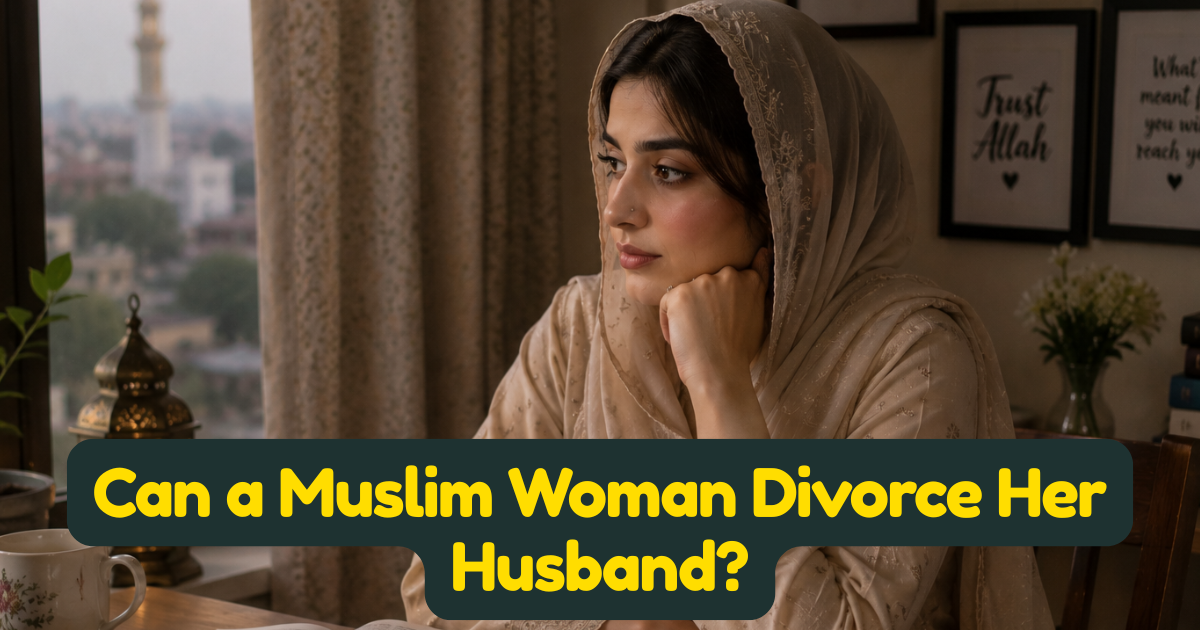
Can a Muslim Woman Divorce Her Husband? Understanding Khul' and Faskh in Islamic Law
The short answer is yes. A Muslim woman can end her marriage under Islamic law. What she cannot do — in most scholarly opinions — is issue a unilateral talaq the way a husband can. But the absence of unilateral talaq does not mean the absence of exit. Islamic jurisprudence provides women with distinct, legitimate, and well-established pathways out of a marriage that cannot or should not continue.
The longer answer requires understanding what those pathways are, how they differ from one another, what conditions apply to each, and — just as importantly — what cultural distortions have accumulated around this topic that obscure what the Shariah actually says.
Because the gap between what Muslim women are told about divorce in Islam and what Islamic law actually provides is, in many communities, significant. Women who do not know their rights cannot exercise them. And women trapped in harmful marriages because they believe Islam offers them no way out are living a reality that the fiqh itself does not require.
This article covers the three primary mechanisms available to Muslim women — khul', faskh, and delegated talaq — with attention to the Quranic foundation, the prophetic precedent, and the positions of all four major Sunni madhabs.
---Understanding Talaq First — And Why It Is Asymmetrical
Talaq is the husband's unilateral right of divorce. He pronounces it — once, under the conditions the scholars have established — and the marriage begins its dissolution process. Islamic law surrounds talaq with significant conditions: it should not be pronounced during menstruation, should not be pronounced three times in a single sitting in the manner that creates permanent prohibition, and is accompanied by an iddah period during which reconciliation is possible. But structurally, a husband can initiate divorce without his wife's agreement and without judicial involvement.
This asymmetry is real. It is also frequently misrepresented in both directions — either weaponised against Islam by those who present it as evidence of inherent oppression, or glossed over by those who do not want to engage with the genuine tension it creates.
The Islamic justification for the asymmetry rests on the complementary financial obligations placed on the husband: the mahr he paid at nikah, the nafaqah he is obliged to provide throughout the marriage, and the financial obligations that continue after divorce during the iddah period. The argument, in classical fiqh, is that the financial weight of dissolution falls primarily on the husband — and the unilateral right of talaq corresponds to that weight.
Whether or not one finds this argument fully satisfying in a contemporary context, what matters practically is this: the asymmetry of talaq does not mean a woman is trapped. It means she accesses divorce through different mechanisms — mechanisms that Islamic law has established and that scholars across centuries have developed and applied.
---Khul' — The Woman's Right to Seek Separation
Khul' (خلع) is the primary mechanism by which a Muslim woman can initiate divorce. It is rooted directly in the Quran and established by prophetic practice — not a later scholarly addition or a concession reluctantly extended to women. It is original Islamic law.
The Quranic Foundation
Allah says: "And it is not lawful for you to take anything of what you have given them unless both fear that they will not be able to keep within the limits of Allah. But if you fear that they will not keep within the limits of Allah, then there is no blame upon either of them concerning that by which she ransoms herself." (Surah Al-Baqarah 2:229)
The phrase "by which she ransoms herself" refers directly to khul' — the woman offering to return the mahr or a negotiated equivalent in exchange for her freedom from the marriage. The verse establishes it not as an exception or an emergency measure, but as a recognized and legitimate Islamic transaction between spouses.
The Prophetic Precedent: The Case of Habibah bint Sahl
The clearest hadith establishing khul' concerns Habibah bint Sahl (in some narrations, Jamilah bint Ubayy ibn Salul) who came to the Prophet ﷺ and told him she did not dislike her husband Thabit ibn Qays for reasons of character or religion, but that she simply could not remain in the marriage — she feared she would not fulfill his rights properly if she stayed. The Prophet ﷺ asked whether she would return the garden Thabit had given her as mahr. She said yes. He ﷺ instructed Thabit to accept the garden and release her. Thabit did so, and the marriage was dissolved. (Bukhari)
This narration is profoundly significant. The woman did not allege abuse. She did not cite mistreatment. She expressed that she could not, for reasons she could not fully articulate beyond personal incompatibility, remain in the marriage. And the Prophet ﷺ facilitated her exit without requiring her to prove harm. He asked only whether she would return the mahr — and when she agreed, the matter was concluded.
This establishes khul' as a right that does not require a woman to demonstrate that her husband has done something wrong. Incompatibility, aversion, the inability to fulfill marital rights — these are sufficient grounds.
How Khul' Works in Practice
The mechanics of khul' involve the woman offering to return the mahr — or a negotiated financial consideration — in exchange for the husband releasing her from the marriage. If the husband agrees, the marriage is dissolved immediately. A single khul' counts as one irrevocable divorce — different from a revocable talaq. The husband cannot take her back during the iddah without a new nikah and her consent.
The woman observes an iddah of one menstrual cycle after khul' in most scholarly opinions — shorter than the three-cycle iddah following a talaq. During this period, no nafaqah from the former husband is owed in most madhab positions, since the woman initiated the separation and received the return of the financial consideration.
What If the Husband Refuses?
This is where the madhabs diverge significantly — and where the question becomes most practically urgent for women seeking khul' against an unwilling husband.
The Maliki and Hanbali schools, alongside a significant scholarly opinion within the Shafi'i tradition, hold that if the husband refuses khul' and there is genuine harm or the woman's inability to maintain the limits of Allah within the marriage, a judge can compel the divorce — or dissolve the marriage through faskh (judicial annulment). The woman's right to exit is not dependent solely on the husband's cooperation.
The classical Hanafi position is more restrictive on judicially compelled khul', requiring the husband's consent for the khul' itself — but then provides faskh as the parallel mechanism for situations of genuine harm.
In practice, contemporary Islamic scholars and institutions — including Shariah councils in the UK and Islamic courts across multiple jurisdictions — operate on the broader principle that a woman cannot be permanently imprisoned in a marriage by a husband's refusal to cooperate. This is the operative consensus position across most functioning Islamic judicial institutions today.
---Faskh — Judicial Dissolution of the Marriage
Faskh (فسخ) is the dissolution of a marriage by a judge or qualified Islamic authority — not by the couple's mutual agreement, and not by the husband's unilateral pronouncement, but by an authoritative third party who has assessed the situation and found grounds to dissolve the contract.
Faskh is available to women and represents the judicial arm of Islamic divorce law. Where khul' is a negotiated exit, faskh is a ruled one.
Grounds for Faskh Across the Madhabs
The grounds on which faskh can be granted vary between the schools, but the Maliki school — historically the most developed on this question — provides the broadest and most woman-protective framework. Grounds include:
- Darar — harm: Physical abuse, emotional cruelty, sustained neglect, or any treatment that creates genuine harm. The article on what darar means in Islamic marriage law covers this in full detail.
- Failure of nafaqah: A husband who cannot or will not provide for his wife — housing, food, clothing — has failed a foundational marital obligation. Most madhabs recognize sustained failure of nafaqah as grounds for faskh. The Maliki and Hanbali schools are the clearest on this; the Shafi'i school is somewhat more restrictive; the classical Hanafi school historically required specific procedural steps but arrives at the same practical conclusion.
- Impotence or physical incapacity: A husband who is unable to fulfill the marital relationship physically — and who concealed this before the nikah — gives the wife grounds for faskh. This is agreed upon across all four madhabs, with variation in the waiting period given to the husband before the dissolution proceeds.
- Extended absence or disappearance: A husband who has been absent for an extended period — leaving his wife in a state of suspension where she is neither a wife in practice nor free to remarry — gives grounds for faskh. The Maliki school sets this threshold at approximately one year of unknown absence; the Hanbali school at four years; the Hanafi school has historically been more restrictive but contemporary Hanafi institutions have moved toward more practical positions.
- Imprisonment: A husband serving a lengthy prison sentence, leaving his wife without provision or companionship, is recognized as grounds for faskh in many contemporary scholarly opinions.
- Apostasy: If a husband leaves Islam, the marriage is dissolved — this is agreed upon across all four madhabs. The woman does not need to initiate a process; the apostasy itself terminates the marriage contract.
- Deception at the time of nikah: If material facts were concealed — a serious pre-existing condition, a previous marriage that was hidden, false information about identity or circumstances — faskh can be sought on grounds that the contract was formed on false premises.
Who Grants Faskh?
Classically, faskh was granted by a qadi — an Islamic judge with formal jurisdiction. In countries with Islamic family law courts, this remains the mechanism. In Western countries where no such court has civil jurisdiction, Shariah councils and recognized Islamic arbitration bodies have developed to fulfill this function within their communities.
In the UK, the Shariah Council and the Islamic Sharia Council both handle faskh applications from Muslim women seeking dissolution of religious marriages. Similar bodies exist across North America, Europe, and Australia. These institutions are not civil courts — they do not grant civil divorces — but they provide the Islamic dissolution that allows a woman to remarry within her faith without the stigma or theological uncertainty of an unresolved religious marriage.
For women in countries without accessible Shariah councils, a qualified Islamic scholar with appropriate knowledge — including those associated with reputable online Islamic services — can assess faskh grounds and issue the relevant Islamic ruling.
---Delegated Talaq — When the Husband Grants Divorce Rights to the Wife
A third mechanism — less commonly known but clearly established in Islamic law — is the delegation of talaq rights to the wife. Called tafwid al-talaq, this is a provision within the nikah contract itself whereby the husband explicitly grants his wife the right to pronounce her own divorce under specified conditions.
This is not a workaround or a modernist innovation. It is recognized in all four Sunni madhabs as a valid contractual provision. If the nikah contract states — for example — that the wife has the right to divorce herself if the husband takes a second wife without her consent, or if he fails to provide for a specified period, or if he relocates the family without her agreement — she can invoke that right when the stated condition occurs, and the marriage is dissolved by her pronouncement without requiring a judge or the husband's cooperation.
The crucial point is that this provision must be built into the nikah contract at the time of marriage. It cannot be inserted later without the husband's agreement. For couples approaching nikah, including this clause is a legitimate, fully Islamic protection that women are entitled to request and men are encouraged to provide as a mark of good faith and equitable partnership.
The pre-nikah conversation about tafwid is one of the questions that belongs in any serious preparation for marriage — and the article on questions Muslims should ask before nikah addresses this and similar contractual considerations in the preparation framework.
---The Iddah After Female-Initiated Divorce
Regardless of the mechanism — khul', faskh, or tafwid — a woman who has exited a consummated marriage observes an iddah before she is free to remarry. The nature and duration of the iddah varies by mechanism and school.
After khul', the majority scholarly position sets the iddah at one menstrual cycle — shorter than the three-cycle iddah following a husband-initiated talaq. The reasoning is that khul' involves the return of the mahr, which compensates the financial asymmetry, and a shorter iddah reflects this.
After faskh, the iddah requirements follow a similar framework — typically three menstrual cycles in most madhab positions, though there is scholarly variation based on the grounds for dissolution.
A woman who is pregnant at the time of divorce — regardless of mechanism — observes an iddah until delivery. This is established clearly in the Quran (Surah At-Talaq 65:4) and is agreed upon across all schools.
Understanding iddah matters practically. During this period, the woman is not free to remarry. She is entitled to housing in most madhab positions for the duration. And the iddah period exists — as the scholars have explained — to establish clarity around parentage, to allow emotional recalibration, and to preserve the possibility of reconciliation where circumstances allow it.
For a deeper treatment of iddah after divorce — what it requires, what it permits, and how it is observed — the article on iddah after divorce covers this comprehensively.
---What the Four Madhabs Say — A Comparative Summary
Because the school of fiqh a woman follows affects which mechanisms are most accessible and how they function procedurally, a brief comparative summary is useful.
Hanafi
Khul' requires the husband's agreement for its khul' form specifically. However, faskh is available through a judge on established grounds — harm, failure of nafaqah, prolonged absence. The classical Hanafi position has historically been somewhat more restrictive on judicially compelled dissolution, but contemporary Hanafi institutions and scholars — including the Darul Uloom network and Deobandi and Barelvi-aligned Shariah councils — operate with broader practical latitude than the classical texts alone might suggest. Tafwid al-talaq is fully recognized.
Maliki
The most developed and woman-protective framework for female-initiated divorce. A judge can compel khul' if the woman demonstrates genuine inability to remain in the marriage. Faskh is available on broad grounds including harm, nafaqah failure, and absence. The Maliki school's historical development in this area — particularly through the North African and Andalusian scholarly tradition — produced the most robust judicial protection for women seeking divorce across the classical schools. Tafwid is fully recognized.
Shafi'i
Khul' requires the husband's agreement in the Shafi'i position. Faskh is available judicially on grounds of harm, nafaqah failure, impotence, and absence — with a generally structured procedural approach. The Shafi'i school provides clear pathways but works primarily through judicial process rather than the woman's independent action. Tafwid is fully recognized.
Hanbali
Relatively accessible faskh provisions, particularly on grounds of harm and nafaqah failure. The Hanbali school historically recognized a judge's power to dissolve a marriage on the wife's petition where genuine grounds exist. Ibn Qudama's treatment in Al-Mughni provides detailed guidance on the conditions and procedural steps. The Hanbali school's position on extended absence is particularly defined — a four-year threshold before faskh on grounds of disappearance. Tafwid is fully recognized.
---Civil Divorce and Islamic Divorce — Two Separate Things
This distinction matters enormously for Muslim women in Western countries and must be stated clearly.
A civil divorce — granted by a government court under the family law of the relevant country — dissolves the legal marriage. It does not dissolve the Islamic marriage. A Muslim woman who has obtained a civil divorce from her husband but has not obtained an Islamic khul', faskh, or talaq is civilly free but islamically still married. If she remarries without an Islamic dissolution, she enters a new nikah while in an existing one — which is clearly impermissible.
The reverse is also true but less common as a problem: an Islamic dissolution without a civil divorce leaves the civil marriage intact — with implications for property, inheritance, and legal rights that can harm the woman significantly.
Both dimensions need to be resolved. In practice, many Muslim women obtain the civil divorce through the courts — which in the UK, USA, Canada, and most Western jurisdictions can be obtained unilaterally after a separation period regardless of the husband's cooperation — and separately pursue the Islamic dissolution through a Shariah council, qualified imam, or Islamic service.
This dual-track approach is the practical reality for most Muslim women in non-Muslim-majority countries, and understanding it prevents the situation where a woman believes she is fully free because a civil court says so — without realizing the Islamic dimension remains unresolved.
---What About a Husband Who Refuses to Give Talaq or Cooperate With Khul'?
This is the practical crisis point for many Muslim women — a husband who holds talaq and refuses to use it, while simultaneously refusing to agree to khul'. It is sometimes called a "talaq hostage" situation, and it is one that Islamic law addresses, though the solutions require navigating the judicial mechanisms rather than bypassing them.
The answer depends on the grounds available. If there is demonstrable harm — physical, emotional, financial neglect — faskh is available through a Shariah council or qualified scholar. If there is no specific harm but genuine and sustained incompatibility, most contemporary scholars — including those operating Shariah councils in the West — will grant faskh on the broader grounds that keeping a woman permanently in a dead marriage against her will itself constitutes darar.
The scholarly evolution on this point is significant. Classical Hanafi fiqh was relatively restrictive on this ground. Contemporary Hanafi-aligned institutions — including major Shariah councils in the UK that primarily serve South Asian Muslim communities — have moved substantially toward the Maliki position in practice, recognizing that a woman's inability to exit a marriage on any terms other than a husband's cooperation creates a situation the Shariah cannot have intended.
Ibn al-Qayyim's principle — that the Shariah does not create situations of pure harm with no remedy — is frequently invoked by contemporary scholars navigating the gap between classical restriction and the reality of women who cannot access justice through the narrow traditional pathways. It is a legitimate and well-grounded scholarly argument, not a modernist revision.
A woman in this situation should approach a recognized Shariah council or a qualified Islamic scholar with experience in dissolution cases, document her situation thoroughly, and understand that the process may take time — but that Islamic law does provide for her. She is not without options, and she is not required to remain in a marriage permanently against her will simply because her husband will not cooperate.
---Remarriage After Islamic Divorce
Once the iddah is complete and the Islamic dissolution is properly established, a Muslim woman is entirely free to remarry. There is no Islamic stigma attached to a divorced woman who has legitimately exited a marriage through the available mechanisms. The Prophet ﷺ himself married women who were previously married. His companions married divorced women. The Quran addresses remarriage after divorce as a normal and legitimate continuation of life.
The cultural stigma that exists around divorced Muslim women in many communities is precisely that — cultural. It has no Quranic foundation and no prophetic grounding. A woman who exercised her Islamic right to exit a marriage that could not continue has done nothing that diminishes her dignity or her eligibility for a new, sound nikah.
For women considering nikah after divorce — including the wali questions, the iddah timing, and the process of beginning again — the article on online nikah after divorce covers these dimensions practically and with attention to the specific circumstances divorced women navigate. The article on a divorced woman's nikah without family consent is also directly relevant — particularly given that a previously married woman holds primary authority over her own remarriage under Islamic law.
---A Final Word on Rights and Knowledge
Islamic law gave Muslim women the right to exit a marriage fourteen centuries before most legal systems in the world did the same. Khul' was established by Quranic verse and prophetic practice in a world where women had no legal personhood in most civilizations. That history matters — not as a rhetorical point, but as a reminder that the rights encoded in Islamic family law are not concessions extracted by modernity. They are original.
What has obscured them is not the fiqh but the cultures that accumulated around it — cultures that treated female silence as Islamic virtue, that weaponized the wali system against women, that made khul' socially shameful and faskh practically inaccessible. These are cultural failures, not Islamic ones.
A Muslim woman who knows her rights under Islamic law is better positioned to exercise them — in a marriage that needs to end, in a nikah she is entering for the first time, and in the conversations she has about both with the people around her.
If you are navigating a situation involving Islamic dissolution — or if you are approaching a new nikah and want to understand how to protect yourself contractually through tafwid or other provisions — the team at InstantNikah.com is available for a confidential consultation. For those ready to begin a new chapter after divorce, you can explore the full nikah process and packages to understand what a Shariah-compliant ceremony involves from start to finish.
Admin User
Author