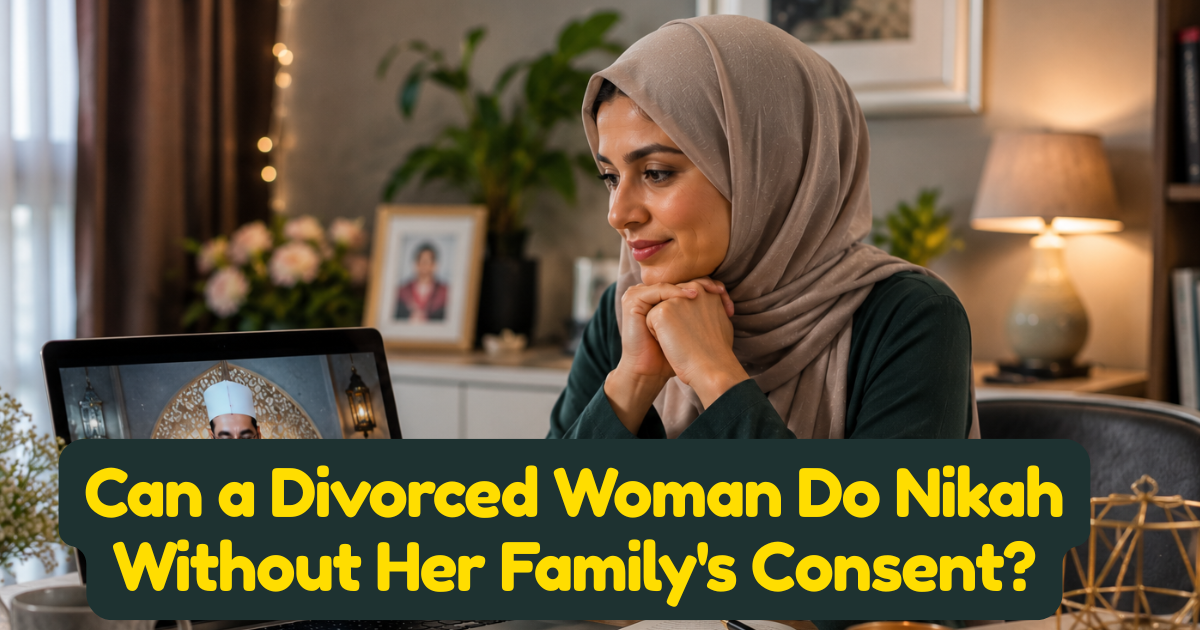
Can a Divorced Woman Do Nikah Without Her Family's Consent? What Islamic Scholars Actually Say
There is a version of this question that floats around family WhatsApp groups, gets answered with confident authority by uncles who have never opened a fiqh manual, and ends with a divorced woman being told she cannot remarry without her father's blessing. There is another version — the one that actually matters — which requires opening those manuals, reading what the scholars wrote, and separating Islamic law from inherited cultural assumption.
The honest answer is this: Islamic scholarship is not uniform on this question. The four major schools of jurisprudence hold genuinely different positions, and the difference between them has enormous practical implications for a divorced Muslim woman deciding whether she needs her family's involvement — or consent — to enter a new nikah.
This article lays out exactly what each school says, what the scholarly reasoning is, and what that means for a divorced woman considering online nikah today — without filtering the answer through cultural comfort.
Why the Question Matters More for Divorced Women
In Islamic jurisprudence, a critical distinction is drawn between a bikr (virgin, never-married woman) and a thayyib (a woman who has previously been married — through divorce, annulment, or widowhood). This distinction is not incidental. It sits at the foundation of how each school approaches wali and consent for remarriage.
The Prophet ﷺ addressed this distinction explicitly. In a hadith recorded in Sahih Muslim, he said: "A previously married woman (thayyib) has more right over herself than her guardian." This hadith is authentic, well-established, and agreed upon across the major hadith collections. The disagreement among scholars is not about whether this hadith is authentic — it clearly is — but about precisely what it means in terms of the legal requirement of a wali for nikah.
The Hanafi Position — The Most Permissive View
The Hanafi school — the largest in terms of global Muslim followership, and dominant across South Asia, Central Asia, Turkey, and significant parts of the Arab world — holds the most empowering position for a divorced woman.
According to Hanafi fiqh, a previously married woman who is of sound mind and has reached adulthood may contract her own nikah without requiring the active consent or presence of a wali. Her own ijab (offer) and qabool (acceptance), delivered in the presence of two adult Muslim witnesses, constitutes a valid nikah.
The Hanafi reasoning rests on a principle of full legal agency: an adult, sane Muslim woman — particularly one who has already experienced marriage and understands its realities — is treated as a complete legal actor. She does not require a guardian to exercise her right to marry on her behalf.
However — and this is an important nuance that even many Hanafi-following Muslims miss — the Hanafi position does recommend the presence of a wali as a matter of preference and social propriety. It is considered more proper for the wali to be involved. But his absence does not invalidate the nikah. A Hanafi-based nikah conducted without a wali is legally valid, not merely tolerated.
This has direct implications for divorced women using an online nikah service: under Hanafi jurisprudence, a divorced woman who chooses to remarry — even without her father's blessing, even without any male family member present — has a valid Islamic basis for proceeding.
The Shafi'i and Hanbali Position — Wali Remains Required
The Shafi'i and Hanbali schools take a different stance. Both hold that a wali is a mandatory condition for nikah — not optional, not preferred, but required — regardless of whether the woman has been previously married.
In these madhabs, the thayyib distinction raised in the hadith of Sahih Muslim is interpreted differently. Scholars in the Shafi'i and Hanbali traditions explain that "more right over herself" refers to the woman's right to consent — meaning she cannot be forced into marriage against her will — rather than a right to conduct nikah independently of a wali altogether.
Under this interpretation, the wali's role is reframed: he is not the one granting permission — he is the one representing the contract on her behalf. A nikah without a wali in these schools is considered invalid (fasid or batil depending on the specific ruling within each school). A Qazi or appointed representative can serve as wali if no natural guardian is available, but the role itself cannot be dispensed with entirely.
The Hanbali school adds an additional layer: if a wali refuses without legitimate Islamic grounds to facilitate a woman's rightful marriage, a judge (Qazi) may step in to serve as her wali and conduct the nikah. This is not a loophole — it is a built-in protection against the weaponization of the wali role to prevent a woman from remarrying.
The Maliki Position — A Middle Path With Conditions
The Maliki school occupies a nuanced position that neither follows the full permissiveness of the Hanafi view nor the strict requirement of the Shafi'i and Hanbali schools.
In Maliki fiqh, a previously married woman of high social standing (sharifa) requires a wali for her nikah to be valid. However, a thayyib of lesser social standing has more latitude, and in certain documented Maliki opinions, she may arrange her own marriage with witnesses present. The emphasis in Maliki jurisprudence falls heavily on social protection — the wali requirement exists largely to protect the woman's dignity and standing, not to restrict her agency.
More practically, Maliki scholars have historically recognized that when a natural wali is absent, obstructive, or unjustly refusing, a Qazi has full authority to step into the wali role and solemnize the nikah. This principle of the Qazi-as-wali is one of the most practically important tools in Islamic jurisprudence for divorced women who face family opposition to remarriage.
When Family Opposition Is Not an Islamic Obstacle
What happens when a divorced woman's family — her father, brothers, or other male relatives — refuses to support her remarriage, not on Islamic grounds, but on cultural, emotional, or purely personal ones?
This situation has a name in Islamic jurisprudence: adhl. It refers to a wali who unjustly prevents a woman from marrying a suitable partner. Across all four schools, adhl on the part of a wali is not merely frowned upon — it is considered a wrong that strips the wali of his guardianship authority in the context of that marriage.
Imam Malik, Imam Shafi'i, and Imam Ahmad ibn Hanbal all held that a wali who commits adhl may be bypassed in favour of the next eligible male relative — or, if no such relative is available or willing, a Qazi steps in to fulfill the wali function. This is classical Islamic jurisprudence, not a modern convenience. It is a protection that has existed within the tradition for over a thousand years.
A father who refuses his divorced daughter's remarriage because he finds the new partner "beneath" the family, or because of pride, or because he disapproves without legitimate Islamic cause — that father is committing adhl. He does not have an Islamic right to prevent the marriage in that circumstance, and classical scholars are unambiguous on this point.
The Qazi's Role — And Why It Matters for Online Nikah
This is where the function of an online Qazi becomes directly relevant to the divorced woman's situation.
An online Qazi — a qualified Islamic scholar authorized to conduct nikah — can serve the wali function when a natural wali is absent, unavailable, or obstructive. This is not a workaround invented by online nikah services. It is a well-established role within Islamic jurisprudence, used historically in Muslim-minority contexts, in diaspora communities, and in any situation where the standard wali chain was broken or dysfunctional.
When InstantNikah.com conducts an online nikah for a divorced woman, the presiding Qazi assesses the specific situation — the madhab she follows, the availability of her wali, and whether any family obstruction constitutes adhl — before proceeding. The ceremony is conducted with full Islamic conditions: witnesses present, mahr agreed, ijab and qabool clearly exchanged. The result is a nikah that is Islamically sound, properly documented, and conducted with the care the situation deserves.
For a complete understanding of how the online nikah process works, visit the InstantNikah.com process page.
What a Divorced Woman Needs to Know Before Proceeding
If you are a divorced Muslim woman exploring your options for remarriage, the following points represent the clearest practical summary of what Islamic scholarship establishes:
- Your iddah must be complete. No nikah is valid — with or without family consent — until your waiting period has ended. Know your iddah status before anything else.
- Your madhab matters. The Hanafi school gives a divorced woman the most autonomy. The Shafi'i and Hanbali schools require a wali but provide the Qazi alternative when a wali is obstructive. The Maliki school balances between the two with Qazi substitution available in cases of adhl.
- Family disapproval is not the same as Islamic prohibition. A family's cultural or emotional objection to your remarriage does not carry Islamic legal weight. If the partner is suitable by Islamic standards, the objection may constitute adhl.
- You have the right to consent — and the right to refuse. Across all four schools, no divorced woman can be coerced into a marriage she does not want. Your consent is not optional; it is a condition of validity.
- A Qazi can serve as your wali. If your natural wali is absent, deceased, unknown, non-Muslim, or obstructive without cause, a qualified Qazi can fulfill the wali function and your nikah remains fully valid.
The Deeper Issue — Cultural Authority Disguised as Religious Ruling
It is worth naming something directly. Much of what divorced Muslim women are told about their remarriage rights is not Islamic ruling — it is cultural authority wearing Islamic clothing.
The idea that a divorced woman must "earn back" her family's goodwill before she may remarry has no foundation in any of the four schools. The idea that her children from a previous marriage make her a less appropriate candidate for nikah is similarly absent from classical fiqh. The idea that a woman who initiated a khul' has somehow forfeited her right to a dignified remarriage — also not Islamic.
These narratives persist because they serve social structures, not divine guidance. Islamic jurisprudence, when read with intellectual honesty, does something quite different: it protects the divorced woman's right to move forward, sets conditions to ensure that forward movement is wise and protected, and provides built-in mechanisms — the Qazi, the adhl ruling, the thayyib principle — specifically for situations where those around her are not supporting her rights.
For those who have faced family opposition specifically, the article on online nikah without family support offers additional practical guidance on navigating that reality within an Islamic framework.
Related Questions Worth Knowing the Answer To
Does a divorced woman need her ex-husband's permission to remarry?
No. Once a valid divorce (talaq or khul') has been completed and the iddah has passed, the former husband has no Islamic authority — legal, moral, or religious — over the divorced woman's decision to remarry. There is no school of Islamic jurisprudence that grants a former husband veto rights over his ex-wife's subsequent nikah.
What if the divorced woman's father has passed away?
The wali chain passes to the next eligible male relative — a paternal grandfather, brother, paternal uncle — in a defined order recognized across the schools. If no male relatives are available, a Qazi serves as wali. The absence of a father does not make nikah impossible; it activates the next layer of the wali system.
Does a divorced woman need witnesses for her new nikah?
Yes — across all four schools, two adult, sane Muslim witnesses are a non-negotiable condition of a valid nikah. This requirement applies regardless of the woman's marital history. There is no scholarly position that removes the witness requirement for a previously married woman. For more on this, the article on online nikah without witnesses addresses the topic in detail.
Is a nikah valid if the woman's family later finds out and objects?
Under the Hanafi school, a previously married woman's valid nikah — conducted with proper witnesses and mahr — does not become invalid because family members later object. Family objection after the fact carries no power to annul a nikah that was concluded with correct Islamic conditions. Under Shafi'i, Maliki, and Hanbali positions, the validity hinges on whether a wali (including a Qazi as substitute) was properly present at the time — not on family approval after the fact.
Taking the Next Step
If you are a divorced woman who has completed your iddah, chosen a suitable partner, and are ready to move forward with a Shariah-compliant nikah — without a ceremony that requires the attendance or approval of people who have not supported you — InstantNikah.com is built for exactly this.
The presiding Qazi is experienced in navigating the full range of wali situations, including those where family is absent, obstructive, or where the Qazi must serve as wali. The process is private, dignified, and conducted with full Islamic care.
You can read through verified accounts from real couples on the reviews page, learn about the full process at instantnikah.com/process, or reach out directly through the contact page if you want to discuss your specific situation before booking.
When you are ready: Book your online nikah at InstantNikah.com.
Admin User
Author