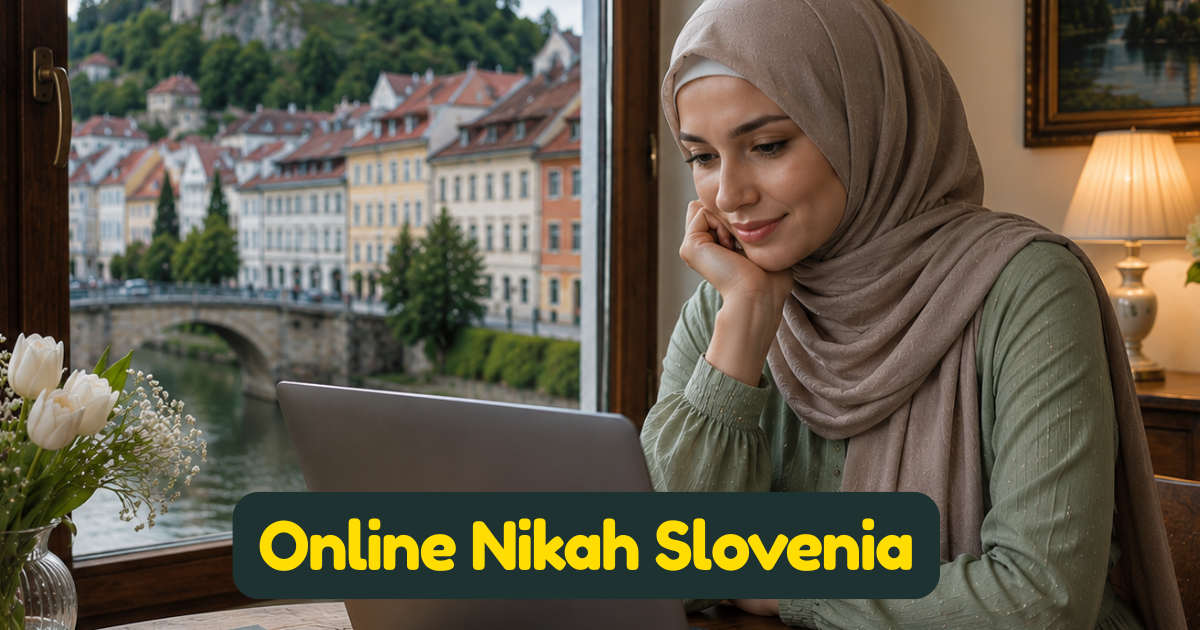
Online Nikah Slovenia — Complete Guide for Muslims in Slovenia and the Slovenian Muslim Diaspora
Slovenia is, in many respects, the most improbable home for a Muslim community in the Western Balkans. Geographically the northernmost and most Central European of the former Yugoslav republics, culturally the most closely integrated with the Austrian and German-speaking world, and economically the most successful post-communist transition story in the entire region, Slovenia might seem at first glance to be a country where Islam has little purchase. Yet the legacy of Yugoslav modernisation — which brought tens of thousands of Bosniak Muslim workers from Bosnia and Herzegovina to Slovenia's industrial cities in the 1960s, 1970s, and 1980s to fuel the growth of Ljubljana's factories and construction sector — created a permanent Muslim community in Slovenia whose roots in Slovenian soil now span more than half a century.
That community's story in post-independence Slovenia has been marked by a particular and revealing difficulty: the decades-long struggle to build a mosque in Ljubljana. For over thirty years after Slovenian independence in 1991, Ljubljana remained one of the few European capitals without a mosque — despite its Muslim community's repeated efforts, legal challenges, and applications for building permission. The Ljubljana Mosque — the Islamic Cultural Centre of Ljubljana — was finally opened in 2020, after a process that began in 1969 with the original application for a prayer space and involved decades of political obstruction, public controversy, and legal proceedings. This struggle — and the community's ultimate success — is the defining story of Islam in Slovenia and one of the most striking examples in European history of a Muslim minority's long campaign for the basic right to worship in a purpose-built space.
For Muslims in Slovenia today — in Ljubljana, Maribor, Celje, Kranj, Koper, and across the country — and for the Slovenian Muslim diaspora scattered across Austria, Germany, Switzerland, and beyond, the question of conducting a properly documented, Shariah-compliant nikah is one that reflects both the community's long-established presence and the ongoing challenges of Islamic institutional life in a country where Islamic infrastructure is still developing. This article provides the complete guide — covering the Islamic validity of online nikah, Slovenian civil marriage law, the Islamic Community of Slovenia's role, the wali and witness requirements, community-specific guidance, diaspora considerations, and how to proceed with a fully documented Shariah-compliant virtual nikah ceremony through InstantNikah.com.
Slovenia's Muslim Community — History, Composition, and Contemporary Reality
Slovenia's Muslim population is estimated at between fifty thousand and seventy thousand — representing approximately two and a half to three and a half percent of Slovenia's total population of approximately two million. The community's composition and its specific circumstances within Slovenian society are shaped by the particular history of Yugoslav-era migration and post-independence integration.
The Bosniak Muslim Core Community
Bosniak Muslims constitute the overwhelming majority of Slovenia's Muslim community. Their migration to Slovenia followed the pattern of Yugoslav internal migration during the socialist modernisation period — workers from Bosnia and Herzegovina responding to the labour demands of Slovenia's rapidly industrialising economy in the 1960s, 1970s, and 1980s. Ljubljana's manufacturing sector, Maribor's industrial base, and the construction of Slovenia's major infrastructure projects drew tens of thousands of Bosniak workers who settled permanently in Slovenia rather than returning to Bosnia and Herzegovina.
The 1992-1995 Bosnian war added a further wave of Bosniak refugees and displaced persons who found refuge in Slovenia — deepening the community's presence and adding a war-displacement dimension that continues to shape family structures and community life. Today the Bosniak Muslim community in Slovenia represents one of the most well-established immigrant communities in the country, with multi-generational families, Slovenian-born children and grandchildren of the original migrants, and deep roots in Slovenian cities that in some cases stretch back over fifty years.
The Struggle for the Ljubljana Mosque — A Community Defining Itself
The story of the Ljubljana Mosque — officially the Islamic Cultural Centre of Ljubljana (Islamski kulturni center Ljubljana) — is inseparable from the story of the Bosniak Muslim community's journey toward recognition and acceptance in Slovenian society. The original application for a mosque building in Ljubljana was filed in 1969 — during the Yugoslav period, when Slovenia was still part of the Socialist Federal Republic of Yugoslavia and its Bosniak Muslim workers were Yugoslav citizens exercising their religious rights within a socialist framework that tolerated rather than fully supported religious practice.
After Slovenian independence in 1991, the mosque application became entangled in Slovenian politics, local planning disputes, and public controversy that repeatedly blocked construction despite the Muslim community's legal right to a place of worship. Multiple building permits were granted and then cancelled or obstructed. Legal challenges were pursued through Slovenian courts and ultimately to the European Court of Human Rights. Public debates about the mosque became a lightning rod for broader anxieties about immigration, Islam, and Slovenian national identity that reflected European-wide tensions in a specifically Slovenian context.
The mosque finally opened in 2020 — fifty-one years after the original application — as a modern architectural complex in Ljubljana's Bežigrad district, with a prayer hall, cultural centre, library, and accompanying facilities that represent a significant statement of Muslim community presence in the Slovenian capital. Its opening was both a victory for the Muslim community's perseverance and a reflection of the broader Slovenian society's gradual acceptance of its Muslim minority as a permanent and legitimate part of Slovenian life.
International Muslim Community
Beyond the core Bosniak community, Slovenia has a small but growing international Muslim population — Arab professionals and students, Turkish nationals in business, Pakistani and Bangladeshi traders, and Muslim professionals drawn by Slovenia's EU membership, its high standard of living relative to cost, and its strategic position as a gateway between Central Europe and the Adriatic. For these communities, the Bosniak-centred Islamic institutional infrastructure of Slovenia may be less directly accessible or culturally familiar.
Slovenian Civil Marriage Law — What Muslims Must Understand
Slovenia's civil marriage law is governed by the Marriage and Family Relations Act (Zakon o zakonski zvezi in družinskih razmerjih — ZZZDR, Official Gazette of the Republic of Slovenia) and by its successor legislation, the Family Code (Družinski zakonik — DZ, which entered into force on 15 April 2019). Under Slovenian civil law, a marriage is legally recognised only through civil registration before a civil registrar (matičar) at the relevant administrative unit (upravna enota).
Both parties must appear in person, produce valid identification documents, submit their birth certificates and any other required documentation, and declare their consent to the marriage before the civil official and two adult witnesses. The civil marriage produces full legal recognition under Slovenian law including all civil spousal rights — property entitlements, inheritance rights, and maintenance claims enforceable through Slovenian civil courts.
Slovenia does not have a concordat or equivalent agreement between the state and the Islamic Community that would allow an Islamic religious ceremony to simultaneously produce civil legal recognition. An Islamic nikah ceremony in Slovenia — whether conducted in a mosque, in a private setting, or through an online service — carries no civil legal weight under Slovenian law without a separate civil registration at the relevant upravna enota. This is true regardless of whether the nikah is conducted by an imam affiliated with the Islamic Community of Slovenia or by any other qualified Islamic scholar.
This distinguishes Slovenia from Croatia — where the 2004 State Agreement framework provides for the possibility of Islamic Community-conducted nikah ceremonies producing civil legal effects — and aligns Slovenia with the majority of EU member states where religious and civil marriages are entirely separate legal processes. For full civil legal spousal rights in Slovenia, a separate civil registration at the upravna enota is mandatory regardless of any Islamic ceremony.
Consistent with the broader Western Balkan and Central European framework, Slovenian civil law does not require civil registration to precede the religious nikah ceremony. The nikah and the civil registration can occur in either order or simultaneously.
The Islamic Community of Slovenia — Its Role and the Long Path to Recognition
The Islamska skupnost v Republiki Sloveniji — the Islamic Community of Slovenia — serves as the primary institutional body representing Sunni Muslim religious affairs in Slovenia. Affiliated with the Islamic Community of Bosnia and Herzegovina's Rijaseta — reflecting the Bosniak character of Slovenia's core Muslim community — it has its headquarters in Ljubljana and maintains regional structures in other Slovenian cities with Muslim populations, including Maribor, Celje, and Kranj.
The Islamic Community of Slovenia's institutional history mirrors the broader story of the Ljubljana Mosque struggle — decades of seeking formal legal recognition within the Slovenian state framework, during which the Community operated in a legal grey area that complicated its ability to formally register marriages, conduct religious education, and access the legal protections that recognised religious communities in Slovenia enjoy. The Religious Communities Act (Zakon o verski svobodi) and subsequent legislation have progressively clarified the legal framework for religious communities in Slovenia, and the Islamic Community has gradually achieved greater formal recognition within this framework.
Today the Islamic Community of Slovenia conducts nikah ceremonies through its network of imams — most actively through the Ljubljana mosque complex and through imams serving Muslim communities in other Slovenian cities. The nikah conducted by a Community imam is registered in the Islamic Community's marriage records and produces an Islamic marriage certificate recognised within the Slovenian Muslim community and within the Islamic Community's institutional framework. It does not produce civil legal recognition — that requires the separate civil registration at the upravna enota.
For Muslims outside Ljubljana — in Maribor, Celje, Kranj, Koper, and smaller Slovenian cities and towns — the Islamic Community's institutional reach is considerably thinner than in the capital. For international Muslims in Slovenia, the Bosniak-oriented Community may be less directly accessible. For all of these Muslims, an online nikah through InstantNikah.com provides the most reliably documented and Islamic-condition-satisfying alternative regardless of location within Slovenia.
Is Online Nikah Islamically Valid for Muslims in Slovenia?
The Islamic validity of an online nikah is determined by classical jurisprudence — not by Slovenian civil law, not by the Islamic Community of Slovenia's institutional procedures, and not by whether the parties are in Ljubljana or in a smaller Slovenian city without direct Islamic Community access. A nikah conducted through a live, simultaneous video call in which all five conditions of a valid nikah are properly met is Islamically valid regardless of where the parties are located.
Slovenia's Muslim communities — predominantly Bosniak in character — follow the Hanafi school of jurisprudence. Under Hanafi fiqh, the majority contemporary scholarly position holds that a live, simultaneous video connection satisfies the simultaneity requirement of the ijab and qabool, provided all parties can clearly see and hear each other in real time and all five conditions are properly fulfilled.
The five universally recognised conditions of a valid nikah under Hanafi fiqh — and across all four major Sunni schools — are:
- A willing bride whose consent is genuine, fully informed, and entirely free from any form of coercion or social pressure.
- A willing groom whose consent is similarly genuine and freely given.
- The wali — the bride's guardian — who makes the offer (ijab) on her behalf, or whose properly appointed wakeel (authorised representative) does so in his place.
- Two witnesses — adult Muslim males of sound character — present and genuinely aware of the ijab and qabool at the time they are exchanged.
- The mahr — the mandatory financial gift from the groom to the bride — specific, mutually agreed, and clearly recorded in the nikah contract.
The comprehensive scholarly analysis of the online nikah ruling is covered in the dedicated articles on whether online nikah is valid in Islam and whether nikah can be done over Zoom or video call.
The Wali Requirement for Muslim Women in Slovenia
The wali requirement within Slovenia's Bosniak Muslim community reflects the same Hanafi fiqh framework discussed throughout this Balkan article series — strongly recommending the wali's involvement while providing some scholarly flexibility for adult women of sound mind. Within the Bosniak Muslim community in Slovenia — which mirrors the Islamic practice of the broader Bosniak world — the wali's role carries the same cultural and Islamic significance as in Bosnia itself.
For Bosniak Muslim women in Slovenia whose wali is physically present within Slovenia — which is often the case for the multi-generational Bosniak families established in Ljubljana, Maribor, and other Slovenian cities since the 1960s and 1970s — the wali can attend the ceremony in person at the bride's location during the video call, or participate through the video call if geographic distance within Slovenia makes in-person attendance impractical.
For Muslim women in Slovenia whose wali is in Bosnia and Herzegovina, Serbia, Germany, Austria, or Switzerland — reflecting the family network realities of a community that spans Slovenia and the broader Yugoslav-successor diaspora — the online nikah format resolves this directly. The wali participates through the live video call from his location while all other parties are connected from Slovenia or elsewhere. Slovenia's Central European Time zone (CET — UTC+1, CEST — UTC+2 in summer) is identical to Bosnia and Herzegovina, Austria, Germany, and Switzerland — making scheduling coordination between Slovenia-based and diaspora parties or Bosnia-based walis completely seamless with no time zone adjustment required.
For Muslim women in Slovenia whose wali is genuinely unavailable — through the 1992-1995 Bosnian war's impact on family structures, through death, incapacity, or wrongful refusal (adhl) — the wali hakim mechanism and the Hanafi school's inherent flexibility provide the established Islamic pathways. The detailed framework is addressed in the dedicated articles on online nikah without a wali and what happens if the wali refuses the nikah. The wakeel mechanism is covered in the article on what a wakeel is in nikah and how to appoint one.
The Witness Requirement for Muslims in Slovenia
Two adult Muslim male witnesses of sound character are required for a valid nikah across all four major Sunni schools. For Muslims in Ljubljana — where the main Islamic Community infrastructure is concentrated and where Slovenia's largest Muslim population is located — finding two qualified Muslim male witnesses within the local Bosniak Muslim community or through the Ljubljana Mosque congregation is generally manageable. For Muslims in Maribor, Celje, Kranj, Koper, and other Slovenian cities where the Muslim community is smaller and more dispersed, finding qualified witnesses locally may require more planning.
The online nikah format addresses this directly. Witnesses do not need to be physically present in Slovenia — they may be connected through the live video call from any location, including from Bosnia and Herzegovina, Croatia, Germany, Austria, or Switzerland, provided they can clearly see and hear the ceremony in real time. The specific Islamic rulings on female witnesses and non-Muslim witnesses are addressed in the dedicated articles on whether a woman can be a witness at nikah in Islam and whether a non-Muslim can be a witness at nikah.
The Mahr in Slovenia's Muslim Community
The mahr — the mandatory financial gift from the groom to the bride — is expressed within Slovenia's Bosniak Muslim community in ways consistent with the broader Bosniak tradition — typically a specified monetary amount or gold equivalent, recorded in the nikah documentation, and understood as the bride's exclusive Islamic entitlement. Slovenian civil law does not recognise the mahr as a legally enforceable marital obligation through Slovenian civil courts in the absence of civil marriage registration. For Muslim women in Slovenia conducting a nikah through InstantNikah.com, the mahr amount and its terms — both prompt and deferred — are confirmed and documented as part of the nikah contract, ensuring the Islamic requirement is fully and clearly met.
The comprehensive framework of mahr is covered in the dedicated articles on what mahr is in nikah and how much mahr is enough in Islamic law.
When Do Muslims in Slovenia Need an Online Nikah Service?
The most common scenarios in which Muslims in Slovenia seek an online nikah through InstantNikah.com reflect the specific realities of Slovenia's Muslim community landscape:
Muslims Outside Ljubljana Where Islamic Community Access Is Limited
The Islamic Community of Slovenia's most active institutional presence is in Ljubljana — concentrated in the new mosque complex. For Muslims in Maribor, Celje, Kranj, Koper, Nova Gorica, and other Slovenian cities where the Muslim community is smaller and the Islamic Community's local infrastructure is limited, accessing a qualified imam for a properly documented nikah may require travel to Ljubljana or advance coordination with the Community's central office. An online nikah through InstantNikah.com resolves this — providing a fully valid, properly documented nikah from any location in Slovenia without requiring travel to the capital.
Cross-Border Relationships — One Party in Slovenia, One Abroad
Bosniak Muslims in Slovenia frequently maintain close family and relationship ties with Bosnia and Herzegovina, Croatia, and other parts of the former Yugoslav space — and with diaspora communities in Austria, Germany, and Switzerland. A Bosniak Muslim woman in Ljubljana whose prospective husband is in Sarajevo, or a Bosniak Muslim man in Maribor whose prospective wife is in Vienna, needs a nikah solution that does not require all parties to travel to a single physical location. The online nikah resolves this directly.
International Muslims in Slovenia Whose Families Are Abroad
For Arab, Turkish, Pakistani, and Bangladeshi Muslims in Slovenia whose walis and families are in their home countries, the online format allows full wali participation from any location in the world without requiring international travel — making it the most accessible route to a properly documented Islamic ceremony regardless of national background or cultural tradition.
Urgency and Privacy Needs
Muslim couples in Slovenia requiring an urgent nikah — or couples who prefer a private ceremony before any public announcement — can access InstantNikah.com's Same Day Nikah and Instant Nikah packages, or the dedicated private ceremony format covered in the article on private online nikah and discreet ceremony guidance.
The Slovenian Muslim Diaspora — Country-Specific Guidance
Slovenian Muslims in Austria
Austria — particularly Vienna and Graz — has a Slovenian Muslim diaspora community alongside the broader Bosniak and Yugoslav-successor diaspora communities in Austria. Slovenia's shared border with Austria and the historical economic migration patterns between the two countries mean that Slovenian Muslim families in Austria are among the most geographically proximate diaspora communities in this series. For Slovenian Muslims in Austria seeking an online nikah, the service is fully accessible from any Austrian location. The dedicated article on online nikah in Austria provides the relevant civil law context.
Slovenian Muslims in Germany
Germany has a Slovenian Muslim diaspora community — primarily Bosniak Muslims who left Slovenia or moved through Slovenia during the Yugoslav period or the 1990s wars — concentrated in Stuttgart, Frankfurt, Munich, and other German cities alongside the broader Bosniak diaspora. For Slovenian Muslims in Germany seeking an online nikah, the service is fully accessible from any German location. The dedicated article on online nikah in Germany provides full civil law guidance.
Slovenian Muslims in Switzerland
Switzerland has a Slovenian Muslim diaspora community concentrated in Zurich, Basel, and other Swiss cities. Slovenia's CET time zone is identical to Switzerland — making ceremony coordination between Slovenia-based and Swiss-based parties completely seamless. For Slovenian Muslims in Switzerland seeking an online nikah, the service is fully accessible. The dedicated article on online nikah in Switzerland provides full civil law guidance.
Slovenian Muslims in the USA and Canada
The United States and Canada have smaller Slovenian Muslim diaspora communities. For Slovenian Muslims in North America seeking an online nikah, InstantNikah.com's service is fully accessible. The dedicated articles on online nikah in the USA and online nikah in Canada provide the relevant civil law guidance.
The 1992-1995 Bosnian War and Its Impact on Slovenia's Muslim Community
The Bosnian War added a specific and historically significant dimension to Slovenia's Muslim community — one that is directly relevant to the wali question for many Bosniak Muslim women in Slovenia today. As refugees from Bosnia flooded into Slovenia during the 1992-1995 conflict, many brought with them the specific losses of the war — fathers, brothers, and male relatives killed during the fighting, family structures disrupted by displacement, and extended family networks shattered across Bosnia, Croatia, Slovenia, and Western Europe.
For Bosniak Muslim women in Slovenia whose wali was killed during the Bosnian war, whose family was separated across multiple countries during the displacement, or whose family network was permanently altered by the war's demographic consequences — the Hanafi school's flexibility on the wali and the wali hakim mechanism are not merely theological provisions. They are practically essential Islamic legal tools that acknowledge the specific historical reality of this community in ways that a rigidly formalistic approach to the wali requirement would fail to serve.
An online nikah service that accommodates these circumstances — applying Hanafi fiqh with both scholarly rigour and genuine pastoral sensitivity to the specific realities of the Bosniak diaspora community in Slovenia — is precisely the kind of practically adapted Islamic solution that serves the community's real needs.
Protecting Rights in the Nikah Contract — Guidance for Muslim Women in Slovenia
Muslim women in Slovenia — whether from the multi-generational Bosniak community, the international Muslim community, or the small Muslim convert community — have the full Islamic right to include binding protective conditions in their nikah contract. These conditions can include the right to continue working or studying after marriage, geographic restrictions on relocation without consent, housing arrangements, conditions protecting against a second wife being taken without consent, and the delegated right of self-divorce through tafwid al-talaq.
For Muslim women in Slovenia who are also civilly married, Slovenian civil family law under the Družinski zakonik (Family Code 2019) provides an additional framework of spousal financial rights enforceable through Slovenian civil courts alongside their Islamic contract rights. The Slovenian Family Code introduced significant reforms to Slovenian family law — including the recognition of same-sex partnerships as marriages with equivalent rights — and its provisions for spousal financial rights, property division, and maintenance apply equally to all civilly married couples in Slovenia regardless of religious affiliation.
The comprehensive guide on protective conditions in the nikah contract for Muslim women explains every available protective condition in detail. The article on financial protection before nikah provides broader context on the financial dimensions of pre-nikah planning.
Common Questions Muslims in Slovenia Ask About Online Nikah
Is an online nikah legally recognised in Slovenia?
An online nikah conducted through InstantNikah.com is Islamically valid but does not produce civil legal recognition under Slovenian law. Unlike Croatia, Slovenia does not have a state agreement framework through which Islamic nikah ceremonies can simultaneously produce civil legal effects. For civil legal recognition in Slovenia, a separate civil marriage registration at the relevant upravna enota is required regardless of the nikah format. The nikah and the civil registration are parallel and complementary processes — both should be pursued by Muslim couples who wish their marriage to carry both Islamic validity and Slovenian civil legal standing.
Does civil marriage need to happen before the nikah in Slovenia?
No — Slovenian civil law does not require civil registration to precede the religious nikah ceremony. The nikah and the civil registration can occur in either order or simultaneously — consistent with the broader Western Balkan and Central European framework and in contrast to Turkey's mandatory civil-first requirement.
Can my wali participate from Bosnia, Austria, or Germany?
Yes — the wali participates through the live video call from Bosnia and Herzegovina, Austria, Germany, Switzerland, or wherever he is located while all other parties are connected from Slovenia. Slovenia's CET time zone is identical to Bosnia, Austria, Germany, Croatia, and Switzerland — making scheduling coordination completely seamless for all the most common cross-border configurations involving these countries.
What is the relationship between the Ljubljana Mosque and online nikah services?
The Ljubljana Mosque and the Islamic Community of Slovenia it serves provide nikah services through the Community's own institutional framework — separate from and independent of online nikah services like InstantNikah.com. Both produce Islamically valid nikah ceremonies when all conditions are properly met. The online service through InstantNikah.com provides an alternative that is accessible from any location in Slovenia — not only Ljubljana — and that is particularly valuable for Muslims outside the capital, for international Muslims in Slovenia, and for cross-border couples where all parties cannot physically gather in a single location.
What documentation will I receive?
Every nikah conducted through InstantNikah.com produces a fully documented Islamic nikah certificate recording all parties' details, the wali's involvement, the witnesses' confirmation, the mahr amount and terms, the date and format of the ceremony, and the officiating scholar's credentials. This serves as evidence of the Islamically valid ceremony for community recognition, Islamic arbitration purposes, and as supporting documentation alongside any civil registration process.
The Ljubljana Mosque — Fifty-One Years in the Making
The Islamic Cultural Centre of Ljubljana — Slovenia's first purpose-built mosque, opened in 2020 after fifty-one years from the original 1969 application — is not merely a building. It is the physical embodiment of one Muslim community's determination to establish its permanent, dignified, and publicly recognised place within a European society that resisted that recognition for over half a century.
The mosque's architecture — designed by the Slovenian architectural firm Bevk Perović arhitekti — is a deliberate statement of Islamic presence in a contemporary European context: modern and uncompromisingly contemporary in its design language, yet unmistakably a mosque in its massing, its orientation toward Mecca, and its minaret that rises above the Ljubljana skyline as the first minaret ever to do so in the city's history. Its opening in 2020 — in the midst of the COVID-19 pandemic — meant that its inauguration ceremony was smaller than the community had hoped and deserved, but the significance of the building's existence was undiminished by the circumstances of its opening.
For Muslims in Slovenia — in Ljubljana and across the country — conducting a properly documented, Shariah-compliant nikah is an expression of the same Islamic commitment that the Ljubljana Mosque represents. Whether conducted in the mosque's prayer hall, through the Islamic Community's institutional framework, or through an online service that reaches Muslims wherever in Slovenia they are located — the nikah that meets all Islamic conditions and is fully documented with scholarly oversight honours that commitment most completely.
How to Proceed With an Online Nikah in Slovenia Through InstantNikah.com
The process for Muslims in Slovenia and the Slovenian Muslim diaspora conducting an online nikah through InstantNikah.com is fully guided from start to completion:
- Select your service package — choose between Instant Nikah, Express Nikah, Same Day Nikah, or Essential Nikah depending on your timeline and specific circumstances.
- Provide the required information — full names and identification details of both parties, wali details and his relationship to the bride, witness names and locations, and the agreed mahr amount with its prompt and deferred terms clearly specified.
- Schedule the ceremony — the InstantNikah.com team coordinates the live video call at a time that works for all parties. Slovenia operates on Central European Time (CET — UTC+1, CEST — UTC+2 in summer) — the same time zone as Bosnia and Herzegovina, Austria, Germany, Switzerland, Croatia, and Italy — making scheduling between Slovenia-based parties and all the most common diaspora and homeland configurations entirely seamless without any time zone complexity.
- Attend the ceremony — a qualified Islamic scholar facilitates the full nikah ceremony over the live video call — delivering the khutbah al-nikah, verifying all five conditions, guiding the ijab and qabool, confirming the mahr terms, and leading the du'a for the couple.
- Receive your nikah certificate — the complete documentation is produced and provided to both parties following the ceremony, recording all conditions, all parties, and the officiating scholar's credentials in full.
You can review the full nikah process, read verified client reviews, or explore the gallery of ceremonies. To proceed, book your nikah directly through packages including Instant Nikah, Express Nikah, Same Day Nikah, and Essential Nikah. For specific questions about your circumstances — including wali arrangements, witness logistics, the relationship between the Islamic Community's institutional framework and online nikah services, or civil registration requirements — the team is available to assist directly.
Admin User
Author