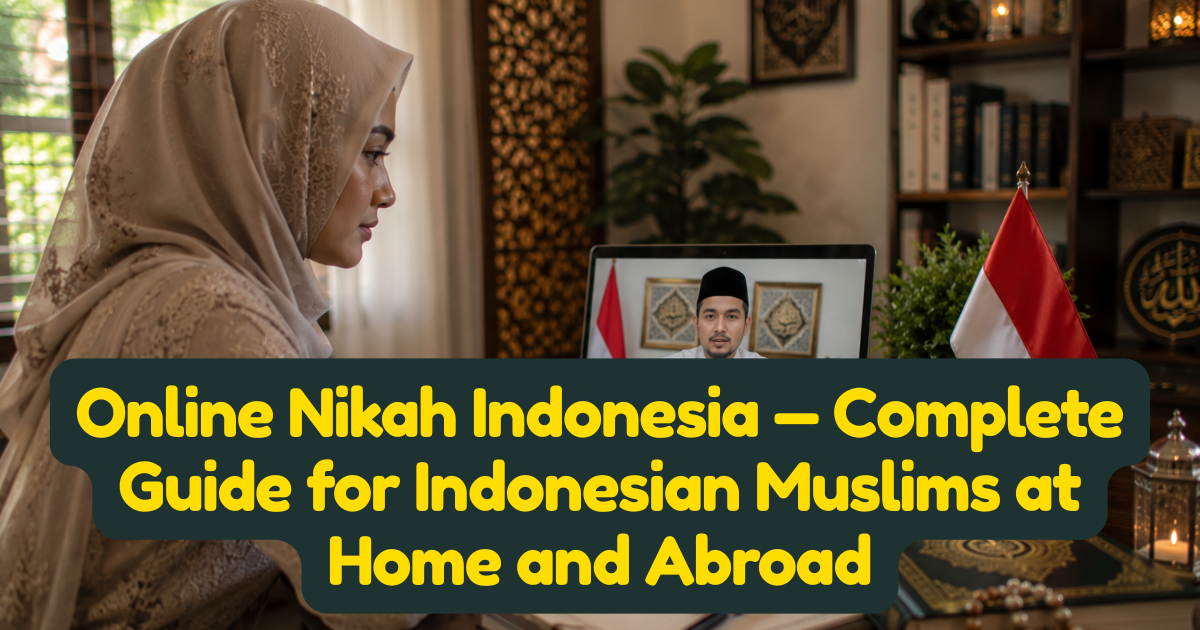
Online Nikah Indonesia — Complete Guide for Indonesian Muslims at Home and Abroad
Indonesia's relationship with Islamic marriage is unlike that of any other country in the world. As the nation with the largest Muslim population on earth — over 230 million Muslims, representing approximately thirteen percent of all Muslims globally — Indonesia has developed an Islamic family law system that is simultaneously deeply rooted in classical Shafi'i jurisprudence and embedded within a modern civil registration bureaucracy that governs every Muslim marriage through a network of local government offices known as KUA (Kantor Urusan Agama — Office of Religious Affairs).
For Indonesian Muslims living within easy reach of a KUA office, the standard nikah registration process — while sometimes bureaucratically demanding — is generally accessible. But Indonesia is also a country with one of the largest overseas diaspora populations in the world. Millions of Indonesian Muslims live, work, and study abroad — in the Netherlands, the United Kingdom, Saudi Arabia, Malaysia, Australia, Japan, South Korea, and across the Middle East and Europe. Millions more live within Indonesia but in circumstances — urgency, geographic distance from their wali or witnesses, family complications, or professional constraints — that make the standard KUA process difficult to navigate quickly or at all.
For all of these Indonesian Muslims, the question of online nikah is not theoretical. It is immediate, practical, and deeply personal. This article provides the complete answer — covering what Indonesian Islamic family law requires, what classical Islamic jurisprudence establishes about online nikah validity, how the wali and witness requirements apply in remote ceremonies, what documentation an online nikah produces, and how InstantNikah.com facilitates properly conducted, fully documented online nikah ceremonies for Indonesian Muslims wherever they are located in the world.
Understanding Indonesia's Islamic Family Law System — The KUA Framework
Indonesia's Islamic family law for Muslim citizens is governed primarily by Law Number 1 of 1974 on Marriage (Undang-Undang Nomor 1 Tahun 1974 tentang Perkawinan) and the Presidential Instruction Number 1 of 1991 on the Compilation of Islamic Law (Kompilasi Hukum Islam — KHI). The KHI codifies the Islamic family law principles that apply to Indonesian Muslim citizens and is enforced through the Religious Court (Pengadilan Agama) system.
In practice, Muslim marriages in Indonesia are registered through the local KUA office — the Office of Religious Affairs under the Ministry of Religious Affairs (Kementerian Agama). For a Muslim marriage to be formally registered in Indonesia, it must be conducted in the presence of a registered marriage registrar (Pegawai Pencatat Nikah — PPN) from the relevant KUA office, with both parties present, with the wali's involvement, and with all required administrative documents submitted and verified in advance.
The KUA registration process includes a mandatory waiting period — typically ten days from the time of registration application to the scheduled nikah date — and requires documentation including identity cards (KTP), family cards (Kartu Keluarga), birth certificates, health certificates, and — for those who have been previously married — divorce certificates or death certificates from the previous marriage. This administrative framework, while thorough, creates genuine practical barriers for Indonesian Muslims who need to marry urgently, who are abroad, or whose circumstances do not align neatly with the standard KUA process.
The critical distinction — as with Malaysian Muslims — is between the KUA registration requirement for formal Indonesian civil recognition of a marriage, and the Islamic validity of a nikah under classical fiqh principles. These are two separate frameworks operating in parallel, and a nikah can be Islamically valid without being KUA-registered — though KUA registration is strongly advisable for Indonesian Muslims who intend to live in Indonesia and need their marriage recognised for all civil and legal purposes within the Indonesian system.
Is Online Nikah Islamically Valid for Indonesian Muslims?
Indonesia's dominant madhhab — the school of Islamic jurisprudence that has shaped Indonesian Islamic practice for centuries — is the Shafi'i school. This is the same school dominant in Malaysia, Brunei, and much of Southeast Asia. The Shafi'i school's approach to the conditions of a valid nikah — and to the question of whether those conditions can be met remotely — is therefore the most relevant scholarly framework for Indonesian Muslims considering an online nikah.
The five conditions of a valid nikah under the Shafi'i school are:
- A willing bride whose consent is genuine, informed, and free from coercion.
- A willing groom whose consent is similarly genuine and freely given.
- The wali — the bride's guardian — whose involvement is a strict validity condition under Shafi'i fiqh. The wali must make the ijab (offer) on behalf of the bride, or appoint a wakeel (authorised representative) to do so.
- Two witnesses — adult Muslim males of sound character — who are present and aware of the ijab and qabool at the time they occur.
- The mahr — the mandatory financial gift from the groom to the bride — specified, agreed, and recorded.
The majority contemporary scholarly position — reflected in fatwas from recognised Islamic bodies across the Shafi'i world including Indonesia's own Majelis Ulama Indonesia (MUI) — holds that a live, simultaneous video call connection satisfies the simultaneity requirement of the ijab and qabool, provided all parties can clearly see and hear each other in real time and all five conditions are properly met. The video call does not replace the conditions — it provides the technological medium through which the conditions are fulfilled.
Indonesia's MUI — the Indonesian Ulama Council, the most authoritative Islamic scholarly body in the country — has engaged with the question of remote and technology-mediated marriage, and while it has emphasised the importance of meeting all conditions and of formal KUA registration, it has not categorically declared all non-physically-present nikah arrangements to be invalid where the conditions are genuinely met through live technological connection. The broader scholarly analysis of this question is covered in the dedicated article on whether online nikah is valid in Islam and the specific ruling on whether nikah can be done over Zoom or video call.
The Wali Requirement for Indonesian Muslim Women
Under the Shafi'i school — and codified in Indonesia's Kompilasi Hukum Islam — the wali is a non-negotiable validity condition for a Muslim woman's nikah. Article 19 of the KHI explicitly states that a wali nikah is an absolute condition for the validity of a Muslim marriage in Indonesia. The wali hierarchy follows the established Shafi'i order: father, then paternal grandfather, then brother, then other male relatives in succession.
For Indonesian Muslim women seeking an online nikah — whether from abroad or within Indonesia — the wali's involvement must be properly incorporated into the ceremony. This can be accomplished in several ways:
- The wali participates directly through the live video call — making the ijab from his location, whether that is Indonesia or anywhere else in the world, while the groom and witnesses are connected from their respective locations.
- The wali appoints a wakeel — an authorised representative who makes the ijab on the wali's behalf. The wakeel can be physically present with either party or connected through the video call. The appointment of the wakeel is itself a documented process that must be properly conducted. The full framework of the wakeel appointment is covered in the dedicated article on what a wakeel is in nikah and how to appoint one.
- Where the wali is unavailable — through death, incapacity, wrongful refusal (adhl), or genuine inability to be contacted — a wali hakim may be appointed by a qualified Islamic scholar or court. This is a documented process with specific conditions, and Muslim women in this situation should seek qualified Islamic scholarly guidance before proceeding. The dedicated articles on online nikah without a wali and what happens if the wali refuses the nikah cover these scenarios in detail.
The Witness Requirement for Indonesian Online Nikah
The KHI (Article 25) requires two witnesses for the validity of a Muslim nikah in Indonesia — both must be adult Muslim males, mentally sound, just (adil), and present at the time of the ijab and qabool. For an online nikah ceremony, the witnesses may be physically present with one of the parties — most commonly with the groom or with the bride and wali — or connected through the live video call where the technology provides clear simultaneous visibility and audio of the ceremony.
Indonesian Muslim women sometimes ask about the possibility of female witnesses or non-Muslim witnesses — questions that arise particularly for those living in non-Muslim-majority countries where finding two adult Muslim male witnesses may be logistically challenging. The specific Islamic rulings on these questions are addressed in the dedicated articles on whether a woman can be a witness at nikah in Islam and whether a non-Muslim can be a witness at nikah.
The Mahr for Indonesian Muslim Women — Cultural Context and Islamic Requirements
Indonesian Muslim culture has rich and varied traditions surrounding the mahr — traditions that differ significantly across the archipelago's hundreds of ethnic and regional communities. In Javanese Muslim tradition, the mahr is often a set of religious items — a prayer mat, a Qur'an, and a small amount of gold or cash. In Acehnese tradition, the mahr may take a different form. In urban Indonesian communities, the mahr is increasingly being set at more substantial amounts that reflect the bride's educational and professional standing.
Regardless of cultural tradition, the Islamic requirement is consistent: the mahr must be a real amount or item of genuine value, agreed by both parties, specified clearly, and recorded in the nikah contract. It belongs exclusively to the bride. Family tradition — however well-established — cannot override the Islamic requirement that the mahr be genuine, specific, and fully the bride's own entitlement.
For Indonesian Muslims conducting an online nikah through InstantNikah.com, the mahr amount and its terms are confirmed and documented as part of the nikah contract — ensuring the Islamic requirement is properly met regardless of the form the mahr takes. The full framework of mahr is covered in the dedicated articles on what mahr is in nikah and how much mahr is enough in Islamic law.
Indonesian Muslims Abroad — Country-Specific Guidance
Indonesian Muslims in the Netherlands
The Netherlands has one of the largest Indonesian diaspora communities in the world — a legacy of the Dutch colonial relationship with the Indonesian archipelago that has produced a multigenerational Indonesian-Dutch Muslim community numbering in the hundreds of thousands. Indonesian Muslims in the Netherlands — whether first-generation migrants, second-generation Dutch-Indonesians, or recent students and professionals — represent one of the largest potential audiences for online nikah services in Europe.
An online nikah conducted through a qualified Islamic service is Islamically valid for Indonesian Muslims in the Netherlands. As with all EU member states, a religious-only nikah carries no civil legal recognition in the Netherlands — civil marriage registration through the Dutch Burgerlijke Stand (civil registry) is a separate process required for civil legal spousal rights. The dedicated article on online nikah in the Netherlands covers the civil registration dimension in full detail for Indonesian Muslims based there.
Indonesian Muslims in Saudi Arabia and the Gulf
Saudi Arabia, Qatar, Kuwait, the UAE, and Bahrain collectively host hundreds of thousands of Indonesian Muslim workers — many of them in domestic work, healthcare, and construction sectors. Indonesian Muslim workers in the Gulf who wish to marry often face significant logistical barriers to conducting a standard KUA-registered nikah, given their distance from Indonesia and the complexity of obtaining leave to return for the registration process.
An online nikah conducted through a qualified Islamic service provides an Islamically valid solution for these Indonesian Muslims — allowing the nikah to proceed with the wali participating from Indonesia through a live video connection and the ceremony fully documented. The article on online nikah in the UAE provides relevant context for Indonesian Muslims in the Gulf region.
Indonesian Muslims in Australia
Australia has a growing Indonesian Muslim community — both through long-established migration patterns and through the significant number of Indonesian students enrolled at Australian universities. An online nikah is Islamically valid for Indonesian Muslims in Australia, and the civil registration dimension is addressed in the dedicated article on online nikah in Australia.
Indonesian Muslims in the United Kingdom
The UK has a smaller but growing Indonesian Muslim community — concentrated particularly in London and university cities. Indonesian Muslims in the UK can conduct a fully valid online nikah through InstantNikah.com, with the wali participating from Indonesia or elsewhere through the live video connection. The dedicated article on online nikah in the UK covers the civil registration requirements for Muslim couples in England and Wales.
Indonesian Muslims in Japan and South Korea
Japan and South Korea host significant numbers of Indonesian Muslim workers and students — in manufacturing, technology, and academic sectors. Muslim communities in both countries are relatively small and geographically dispersed, making access to a local imam or Islamic officiant genuinely difficult for many Indonesian Muslims in these countries. An online nikah conducted through a qualified international service is both Islamically valid and practically the most accessible solution for Indonesian Muslims in Japan and South Korea who wish to marry without returning to Indonesia for the ceremony.
Long-Distance Nikah — One Party in Indonesia, One Abroad
One of the most common scenarios for Indonesian Muslims seeking an online nikah is the long-distance situation — one party in Indonesia and one working or studying abroad. A fully valid online nikah in this scenario is conducted through a live video call where all parties — the bride (or her wali making the ijab on her behalf), the groom, the witnesses, and the officiating Islamic scholar — are simultaneously connected. The geographical distance between the parties does not affect the Islamic validity of the ceremony provided all conditions are properly met.
The dedicated article on online nikah for couples in different countries covers the specific requirements and practical considerations for cross-border nikah ceremonies — including time zone coordination, witness arrangements across locations, and the documentation process for geographically separated parties.
The KHI and Online Nikah — What Indonesian Law Says
Indonesia's Kompilasi Hukum Islam does not specifically address online or remote nikah ceremonies — it was codified in 1991, before the era of live video communication technology. The absence of explicit KHI provisions on online nikah means that the question is addressed through the general principles of Islamic jurisprudence and through MUI fatwa guidance rather than through explicit statutory text.
The Ministry of Religious Affairs (Kemenag) has, in recent years — particularly during and after the COVID-19 pandemic, during which remote religious ceremonies became a practical necessity — engaged with the question of technology-mediated religious practices. The pandemic period saw a significant increase in remote nikah arrangements across Indonesia, with some KUA offices experimenting with video-assisted ceremonies for parties who could not be physically present. While these arrangements were not universally standardised, they demonstrated that the Indonesian Islamic institutional framework is not categorically opposed to technology-mediated nikah where the substantive conditions are met.
For Indonesian Muslims, the practical takeaway is this: an online nikah conducted with all Islamic conditions properly met is Islamically valid. KUA registration — which provides formal civil recognition within the Indonesian system — is a separate administrative step that couples who intend to live in Indonesia should pursue after the Islamic ceremony, using the nikah certificate from the online ceremony as part of their documentation.
Common Questions Indonesian Muslims Ask About Online Nikah
Can an online nikah be registered with the KUA in Indonesia?
An online nikah conducted outside the standard KUA process is Islamically valid but is not automatically registered within the Indonesian civil system. Indonesian Muslim couples who wish their marriage to be formally recognised within Indonesia — for purposes of civil documentation, divorce proceedings through the Religious Court, children's birth registration, and inheritance claims — should pursue KUA registration as a separate step after the nikah ceremony. The specific requirements for retroactive or belated KUA registration vary by district and couples should contact their local KUA office for guidance specific to their situation.
Is an online nikah valid under Indonesian Shafi'i fiqh?
The majority contemporary Shafi'i scholarly position holds that a live, simultaneous video connection satisfies the simultaneity requirement of the ijab and qabool where all five conditions are properly met. This position is consistent with the reasoning of contemporary scholars engaged with technology and Islamic jurisprudence. Indonesian Muslims should be aware that scholarly opinions on this question are not unanimous — a minority position maintains that physical presence in the same location is required — and should seek qualified Islamic guidance if they have specific concerns about the ruling applicable to their situation.
What if my wali is in Indonesia but I am abroad?
Your wali can participate in the online nikah ceremony through the live video call from Indonesia. He makes the ijab through the video connection while you and the groom are at your respective locations. This arrangement is accommodated within the online ceremony facilitated by InstantNikah.com. Alternatively, your wali may appoint a wakeel — an authorised representative — to make the ijab on his behalf, with the wakeel physically present at either the bride's or groom's location.
What documents will I receive from an InstantNikah.com ceremony?
Every nikah conducted through InstantNikah.com produces a fully documented Islamic nikah certificate recording all parties' details, the wali's involvement, the witnesses' confirmation, the mahr terms, the date and method of the ceremony, and the officiating scholar's credentials. This certificate serves as evidence of the Islamically valid ceremony and as part of any subsequent documentation package for KUA registration or other official purposes.
Can Indonesian Muslims use InstantNikah.com from within Indonesia?
Yes. Indonesian Muslims within Indonesia — whether facing urgency, geographic separation from their wali or witnesses, family complications, or circumstances that make the standard KUA process difficult to navigate quickly — can use InstantNikah.com's online nikah service. The ceremony is Islamically valid regardless of whether both parties are in Indonesia. Couples should pursue KUA registration as a separate administrative step if civil recognition within Indonesia is required.
Protective Conditions in the Nikah Contract — Rights Indonesian Women Should Know
Indonesian Muslim women — whether marrying for the first time or remarrying after divorce or widowhood — have the right to include binding protective conditions in their nikah contract. Under the Shafi'i school and codified in Indonesia's KHI, certain conditions can be included in the taklik talak — the conditional talak declaration that forms part of the standard Indonesian nikah documentation. The taklik talak is a form of conditional divorce right that gives the wife a pathway to dissolution if the husband violates specified conditions — similar in function to the tafwid al-talaq mechanism discussed in classical fiqh.
Beyond the taklik talak, Indonesian Muslim women have the broader right to include protective conditions in their nikah contract — covering matters such as the right to continue working or studying, geographic restrictions on relocation, and housing arrangements. The comprehensive guide on protective conditions in the nikah contract for Muslim women covers the full framework of these rights in detail — rights that are as applicable to Indonesian Muslim women as to any other Muslim woman globally.
How to Proceed With an Online Nikah Through InstantNikah.com
The process for Indonesian Muslims conducting an online nikah through InstantNikah.com is fully guided by the team from start to completion. The key steps are:
- Select your service package — choosing between Instant Nikah, Express Nikah, Same Day Nikah, or Essential Nikah based on your timeline and requirements.
- Provide required information — full names and identification details of both parties, wali details and relationship to the bride, witness details, and the agreed mahr amount and terms — prompt and deferred portions specified clearly.
- Schedule the ceremony — the InstantNikah.com team coordinates the live video call at a time that accommodates all parties across their time zones — including the significant time difference between Indonesia (WIB, WITA, or WIT) and Western countries.
- Attend the ceremony — the qualified Islamic scholar facilitates the full nikah ceremony over the live video call, delivering the khutbah, verifying all conditions, guiding the ijab and qabool, confirming the mahr, and leading the du'a for the couple.
- Receive your nikah certificate — the complete documentation is produced and provided to both parties following the ceremony, recording all conditions and all parties in full.
You can review the full nikah process, read verified client reviews, or explore the gallery of ceremonies. To proceed, book your nikah directly through packages including Instant Nikah, Express Nikah, Same Day Nikah, and Essential Nikah. For specific questions about your circumstances — including wali arrangements, witness requirements across time zones, or documentation needs — the team is available to assist directly.
Admin User
Author