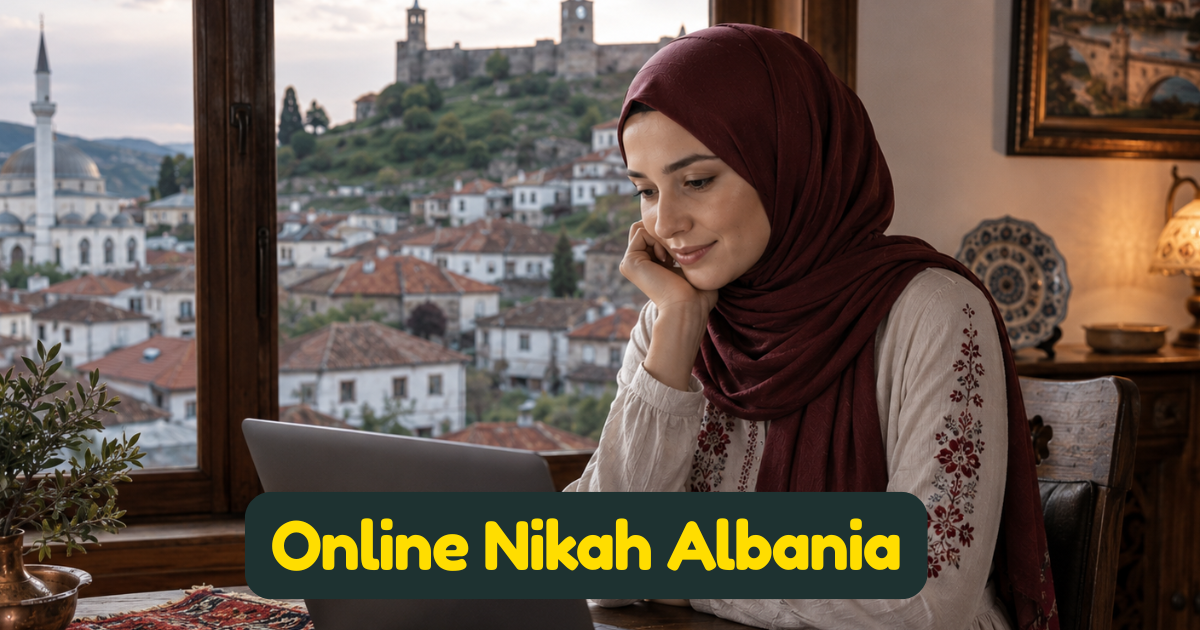
Online Nikah Albania — Complete Guide for Muslims in Albania and the Albanian Diaspora
Albania's relationship with Islam is one of the most layered and historically complex of any European country. Islam arrived in the Albanian lands during the Ottoman conquest of the fifteenth century and, over the centuries that followed, became the religion of the majority of the Albanian population — expressed not only through the mainstream Sunni Hanafi tradition that dominated Ottoman religious administration but also through the Bektashi Sufi order, whose world headquarters is in Tirana and which represents one of the most distinctively Albanian contributions to global Islamic civilisation.
Yet Albania's twentieth century imposed upon this centuries-old Islamic heritage one of the most radical disruptions experienced by any Muslim community anywhere in the world. In 1967, the communist government of Enver Hoxha declared Albania the world's first officially atheist state — banning all religious practice, closing and repurposing every mosque, church, and tekke in the country, and making religious observance a criminal offence punishable by imprisonment. This campaign of enforced atheism lasted until 1990 — over two decades during which Albanian Muslims maintained their faith privately, at great personal risk, in a society that had systematically destroyed its own religious institutional infrastructure.
The post-communist revival of Islamic practice in Albania since 1990 has been remarkable — mosques rebuilt or restored, the Muslim Community of Albania (Komuniteti Mysliman i Shqipërisë) re-established as the official Islamic institutional authority, the Bektashi Order reconstituted with its world seat in Tirana, and Islamic education reinstituted at all levels. But the decades of enforced atheism left a profound institutional gap — a generation of Albanians raised without religious education, without access to Islamic scholarship, and without the intergenerational transmission of Islamic practice that sustains Muslim communities across the centuries.
For Albanian Muslims today — whether within Albania or across the vast Albanian diaspora in Italy, Greece, Germany, the UK, Switzerland, the USA, and Canada — the question of conducting a properly documented, Shariah-compliant nikah reflects both the revival of Islamic practice and the practical realities of a community still rebuilding its institutional capacity after decades of enforced secularism. This article provides the complete guide — covering Islamic validity, Albanian civil marriage law, the Muslim Community of Albania's role, the wali and witness requirements, diaspora-specific guidance, and how to proceed with a fully documented virtual nikah ceremony through InstantNikah.com.
Albania's Muslim Community — Understanding Its Distinctive Character
Albania's Muslim population is estimated at between fifty-five and sixty percent of the total population of approximately two point eight million — making it the most Muslim-majority country in mainland Europe after Kosovo and Bosnia. However, the character of Albanian Muslim identity differs significantly from the Muslim communities of neighbouring Kosovo and Bosnia in ways that are important for understanding the nikah landscape in Albania.
The decades of communist-enforced atheism produced a Muslim population that in many cases has a stronger cultural than theological identification with Islam — particularly among older generations who were raised in the atheist state and had no access to formal Islamic education during their formative years. Post-1990 Islamic revival has brought genuine religious commitment back to many Albanian Muslim communities — but it has also produced a diversity of religious practice and observance levels that is broader than in communities where Islamic tradition was maintained through continuous institutional transmission.
The Bektashi Sufi order — whose world headquarters, the Seat of the Kryegjyshi Botëror (World Bektashi Leader), is in Tirana — represents a uniquely Albanian dimension of Islamic practice that is found nowhere else in the world at this institutional level. The Bektashi tradition — a Sufi order that blends elements of Shia Islam, Sufi mysticism, and pre-Islamic Albanian folk religious practice — is deeply embedded in Albanian cultural identity and is officially recognised as a separate religious community from the mainstream Sunni Muslim Community of Albania. For Bektashi-identified Albanian Muslims, the specific religious framework for marriage may differ from the mainstream Hanafi Sunni practice that dominates the rest of Albania's Muslim population.
The mainstream Albanian Sunni Muslim community follows Hanafi fiqh — the tradition of the Ottoman world — and is served by the Muslim Community of Albania (Komuniteti Mysliman i Shqipërisë — KMSH), headquartered in Tirana and led by the Kryetar (Chairman), with regional structures across Albania's districts. It is within this Hanafi Sunni framework that the standard nikah ceremony in Albania is conducted.
Albanian Civil Marriage Law — What Muslims in Albania Must Understand
Albania's civil marriage law is governed primarily by the Albanian Family Code (Kodi i Familjes — Law No. 9062 of 2003, as amended) and by the Civil Status Law (Ligji për Gjendjen Civile). Under Albanian civil law, a marriage is legally recognised only through civil registration — there is no concordat or equivalent agreement between the Albanian state and any religious community that would allow religious ceremonies to simultaneously produce civil legal effects.
A civil marriage in Albania is conducted before a civil status officer (nënpunës i gjendjes civile) at the local civil status office (zyra e gjendjes civile) of the relevant municipality (bashki or komunë). Both parties must appear in person, produce valid identification documents, submit their birth certificates and any other required documentation, and declare their consent to the marriage before the civil official and two adult witnesses. The civil marriage produces full legal recognition under Albanian law including all civil spousal rights — property entitlements, inheritance rights, and maintenance claims enforceable through Albanian civil courts.
The Islamic nikah — conducted within the framework of the Muslim Community of Albania or independently by a qualified imam — exists as a separate religious ceremony entirely outside the civil registration framework. It produces Islamic religious validity and community recognition but carries no civil legal weight under Albanian law. For full civil legal spousal rights in Albania, a separate civil registration at the zyra e gjendjes civile is mandatory regardless of the Islamic ceremony.
Albanian civil law, like Bosnia's and Kosovo's and unlike Turkey's, does not require civil registration to precede the religious nikah ceremony. The nikah and the civil registration can occur in either order or simultaneously — giving Albanian Muslim couples flexibility in how they manage the civil and religious dimensions of their marriage.
The Muslim Community of Albania — Its Role and Post-Communist Reconstruction
The Komuniteti Mysliman i Shqipërisë — the Muslim Community of Albania — is the official institutional body representing Sunni Muslim religious affairs in Albania. Re-established after the fall of communism in 1990, it has undergone significant institutional rebuilding over the past three decades — restoring and constructing mosques across Albania, re-establishing religious education through its network of medrese and Islamic schools, training new generations of imams and religious scholars, and reconnecting Albanian Muslims with the Hanafi scholarly tradition that had been suppressed for over two decades.
The KMSH maintains a network of mosques and imams across Albania — concentrated most strongly in Tirana, Durrës, Shkodër, Elbasan, Korçë, Gjirokastër, and other major Albanian cities. For Albanian Muslim couples who wish to conduct their nikah through the KMSH's institutional framework, local imams affiliated with the Community can conduct and document the ceremony in accordance with Hanafi fiqh and the Community's established procedures.
However — and this is an important practical reality — the post-communist rebuilding of Albania's Islamic institutional infrastructure, while remarkable in its pace and scope, has not yet reached the level of institutional density and geographic uniformity found in countries whose Islamic institutions were never suppressed. In some regions of Albania, particularly in rural areas and in communities where the communist-era disruption was most severe, accessing a qualified imam for a properly documented nikah may require planning and coordination that is not always straightforward. For Albanian Muslims in the diaspora abroad, the KMSH's institutional reach does not extend in any systematic way to diaspora communities in Italy, Greece, Germany, the UK, or elsewhere.
Is Online Nikah Islamically Valid for Albanian Muslims?
The Islamic validity of an online nikah is determined by classical jurisprudence — not by Albanian civil law, not by the KMSH's institutional procedures, and not by the post-communist reconstruction challenges facing Albania's Islamic institutional infrastructure. An online nikah conducted through a live, simultaneous video call in which all five conditions of a valid nikah are properly met is Islamically valid regardless of whether the parties are in Tirana, Durrës, Shkodër, or anywhere across the Albanian diaspora in Europe and beyond.
Albanian Muslim practice follows the Hanafi school of jurisprudence — the dominant madhhab of the Ottoman world and the tradition maintained by the KMSH within Albania. Under Hanafi fiqh, the majority contemporary scholarly position holds that a live, simultaneous video connection satisfies the simultaneity requirement of the ijab and qabool, provided all parties can clearly see and hear each other in real time and all five conditions are properly fulfilled.
The five universally recognised conditions of a valid nikah under Hanafi fiqh — and across all four major Sunni schools — are:
- A willing bride whose consent is genuine, fully informed, and entirely free from any form of coercion or social pressure.
- A willing groom whose consent is similarly genuine and freely given.
- The wali — the bride's guardian — who makes the offer (ijab) on her behalf, or whose properly appointed wakeel does so in his place. Under Hanafi fiqh, the wali's involvement is strongly recommended and culturally important, even where the school's technical position provides some flexibility for adult women of sound mind.
- Two witnesses — adult Muslim males of sound character — present and genuinely aware of the ijab and qabool at the time they are exchanged.
- The mahr — the mandatory financial gift from the groom to the bride — specific, mutually agreed, and clearly recorded in the nikah contract.
The comprehensive scholarly analysis of this ruling is covered in the dedicated articles on whether online nikah is valid in Islam and whether nikah can be done over Zoom or video call.
The Wali Requirement Within the Albanian Hanafi Tradition
The wali requirement in Albanian Muslim practice reflects the same Hanafi fiqh framework discussed in the Kosovo and Bosnia articles — a position that strongly recommends the wali's involvement while providing some scholarly flexibility for adult women of sound mind that distinguishes the Hanafi school from the Shafi'i school's strict requirement.
Within Albanian Muslim culture — particularly in more traditional Muslim communities in northern Albania, in the diaspora communities of older immigrants, and in communities where Islamic practice has been actively revived since 1990 — the father's role as wali carries significant cultural weight alongside its Islamic legal dimension. For Albanian Muslim women seeking an online nikah, the wali's involvement is strongly encouraged and should be incorporated into the ceremony wherever possible.
The online nikah format resolves the most common practical challenge — the wali being in a different country from the bride or groom — directly and completely. A father in Tirana, a brother in Durrës, or an uncle in Shkodër can all participate fully in the ceremony through the live video call while the other parties are connected from Italy, Greece, Germany, the UK, or any other location. The geographic separation that characterises so many Albanian Muslim families — split between Albania and the diaspora — is no barrier to the wali's full participation in the ceremony.
For Albanian Muslim women whose wali is genuinely unavailable — whether through death, incapacity, prolonged absence, or the communist period's disruption of family structures and Islamic knowledge — the wali hakim mechanism and the Hanafi school's inherent flexibility provide the established Islamic pathways. The detailed framework is addressed in the dedicated articles on online nikah without a wali and what happens if the wali refuses the nikah. The wakeel appointment mechanism is covered in the article on what a wakeel is in nikah and how to appoint one.
The Communist Period's Impact on the Wali Question
Albania's unique history of enforced atheism creates a dimension of the wali question that is entirely specific to the Albanian community — and that deserves explicit acknowledgement. During the 1967-1990 period of state atheism, Albanian families were systematically cut off from Islamic religious knowledge and practice. An Albanian Muslim man born in 1960 would have grown up with no access to Islamic education, no knowledge of the Hanafi fiqh framework governing the wali, and no understanding of the Islamic conditions of the nikah. His daughter, marrying in the 1990s or 2000s after the communist period ended, would have had a father whose understanding of the Islamic wali role may have been incomplete, culturally remembered rather than theologically grounded, or entirely absent.
This means that for many Albanian Muslim families — particularly those from regions where the communist suppression of religion was most thorough — the wali function in a nikah may need to be approached with greater pastoral sensitivity and scholarly flexibility than in communities where Islamic practice and knowledge were maintained continuously. A qualified Islamic scholar facilitating the ceremony — as every InstantNikah.com ceremony provides — can guide the wali through his role with the care and explanation that may be needed to ensure the Islamic conditions are properly fulfilled even where the wali himself has limited prior exposure to the Islamic framework of the nikah.
The Witness Requirement for Albanian Muslims
Two adult Muslim male witnesses of sound character are required for a valid nikah across all four major Sunni schools. For Albanian Muslims within Albania — where the majority of the population identifies as Muslim and mosque communities are active and growing across the country — finding two qualified Muslim male witnesses is generally manageable within the local community context, particularly in cities where the KMSH's network is well-established.
For Albanian Muslims in the diaspora — in Italy, Greece, Germany, the UK, Switzerland, the USA, or Canada — the Muslim community varies significantly in size and density by location. For Albanians in major European cities with large Muslim communities, finding two qualified Muslim male witnesses may be straightforward. For those in smaller cities or towns, witnesses can participate through the live video call from any location — including from Albania, from another European country, or from wherever qualified Muslim male witnesses are accessible.
The specific Islamic rulings on female witnesses and non-Muslim witnesses are addressed in the dedicated articles on whether a woman can be a witness at nikah in Islam and whether a non-Muslim can be a witness at nikah.
The Mahr in Albanian Muslim Culture and Islamic Law
The mahr — known in Albanian Muslim contexts as mehr — is the mandatory financial gift from the groom to the bride that forms a non-negotiable condition of every valid nikah. The communist period's suppression of Islamic practice created a situation where the mahr was often culturally remembered as part of the Albanian Muslim marriage tradition without being understood in its precise Islamic legal dimensions — its exclusive ownership by the bride, its independence from any family gift exchange, and its enforceability as a binding financial obligation of the husband.
As Islamic practice has been revived in Albania since 1990 — and as Albanian Muslims in the diaspora have engaged more deeply with Islamic scholarship through mosques, online resources, and educational institutions — the understanding of the mahr as an Islamic legal entitlement rather than merely a cultural tradition has deepened across the community. For Albanian Muslims conducting a nikah through InstantNikah.com, the mahr amount and its terms — both prompt and deferred portions — are confirmed and documented as part of the nikah contract, ensuring the Islamic requirement is fully and clearly met regardless of the couple's prior familiarity with the legal framework.
The comprehensive framework of mahr — including appropriate amounts, documentation requirements, and post-dissolution consequences — is covered in the dedicated articles on what mahr is in nikah and how much mahr is enough in Islamic law.
When Do Albanian Muslims Need an Online Nikah Service?
The most common scenarios in which Albanian Muslims seek an online nikah through InstantNikah.com reflect the specific realities of the Albanian diaspora-homeland dynamic and the post-communist institutional landscape:
One or Both Parties Are in the Albanian Diaspora Abroad
Albania has one of the highest emigration rates in Europe relative to its population — it is estimated that between eight hundred thousand and one point two million Albanians live abroad, representing a staggering proportion of Albania's total population. Italy and Greece are the largest destinations, followed by Germany, the UK, Switzerland, the USA, and Canada. A large proportion of this diaspora is Muslim, and many diaspora Albanians are in long-distance relationships with partners in Albania or in other diaspora countries. The online nikah resolves the most common logistical challenge — all parties connecting through a live video call regardless of their physical locations.
Limited Local Imam Access in Albania or Abroad
Despite the KMSH's post-communist rebuilding efforts, the density of qualified imams across Albania is still developing — particularly in rural areas and in communities where the communist-era disruption was most severe. For Albanian Muslims in these areas who cannot easily access a local KMSH-affiliated imam for a properly documented nikah, an online service conducted by an internationally qualified Islamic scholar provides a reliably documented alternative. For Albanian Muslims abroad — in Italy, Greece, or smaller European cities — local Albanian Islamic institutional presence is in most cases minimal or entirely absent.
Cross-Cultural Muslim Marriages
Albanian Muslims in the diaspora — particularly in Italy and Greece, where the Albanian community has deep roots — increasingly enter relationships with Muslims from other communities, including Italian Muslim converts, Greek Muslim converts, Arab Muslims, and Turkish Muslims. An internationally qualified online Islamic service provides a neutral, inclusive ceremonial framework that accommodates the nikah conditions fully regardless of the cultural backgrounds of the parties.
Urgency and Same Day Nikah Requirements
Albanian Muslims in urgent circumstances can access a properly documented nikah arranged and conducted within hours through InstantNikah.com's Same Day Nikah and Instant Nikah packages — without requiring travel to Albania or to a local mosque.
The Albanian Diaspora — Country-Specific Guidance
Albanian Muslims in Italy
Italy has the largest Albanian diaspora community in the world — estimated at between four hundred thousand and five hundred thousand, making Albanians the second-largest foreign national group in Italy after Romanians. The Albanian Muslim community in Italy is concentrated in cities including Rome, Milan, Florence, Bologna, Turin, and Brescia, as well as in smaller cities across northern and central Italy where Albanian labour migrants settled in large numbers during the 1990s and 2000s.
Italian civil law — governed by the Italian Civil Code — does not grant civil legal recognition to Islamic religious ceremonies. A nikah conducted in Italy, whether in person or online, carries no civil legal weight under Italian law without a separate civil marriage registration at the Comune (municipal administration). For Albanian Muslims in Italy seeking an online nikah, the service is fully accessible from any Italian location, with the wali connecting from Albania or elsewhere and witnesses joining from wherever they are located. The dedicated article on online nikah in Italy provides the full Italian civil law context.
Albanian Muslims in Greece
Greece has the second-largest Albanian diaspora — estimated at between two hundred and fifty thousand and three hundred and fifty thousand, representing one of the most significant immigrant communities in Greek society. The Albanian Muslim community in Greece is concentrated primarily in Athens, Thessaloniki, Patras, and across the Greek mainland. Greek civil law does not recognise Islamic religious ceremonies as producing civil legal effects — a civil marriage at the local lixiarchion (civil registry office) is required for legal recognition. For Albanian Muslims in Greece seeking an online nikah, the service is fully accessible from any Greek location. The dedicated article on online nikah in Greece provides the relevant civil law context.
Albanian Muslims in Germany
Germany has a growing Albanian Muslim community — both from direct migration from Albania and from the overlap with the Kosovar Albanian diaspora that shares cultural and linguistic ties with Albanian Albanians. For Albanian Muslims in Germany seeking an online nikah, the service is fully accessible from any German location. The dedicated article on online nikah in Germany provides full civil law guidance for Germany.
Albanian Muslims in the United Kingdom
The UK has an Albanian Muslim community — augmented in recent years by significant numbers of Albanian asylum seekers — concentrated primarily in London and other major British cities. For Albanian Muslims in the UK seeking an online nikah, the service is fully accessible from any UK location. The dedicated article on online nikah in the UK provides the full civil law context relevant to Albanian Muslims in England and Wales.
Albanian Muslims in the USA and Canada
The Albanian Muslim community in the United States — concentrated in New York, New Jersey, Michigan, and other states — has deep roots going back to early twentieth century immigration, with more recent additions from post-communist emigration. For Albanian Muslims in North America seeking an online nikah, InstantNikah.com's service is fully accessible from any US or Canadian location. The dedicated articles on online nikah in the USA and online nikah in Canada provide the relevant civil law guidance.
The Bektashi Dimension — A Note for Bektashi Albanian Muslims
The Bektashi Sufi order — whose world headquarters is in Tirana — represents a distinctively Albanian form of Islamic spirituality that has shaped the religious life of significant portions of the Albanian population, particularly in central and southern Albania. Bektashism is officially recognised as a separate religious community from the mainstream KMSH Sunni Muslim community in Albania, and its approach to Islamic practice — including marriage — has its own specific dimensions that differ from mainstream Hanafi Sunni nikah practice.
For Bektashi-identified Albanian Muslims who wish to conduct a nikah within the Bektashi framework, the appropriate route is through the Bektashi Order's own institutional structures in Albania. For Bektashi Albanian Muslims abroad who wish to conduct a Sunni nikah — either because they are marrying a non-Bektashi Muslim partner or because their own Islamic practice has moved toward mainstream Sunni practice — InstantNikah.com's service, conducted within the Hanafi Sunni framework, is fully accessible and appropriate for their circumstances.
Protecting Rights in the Nikah Contract — Guidance for Albanian Muslim Women
Albanian Muslim women — whether in Albania or in the diaspora in Italy, Greece, Germany, the UK, or North America — have the full Islamic right to include binding protective conditions in their nikah contract. These conditions can include the right to continue working or studying after marriage, geographic restrictions on relocation without consent, housing arrangements, conditions protecting against a second wife being taken without consent, and the delegated right of self-divorce through tafwid al-talaq.
The post-communist revival of Islamic knowledge in Albania has created an opportunity — and an obligation — to ensure that Albanian Muslim women are fully informed of the rights that Islamic law grants them within marriage. The communist period's suppression of Islamic religious knowledge meant that these rights were often unknown even to devout Albanian Muslim families. Re-establishing awareness of these rights within the Albanian Muslim community is part of the broader project of Islamic educational revival that the KMSH and independent Islamic scholars have been pursuing since 1990.
The comprehensive guide on protective conditions in the nikah contract for Muslim women explains every available protective condition in detail. The article on financial protection before nikah provides broader context on the financial dimensions of pre-nikah planning.
Common Questions Albanian Muslims Ask About Online Nikah
Is an online nikah legally recognised in Albania?
An online nikah conducted through InstantNikah.com is Islamically valid but does not produce civil legal recognition under Albanian law. For civil legal recognition in Albania, a separate civil marriage registration at the local zyra e gjendjes civile is required. The nikah and the civil registration are parallel and complementary processes — both should be pursued by Albanian Muslim couples who wish their marriage to carry both Islamic validity and Albanian civil legal standing.
Does civil marriage need to happen before the nikah in Albania?
No — Albanian civil law does not require civil registration to precede the religious nikah ceremony. The nikah and the civil registration can occur in either order or simultaneously. This flexibility distinguishes Albania from Turkey, where civil registration must legally precede the religious ceremony.
Can my wali participate from Albania if I am in Italy or Greece?
Yes — the wali participates through the live video call from Albania while the groom and other parties are connected from Italy, Greece, Germany, or wherever they are located. Albania's Central European Time zone (CET — UTC+1, CEST — UTC+2 in summer) is the same as Italy, Germany, and Austria — making scheduling coordination between Albania-based and European diaspora parties completely seamless with no time zone adjustment required.
What about the communist period's impact on Islamic knowledge within my family?
The InstantNikah.com ceremony is facilitated by a qualified Islamic scholar who can guide all parties — including the wali — through their roles in the ceremony with the explanation and care needed to ensure all conditions are properly met. If your family's Islamic knowledge was disrupted during the communist period, the scholar's guidance through the ceremony is specifically designed to ensure the nikah is Islamically valid regardless of prior familiarity with the detailed fiqh framework.
What documentation will I receive?
Every nikah conducted through InstantNikah.com produces a fully documented Islamic nikah certificate recording all parties' details, the wali's involvement, the witnesses' confirmation, the mahr amount and terms, the date and format of the ceremony, and the officiating scholar's credentials. This serves as evidence of the Islamically valid ceremony for community recognition, Islamic arbitration purposes, and as supporting documentation alongside any civil registration process.
Shkodër — Albania's Historic Islamic Heart
No article on Islamic Albania is complete without acknowledging Shkodër — the ancient city in northwestern Albania that served for centuries as one of the most significant centres of Islamic learning, culture, and commerce in the Western Balkans. Shkodër's Ebu Bekr Mosque — rebuilt and restored after the communist period — stands as the most visible symbol of the city's Islamic heritage. The city's historic bazaar, its tekkes, and its tradition of Islamic scholarly learning make it one of the most important cities in the history of Albanian Islam.
Shkodër was also the city where the communist campaign against religion was perhaps most brutally implemented — the communist government's transformation of the Ebu Bekr Mosque into a sports facility during the atheist period stands as one of the most stark symbols of the regime's campaign against Albanian Islamic identity. The restoration of that mosque after 1990 — and its return to active religious use — represents the broader story of Albanian Islam's revival after decades of enforced silence.
For Albanian Muslims anywhere in the world conducting a nikah — whether in Shkodër's shadow, in the Albanian diaspora across Europe, or through a live video call that connects parties across continents — they are participating in a tradition of Islamic practice that Albanian soil has sustained for six centuries, survived through two decades of enforced atheism, and revived with a resilience that speaks to the depth of Islam's roots in Albanian identity and Albanian life.
How to Proceed With an Online Nikah in Albania Through InstantNikah.com
The process for Albanian Muslims conducting an online nikah through InstantNikah.com is fully guided from start to completion:
- Select your service package — choose between Instant Nikah, Express Nikah, Same Day Nikah, or Essential Nikah depending on your timeline and specific circumstances.
- Provide the required information — full names and identification details of both parties, wali details and his relationship to the bride, witness names and locations, and the agreed mahr amount with its prompt and deferred terms clearly specified.
- Schedule the ceremony — the InstantNikah.com team coordinates the live video call at a time that works for all parties. Albania operates on Central European Time (CET — UTC+1, CEST — UTC+2 in summer) — the same time zone as Italy, Germany, Austria, and Switzerland — making ceremony coordination between Albania-based and European diaspora parties entirely seamless with no time zone complexity for the most common diaspora configurations.
- Attend the ceremony — a qualified Islamic scholar facilitates the full nikah ceremony over the live video call — delivering the khutbah al-nikah, verifying all five conditions, guiding the ijab and qabool, confirming the mahr terms, and leading the du'a for the couple — with the scholarly care and explanation that accommodates any variation in the parties' prior familiarity with the Islamic nikah framework.
- Receive your nikah certificate — the complete documentation is produced and provided to both parties following the ceremony, recording all conditions, all parties, and the officiating scholar's credentials in full.
You can review the full nikah process, read verified client reviews, or explore the gallery of ceremonies. To proceed, book your nikah directly through packages including Instant Nikah, Express Nikah, Same Day Nikah, and Essential Nikah. For specific questions about your circumstances — including wali arrangements, the communist period's impact on your family's Islamic knowledge, witness logistics, or documentation requirements — the team is available to assist directly.
Admin User
Author