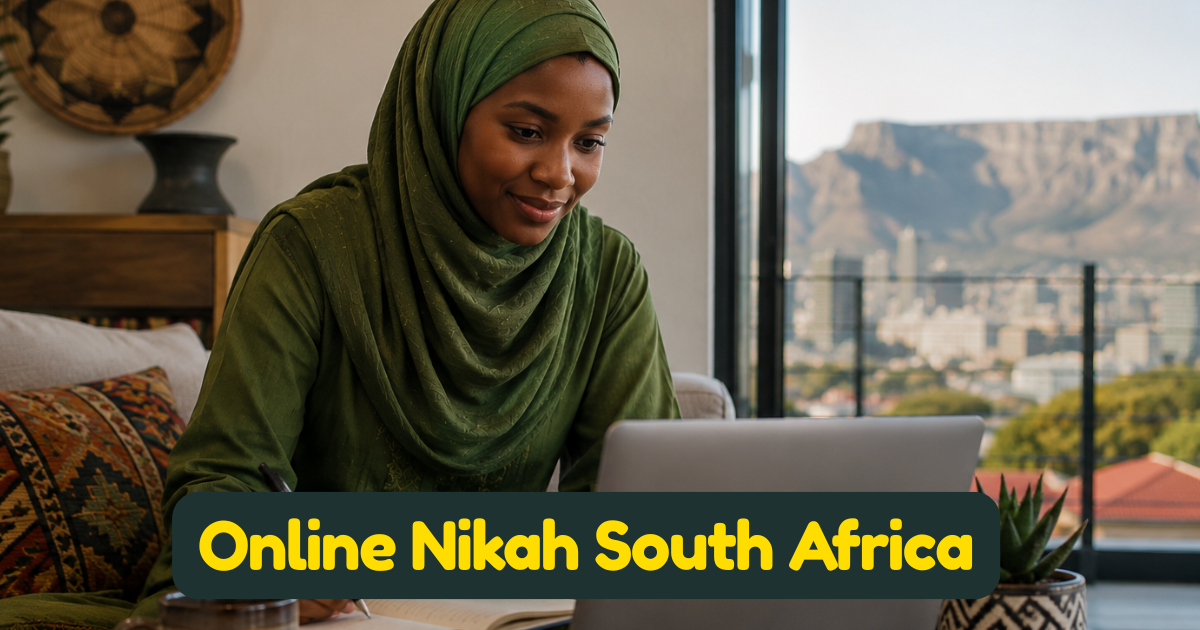
Online Nikah South Africa — Complete Guide for Muslims in South Africa and the South African Muslim Diaspora
South Africa's Muslim community is one of the most historically remarkable in the world — not because of its size, which at approximately eight hundred thousand represents a modest minority within a nation of sixty million, but because of the extraordinary circumstances of its origins and the depth of its institutional development over three and a half centuries of continuous Muslim presence on the southern tip of the African continent. Islam arrived at the Cape of Good Hope not through conquest, not through voluntary migration, but through the vessels of the Dutch East India Company — the VOC — which brought enslaved people from the Indonesian archipelago, political prisoners exiled from VOC-administered territories across Asia, and free Muslim merchants and religious leaders who settled in the Cape Colony from the 1650s onwards.
Among the most historically significant of these arrivals was Sheikh Yusuf of Macassar — a prince and Islamic scholar from Sulawesi who was exiled to the Cape Colony by the Dutch in 1694 following his resistance to VOC colonialism in the Indonesian archipelago. His arrival at the Cape — where he continued to teach Islam to both the enslaved Muslim population and to anyone who would listen — marks one of the foundational moments of South African Islamic history. His kramat (shrine) at Macassar near Strand, along with four other kramats forming a spiritual circle around the Cape Peninsula, remains a site of annual pilgrimage for South African Muslims to this day.
Three and a half centuries after Sheikh Yusuf's arrival, South Africa's Muslim community presents a striking contrast between the depth of its historical roots, the sophistication of its Islamic institutional infrastructure, and the significant legal gap that continues to define the practical reality of Muslim marriage in South Africa: Islamic marriages are not recognised under South African civil law. This legal gap — despite decades of advocacy, legislative proposals, and the long-pending Muslim Marriages Bill — means that Muslim couples in South Africa who conduct a nikah without also registering a civil marriage have no civil legal standing as spouses in South African courts. It is one of the most significant and most practically consequential examples of the Islamic-civil law divide in any country in the world — and it makes the documentation and proper conduct of the nikah more important, not less, for South African Muslim couples.
This article provides the complete guide — covering the Islamic validity of online nikah for South African Muslims, the civil marriage law landscape and the Muslim Marriages Bill context, the MJC and ulama body institutional framework, the wali and witness requirements, community-specific guidance across South Africa's diverse Muslim population, diaspora-specific considerations for South African Muslims abroad, and how to proceed with a fully documented Shariah-compliant virtual nikah ceremony through InstantNikah.com.
South Africa's Muslim Community — History, Composition, and Geographic Distribution
South Africa's Muslim population is distributed across several distinct communities whose origins, cultural traditions, and Islamic scholarly frameworks differ significantly — reflecting the diverse pathways through which Islam reached different parts of South African society over three and a half centuries.
Cape Malay Muslim Community — Western Cape
The Cape Muslim community — sometimes referred to as Cape Malay, though the term encompasses Muslims of diverse origins beyond Malay-speaking people — is the oldest and most institutionally developed Muslim community in South Africa. Concentrated primarily in Cape Town and the Western Cape, this community traces its origins to the enslaved and exiled Muslim populations brought to the Cape by the Dutch East India Company from the seventeenth century onwards. Its members include descendants of Indonesian, Indian, Malagasy, and East African Muslims, as well as the descendants of later Indian Muslim migrants who integrated into the Cape Muslim community over subsequent generations.
The Cape Muslim community is served primarily by the Muslim Judicial Council (MJC) — one of the most respected Islamic scholarly bodies in the Southern Hemisphere — which was established in 1945 and has since developed into a comprehensive Islamic institutional authority overseeing fatwa issuance, nikah registration, halal certification, and a wide range of Islamic community services. The MJC's approach to Islamic jurisprudence reflects the Shafi'i school — the dominant madhhab in the Indonesian and Malay Islamic world from which much of the Cape Muslim community's ancestral religious practice derives — though its rulings engage with all four major Sunni schools and its scholars are comprehensively trained in classical Islamic jurisprudence.
Indian Muslim Community — KwaZulu-Natal and Gauteng
South Africa's Indian Muslim community — concentrated primarily in KwaZulu-Natal (particularly Durban and surrounds), Gauteng (Johannesburg and Pretoria), and the Eastern Cape — traces its origins to the indentured labour migration that brought Indian workers to Natal from 1860 onwards, and to the subsequent free passenger Indian migration of Muslim merchants and professionals. The Indian Muslim community in South Africa is predominantly Gujarati and Tamil-speaking in its historical origins, follows Hanafi fiqh — the dominant school of the Indian subcontinent — and has developed its own distinctive South African Islamic institutional framework including the United Ulama Council of South Africa (UUCSA) and numerous local ulama bodies.
Durban — home to one of the largest Indian-origin Muslim communities outside India — has one of the most active Islamic community infrastructures in the Southern Hemisphere, with major Islamic educational institutions, a thriving halal industry, and a dense network of mosques and ulama that gives the KwaZulu-Natal Muslim community a level of Islamic institutional depth comparable to established Muslim communities in South Asia.
Black African Muslim Community
A growing and increasingly significant dimension of South African Islam is the Black African Muslim community — Muslims from various South African Bantu-speaking communities who have embraced Islam through da'wah activities, through contact with Muslim communities in South Africa's cities, and through the influence of Tabligh Jamaat and other Islamic outreach movements. This community is growing rapidly and is increasingly present across South Africa's townships and urban areas. Its members typically follow Hanafi fiqh and are served by a growing network of mosques and Islamic institutions specifically oriented toward the South African indigenous population.
Somali, Malawian, and Other African Muslim Communities
South Africa's post-apartheid opening to African migration has brought significant communities of Somali, Ethiopian, Malawian, Zimbabwean, Mozambican, Nigerian, and Senegalese Muslims to South African cities — particularly to Johannesburg, Cape Town, and Durban. These communities bring their own distinct Islamic traditions — Somali Muslims follow Shafi'i fiqh, West African Muslims follow Maliki fiqh — and their presence adds further diversity to South Africa's already richly varied Muslim landscape.
South African Civil Marriage Law and the Muslim Marriages Bill — The Critical Legal Gap
The most practically important legal reality for South African Muslim couples is one that sets South Africa apart from virtually every other country in this article series: Islamic marriages are not recognised under South African civil law. This means that a couple who conducts only a nikah — however properly conducted and documented — has no civil legal standing as spouses under South African law. They have no community of property rights, no inheritance rights as spouses under intestate succession, no maintenance claims as a spouse enforceable through South African courts, and no ability to claim spousal benefits from pension funds, medical aids, or life insurance policies without being civilly married.
The History of the Muslim Marriages Bill
The Muslim Marriages Bill — legislation specifically designed to provide civil legal recognition for Islamic marriages in South Africa while respecting the specific requirements of Islamic law — has been in development, consultation, and various stages of legislative process for over two decades. First formally proposed in the early 2000s, the Bill has been revised multiple times, debated extensively within the South African Muslim community, and remains — at the time of writing — not yet enacted into law despite broad support for the principle of civil recognition of Muslim marriages.
The delays in enacting the Muslim Marriages Bill reflect the genuine complexity of reconciling South African constitutional law — which includes robust provisions for gender equality, freedom of religion, and the rights of children — with the specific provisions of Islamic family law on matters including polygyny, divorce rights, and the role of the wali. The South African Law Reform Commission and subsequent legislative processes have grappled with these tensions, and the result has been a prolonged legislative process that has left South African Muslim couples in a legal limbo that affects millions of people's daily lives.
The Constitutional Court of South Africa has, in the interim, issued several significant rulings that have extended some civil law protections to Muslim marriages — most notably in the Ryland v Edros case (1997) and subsequent decisions — establishing that courts can enforce contractual obligations arising from Muslim marriages even in the absence of legislative recognition. But these judicial interventions, while important, do not provide the comprehensive civil recognition that the Muslim Marriages Bill would if enacted.
The Practical Implication — Why Nikah Documentation Matters Even More in South Africa
The absence of civil recognition for Islamic marriages in South Africa does not diminish the importance of the nikah — it increases it. Because the nikah is the only formal document evidencing the Islamic marriage contract, its proper documentation is the only protection a Muslim spouse has within the Islamic community and Islamic arbitration framework if a dispute arises. A nikah that is properly documented — with all conditions recorded, the mahr specified, the wali identified, the witnesses confirmed — is a document that an Islamic arbitration body, a qualified ulama panel, or a South African court applying Islamic law principles can rely on. A nikah that was conducted informally without proper documentation provides no such protection.
This is why the MJC's nikah registration system, UUCSA's documentation practices, and the documentation produced by online nikah services like InstantNikah.com are not merely ceremonial — they are practically essential protections for South African Muslim spouses, particularly Muslim women whose rights within the marriage relationship depend on the enforceability of the nikah contract and its documented conditions.
The MJC, UUCSA, and South Africa's Ulama Framework — Institutional Context
South Africa's Islamic institutional landscape is among the most developed in the Southern Hemisphere, reflecting the depth of the Muslim community's roots and the sophistication of the scholarly tradition that has been maintained across three and a half centuries.
The Muslim Judicial Council (MJC) — Cape Town
The Muslim Judicial Council — headquartered in Cape Town and serving primarily the Western Cape Muslim community — is one of the most authoritative Islamic scholarly bodies in Southern Africa. Established in 1945, it maintains a comprehensive fatwa department, a nikah registration system, halal certification authority, and a range of Islamic community services. The MJC's nikah registration system issues nikah certificates that are widely recognised within the South African Muslim community and that serve as the primary evidence of an Islamic marriage for South African Muslims in the Western Cape. The MJC follows a broad Shafi'i-influenced scholarly approach while engaging all four major schools, and its rulings on contemporary questions — including remote nikah and online ceremony validity — reflect engagement with the full spectrum of classical and contemporary Islamic jurisprudence.
The United Ulama Council of South Africa (UUCSA)
UUCSA — the representative body of ulama organisations across South Africa — provides an umbrella institutional framework that coordinates Islamic scholarly positions across the country's diverse Muslim communities. Its member organisations include the major ulama bodies of KwaZulu-Natal, Gauteng, the Eastern Cape, and other provinces, giving it a national reach that complements the MJC's specific Western Cape focus. UUCSA engages with national Islamic affairs including the Muslim Marriages Bill legislative process, represents South African Muslims before the government, and coordinates Islamic positions on matters of national significance.
Local Ulama Bodies and Jamiat Organisations
Across South Africa's provinces, a network of local ulama bodies and Jamiat organisations — including the Jamiatul Ulama KwaZulu-Natal (JUKZN), the Jamiatul Ulama South Africa (based in Johannesburg), and various provincial ulama councils — provide Islamic scholarly services including nikah registration, fatwa issuance, and community religious guidance at the local level. These bodies collectively provide the most geographically accessible Islamic institutional infrastructure for South African Muslims across the country's diverse regions.
Is Online Nikah Islamically Valid for South African Muslims?
The Islamic validity of an online nikah is determined by classical jurisprudence — not by South African civil law, not by the pending Muslim Marriages Bill, and not by whether the ceremony is conducted through the MJC, UUCSA, a local ulama body, or an international online service. A nikah conducted through a live, simultaneous video call in which all five conditions are properly met is Islamically valid regardless of whether the parties are in Cape Town, Durban, Johannesburg, Pretoria, Port Elizabeth, or anywhere across the South African Muslim diaspora internationally.
South Africa's diverse Muslim communities follow different schools of jurisprudence — the Cape Muslim community leans toward Shafi'i fiqh, the Indian Muslim community follows Hanafi fiqh, Somali Muslims follow Shafi'i fiqh, and West African Muslims follow Maliki fiqh. All four major Sunni schools hold the same fundamental conditions for a valid nikah, and all four's majority contemporary scholarly positions hold that a live, simultaneous video connection satisfies the simultaneity requirement of the ijab and qabool.
The five universally recognised conditions of a valid nikah — across all four major Sunni schools — are:
- A willing bride whose consent is genuine, fully informed, and entirely free from any form of coercion or social pressure.
- A willing groom whose consent is similarly genuine and freely given.
- The wali — the bride's guardian — who makes the offer (ijab) on her behalf, or whose properly appointed wakeel (authorised representative) does so in his place.
- Two witnesses — adult Muslim males of sound character — present and genuinely aware of the ijab and qabool at the time they are exchanged.
- The mahr — the mandatory financial gift from the groom to the bride — specific, mutually agreed, and clearly recorded in the nikah contract.
The comprehensive scholarly analysis of the online nikah ruling is covered in the dedicated articles on whether online nikah is valid in Islam and whether nikah can be done over Zoom or video call.
The Wali Requirement for South African Muslim Women — Multi-School Consideration
The wali requirement in South Africa's Muslim community must be understood through the lens of the diverse schools of fiqh present within the community — because the Cape Muslim community's Shafi'i orientation, the Indian Muslim community's Hanafi orientation, and the Somali and West African communities' Shafi'i and Maliki orientations each bring different approaches to the wali's role.
Under the Shafi'i school — which is the orientation of the Cape Muslim community and the Somali Muslim community — the wali is a strict validity condition for the nikah. His involvement is not merely recommended but required. For Cape Malay Muslim women and Somali Muslim women in South Africa, the wali's participation in the nikah ceremony is therefore a non-negotiable Islamic requirement that must be properly incorporated.
Under the Hanafi school — which governs the Indian Muslim community of KwaZulu-Natal and Gauteng — the wali's involvement is strongly recommended and culturally important, with some scholarly flexibility for adult women of sound mind as discussed throughout this series.
Under the Maliki school — which governs West African Muslim communities in South Africa — the wali is a validity condition, as in the Shafi'i school.
For all South African Muslim women — regardless of their specific fiqh tradition — the online nikah format fully accommodates the wali's participation through the live video call from any location. A father in Cape Town, a brother in Durban, a wali in India or Pakistan, or a guardian anywhere in the world can participate fully in the ceremony through the live video connection while the bride and groom are connected from their respective locations. For Muslim women in South Africa whose wali is genuinely unavailable — through the specific circumstances of the Cape Muslim community's diverse historical origins, through death, incapacity, or wrongful refusal — the wali hakim mechanism provides the established Islamic pathway across all schools. The detailed framework is addressed in the dedicated articles on online nikah without a wali and what happens if the wali refuses the nikah.
The Witness Requirement for Muslims in South Africa
Two adult Muslim male witnesses of sound character are required for a valid nikah across all four major Sunni schools. For Muslims in South Africa's major Muslim community centres — Cape Town, Durban, Johannesburg — finding two qualified Muslim male witnesses within the local community is generally straightforward given the density of Muslim community infrastructure. For Muslims in smaller South African cities, rural areas, or the growing township Muslim communities where mosque infrastructure is still developing, the online format accommodates witnesses connecting through the live video call from any location. The specific rulings on female witnesses and non-Muslim witnesses are addressed in the dedicated articles on whether a woman can be a witness at nikah and whether a non-Muslim can be a witness at nikah.
The Mahr in South African Muslim Communities
The mahr — the mandatory financial gift from the groom to the bride — is expressed across South Africa's diverse Muslim communities in ways that reflect the distinct traditions of the Cape Malay Shafi'i world, the Indian Hanafi world, and the various African Muslim communities. Within the Cape Muslim community, the mahr tradition reflects Shafi'i fiqh's specific minimum mahr requirement and its documentation practices. Within the Indian Muslim community of KwaZulu-Natal, the mahr reflects South Asian Hanafi practices with their specific cultural expressions.
In the absence of the Muslim Marriages Bill and civil recognition of Islamic marriages, the mahr documentation within the nikah contract is particularly critical in South Africa — because it is the primary evidence of the financial entitlement that a Muslim woman holds against her husband within the Islamic framework, in the absence of the civil law protections that would apply if the marriage were civilly registered. A properly documented mahr clause in a properly documented nikah contract is the most important financial protection available to a South African Muslim woman in the current legal landscape. The comprehensive framework of mahr is covered in the dedicated articles on what mahr is in nikah and how much mahr is enough in Islamic law.
When Do South African Muslims Need an Online Nikah Service?
Cross-Border Relationships — One Party in South Africa, One Abroad
South African Muslims in relationships with partners in India, Pakistan, the UK, the USA, Australia, or other countries — and diaspora South African Muslims in long-distance relationships with partners in South Africa — represent the most common scenario for online nikah in the South African context. The online format allows all parties to connect through the live video call regardless of geographic distances, with the ceremony conducted and documented with full scholarly oversight.
Geographic Distance Within South Africa
South Africa is a large country — approximately one and a half million square kilometres — where the distance between Cape Town and Durban, or between Johannesburg and Port Elizabeth, represents significant travel time and cost. For Muslim couples where the bride's family is in Cape Town and the groom's family is in Durban, or where the nikah officiant most qualified for their specific community's fiqh tradition is in another city, an online nikah through InstantNikah.com provides a solution that does not require all parties to travel to a single physical location.
Documentation Priority in the Absence of Civil Recognition
Given the absence of civil recognition for Islamic marriages in South Africa, the quality and completeness of nikah documentation is even more important than in countries where the marriage is civilly registered. An online nikah through InstantNikah.com produces a comprehensive Islamic nikah certificate with full scholarly documentation — providing the most complete and professionally documented Islamic marriage record available, which is particularly valuable in the South African context where the nikah certificate is the primary legal evidence of the Islamic marriage relationship.
South African Muslims Abroad
South Africa has a significant diaspora community — concentrated particularly in the UK, USA, Canada, and Australia — that includes a significant Muslim component. For South African Muslims abroad in long-distance relationships with partners in South Africa or elsewhere, the online nikah provides the most accessible solution. South African Muslims in the UK should note that a religious-only nikah in the UK carries no civil legal weight, and civil marriage registration at a UK register office should be pursued separately if civil legal spousal rights in the UK are desired. The dedicated articles on online nikah in the UK and online nikah in Australia provide country-specific civil law guidance for South African Muslims in these diaspora locations.
Protecting Rights in the Nikah Contract — Critical Guidance for South African Muslim Women
For South African Muslim women — in the absence of civil recognition for Islamic marriages — the nikah contract conditions are not merely optional enhancements to the ceremony. They are, in the current legal landscape, the primary mechanism through which a Muslim woman can establish enforceable protections within her marriage relationship within the Islamic community framework.
This makes the protective conditions available within the nikah contract even more important for South African Muslim women than for Muslim women in countries where civil marriage provides a parallel protection framework. A condition in the nikah contract providing the wife with tafwid al-talaq — the delegated right of self-divorce — is particularly critical in South Africa, where the absence of civil divorce proceedings for unrecognised Islamic marriages means that a Muslim woman's ability to exit a harmful marriage depends almost entirely on her Islamic rights rather than on civil court intervention.
The Constitutional Court's ruling in Dawood and Another v Minister of Home Affairs and Others (2000) and subsequent cases have progressively strengthened the recognition of Muslim wives' rights within South African jurisprudence — but the fundamental protection for a South African Muslim woman remains the proper documentation of her nikah contract and the conditions it contains. The comprehensive guide on protective conditions in the nikah contract for Muslim women explains every available protective condition. The article on financial protection before nikah provides broader context on the financial dimensions of pre-nikah planning.
Common Questions South African Muslims Ask About Online Nikah
Is an online nikah recognised by the MJC or UUCSA?
An online nikah conducted through InstantNikah.com is Islamically valid — meeting all the conditions of a valid nikah across all four major Sunni schools. It is not conducted through the MJC's or UUCSA's own institutional registration systems, which are separate organisational frameworks. For South African Muslims who wish their nikah to be registered within the MJC's or their local ulama body's registration system — which provides community recognition within the South African Muslim institutional framework — the appropriate route is through those bodies directly. InstantNikah.com's ceremony provides a fully documented, internationally recognised Islamic nikah certificate as an alternative for couples who cannot access those local services or who require a cross-border solution.
What is the current status of the Muslim Marriages Bill?
The Muslim Marriages Bill has been through multiple revisions and consultation processes over two decades and remains, as of the time of writing, not yet enacted into South African law. The South African Law Reform Commission's work and subsequent parliamentary processes continue, but the precise timeline for enactment remains uncertain. South African Muslim couples should not rely on the Bill's imminent enactment when planning their marriage arrangements and should pursue civil marriage registration separately if civil legal spousal rights in South Africa are desired.
Which school of fiqh does InstantNikah.com follow for South African couples?
InstantNikah.com's ceremonies accommodate all four major Sunni schools — Hanafi, Shafi'i, Maliki, and Hanbali. South African Muslim couples should indicate their school of fiqh when booking — Cape Malay and Somali Muslim couples following Shafi'i fiqh, Indian Muslim couples following Hanafi fiqh, and West African Muslim couples following Maliki fiqh — so that the ceremony can be conducted with full attention to the specific conditions of their tradition, particularly regarding the wali's role.
Can my wali participate from another South African city or from abroad?
Yes — the wali participates through the live video call from wherever he is located, whether in Cape Town, Durban, Johannesburg, India, Pakistan, or any other location. South Africa operates on South Africa Standard Time (SAST — UTC+2), which facilitates coordination with the UK (two hours behind in winter, one hour behind in summer), South Asia (three and a half to four hours ahead), and the Middle East (one to two hours ahead).
What documentation will I receive?
Every nikah conducted through InstantNikah.com produces a fully documented Islamic nikah certificate recording all parties' details, the wali's involvement, the witnesses' confirmation, the mahr amount and terms including any protective conditions stipulated, the applicable school of fiqh, the date and format of the ceremony, and the officiating scholar's credentials. Given the specific importance of nikah documentation in the South African context — where the nikah certificate is the primary evidence of the Islamic marriage in the absence of civil recognition — the completeness and professional quality of this documentation is particularly significant.
The Kramats of the Cape — Islam's Sacred Geography in South Africa
No article on Islam in South Africa can be complete without acknowledging the kramats — the shrines of Muslim saints and scholars that mark the spiritual geography of the Cape Peninsula and constitute one of the most distinctive expressions of South African Muslim identity. The five kramats forming the spiritual circle of protection around the Cape Peninsula — at Macassar (Sheikh Yusuf of Macassar), Signal Hill (Tuan Guru), Constantia (Sayed Abdurahman Matebe Shah), Oudekraal (Sheikh Nuraldeen), and Faure (Sheikh Mahmud) — are sites of annual pilgrimage, of du'a and remembrance, and of a living connection between contemporary Cape Muslims and the founding generation of Islam at the Cape.
Tuan Guru — Sheikh Abdullah ibn Qadi Abdus Salaam — who arrived at the Cape as a political prisoner in 1780 and spent over a decade transcribing the Qur'an from memory during his imprisonment on Robben Island, is one of the most remarkable figures in the history of Islam in the Southern Hemisphere. His transcription of the Qur'an from memory — a feat of Islamic scholarship and spiritual fortitude conducted under the conditions of colonial imprisonment — is a defining story of the Cape Muslim community's founding period and a testament to the depth of Islamic commitment that has sustained Muslim life at the southern tip of Africa for over three and a half centuries.
For Muslims in South Africa — in Cape Town's Bo-Kaap neighbourhood where the call to prayer echoes across painted terraced houses that have been Muslim homes since the eighteenth century, in Durban's mosques where the sound of recitation drifts across the Indian Ocean, or in Johannesburg's diverse Muslim communities that reflect the full global spectrum of Islamic culture — conducting a properly documented, Shariah-compliant nikah is an act of participation in a tradition of Islamic commitment that has been maintained on South African soil for longer than the South African state itself has existed.
How to Proceed With an Online Nikah in South Africa Through InstantNikah.com
The process for South African Muslims conducting an online nikah through InstantNikah.com is fully guided from start to completion:
- Select your service package — choose between Instant Nikah, Express Nikah, Same Day Nikah, or Essential Nikah depending on your timeline and specific circumstances.
- Provide the required information — full names and identification details of both parties, wali details and his relationship to the bride, witness names and locations, the agreed mahr amount with its prompt and deferred terms clearly specified, any protective conditions to be included in the nikah contract, and your school of fiqh — Shafi'i for Cape Malay and Somali couples, Hanafi for Indian Muslim couples, Maliki for West African Muslim couples — so the ceremony can be conducted with full attention to your tradition's specific requirements.
- Schedule the ceremony — the InstantNikah.com team coordinates the live video call at a time that works for all parties. South Africa operates on South Africa Standard Time (SAST — UTC+2) — facilitating coordination with the UK, Europe, the Middle East, and South Asia within practical hours. The team handles all time zone logistics as part of the scheduling process.
- Attend the ceremony — a qualified Islamic scholar facilitates the full nikah ceremony over the live video call — delivering the khutbah al-nikah, verifying all five conditions with full attention to the applicable school of fiqh, guiding the ijab and qabool, confirming the mahr terms and any protective conditions, and leading the du'a for the couple.
- Receive your nikah certificate — the complete documentation is produced and provided to both parties following the ceremony, recording all conditions, all parties, the applicable fiqh school, any protective conditions stipulated, and the officiating scholar's credentials in full. Given the specific importance of nikah documentation in South Africa, couples are encouraged to retain this certificate carefully as the primary evidence of their Islamic marriage.
You can review the full nikah process, read verified client reviews, or explore the gallery of ceremonies. To proceed, book your nikah directly through packages including Instant Nikah, Express Nikah, Same Day Nikah, and Essential Nikah. For specific questions about your circumstances — including your school of fiqh, wali arrangements, protective nikah contract conditions, or documentation requirements given the South African legal context — the team is available to assist directly.
Admin User
Author