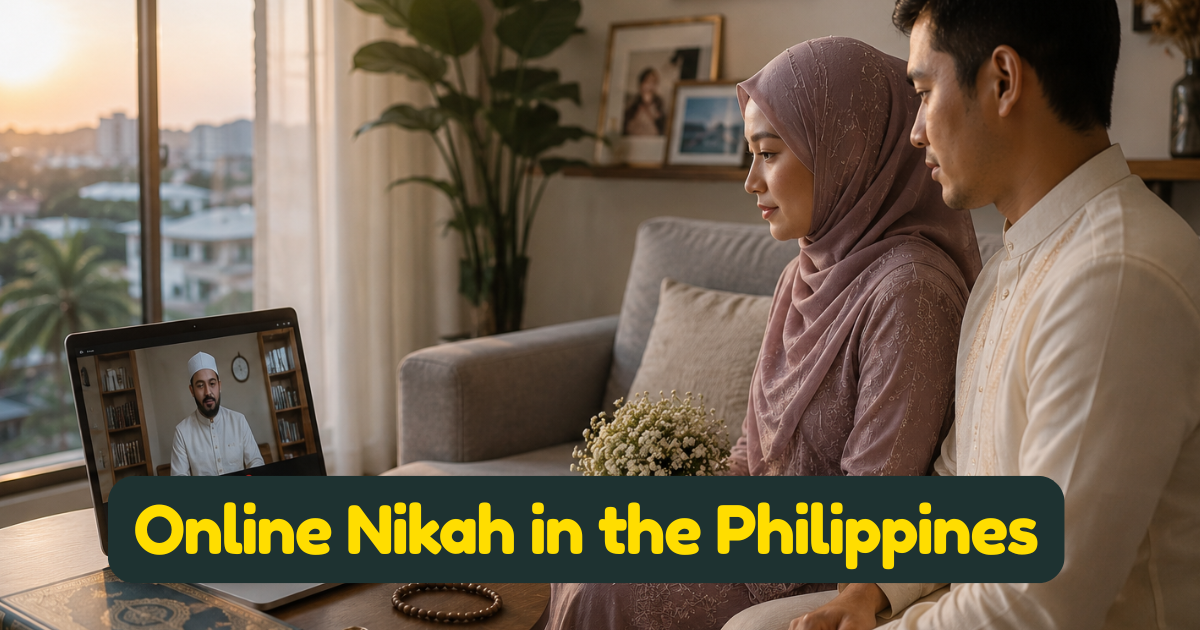
Online Nikah in the Philippines: A Complete Guide for Filipino Muslims, OFWs, and Couples in Mindanao and Beyond
The Philippines occupies a quietly singular place in the world of Islamic family law. It is a predominantly Catholic nation, yet it carries on its statute books a complete Shariah-based legal code for Muslim personal affairs — Presidential Decree No. 1083, the Code of Muslim Personal Laws, enacted in 1977 and still in force today. That code formally recognises the nikah, the Islamic marriage contract, as a legal act of state. It establishes Shariah Circuit Courts to register it, defines the role of the wali, mandates mahr, and requires witnesses.
And yet, for a very large share of Filipino Muslims, reaching those structures is simply not possible when it matters most. According to the Philippine Statistics Authority, 2.19 million Filipinos were working abroad in 2024 — and a meaningful slice of them are Muslims from Mindanao and the Bangsamoro region, now dispersed across the Gulf, East Asia, and Europe. They cannot walk into a Shariah Circuit Court in Cotabato or Marawi. A fiancée is in Zamboanga; a groom is in Riyadh. Or both are abroad, separated by work contracts and airline costs they cannot currently absorb.
This is exactly what an online nikah service addresses, and it is why InstantNikah.com conducts Shariah-compliant ceremonies for Filipino Muslim couples wherever they are in the world.
Understanding the Legal Landscape: What PD 1083 Actually Provides
Presidential Decree No. 1083 is one of the most detailed statutory recognitions of Islamic marriage in any non-Muslim-majority country. Under it, a Muslim marriage is simultaneously a religious and a civil act. The Code requires, at the time of the ceremony:
- Legal capacity of both parties to marry under Shariah.
- Mutual free consent — the offer (ijab) and acceptance (qabul) — witnessed by at least two competent persons.
- The wali's consent for the bride. Where no natural guardian is available, the Shariah Court itself may act as wali.
- Mahr (dower), whether paid immediately or deferred, belonging exclusively to the wife.
The marriage must then be registered — typically within thirty days — with the Shariah Circuit Court, whose Clerk acts as the circuit registrar, forwarding a certificate to the Civil Registrar General for national recording. As summarised comprehensively by the legal commentary site Respicio & Co., which cites PD 1083 directly, all of these elements must be present for the marriage to be valid and registrable under Philippine law.
The U.S. State Department's 2023 International Religious Freedom Report on the Philippines confirms that Shari'ah courts operate within BARMM and that Muslim personal law is an active, government-administered framework in the country's southern regions. Muslims constitute the Philippines' third-largest Muslim community in Southeast Asia, with approximately 12 million adherents according to 2024 data from the National Commission for Muslim Filipinos, as reported by Arab News.
The Problem Distance Creates — and What an Online Nikah Solves
The problem is not legal complexity at home — PD 1083 is actually a generous framework. The problem is physical distance. A Filipino Muslim woman working in Dubai cannot present herself before a Shariah Circuit Court in Cotabato. An OFW on a two-year contract in Japan cannot fly home to marry before his contract expires. A couple from Lanao del Sur, one of whom is now a student in Europe, cannot coordinate a hometown ceremony around semester schedules and visa windows.
An online nikah solves all three scenarios, not by bypassing Islamic requirements, but by fulfilling them remotely. The Islamic contract — the wali, the offer and acceptance, the two witnesses, the mahr — does not require a courthouse or a mosque. It requires the right people, in defined roles, clearly hearing the right words. Over a properly managed secure video connection, every one of those elements can be satisfied.
What Scholars Say About a Remote Nikah
This is not a fringe position. The question of marrying across distance has a real scholarly record, and the mainstream view among contemporary jurists is that a remote contract is valid when the essential conditions are met — identity verified, the wali present and willing, and crucially, two qualified witnesses who genuinely hear the offer and acceptance.
The Hanafi school — widely followed across the Philippine Muslim community and the broader South and Southeast Asian diaspora — requires witnesses to hear and understand both the ijab and the qabul. It is not their physical presence in a room that validates; it is their actual perception of the contract words. Detailed Hanafi analysis on this point is available through the Darul Iftaa, which addresses the witness conditions with precision.
Where a scholar is more cautious, the preferred workaround is appointing a wakeel — a proxy who represents the groom at the same physical location as the bride and wali. InstantNikah.com's qualified officiants are familiar with both approaches and advise couples based on their madhab and circumstance. For a deeper treatment of the ruling, our explainer on the video-call nikah ruling walks through the positions of each school.
The OFW Reality: Millions of Muslims Marrying Across Borders
There is a human dimension here that statistics only partially capture. The PSA's 2024 OFW survey records that 74.5 percent of Filipino overseas workers are based in Asian countries — the Gulf states, Japan, South Korea, Singapore, and Hong Kong feature prominently. A significant number are from Mindanao and the Bangsamoro region. These are people who send money home every month, who sustain families across time zones, and for whom a proper Islamic marriage — a nikah that actually meets the conditions — is a matter of deep personal and religious seriousness.
Telling an OFW nurse in Riyadh or a seafarer in Rotterdam to "just wait until you get back" is not always a realistic answer. Halal relationships cannot always pause for two years. An online nikah conducted with care is, for many of these couples, the only dignified and religiously sound path forward.
Our guide on online nikah for expat Muslims and the companion article on nikah for couples in different countries both speak directly to this reality.
After the Nikah: Registering the Marriage for Philippine Civil Purposes
An online nikah makes you married in Islam. For the Philippine state to recognise the marriage — for civil documentation, inheritance, Philippine passports for children, spousal visa applications, and social security purposes — the marriage must also enter the civil record.
For a couple who married abroad, the Department of Foreign Affairs (DFA) requires Filipino citizens to file a Report of Marriage at the nearest Philippine Foreign Service Post (embassy or consulate) in the country where the ceremony took place. Three copies of the Report of Marriage form are submitted along with the marriage certificate. This process is documented by the PSA Helpline, which guides OFWs through the registration sequence step by step.
For a marriage conducted within the Philippines, registration with the Shariah Circuit Court and subsequently the local civil registrar is required under PD 1083 within thirty days of the ceremony. The Philippine Congress Research and Development staff have published useful background on the OFW profile and the broader legal context via the Congressional Policy and Budget Research Department.
For a broader guide on sequencing a nikah first and civil registration second, see our dedicated resource on registering a nikah civilly after the Islamic ceremony.
Situations Where an Online Nikah Is the Practical Answer in the Philippines
- OFWs separated by work contracts. The most common case. Both or one partner is abroad; the ceremony happens online, the civil report follows at the embassy.
- Couples in Manila or other cities far from Mindanao's Shariah courts. The five Shariah District Courts all sit in Mindanao. A Muslim couple living in Metro Manila has no local Shariah court within reach.
- Students abroad. Filipino Muslim students in Europe, the UK, or the Middle East who cannot return for a ceremony mid-semester.
- Converts with no Muslim guardian. A Filipino revert, or the non-Muslim fiancée of a Filipino Muslim who is converting, may have no wali available. InstantNikah.com arranges a qualified alternative.
- Private ceremonies. Some couples, for professional or family reasons, prefer a discreet but fully valid ceremony before a larger public event. Our article on private online nikah covers this in detail.
Quick Answers for Filipino Muslim Couples
Is an online nikah valid for Filipino Muslims? Islamically, yes — if the wali, two witnesses who genuinely hear the contract, agreed mahr, and free consent are all present, the contract is valid regardless of whether the parties are in the same room or on a video call.
Does PD 1083 recognise online nikah? PD 1083 does not specifically address online ceremonies. Its validity requirements focus on the substance of the contract — wali, witnesses, mahr, consent — rather than the medium. A properly conducted online ceremony fulfils all substantive requirements.
How do we register the marriage in the Philippines after an online nikah abroad? File a Report of Marriage at the nearest Philippine embassy or consulate in the country where the ceremony was conducted. Then ensure the record is forwarded to the PSA through the DFA process.
What if the wali is in the Philippines and the bride is abroad? The wali can join the call remotely, or appoint a wakeel — a trusted proxy present in the bride's location — to give her in marriage on his behalf. Both approaches are recognised in Islamic jurisprudence.
Beginning the Right Way, Wherever You Are
The Philippines has done something rare: it has woven Islamic marriage into the fabric of its national law. But law written for a region cannot always follow its people across the world. For the Filipino Muslim nurse in Abu Dhabi, the student in Sheffield, or the engaged couple separated by a work contract and two continents, the substance of a valid nikah — the wali, the witnesses, the mahr, the words — can travel wherever you are. InstantNikah.com brings qualified officiants, proper witnesses, and careful documentation to your screen, so you can begin married life on both Islamic and civil solid ground. When you are ready, book your online nikah and speak with our team about your circumstances.
Admin User
Author