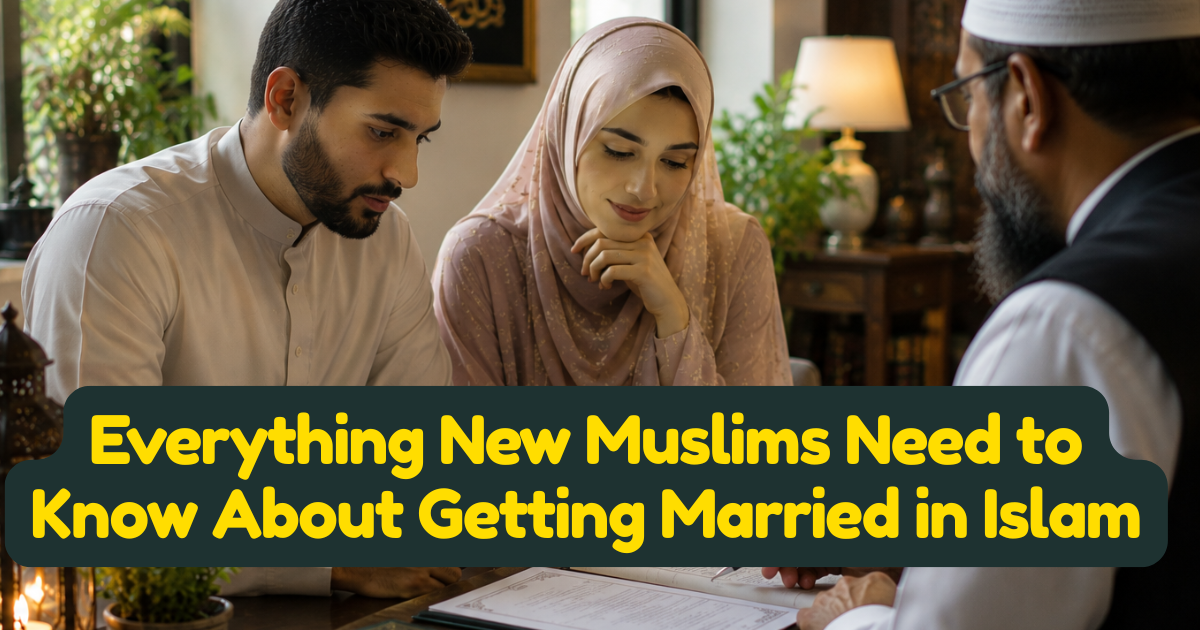
I Just Took My Shahada — Everything New Muslims Need to Know About Getting Married in Islam
Taking the shahada is one of the most profound moments a person can experience. The words Ash-hadu an la ilaha illa Allah, wa ash-hadu anna Muhammadan rasul Allah — "I bear witness that there is no god but Allah, and I bear witness that Muhammad is His messenger" — carry with them a weight that reshapes everything: your identity, your relationship with the Creator, your sense of purpose, and your understanding of how to live.
And if marriage is already part of your life or your plans, the shahada also reshapes that. Questions arrive quickly, often without clear answers. What happens to my current relationship? What does Islam require for a valid marriage? Do I need a wali, and where do I find one? What is mahr? How do I have a proper Islamic nikah when I have no Muslim family? Can I still use a civil ceremony?
This guide is written specifically for you — the new Muslim, the revert, the person who has just stepped into Islam and needs a clear, honest, warm guide to navigating marriage in this new chapter. Every question is real. Every answer is grounded in the Islamic scholarly tradition. And nothing here assumes you already know things you have not yet had the chance to learn.
First: What Islam Teaches About the Importance of Marriage
Before the practical details, it helps to understand how Islam views marriage itself — because the Islamic understanding of nikah is deeply different from the cultural assumptions many converts bring with them.
In Islam, marriage is not a social convention or a legal arrangement added on top of a relationship that already exists. It is a sacred covenant — the Quran calls it a mithaqan ghaliza, a solemn and weighty covenant (Surah An-Nisa 4:21). The Prophet Muhammad (peace be upon him) described marriage as half of one's faith. It is an act of worship. It is the framework within which a believing man and woman build a life together, raise children, and support each other in their journey toward Allah.
For new Muslims, this understanding is both empowering and clarifying. Marriage in Islam is not complicated by design — it is actually structurally simple, built around a small number of essential conditions rather than elaborate ceremony. What makes it sacred is not the grandeur of the occasion but the sincerity of the intention and the fulfilment of those conditions. As the Islamic guidance at NikahPlus's comprehensive guide to Muslim marriage for reverts notes: "Everything beyond these five elements — the elaborate multi-day celebrations, the specific dress codes, the dowry negotiations, the family approval rituals — belongs to the domain of culture and custom." What Islam requires is the contract. Everything else is cultural addition.
What Actually Happened When You Took Your Shahada
Understanding what the shahada actually does — and does not do — to your legal and personal status is the starting point for navigating marriage as a new Muslim.
When you said the shahada, you became Muslim. Your spiritual standing before Allah changed in that moment. All previous sins are forgiven — a mercy the Prophet (peace be upon him) described as the slate being wiped clean. You are now subject to Islamic obligations: prayer, fasting, zakah, and the ethical framework of Islamic life.
What the shahada does not automatically do is dissolve existing relationships, create new legal statuses in civil law, or solve every question about your life at once. Islam is a religion of guidance and ease, not sudden disruption. As the AboutIslam guidance on marriage and conversion explains: the formal shahada before witnesses creates the Islamic record of conversion, while the sincere intention in the heart is what Allah responds to.
Situation One: You Are Single and Want to Get Married as a New Muslim
If you took your shahada and are now single and looking to marry, you are in the most straightforward situation. Islam's framework for marriage applies to you fully, and the only question is how to navigate it without the Muslim family network that born-Muslims typically have.
Understanding the Five Conditions of a Valid Nikah
As detailed in the IslamOnline Fiqh resource on the conditions of Islamic marriage, citing Dr. Muzammil H. Siddiqi: a valid Islamic marriage requires five things — mutual consent, the mahr, the wali (guardian), two Muslim witnesses, and public announcement. These five elements are what make a nikah valid. Everything else is culture.
For new Muslims, each of these elements may require some navigation:
- Your consent — this is always yours alone. No one can override your genuine, free decision to marry or not to marry.
- The mahr — a gift from the groom to the bride. It can be money, gold, property, or any item of genuine value. It has no minimum amount in the Hanafi madhab (though a symbolic figure below the equivalent of approximately 30g of silver is considered too low). It can be paid immediately, deferred, or split between prompt and deferred portions. It is the bride's exclusive right and cannot be touched by family or returned under pressure.
- The wali — this is the most practically complex element for new Muslims without Muslim families, and is addressed in full below.
- Two Muslim witnesses — adult, sane, Muslim individuals who hear and comprehend the ceremony. Finding these witnesses can be a challenge for converts without Muslim connections — also addressed below.
- Public announcement — telling people you are married. This does not require a large party; informing family and friends that the nikah has taken place fulfils this requirement.
The Wali Question: What Do New Muslims Without Muslim Families Do?
The wali is the bride's Islamic guardian — in classical practice, her father or nearest male Muslim relative. For a new Muslim woman whose father is not Muslim, or whose family has not embraced Islam, the classical wali system cannot function in its typical form. Non-Muslim family members cannot serve as wali for a Muslim woman's nikah.
This is one of the most common and most urgent practical questions new Muslim women face — and Islam has a clear solution for it. As confirmed at Silk Marriage's guide on marrying a revert woman Islamically: "If she's a revert without Muslim relatives, an imam or Islamic center can act as her wali."
This provision is established across all four madhabs. When a Muslim woman has no available Muslim male relative to serve as wali, the Islamic judge (qadi) or the imam of her local community takes on the wali role. For new Muslims using an online nikah service, the qualified scholar conducting the ceremony can serve as wali — this is a well-established and widely accepted provision, not a workaround or compromise.
For a complete guide to finding a wali as a Muslim convert, the dedicated article at How a Muslim Convert Can Find a Wali for Nikah covers every option in detail.
Finding Muslim Witnesses When You Have No Muslim Community
The two Muslim witnesses required for your nikah must be adult, sane, and Muslim. If you have no Muslim friends or community connections nearby, finding witnesses is a genuine practical challenge. The following options help:
- Your local mosque — even without an established relationship, many mosques are willing to help new Muslims who come to them with the honest situation. Introducing yourself, explaining that you recently took your shahada, and asking if two community members could serve as witnesses is often received warmly.
- Muslim convert support networks — organisations like NewMuslims.com and local convert support groups can help connect you with Muslims who are happy to assist new members of the community.
- Online nikah services with witness arrangements — a professional online nikah service can advise on or help arrange witnesses as part of the ceremony package, removing the burden from you entirely.
Situation Two: You Are in a Relationship and Have Just Converted
If you were already in a relationship — dating, living together, or engaged — when you took your shahada, the Islamic guidance is clear about what this means and what steps are appropriate.
If You Are Dating or in a Relationship Without Marriage
In Islamic law, romantic or intimate relationships outside of marriage are not permitted. If you were in a relationship prior to taking your shahada, the sincere first step is to either formalise the relationship through a nikah as soon as practically possible, or to separate if the relationship is one that Islamic law cannot accommodate (such as a relationship with a married person, or a relationship within prohibited degrees of relation).
Islam is a religion of ease and does not expect new Muslims to immediately dismantle every aspect of their lives on the day of the shahada. But the guidance of scholars is consistent: do not delay necessary changes longer than necessary. If you and your partner intend to marry, performing the nikah promptly — even before a formal wedding celebration — is the appropriate path. As covered in the article on Online Nikah for Muslim Couples Facing Immigration Delays, the nikah contract and the wedding celebration are two separate things. The nikah can be performed quickly and privately; the celebration can follow when circumstances allow.
If You Are Already Civilly Married and Both Partners Have Converted
If both you and your spouse have embraced Islam together, or your spouse is already Muslim, your existing civil marriage continues to be recognised under Islamic law. As established across multiple scholarly sources including the analysis at Al-Mawrid Islamic Research Foundation: pre-Islamic marriages are recognised as valid unless there is an explicit Islamic impediment. You do not automatically need to perform a new nikah. Many converts choose to perform one as a spiritual celebration and affirmation — and this is beautiful and meaningful — but it is not legally required.
If You Are Married and Your Spouse Has Not Converted
This is the most emotionally complex situation a new Muslim can face, and it deserves honesty rather than oversimplification. The Islamic ruling on this scenario is covered in full in the dedicated article at Is a Second Nikah Required After Converting to Islam If You Are Already Married. The short version: the answer depends on the religion of your spouse, your madhab, and the specific circumstances — and consulting a qualified Islamic scholar with your full situation is the most important step you can take.
What Mahr Means for New Muslims — A Practical Guide
Mahr is one of the most distinctive and meaningful aspects of Islamic marriage for new Muslims. It is a financial gift from the groom to the bride — not from her family to his, not a shared cost of the wedding, but a specific right belonging exclusively to her as a condition of the marriage contract.
For new Muslims who come from Western cultural backgrounds, mahr is sometimes confused with a dowry (which flows from the bride's family to the groom's) or with wedding costs. It is neither. It is the bride's personal financial right, established by Allah in Surah An-Nisa 4:4: "And give to the women their mahr with a good heart."
The practical guidance for new Muslims on mahr:
- There is no fixed amount — mahr can be as simple as teaching the bride Quran (the Prophet accepted this as mahr), or as substantial as gold, property, or a significant sum of money
- It should be realistic — the Prophet warned against setting mahr so high that it becomes a burden; a sincere mahr the groom can genuinely provide is more blessed than an impressive figure that creates debt
- It belongs entirely to the bride — no family member has any right to it, and she cannot be pressured to waive it
- It can be immediate, deferred, or split — part paid at the nikah, part to be paid later (at divorce or death)
For a comprehensive exploration of mahr, the guides at What Is Mahr in Nikah and How Much Mahr Is Enough provide full scholarly context.
Do You Also Need a Civil Marriage?
This is a question that many new Muslims in Western countries ask — and the answer matters enormously for your practical protection. An Islamic nikah makes you married in Islam and in the eyes of your faith community. But in countries like the UK, USA, Canada, Australia, and most of Europe, a nikah alone does not create legal marriage rights under civil law.
Without civil registration, you may not have the legal right to spousal inheritance, civil divorce proceedings, access to your spouse's pension, or recognition as a spouse in medical or legal emergencies. As the UK legal analysis at Reiss Edwards Family Law confirms: couples who have only a nikah without civil registration are treated as cohabiting partners under UK law, with significantly reduced legal protection.
The recommended approach for new Muslims in Western countries is to combine Islamic and civil marriage — performing the nikah for the spiritual and religious dimension, and separately completing civil registration for the legal dimension. These two acts complement each other completely and do not conflict. A full country-by-country guide to this process is available at How to Register Your Nikah Civilly After the Islamic Ceremony.
Building Your Muslim Community: You Are Not Alone
One of the most important things new Muslims need to hear — particularly around the practical questions of marriage — is that you are not expected to navigate this alone. The Islamic community has resources, support structures, and obligations of care toward new Muslims that are built into the faith itself.
The Prophet Muhammad (peace be upon him) said: "The believer to the believer is like a building whose different parts enforce each other." (Bukhari, Muslim). The Muslim community you are entering has an obligation to support you in exactly the practical challenges you are facing — finding witnesses, understanding your rights, locating a wali, arranging a nikah. You are not a burden when you ask for this help. You are a new member of a family exercising a right.
Organisations that specifically support new Muslims in Western countries include the IONA (Islamic Organization of North America) Convert Support Program, the Islamic Society of Britain's New Muslims Project, and local convert circles attached to mosques and Islamic centres in major cities. These organisations can help with everything from basic Islamic education to practical marriage support.
How Online Nikah Services Support New Muslims
For new Muslims who do not have a mosque connection, do not have Muslim family members available for the wali role, or who live in areas without accessible Islamic infrastructure, an online nikah service provides a complete and fully Shariah-compliant solution.
InstantNikah.com has significant experience serving Muslim converts — understanding the specific practical questions that arise, the wali arrangements that apply when no Muslim male relative is available, the witness considerations, and the particular emotional and spiritual significance this ceremony holds for someone experiencing it for the first time as a Muslim. The service provides everything needed for a valid nikah: a qualified Islamic scholar to conduct the ceremony, proper wali arrangements, witness coordination guidance, agreed mahr recording, and a professionally issued nikah certificate.
For a complete overview of what new Muslims should know before their nikah, see the dedicated article at What a Muslim Convert Should Know Before Nikah. For guidance specifically on the convert nikah service, visit Online Nikah for Converts.
To book your ceremony, visit the process page and choose from Instant Nikah, Same Day Nikah, Express Nikah, or Essential Nikah. For personal questions about your specific situation as a new Muslim, the team is reachable through the contact page.
Welcome to Islam. May Allah make your path easy and bless your marriage with love, mercy, and tranquillity — the three gifts He promised in Surah Ar-Rum 30:21 to those who enter His covenant of marriage with sincerity.
Admin User
Author