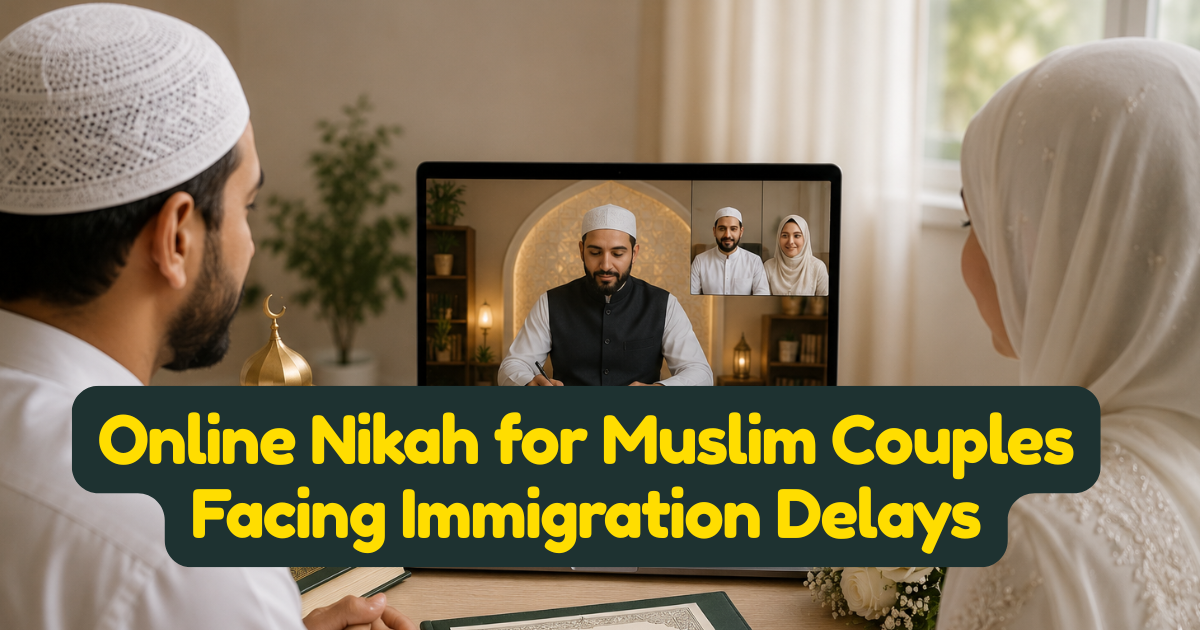
Online Nikah for Muslim Couples Facing Immigration Delays — How to Get Married Islamically While Waiting for a Visa
It is one of the most quietly difficult situations in the lives of Muslim couples who live between countries: they have agreed to marry, families have given their blessing, and the intention is sincere — but a visa application is pending, travel is restricted, and the waiting could last months or longer. In that gap, a question grows: do we delay the nikah entirely until everything is in place, or is there another way?
This is not a niche scenario. With spousal visa processing times running to twelve months or more in the UK, the USA, Canada, and across Europe, and with travel restrictions still affecting Muslim-majority countries in various ways, the gap between engagement and the ability to physically be in the same place is a daily reality for tens of thousands of Muslim couples. This article addresses the Islamic position, the practical options, and the important considerations that any couple in this situation needs to understand before acting.
The Islamic Position: Unnecessarily Delaying the Nikah Has Real Consequences
Islam does not treat engagement as a neutral waiting period with no stakes. An engaged couple — no matter how sincere their intention — remains non-mahram to each other until the nikah is performed. Every phone call, every video call, every conversation carries an Islamic character that is distinct from what is permissible between husband and wife. The emotional intimacy that naturally deepens during a long engagement can create situations of fitnah that the scholars specifically warned against.
The Islamic guidance on this question is not ambiguous. As established in the IslamQA ruling on delaying marriage when harm is feared, citing Ibn Qudamah's al-Mughni: "The scholars state that marriage is obligatory in such cases. It may be sufficient to do the marriage contract which meets the conditions stipulated in Sharee'ah, until you are able to do the waleemah (wedding feast) and consummate the marriage, because this will make it permissible for him to be alone with you and to touch you, because in this case he will be considered to be your husband according to Sharee'ah."
This is a profound and practical ruling. The scholars recognised that the full wedding celebration — the gathering, the walima, the rukhsati — may not always be immediately possible. But the nikah contract itself, with all its legal and spiritual weight, can be performed in advance of those celebrations. Once the nikah is done, the couple are husband and wife in Islamic law. The wedding party and the gathering of families are Sunnah and culturally important, but they are not what makes the marriage.
The question of whether delaying the nikah is wise or unwise therefore has a clear Islamic answer when harm is a genuine concern: perform the nikah contract as soon as it can be properly done, even if the celebrations must wait. The nikah protects both parties. It establishes their rights and responsibilities. It removes the ambiguity and emotional risk of a long engagement. And it is entirely possible to perform the nikah contract before the couple are physically together — the scholars have addressed exactly this scenario.
The Nikah Contract and the Wedding Are Two Separate Things in Islam
One of the most important clarifications for Muslim couples facing immigration delays is this: the nikah contract and the wedding celebration are two entirely separate acts in Islamic law. The nikah contract — the ijab and qabul before witnesses, with an agreed mahr — is the marriage itself. The walima, the rukhsati, the formal bringing of the bride to the groom's home — these are subsequent events that celebrate and complete the social dimension of the marriage, but they do not constitute the marriage itself.
As the MuslimMatters scholarly analysis of nikah and rukhsati timing confirms: "From a technical fiqhi perspective, when a man and woman have their nikah done Islamically, they are considered husband and wife. It is permissible to delay the consummation of marriage (rukhsati or wedding) for a later and more convenient date with no specific time limit as long as they both mutually agree on it until the circumstances are right for them."
This means the entire model of "we need to wait until we are together to get married" is not Islamically required. The couple can perform the nikah now, through an online ceremony conducted by a qualified scholar, become husband and wife in Islamic law, and hold the wedding celebration, walima, and rukhsati when they are physically together — whether that is six months later, a year later, or whenever circumstances allow.
Islamic Scholars on Online Nikah During Distance and Immigration Delays
Contemporary Islamic scholars have directly addressed the scenario of couples who cannot travel to each other and need to perform the nikah at a distance. As documented in the IslamQA Shafi'i response to a similar question at Shall We Wait for Our Nikah or Do It Online?: Ustadha Shazia Ahmad's guidance acknowledges the scenario directly — couples in different countries, unable to meet due to travel restrictions, exploring online nikah to avoid the harms of a prolonged engagement.
The guidance from AboutIslam on whether getting married over Zoom is permissible confirms the scholarly basis: "It is permissible to get married over Zoom or online or via telephone with the condition that there are enough circumstantial evidences to basically identify with certainty the bride and the groom, as well as the witnesses and the wali." The key conditions are identity verification, proper witnesses, and the presence of the wali — all of which a properly structured online nikah service ensures.
For a deeper examination of the scholarly positions on video call nikah validity, the dedicated article at Can a Nikah Be Done Over Zoom — Video Call Nikah Ruling covers the full scholarly analysis across madhabs.
The Immigration Consideration: What You Must Understand Before Acting
Before performing an online nikah during an immigration waiting period, Muslim couples must understand one critical legal principle: the visa or immigration pathway you are using may depend on whether you are legally married or legally unmarried at the time of application. Acting without understanding this can create serious immigration complications.
The K-1 Fiancé(e) Visa (USA) — Only for Unmarried Couples
The US K-1 fiancé(e) visa is specifically designed for couples who are engaged but not yet married. It allows the foreign fiancé(e) to enter the USA with the intention of marrying within 90 days of arrival. If the couple performs a legally recognised nikah before the K-1 is approved, they are no longer eligible for the K-1 route — they are married and must use a spousal visa instead.
As confirmed by the immigration guidance at TN Visa Expert on US marriage visas and Islamic law: the CR1 spousal visa is generally a better option for many Muslim couples because it works naturally with the situation where the nikah and civil marriage have already been performed. The K-1 route requires the couple to remain legally unmarried until the foreign partner arrives in the USA.
The practical implication: if your current application is based on being a fiancé(e) rather than a spouse, performing a legally recognised nikah before the visa is approved could affect or invalidate your application. This is a question to raise with an immigration lawyer before proceeding.
Islamic Nikah vs Legally Registered Nikah — A Crucial Distinction
Here is where many Muslim couples misunderstand the situation. There is a meaningful difference between:
- An Islamic nikah that is not civilly registered — this makes the couple husband and wife under Islamic law and in the eyes of their community, but is generally not recognised as a legal marriage by Western immigration authorities
- A civilly registered Islamic nikah — this makes the couple married both under Islamic law and under the civil law of the country where the registration took place
For couples using a K-1 fiancé(e) visa route who wish to protect their Islamic integrity during the wait, some choose to perform an Islamic nikah contract without civil registration. This means they are Islamically married — they have the rights and responsibilities of spouses under Islamic law, the halal interaction that protects them from fitnah — without creating a legal marriage record that would affect their immigration application.
However, as the immigration law firm Qazi Law Offices explains in its analysis of nikah and US immigration: this approach requires careful understanding of the jurisdiction. If the nikah was performed in a country or US state where Islamic marriages are legally recognised without separate civil registration, it may legally constitute a marriage that must be disclosed on immigration forms — even if the couple did not intend it to create civil legal status. Misrepresenting marital status on immigration forms, even through ignorance, carries serious consequences. Always consult an immigration solicitor or attorney before making any decision about your nikah in the context of a pending visa application.
Spousal Visas (UK, USA, Canada, EU) — Building Your Case With a Nikah Certificate
For couples on the spousal visa pathway — where the nikah has already been performed and civilly registered — the nikah certificate becomes one of the primary documents in the visa application. As covered in the previous article on Can a Non-Muslim Country Recognise a Pakistani or Bangladeshi Nikah Certificate, the specific documents required vary by country. But a properly issued nikah certificate from a reputable service — accompanied by the appropriate civil documentation — is a legitimate and accepted form of marriage evidence in UK, US, Canadian, and most European immigration applications.
The Practical Reality: What an Online Nikah During the Immigration Wait Looks Like
For couples who have thought through the immigration considerations above and have decided — with appropriate advice — that an online nikah is the right path during their waiting period, here is what the process looks like in practice.
Both Parties in Different Countries
This is the most common scenario — one partner is in Pakistan, Bangladesh, or another Muslim-majority country, and the other is in the UK, USA, Canada, or Europe. A professional online nikah service conducts the ceremony via video call with both parties on screen, witnesses physically present with at least one of the parties, the wali or his duly appointed wakeel present, and the qadi facilitating the exchange of ijab and qabul with the mahr clearly stated. The entire ceremony can be completed in under an hour. Both parties receive a properly issued nikah certificate.
One Party Unable to Travel Due to Visa Restrictions
When visa restrictions prevent travel but the couple wishes to perform the nikah, the wakeel system provides an additional option. The party who cannot travel appoints a trusted person as wakeel — a proxy who accepts or offers the nikah on their behalf at a single physical location where the other party and witnesses are present. This means no remote participation by the incarcerated or travel-restricted party is even needed. The nikah is performed entirely at one physical location, with the absent party's authorised representative present, which is the most scholarly-robust approach for those concerned about the madhab-specific questions around remote participation.
Both Parties in the Same Country but Unable to Gather Families
Some couples are in the same country but face family attendance difficulties — elderly relatives overseas, family members in a different region, or simply the logistical reality that a full family gathering is months away. In this case, an online nikah still serves a valuable function as the formal ceremony, with the family gathering and walima to follow. The nikah is the marriage; the celebration can be deferred.
After the Nikah: The Post-Nikah Pre-Rukhsati Period
Many couples who perform an online nikah during an immigration waiting period enter what Islamic tradition recognises as the post-nikah pre-consummation period. This is a well-established concept in Islamic jurisprudence — the couple are husband and wife, the marriage is complete, but the rukhsati (the sending of the bride to the groom's home and the beginning of cohabitation) has not yet occurred.
In this period, the couple's interaction is governed by the rights and responsibilities of a married couple rather than an engaged couple. They are mahram to each other. The husband has financial responsibilities toward his wife from the time of the nikah. Communication between them is that of spouses. But the physical dimension of the marriage relationship awaits their being together.
This is not a new or unusual arrangement in Islamic history. Many cultures within the Muslim world have practised the nikah and rukhsati as separate events for centuries — the nikah being a legal and religious act performed in a relatively intimate setting, with the rukhsati being the social and celebratory event that follows months later. The immigration waiting period is simply a modern version of this same structure.
Key Questions to Answer Before Your Online Nikah During a Visa Wait
For any couple considering this path, the following questions should be carefully addressed — ideally with both a qualified Islamic scholar and an immigration lawyer or solicitor:
- What visa pathway are you currently on or applying for? — If you are on a K-1 fiancé(e) visa route in the USA, a legally registered nikah before approval may affect your eligibility. If you are on a spousal visa route, a properly registered nikah supports your application.
- Will your nikah be civilly registered? — Understand clearly whether your online nikah will create a civil legal marriage record or only an Islamic marriage record, and what the implications of each are for your specific immigration situation.
- Which madhab conditions apply to your ceremony? — Confirm with your qadi which scholarly position the ceremony is being conducted under, particularly regarding witnesses and remote participation, so you understand the validity framework.
- Is there a wali arrangement in place? — Particularly for Shafi'i, Maliki, or Hanbali couples, the wali must be confirmed before the ceremony proceeds. If the wali is in a different country, a wakeel appointment must be arranged in advance.
- What documentation will you receive and how will it be used? — Confirm what the nikah certificate will contain and whether additional civil registration or authentication steps are needed for your intended use. For guidance on using a nikah certificate for immigration purposes, see Can a Non-Muslim Country Recognise a Pakistani or Bangladeshi Nikah Certificate.
How InstantNikah.com Serves Couples in Immigration Waiting Situations
InstantNikah.com has significant experience in serving Muslim couples separated by international borders — including couples in active visa application processes who need to perform their nikah while the paperwork is pending. The qualified Islamic scholars who conduct ceremonies at InstantNikah.com understand the specific considerations that arise in these situations: the wakeel arrangements needed when one party cannot travel, the madhab-specific conditions for remote ceremonies, the documentation requirements for immigration use, and the timing sensitivities around visa applications.
Every ceremony is conducted with full attention to Islamic validity and accompanied by a properly issued nikah certificate. The service operates globally and can accommodate any time zone combination — a ceremony connecting a partner in the UK with a partner in Pakistan at a mutually workable time is a routine matter for the team.
To understand the full process, visit the process page. For urgent situations where a visa interview is approaching or a timeline is pressing, the Instant Nikah and Same Day Nikah services are available. For fully planned ceremonies, Express Nikah and Essential Nikah provide comprehensive support. For specific questions about your immigration situation and how an online nikah fits into it, the team is reachable through the contact page. Verified experiences from couples who navigated exactly this situation can be found in the reviews.
Admin User
Author