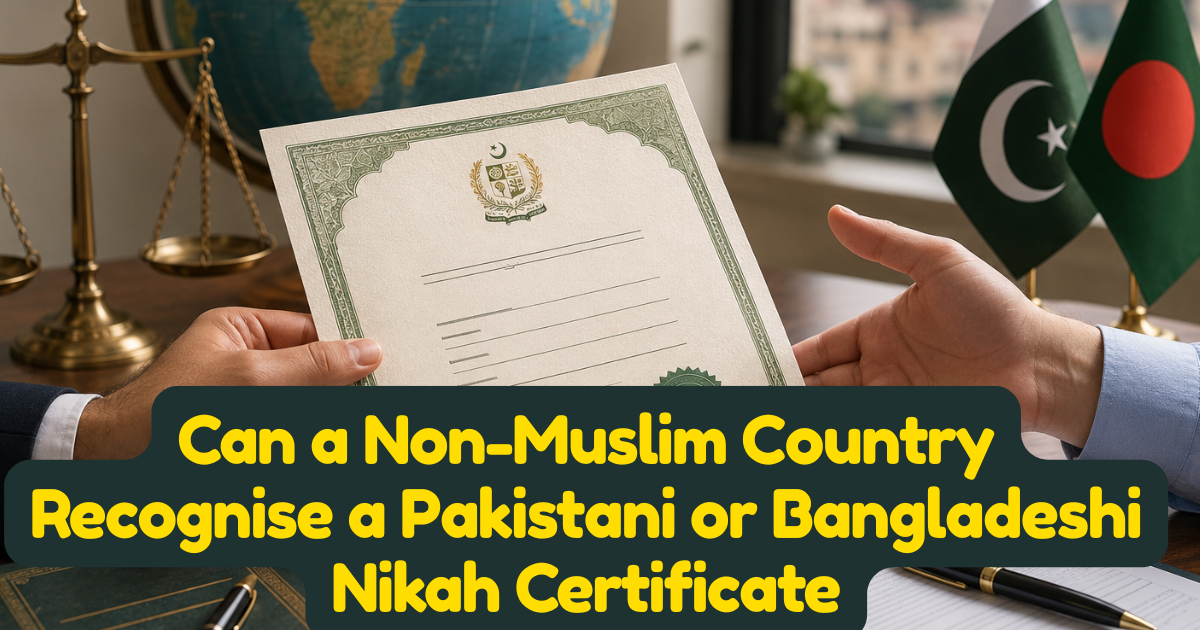
Can a Non-Muslim Country Recognise a Pakistani or Bangladeshi Nikah Certificate — Legal Analysis for Couples
For millions of Muslims from Pakistan and Bangladesh who live in the UK, USA, Canada, Europe, and Australia, the question of whether their nikah certificate will be recognised by the authorities in their country of residence is not an abstract legal curiosity. It is an urgent, practical question that affects visa applications, spousal reunification, inheritance rights, and access to legal protections that only recognised spouses enjoy.
The answer is more nuanced than most online guidance suggests. A nikah certificate issued in Pakistan or Bangladesh can be recognised — but only when it is the right document, properly issued, properly authenticated, and accompanied by the correct additional civil documentation. Getting even one of these elements wrong can result in visa refusal, immigration delays, or legal complications that take months to resolve.
This article maps the full picture: what Western authorities actually require from Pakistani and Bangladeshi marriage documentation, the critical difference between the nikah nama and the NADRA certificate, what "legally recognised in the country where the marriage took place" means in practice, and how online nikah certificates fit into this framework.
The Core Principle: Western Countries Require Legal Civil Recognition
The starting principle that runs through every Western country's approach to foreign marriages is this: for a marriage to be recognised in a Western country, it must have been legally valid in the country where it took place. A religious ceremony that was not registered with civil authorities in Pakistan or Bangladesh — however spiritually meaningful, however properly conducted according to Islamic law — does not automatically constitute a legally recognised marriage in the UK, USA, Canada, or most of Europe.
As the Halal Marriage Contract's comprehensive legal analysis states directly: "In the vast majority of cases, Islamic religious marriage alone has little to no civil legal effect and the countries' authorities therefore do not consider the couple married. Religious marriage generally does not create any rights in non-Muslim countries."
This principle is not a matter of anti-Islamic bias — it is the standard applied to all foreign religious marriages equally. A Catholic church wedding, a Hindu temple ceremony, or a Jewish religious marriage conducted abroad without civil registration faces the same problem. What matters to Western immigration and civil authorities is whether the marriage was registered with the civil authorities of the country where it was performed — producing an official, government-issued document that confirms the legal standing of the marriage.
The good news for Pakistani and Bangladeshi Muslim couples is that both countries have clear civil registration frameworks for Muslim marriages — and when those frameworks are properly followed, the resulting documents are widely accepted internationally.
Pakistan: The Three Documents and Their Standing
Pakistani Muslim marriages produce a specific set of documents, and understanding the different weight each carries in international legal contexts is essential for any couple navigating immigration or civil recognition abroad.
The Nikah Nama
The nikah nama is the Islamic marriage contract — the document that records the terms of the nikah, including the names of the parties, the witnesses, the wali, and the agreed mahr. It is signed by the nikah khawan (officiant), the parties, the witnesses, and the wali. The nikah nama is a religiously significant document that establishes the Islamic validity of the marriage.
However, a nikah nama alone — even one properly signed and stamped — is not sufficient for most international immigration purposes. As the immigration guidance at UK Marriage Visa states explicitly: "The UKVI only accepts certificates issued by the civil authorities. Applicants in Pakistan are required to submit Nikah Namas that have been certified by the appropriate Union Council."
The nikah nama becomes part of the accepted documentation package when it has been registered and certified. A nikah nama that was never submitted to a Union Council for registration — which is common in informal ceremonies or where families did not follow up on civil formalities — carries significantly less evidentiary weight in immigration proceedings.
The Union Council Registration
Under Pakistani law, specifically the Muslim Family Laws Ordinance 1961, every nikah must be registered with the local Union Council within a specific period after the ceremony. The Union Council maintains a register of marriages and issues a stamped, certified copy of the nikah nama. This Union Council-certified nikah nama represents the civil registration of the marriage under Pakistani law.
This Union Council-certified document is significantly stronger than an uncertified nikah nama for international purposes. It demonstrates that the marriage was not merely a private religious ceremony but was registered with a government-level administrative body — creating an official civil record.
The NADRA Marriage Registration Certificate
The strongest and most widely accepted Pakistani marriage document for international purposes is the NADRA (National Database and Registration Authority) computerised marriage registration certificate. This bilingual document (Urdu and English) is issued by NADRA and draws on the civil registration records maintained through the Union Council system.
As the immigration specialist guidance at Family Visa UK confirms: "The official marriage certificate most widely accepted for immigration purposes is the Computerised Marriage Certificate issued by NADRA. This bilingual certificate (Urdu and English) is recognised by the UK Home Office as proof of a valid marriage."
For USA immigration specifically, the guidance published by Fickey Martinez Law on Pakistan civil documents for US immigration is explicit: "Must present both an original, signed Nikah Nama (with its English translation) and a NADRA-issued marriage registration certificate. Note that while both documents reflect similar information, each on its own does not constitute sufficient proof of marriage."
This is a critical point for Pakistani couples. For US immigration purposes, neither the nikah nama alone nor the NADRA certificate alone is sufficient. Both documents are required together. A couple who has only one of the two will need to obtain the missing document before their application can proceed.
Bangladesh: The Kabinnama and Its International Standing
In Bangladesh, the equivalent of the nikah nama is the kabinnama — the Muslim marriage deed, also called the Nikah Nama. Under Bangladeshi law, Muslim marriages can be registered under the Muslim Family Laws Ordinance 1961, which applies in Bangladesh as well as Pakistan. The kabinnama must be registered with a licensed Kazi (marriage registrar).
For international purposes, including US immigration, the US Embassy in Bangladesh provides specific instructions at the US Embassy Bangladesh marriage certificate guidance: "According to Bangladeshi civil law, Muslim marriages can only be registered by a Muslim Marriage Deed AKA Nikah Nama (Bengali and English version). Both the Nikah Namas (Bengali and English version) must be submitted during the visa interview."
Unlike Pakistan, Bangladesh does not have a NADRA equivalent — the registered kabinnama itself constitutes the primary civil marriage document. The key requirement is that it must be a properly registered document issued by a licensed Kazi under the official registration system — not a private certificate from an unregistered religious ceremony.
For UK visa purposes, Bangladeshi couples must demonstrate that their marriage was legally recognised in Bangladesh. As confirmed in the guidance from UK Visa Gateway on proving religious marriages for UK spouse visas: "For Islamic, Hindu, or other religious ceremonies abroad, you must also prove civil registration of the marriage."
What "Legally Recognised in the Country of Marriage" Means in Practice
Western immigration authorities apply a consistent principle: they assess whether the marriage was recognised under the law of the country where it was performed. This means a Pakistani nikah that was properly conducted and registered under the Muslim Family Laws Ordinance 1961 will generally be treated as a legally valid marriage by the UK Home Office, USCIS in the USA, IRCC in Canada, and other Western immigration bodies.
However, this recognition is not automatic. The couple must demonstrate legal recognition through the correct documentation. A nikah performed in Pakistan but never registered with the Union Council — creating no civil record whatsoever — is not "legally recognised in Pakistan" in the sense that Western authorities require. The Islamic validity is not in question; the civil legal status is.
As the LegalSeba Bangladesh marriage guide explains for Bangladeshi couples with international partners: a religiously performed nikah is possible but the Special Marriage Act or official Kazi registration is necessary for foreign embassies to accept the marriage for visa processing purposes.
The UK Home Office Position: What Is and Is Not Accepted
The UK Home Office's position on Pakistani and Bangladeshi marriage certificates is clear, consistently applied, and more nuanced than many applicants realise.
What the UK Home Office accepts for Pakistani marriages:
- Union Council-certified nikah nama (with certified English translation)
- NADRA computerised marriage registration certificate (bilingual, no translation needed)
- Both documents together provide the strongest evidence package
What the UK Home Office does not accept as sufficient on its own:
- An uncertified nikah nama not submitted to the Union Council for registration
- A private nikah certificate issued by a mosque or imam without Union Council or NADRA registration
- Witness statements or family declarations about the marriage in the absence of official documents
The immigration guidance at UK Visa Gateway is explicit about a common mistake: "Assuming a UK Nikah is sufficient without civil registration" and "Failing to prove the marriage is recognised in the home country" are among the most common grounds for UK spouse visa refusal in religious marriage cases.
Importantly, the Home Office does take cultural context into account. As confirmed by the immigration guidance at Migrate UK on spouse visas from Pakistan: "Home Office caseworkers are required to take cultural factors into account when making this assessment." This means that a couple whose marriage is clearly genuine, supported by extensive relationship evidence, is not automatically refused simply because their documentation is imperfect — but the correct civil documentation significantly strengthens any application and removes the most common basis for refusal.
The USA USCIS Position: Both Documents Required for Pakistani Marriages
For Pakistani couples applying for US immigration benefits — including the spousal immigrant visa (IR-1/CR-1) via Form I-130 — the USCIS and State Department require a specific documentation package. As confirmed by the immigration specialists at Fickey Martinez Law on Pakistani civil documents for US immigration: the requirement is for both the original signed nikah nama with English translation AND a NADRA-issued marriage registration certificate. Neither document alone meets the standard.
The US State Department's own guidance at travel.state.gov on immigrant visas for spouses confirms that all documents in foreign languages must be accompanied by certified translations into English. For the nikah nama — which is in Urdu — a certified English translation by a qualified translator must accompany every submission.
For Bangladeshi couples applying for US visas, the US Embassy Bangladesh's own published guidance (updated July 2025) requires both Bengali and English versions of the Nikah Nama. Where only the Bengali version exists, a certified English translation must be obtained.
Online Nikah Certificates and International Recognition: What Couples Need to Know
A question that arises specifically for couples who conducted their nikah through an online service — particularly where one or both parties are living abroad — is whether the certificate issued by the online service carries the same international weight as a Union Council-registered nikah nama from Pakistan or a Kazi-registered kabinnama from Bangladesh.
The honest answer requires careful distinction:
Islamic Validity
A properly conducted online nikah, performed by a qualified Islamic scholar with proper witnesses, wali, mahr, and ijab and qabul, is Islamically valid regardless of whether it was registered with a civil authority. The nikah certificate issued by a reputable online nikah service documents this Islamic validity and is accepted by Islamic institutions, sharia councils, and Muslim scholars worldwide as evidence of a valid Islamic marriage.
Civil Recognition for Immigration Purposes
For immigration purposes in Western countries, the critical question is always: was this marriage legally registered with the civil authorities of the country where it was performed, in a way that those authorities officially recognise? An online nikah certificate from a service based in the UK, for example, is not a civil marriage certificate — it does not substitute for the Registration Office certificate or the NADRA document that immigration authorities require.
As the general guidance at IslamOnline Fiqh on Islamic marriage and legal registration advises: "In non-Muslim countries, it is highly recommended that couples also register their marriage with the local authorities. This ensures that both partners are protected under the law, especially in cases of disputes, inheritance, and divorce."
The practical solution for couples who conducted their nikah online:
- If the nikah was conducted by a UK-based service for a couple in the UK, civil registration at a UK register office is required for immigration and legal purposes
- If one party is in Pakistan and the nikah was conducted online, the marriage should ideally also be registered through the Pakistani Union Council and NADRA system
- If one party is in Bangladesh, Kazi registration of the marriage under the official system should be pursued
The nikah certificate from a reputable online service is an important Islamic document that demonstrates the religious validity of the marriage. For immigration purposes, it is valuable as supporting evidence alongside the required civil documentation — but it does not replace that civil documentation.
What Happens If the Marriage Was Never Civilly Registered?
Many couples discover this issue only when they begin a visa application and realise their marriage documents are not in the form required by immigration authorities. If the nikah was performed in Pakistan or Bangladesh without civil registration, several paths exist:
- Retroactive registration in Pakistan — it is possible to register an unregistered nikah with the Union Council after the fact, though this process may require additional documentation and may face scrutiny. A family lawyer in Pakistan can guide this process.
- Retroactive registration in Bangladesh — similarly, a Kazi can register a previously unregistered marriage under the Muslim Family Laws Ordinance, with appropriate documentation confirming the original ceremony.
- Applying as an unmarried partner — in the UK, couples who cannot demonstrate a legally recognised marriage may apply under the unmarried partner route, which requires evidence of at least two years of cohabitation. This route is available but carries additional evidentiary requirements and does not provide the same legal status as a recognised spouse visa.
How InstantNikah.com Supports Couples Through Documentation
InstantNikah.com provides professionally issued nikah certificates for every ceremony conducted — documenting the Islamic validity of the marriage with full details of the parties, witnesses, wali, mahr, and conditions. These certificates are accepted by Islamic institutions and sharia councils worldwide.
For couples who need advice on how their InstantNikah.com certificate fits into the broader documentation picture for visa or immigration purposes — including what additional civil registration steps are needed in Pakistan, Bangladesh, the UK, the USA, or elsewhere — the team is available through the contact page to provide guidance specific to their situation.
The detailed guide on civil registration at How to Register Your Nikah Civilly After the Islamic Ceremony covers the step-by-step process for the UK, USA, Canada, Australia, and Europe. For understanding what makes a nikah certificate valid under Islamic and civil law, see What Makes a Nikah Certificate Islamically and Legally Valid.
To book a properly documented online nikah ceremony, visit the process page and choose from Instant Nikah, Same Day Nikah, Express Nikah, or Essential Nikah.
Admin User
Author