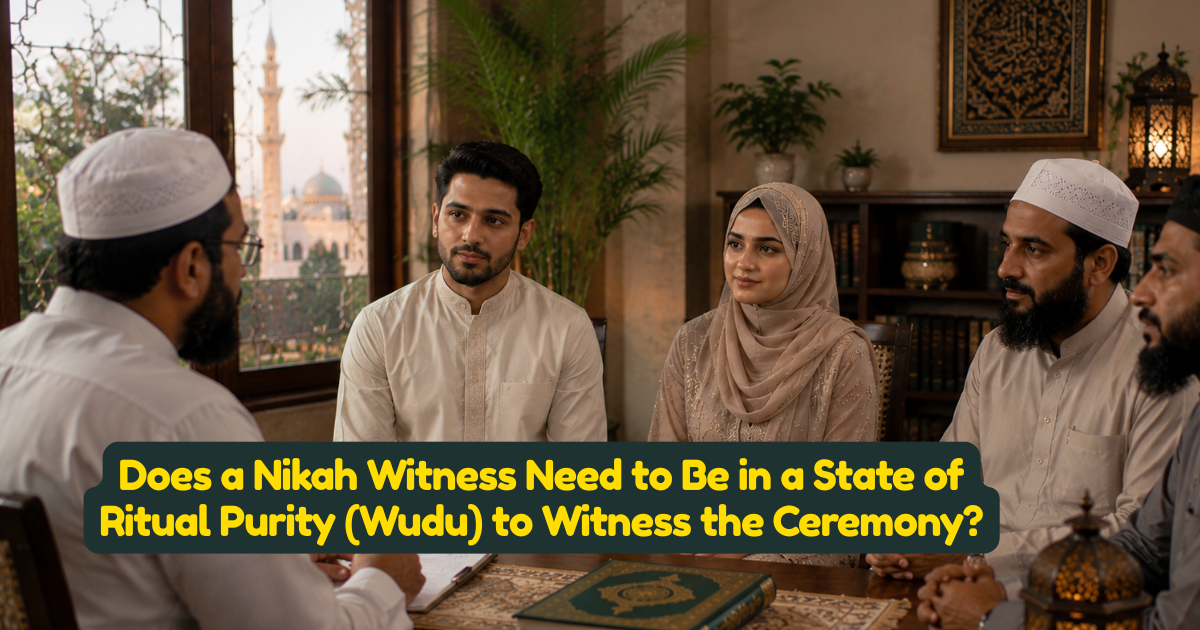
Does a Nikah Witness Need to Be in a State of Ritual Purity to Witness the Ceremony?
He'd rushed straight from a twelve-hour shift to log into the video call, still in his work clothes, hadn't prayed Asr yet, and definitely hadn't performed wudu. As the ceremony was about to start, a small, nagging thought crossed his mind: is it even appropriate for him to serve as a witness to something this sacred while he's not in a state of ritual purity? It's a sincere, respectful instinct — treating the nikah with the seriousness it deserves — but it rests on a comparison to prayer that doesn't actually hold up under the fiqh conditions for witnessing.
Why This Comparison Feels Natural
It makes sense that this concern would surface. Wudu and ghusl are central to how Muslims approach acts of devotion — prayer, touching the Qur'an, entering a state of ihram. A nikah carries real spiritual weight, is often described as half of one's faith, and includes recitation from the Qur'an during the khutbah. Given all of that, assuming ritual purity might be expected somewhere in the process isn't an unreasonable leap.
What the Actual Conditions for a Witness Require
But the classical conditions for a valid nikah witness are specific and don't include ritual purity anywhere among them: sound mind, having reached puberty, and sound hearing sufficient to understand the offer and acceptance. That's the complete list. Being in a state of wudu or ghusl was never part of what qualifies someone to witness a marriage contract, because witnessing a nikah is a legal-testimonial act, not a devotional act of worship in the way prayer or tawaf are.
This distinction is explicitly addressed at the level of the bride and groom themselves, which resolves the witness question even more directly by extension. A ruling addressing this exact concern confirms that being in a state of ghusl is not necessary for a nikah to be valid — meaning even the two people actually entering into the marriage contract aren't required to be in a state of ritual purity for the contract itself to be religiously sound. If purity isn't a condition for the bride and groom completing the actual contract, it follows naturally that it isn't a condition for a witness whose role is simply to hear and confirm that contract.
Why Nikah Is Treated Differently From Prayer or Tawaf
The underlying reason for this distinction is worth understanding, because it clarifies a lot of adjacent questions too. Ritual purity requirements in Islamic law attach specifically to acts of worship that are defined, in their essence, as devotional acts performed directly before Allah — prayer being the clearest example. A nikah, while spiritually significant and described in a hadith as half of one's religion, is legally classified as a contract (‘aqd) — closer in structure to other binding agreements than to an act of ritual worship. Contracts in Islamic law generally don't carry purity conditions for the people executing or witnessing them, because the legal validity of a contract depends on things like sound mind, clear consent, and proper conditions being met — not on the physical ritual state of the participants.
What About the Khutbah's Qur'anic Recitation?
This is a fair follow-up question, since the khutbah often includes verses from the Qur'an, and touching or reciting the Qur'an does carry its own separate purity considerations in some circumstances. But this concern attaches to whoever is reciting the khutbah — typically the officiant — not to the witnesses, who are simply listening. A witness present without wudu isn't reciting anything; they're fulfilling their role purely by hearing and understanding the offer and acceptance, which carries none of the recitation-specific considerations that might apply to someone actively reciting Qur'anic text.
What a Witness Should Actually Take From This
- Wudu is not required to serve as a nikah witness — showing up straight from work, without having performed wudu, does not affect eligibility to witness.
- It's still a good instinct to want to approach the ceremony in a clean, presentable, attentive state out of respect for the occasion — that's simply a matter of personal etiquette (adab), not a condition for the marriage's validity.
- If a witness is genuinely unsure and time allows, performing wudu before the ceremony is a fine, positive choice — just not a necessary one.
Frequently Asked Questions
Does a menstruating woman face any restriction on serving as a witness?
No — menstruation restricts certain specific acts of worship like prayer, fasting, and touching the Qur'an directly, but it has no bearing on a woman's eligibility to serve as a nikah witness, since witnessing carries none of those purity-linked conditions.
Does this apply the same way to the officiant conducting the ceremony?
Generally yes, for the same reasoning — though an officiant actively reciting Qur'anic verses may choose to be in wudu as a matter of respect for that specific act of recitation, independent of the nikah's own validity requirements.
Is there any part of the nikah ceremony that does require ritual purity?
Not as a condition for the contract's validity itself — any purity considerations that arise relate to specific devotional acts like Qur'anic recitation, not to the nikah contract or its witnessing.
Authority References Used (Live & Clickable)
- Darul Ifta Birmingham (via islamqa.org) — direct Hanafi ruling confirming ritual purity is not a condition for nikah validity
Suggested Internal Links
- What Should Be Said in the Khutbah at an Online Nikah?
- How to Choose the Right Witnesses for Online Nikah
- Two Female Witnesses Alone in Online Nikah
- Do Both Spouses Need Their Camera On for Online Nikah?
- Book Your Online Nikah
Why This Article Is Different
This is a sincere, common, but rarely addressed anxiety — most witness-eligibility content never even considers ritual purity as a variable, since it's simply not a listed condition, but that means the question is left unanswered for the people who genuinely wonder about it. Explaining the legal-contract-versus-devotional-act distinction gives the answer real substance rather than a bare "no," and directly resolves the natural follow-up question about Qur'anic recitation during the khutbah that a shallower answer would leave hanging.
Zainab Butt
Author