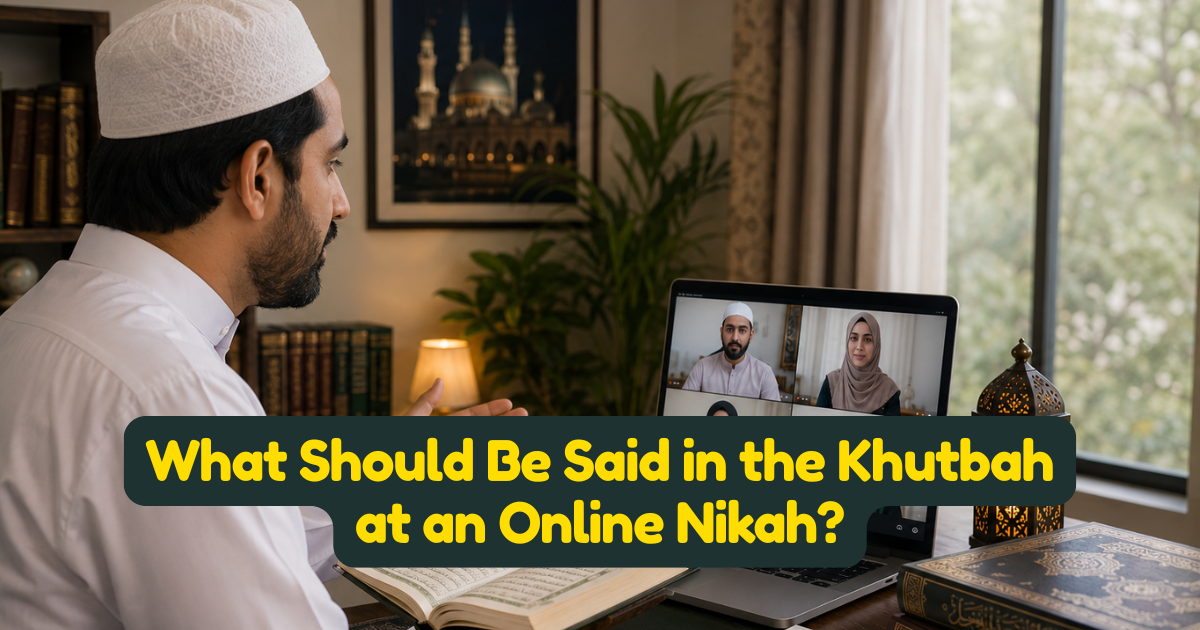
The khutbah that opens a nikah ceremony doesn't change because the wedding is happening over video instead of in a room — but delivering it well to a remote audience scattered across different countries and time zones does take a bit more thought than reciting it to people physically present.
The Traditional Content: Khutbatul Hajjah
The sermon traditionally opened by the officiant follows a structure going back to the Prophet's own practice. A detailed account of the Prophet's marriage sermon describes its consistent shape: it begins with praise of Allah, seeking His guidance and forgiveness, and the declaration of faith — that there is no god but Allah and that Muhammad is His messenger. After this opening, the officiant recites several Quranic verses that consistently centre on taqwa, or God-consciousness — drawn from Surah An-Nisa, Surah Aal-Imran, and Surah Al-Ahzab — each reinforcing that the marriage being entered into is, first and foremost, a commitment grounded in awareness of Allah.
Why These Particular Verses
A detailed explanation of the sermon's content notes the reasoning behind this consistent selection: by invoking taqwa multiple times across these verses, the sermon sets the foundational principle for a stable family life before anything else is addressed — the spouses are first reminded of their relationship with Allah, on the understanding that a marriage genuinely grounded in that awareness has the strongest foundation for everything that follows. The verses also touch on the shared origin of humanity and the importance of honouring family ties, framing the new marriage as something that extends and strengthens a much broader web of relationships, not just a bond between two individuals.
What Comes After the Verses
A detailed walkthrough of the full ceremony confirms what typically follows: the khutbah leads directly into confirming the bride's consent through her wali, then the offer and acceptance itself, witnessed clearly, followed by the declaration of mahr, and a closing dua for the couple and their families. The khutbah isn't a standalone formality — it sets the tone for everything that immediately follows it in the same sitting.
What Changes for an Online Delivery
- Speak clearly and at a measured pace — video and audio compression can blur fast or quiet speech in a way an in-person room never would, and the khutbah is exactly the part of the ceremony where clarity matters most.
- Consider a brief translation or summary for family watching remotely who may not follow Arabic or the officiant's primary language, particularly given how many online nikah audiences span multiple countries and linguistic backgrounds.
- Keep the sermon appropriately concise for a video format — the traditional khutbah is already brief by design, and that's worth preserving rather than extending it for an online audience.
- Make sure the connection is stable through this portion specifically, since the khutbah, while not itself a pillar of the contract's validity, sets the tone the witnesses and family carry into the actual offer and acceptance that follows.
A Reminder That No Special Officiant Status Is Required
It's worth remembering, as confirmed by detailed guidance on who can lead a nikah ceremony, that any trustworthy, knowledgeable Muslim can deliver the khutbah and conduct the ceremony — Islam doesn't have a formal priesthood requirement for this role. What matters far more than any title is that the person delivering it is genuinely familiar with the sermon's traditional content and conducts it with the care the occasion deserves.
Key Takeaway
The khutbah at an online nikah follows the same traditional structure it always has — praise of Allah, the declaration of faith, and Quranic verses centred on taqwa — and that content doesn't need to change simply because the ceremony is happening over video. What does deserve extra attention online is delivery: clear, measured pacing, a stable connection through this portion, and thoughtful consideration for family watching remotely who may benefit from a brief translation, so the sermon's meaning genuinely reaches everyone it's intended for.
```Admin User
Author