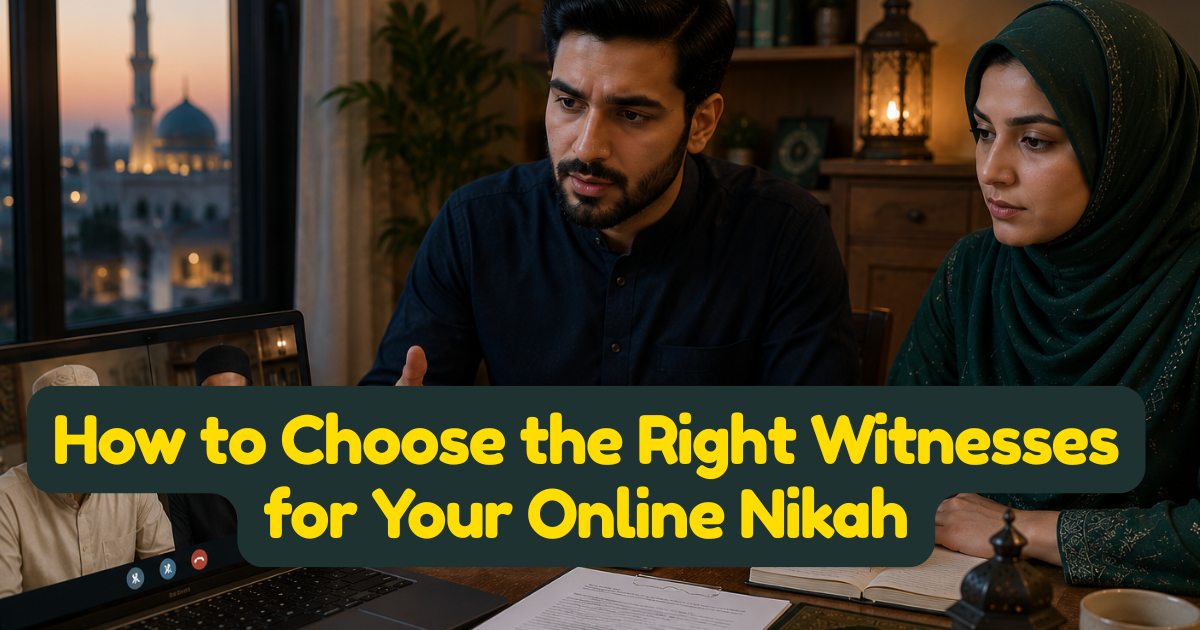
How to Choose the Right Witnesses for Your Online Nikah — Islamic and Practical Checklist
Every couple planning a nikah spends time thinking about the mahr, the wali, the qadi, the date. Very few spend equivalent time thinking carefully about the witnesses — who they will be, whether they genuinely qualify, and whether anything about their circumstances might create a question about the nikah's validity. This is the gap that this guide addresses.
Witnesses are not a ceremonial addition to the nikah. They are a structural pillar. The Prophet Muhammad (peace be upon him) said: "There is no marriage without a wali and two upright witnesses." (Ahmad, Bayhaqi). Their role is legal, not decorative. The wrong witnesses — or witnesses who are not properly qualified, positioned, or informed — can create questions about a nikah that couples should never have to face. Choosing witnesses thoughtfully, against a clear set of criteria, prevents all of that.
This guide is specifically oriented toward online nikah, where the witness question has additional practical dimensions that in-person ceremonies do not face. But the Islamic requirements apply equally in both settings, and everything covered here is relevant to any couple planning a nikah.
Understanding What Witnesses Are Actually For
Before choosing witnesses, it helps to understand what their function actually is — because this shapes everything about how they should be selected and positioned.
The primary purpose of witnesses in a nikah is ishhar — making the marriage known. As the resource at Halal Marriage Contract's comprehensive witness guide explains: "Their main role is thus to ensure a minimum public knowledge of the marriage in order to avoid secret marriages, which are forbidden." Witnesses are the two people who can confirm, independently and reliably, that this specific nikah took place, between these specific parties, on this specific date, with these specific terms.
This purpose has direct implications for who should be chosen. A witness must be someone whose testimony about the marriage would be credible, independent, and verifiable. They must be someone who can be contacted — potentially years later — to confirm what they witnessed. They must be someone who has no reason to deny, distort, or dispute what they observed. And they must be someone who was genuinely paying attention during the ceremony itself.
As noted by the Muslim Family Law Information resource (UK): "Witnesses could help to confirm that neither party has been coerced or forced into the marriage and act as a layer of protection for the woman, by ensuring that her rights have been upheld." The witness function, properly understood, is one of the most important protective mechanisms in the nikah for both parties — especially the bride.
The Core Islamic Conditions: What Every Witness Must Meet
The following conditions are required by the majority of scholars across all four madhabs. A witness who does not meet these conditions does not fulfil the legal function and the nikah may be affected:
1. Muslim
Both witnesses must be Muslim. This is agreed upon across all four major Sunni madhabs for a nikah in which both parties are Muslim. A non-Muslim witness does not satisfy the witnessing condition, regardless of how much they respect the ceremony or how close they are to the couple. As established by Darul Uloom Trinidad and Tobago: "All witnesses must be from among those who have reached the age of puberty (they cannot be minors), and must be Muslims who are sane."
For couples with non-Muslim family members who they wish to involve in the ceremony, the solution is to involve them in other ways — the reception, the walima, the celebration. The two formal nikah witnesses must be Muslim.
2. Adult (Having Reached Puberty)
Witnesses must be adults — they must have reached the age of puberty. A minor, regardless of how mature they appear, does not have the legal capacity to serve as a nikah witness under any of the four madhabs. This is unanimous across all schools, as confirmed in the four-madhab consensus documented at Al-Dorar Al-Saniea. Practically, this means confirming that both witnesses are at least in their mid-to-late teens and, to be safe, preferably adults in the fullest social sense.
3. Sane (Of Sound Mind)
Witnesses must be of sound mind. A person who is intoxicated, mentally incapacitated, or in a condition that prevents genuine comprehension cannot serve as a valid witness. This applies at the moment of the ceremony, not merely in general terms. A witness who is drunk at the time of the nikah — even if they are a perfectly capable person in ordinary life — does not fulfil the witnessing condition. This is explicitly stated in Fiqh al-Sunnah by Sayyid Sabiq and referenced in the IslamOnline Fiqh conditions of witnesses resource.
4. Able to Hear and Comprehend the Ceremony
Witnesses must be able to hear the ijab and qabul clearly and understand that a marriage is being contracted. The four madhabs agree that the witness of a permanently deaf person is invalid for an oral ceremony, as their comprehension of the spoken exchange cannot be confirmed. For online nikah ceremonies specifically, this means that audio quality must be confirmed before the ceremony begins — a witness who cannot hear clearly due to technical problems is not fulfilling their legal function. The IslamOnline Fiqh resource is explicit: witnesses must be of "sound hearing so that they can hear and understand what the parties to the contract are concluding."
5. Male (Per Shafi'i and Hanbali Schools) or Male/Female Combination (Per Hanafi)
This is the point on which madhabs differ most practically, and couples need to know their own madhab position before choosing witnesses.
Under the Hanafi madhab — the most widely followed in South Asia, Turkey, and Central Asia — two male witnesses are the standard, but one male and two female witnesses are also valid. Three female witnesses alone are not valid. As confirmed in the ruling at SeekersGuidance on female witnesses in nikah: "There had to be one male witness for your marriage to be valid Islamically."
Under the Shafi'i and Hanbali madhabs — widely followed in Southeast Asia, East Africa, and the Arabian Peninsula — witnesses must be male. Two male witnesses are required; the combination of male and female witnesses does not satisfy the Shafi'i or Hanbali standard. As noted at IslamOnline Fiqh, the Shafi'i and Hanbali position is that women's testimony is not valid for the marriage contract specifically, citing a statement attributed to Az-Zuhri.
Under the Maliki madhab — predominant in North and West Africa — formal witnessing at the contract itself is not strictly required, but witnessing before consummation is. The Maliki tradition also requires witnesses of established good character (adalah).
The safest practical approach: use two adult Muslim men as witnesses. This satisfies the conditions of all four madhabs simultaneously and removes any doubt regardless of which school applies to your circumstances.
6. Of Good Character (Required by Shafi'i, Maliki, and Hanbali; Not by Hanafi)
The Shafi'i, Maliki, and Hanbali schools require witnesses to possess adalah — moral uprightness, or good character. A person who openly engages in major sins, who is known for dishonesty, or whose Islamic practice is severely lacking may not qualify as a valid witness under these schools. As the Al-Islam.org comparative madhab resource confirms, the Shafi'i and Hanbali schools require male Muslim witnesses possessing the quality of adalah.
The Hanafi school does not require adalah as a formal condition. A Muslim who does not pray regularly can still serve as a valid Hanafi nikah witness. This is a significant practical difference for Muslims in diaspora communities where finding witnesses who are observant in the strictest sense may be challenging.
The practical guidance from the Shafi'i tradition is pragmatic, however: it is sufficient for witnesses to appear upright to those present. An extensive investigation of a witness's private conduct is not required. A witness who presents themselves respectably and has no known, flagrant violations of Islamic practice is considered to meet the character standard for most practical purposes.
Who Cannot Serve as a Nikah Witness
Understanding the disqualifying conditions is just as important as understanding the qualifying ones. The following categories require careful consideration:
The Wali Cannot Be a Witness in Most Cases
The bride's wali (guardian) is performing a distinct legal function — he is either making the ijab (offer) himself or authorising it. A person cannot simultaneously be a contracting party and a neutral witness to the contract. As confirmed in the ruling at IslamQA on video phone nikah and witness roles: "It is not permissible for the wali to be a witness to the marriage contract of the woman under his guardianship."
An important exception exists across all four madhabs: where the wali has appointed a wakeel (proxy) to act on his behalf, the wali himself may in some interpretations be counted as a witness — because in that case he is no longer serving as the contracting party. As established in the IslamQA response citing Fiqhul Islam: "The wali will suffice as one of the witnesses for the nikah according to all 4 madhabs" when he has appointed a wakeel to make the contract. This is a nuanced ruling that should be confirmed with your qadi before relying on it.
Parents and Close Relatives of the Couple — Scholarly Disagreement
There is genuine scholarly disagreement about whether the ascendants and descendants of the couple (fathers, sons, grandfathers, grandsons) can serve as valid witnesses. The stricter Hanbali position holds that such witnesses are disqualified due to the risk of bias — they are considered partial to their own family member. As cited from Kashshaaf al-Qinaa in the ruling at IslamQA on ascendants and descendants as witnesses: "The marriage contract cannot be valid if the witness is biased, such as the sons of the couple or their fathers... because of the risk of bias."
However, the majority and preferred position — including that endorsed by Shaykh Ibn Uthaymin — permits the groom's father or son to serve as a witness, distinguishing him from the bride's wali (who cannot witness because of his contracting role). Brothers, uncles, and cousins of either party are generally valid witnesses across madhabs. The brother of the bride is specifically confirmed as valid by the scholarly sources. The safest approach — to avoid any scholarly disagreement — is to choose witnesses who are not the direct parents of either party, particularly the bride's wali and his immediate male relatives.
The Groom Cannot Witness His Own Nikah
This may seem obvious but bears stating: the groom is a principal contracting party and cannot simultaneously serve as his own witness. As the Darul Ifta Birmingham ruling at IslamQA confirms, citing Radd al-Muhtar: "A person himself cannot be deemed an acceptable witness to their own transaction, according to Islamic jurisprudence."
The Practical Checklist: Questions to Ask Before Confirming Your Witnesses
With the Islamic conditions established, the following checklist translates them into practical questions every couple should work through before confirming their witnesses — especially for an online nikah where these questions have added dimensions:
✓ Are both witnesses Muslim?
Confirm this directly — do not assume. In settings where witnesses are chosen from a broad social circle, this is not always certain. A close friend who has never explicitly stated their religion, or a family member in a household where not all members are practicing Muslims, should be confirmed rather than assumed.
✓ Are both witnesses adult?
If a young family member is being considered — a younger brother, a nephew, a cousin in their early to mid-teens — their puberty and age of majority should be confirmed. When in doubt, choose someone older.
✓ Are both witnesses of sound mind and not intoxicated?
This applies at the moment of the ceremony. In most planned nikah settings this is not a concern, but it is worth stating explicitly to the qadi in advance if there is any reason it might be.
✓ Do both witnesses meet the gender requirements for your madhab?
If you follow the Shafi'i or Hanbali school, both witnesses must be male. If you follow the Hanafi school, one male and two females is also valid, but two males is always safest. Confirm this with your qadi and match the witness selection to the relevant madhab.
✓ Are both witnesses free of any conflict of interest in this specific nikah?
Check that neither witness is serving simultaneously as the wali or the wali's agent. Check that neither is in a position where their testimony could later be questioned due to personal involvement in the marriage outcome.
✓ Do both witnesses understand their role before the ceremony begins?
This is the most frequently skipped step and one of the most important. Witnesses must know that they are serving as legal witnesses to an Islamic marriage contract — not just attending. They should be told the names of both parties, the agreed mahr, and what they will be asked to confirm during and after the ceremony.
✓ Can both witnesses clearly hear the ijab and qabul?
For in-person ceremonies, this means positioning. For online nikah ceremonies, this means confirming audio quality before the ceremony begins. Test the connection. Confirm the witnesses can hear the qadi and the contracting parties clearly. Do not proceed if audio is unclear.
✓ Will both witnesses be available to confirm the nikah in writing if needed?
A nikah certificate records the witnesses' names and their acknowledgement of the ceremony. Witnesses should be willing to sign this document. For online ceremonies, confirm whether the qadi will issue documentation that records the witnesses and their confirmation. The Sharee Council UK notes that when a nikah certificate is unavailable, "testimony will be required from two or more persons who witnessed the nikah ceremony" — making the ongoing availability and cooperation of witnesses a practical consideration for the future.
Additional Considerations Specific to Online Nikah
Online nikah introduces a set of practical witness considerations that in-person ceremonies do not face. The following should be actively managed:
Position Witnesses Physically With One of the Contracting Parties
In an online nikah, the witnesses should be physically co-located with at least one of the contracting parties — not participating remotely themselves. The safest structure is for the witnesses to be physically present with the wali and bride, or with the groom, hearing the ceremony directly from the speakers or in person where possible. A ceremony in which all parties — including the witnesses — are in separate locations with no physical gathering point is structurally weaker and faces more scholarly scrutiny.
Confirm Internet Connectivity and Audio Quality in Advance
Run a test call before the ceremony. Confirm that the witnesses can hear all parties clearly — the qadi's voice, the wali's ijab, the groom's qabul, and any responses from the bride's side. Any audio drop-out during the key moments of ijab and qabul creates a genuine validity question. As confirmed by the Darul Ifta Birmingham ruling on witness presence, the witnesses must be present and hearing the contract — technical failure that prevents this is not a technicality, it is a substantive issue.
Ensure Witnesses Know the Identity of All Parties
In a video call ceremony, witnesses who are physically present with one party may not know the other party personally. The qadi should introduce all parties by name at the start of the ceremony, confirm identities, and ensure that witnesses are aware of who they are witnessing the nikah for. Identity verification is part of what makes witnessing meaningful — as emphasised in the scholarly analysis published at Cardiff University's peer-reviewed study on online nikah in Hanafi fiqh (Journal of Hanafi Studies, 2024).
Ask the Qadi to Formally Confirm Witnesses Before Proceeding
A professional qadi conducting an online nikah should, before beginning the ceremony, address the witnesses directly — state their names, confirm their role, confirm they can hear clearly, and confirm they understand they are serving as legal witnesses to a nikah. This takes two minutes and eliminates any later question about whether the witnessing condition was properly fulfilled.
Choosing Witnesses When You Have Limited Options
Couples arranging an online nikah — especially converts, those without Muslim family nearby, or those in countries with small Muslim communities — sometimes find it genuinely difficult to identify two suitable witnesses. Several solutions exist:
- Contact your local mosque or Islamic centre — most are willing to assist in identifying witnesses from the community for couples who have no suitable contacts. The Islamic Sharia Council UK and institutions like the Islamic Sharia Council Northern Britain both provide nikah services with witness arrangements included.
- Ask your online nikah service to arrange witnesses — a structured online nikah service should be able to provide or recommend qualified witnesses as part of the ceremony package, removing the burden from the couple entirely.
- Online Muslim community networks — for converts or isolated Muslims, reaching out to Muslim convert support networks or local Muslim student associations may identify willing, qualified witnesses.
- Friends who are Muslim but not close to either party — there is no requirement for witnesses to be family members. A Muslim friend, colleague, or community acquaintance who meets the conditions is entirely valid and may in some ways be preferable precisely because they have no personal stake in the marriage outcome.
A Word on Documentation: Why Your Witnesses' Details Must Be Recorded
Whatever happens during the ceremony, the nikah certificate should record the full names of both witnesses, their confirmation of the ceremony, and — ideally — their signatures. This documentation matters far beyond the wedding day. For visa applications, for inheritance purposes, for civil recognition of the marriage, and for any future Islamic legal questions, the witnesses' names on a properly issued certificate are the most reliable confirmation that the nikah was properly witnessed.
As the UK House of Commons Library research briefing on Islamic marriage has highlighted, the lack of proper documentation of Islamic marriages creates significant practical vulnerability for couples — particularly women — in countries where civil recognition matters for legal rights. Proper nikah documentation, with witnesses' details recorded, is one of the most practical protections a couple can give themselves.
How InstantNikah.com Handles the Witness Question
At InstantNikah.com, every ceremony is structured so that the witness conditions are actively managed — not left to chance. The qualified Islamic scholar conducting the ceremony briefs witnesses in advance, confirms their qualifications and comprehension, addresses them formally at the start of the ceremony, and records their details in the nikah certificate issued after the ceremony.
For couples who do not have two suitable witnesses available, the team can advise on witness arrangements as part of the booking process. No ceremony proceeds until the witness conditions are properly confirmed. This level of procedural care is what separates a properly conducted online nikah from an informally arranged one — and it is why the nikah certificate issued by InstantNikah.com stands up to scrutiny from scholars, embassies, and Islamic institutions worldwide.
To understand the full ceremony process, visit the process page. To book, choose from Instant Nikah, Same Day Nikah, Express Nikah, or Essential Nikah. Couples with specific questions about witnesses or eligibility are welcome to reach out through the contact page. Verified reviews from couples who have used the service are available at the reviews page.
Admin User
Author