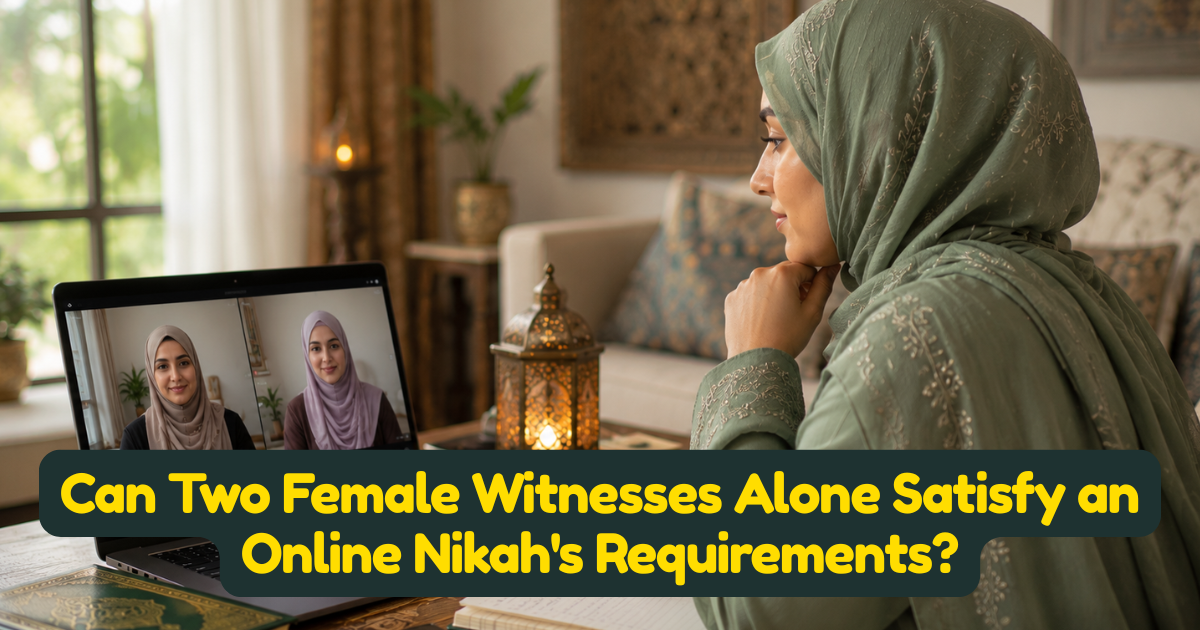
It's a genuinely common point of confusion: many Muslims know that some legal contexts in Islam accept "one man and two women" as valid witnesses, drawing on the Quranic principle for financial contracts. The natural follow-up question is whether two women alone — without any male witness present at all — could ever satisfy a nikah's witnessing requirement on their own. Across the major schools, the answer is consistently no, though the reasoning for why differs in an interesting way.
The Quranic Commercial-Contract Pattern, and Its Limits
A detailed fiqh explanation of the conditions for marriage witnesses traces where the "one man, two women" pattern actually comes from: it's drawn from the Quranic verse on financial contracts, which permits two men, or one man and two women, as witnesses to a transaction. The Hanafi school extends this same logic to marriage contracts, holding that women's testimony to a marriage contract is valid — but specifically as part of that same one-man-plus-two-women structure, never as two women standing entirely on their own without any male witness present.
Why Other Schools Reject Women's Testimony for Nikah Entirely
The Shafi'i and Hanbali schools take a different, stricter position altogether: they hold that marriage witnesses specifically must be male, and that a man together with two women would not constitute valid witnessing for a nikah, even though that same combination would work for an ordinary business contract. Their reasoning, as recorded in classical sources, treats marriage as categorically different from a financial transaction — something traditionally conducted in the presence of men specifically, where female testimony historically wasn't considered the customary or effective form of proof for this particular kind of contract.
So What Combinations Actually Work?
- Two qualifying male witnesses — accepted across all major schools, the most universally agreed-upon combination.
- One qualifying male witness plus two qualifying female witnesses — accepted specifically under the Hanafi school, but rejected under the Shafi'i and Hanbali positions.
- Two female witnesses alone, with no male witness present — not accepted under any of the major schools' standard positions on nikah specifically, regardless of how the same combination might function in a different kind of contract.
What This Means Practically for an Online Nikah
For couples arranging witnesses for an online ceremony — often drawing from a smaller, more convenient pool of people already available on a call — this distinction matters in practice. If your available witnesses happen to be two women and no man, the safer and more broadly accepted path is to add at least one qualifying male witness to the arrangement, satisfying either the universally accepted "two men" standard or, if following Hanafi fiqh specifically, the "one man plus two women" combination. Relying on two women alone risks the ceremony being invalid under every major school's position, not just a disputed minority view.
A Note on Witness Qualifications More Broadly
It's worth remembering that gender is only one of several witness conditions — witnesses also need to be of sound mind, mature, and able to genuinely hear and understand what's being agreed. Getting the gender composition right doesn't substitute for making sure your witnesses also meet these other basic conditions, which matter just as much to the contract's validity.
Key Takeaway
Two female witnesses alone, without any male witness present, don't satisfy the nikah witnessing requirement under any of the major Sunni schools — the "one man, two women" pattern some people recall from financial contract law applies to marriage only under the Hanafi school specifically, and even then, always alongside a qualifying male witness, never replacing him entirely. Couples arranging witnesses for an online nikah should make sure at least one witness is a qualifying male, regardless of which school they follow, to avoid relying on a combination no major school actually accepts.
```Admin User
Author