Our Journal
Insights, updates, and guidance on your journey to a blessed union.
Online Nikah for Comoros: The Country Where Marriage Is Constitutionally Required to Be Muslim
Comoros' own Family Code states directly that marriage is "necessarily Muslim" and can only be concluded between Muslims — with real, specific witness and consent provisions written into the code itself. Here's the genuinely distinctive, sourced structure.

Online Nikah for Sierra Leone: The 1905 Muslim Marriage Act and a Real Bigamy Loophole Worth Knowing
Sierra Leone's Muslim population, at 77% of the country, marries under a dedicated act dating back to 1905 — with certified entries carrying real evidentiary weight in every court. A real, documented structural gap in how bigamy is actually enforced is worth understanding too.
Online Nikah for Ivory Coast: Why "Possession of Status" Can Prove a Marriage Without a Certificate
Ivory Coast's Family Code generally requires a marriage certificate for legal recognition — but real, codified exceptions allow "possession of status" to prove a marriage through accumulated facts alone. Here's the genuinely useful, sourced structure.
Online Nikah for Benin: The Real 2002 Court Battle That Made Monogamy the Only Legal Marriage
Benin's Constitutional Court struck down its own parliament's polygamy provision in a real, dramatic 2002 ruling — making civil monogamous marriage the only legally recognised form in the country. Here's the honest, sourced story and what it means for a Nikah today.
Online Nikah for Togo: A Secular State With Four Distinct Marriage Types
Togo formally recognises four separate marriage types — civil, customary, Christian, and Muslim — reflecting the country's genuine religious diversity as a constitutionally secular state. Here's the real, current structure, including a recent effort to translate the code into local languages.
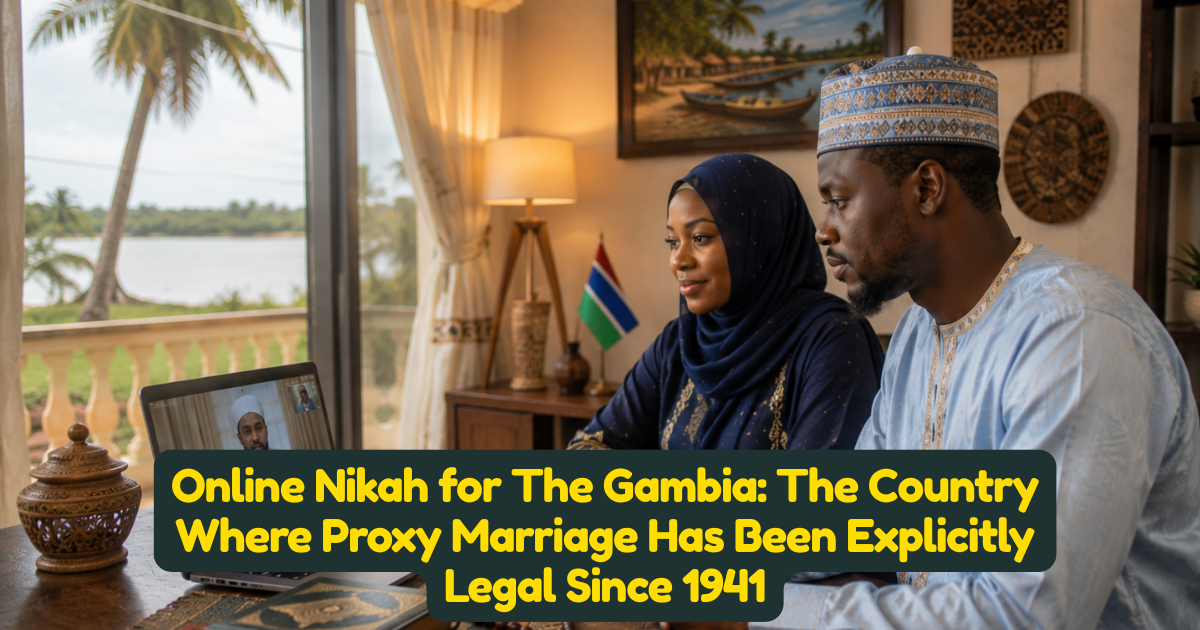
Online Nikah for The Gambia: The Country Where Proxy Marriage Has Been Explicitly Legal Since 1941
The Gambia's own law explicitly permits Islamic marriage by proxy — including situations where both parties are absent — a real, codified position the Library of Congress itself has researched in detail. Here's what this genuinely distinctive framework means for an online Nikah.