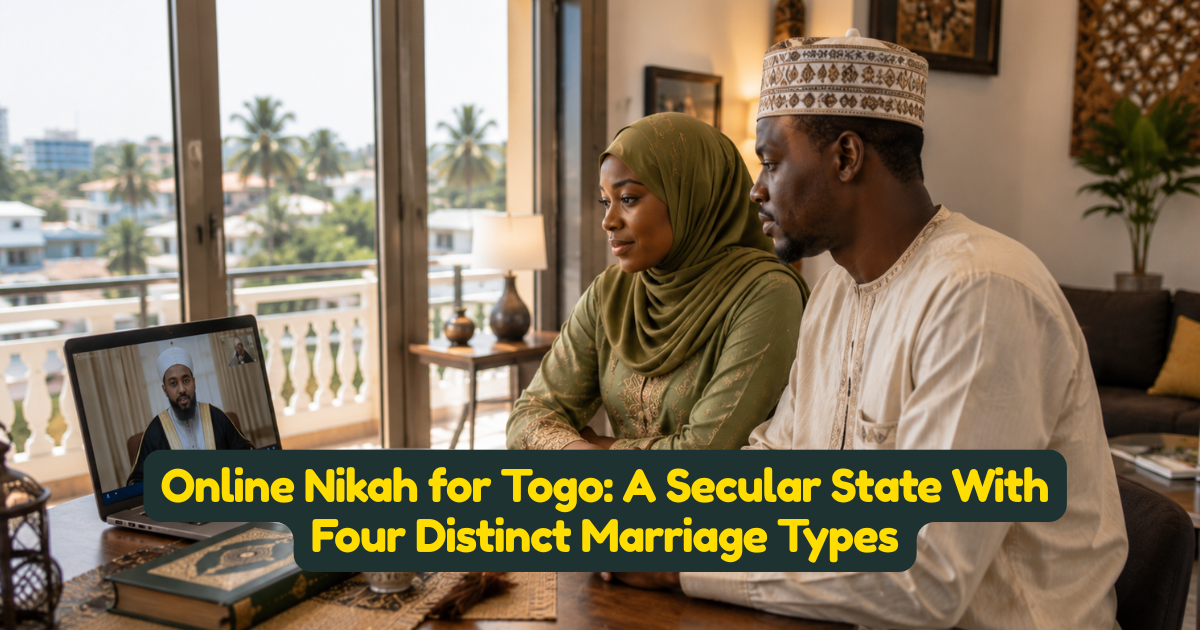
Online Nikah for Togo: A Secular State With Four Distinct Marriage Types
Togo is a constitutionally secular country with a Christian majority and a real, established Muslim minority — and its Family Code formally recognises Islamic marriage as one of four distinct marriage categories nationally. Understanding this real structure, alongside a genuinely useful current government initiative to make the code more accessible, matters for anyone with a Togolese connection planning a Nikah.
Four Recognised Marriage Types
This is the foundational structural fact worth understanding about Togo's system. Official guidance from Togo's Ministry of Social Action confirms that beyond civil marriage, there exist three additional types of marriage depending on the religion or tradition to which each citizen belongs: customary marriage, Christian marriage, and Muslim marriage. This gives Togo a genuinely explicit, four-category framework — a structure worth understanding clearly for any couple planning a Nikah with a Togolese connection.
A Constitutionally Secular State — But With Real Religious Diversity
This context matters for understanding how Togo's system actually operates in practice. Detailed legal analysis confirms Togo is a secular country, with a Christian majority and a Muslim minority — creating two distinct types of religious marriage: Christian marriage and Muslim marriage. The same source notes that marriage is a sacrament for Catholics specifically but is not itself obligatory under Catholic practice, illustrating the genuinely varied religious practice landscape the Family Code has to accommodate across its four recognised categories.
A Genuinely Useful, Real Current Government Initiative
This is a genuinely practical, current development worth knowing about directly. The same official Ministry guidance confirms Togo's government wants to make the new Code des personnes et de la famille an accessible tool for all layers of the population, and has translated the new code into four national languages — Ewé, Kabiyè, and Tem among them — with dedicated public education sessions ("vulgarisation") specifically conducted in different regions of the country to improve genuine public understanding of the code's provisions.
Why This Matters Practically for Nikah Couples
The same official Ministry guidance offers a genuinely honest, useful piece of context: it notes that in Togo, as in many African countries, the majority of the population is still more influenced by religion and tradition than by formal civil law, with the exception of a minority. This is precisely why the government's multi-language translation and public education initiative matters directly — it reflects a real, active effort to ensure Muslim, Christian, and customary communities alike genuinely understand how their specific marriage type interacts with Togo's broader civil legal framework, rather than assuming this understanding is already widespread.
The Real Role of Initiation Rites in Some Communities
This is a genuinely distinctive, real cultural detail worth understanding as context, even though it applies more broadly to Togolese customary practice than to Islamic marriage specifically. The same detailed legal analysis confirms that among certain communities, such as the Kabyè, both the man and woman must pass through specific initiation rites before they can contract a marriage — for young women, the "Akpéma" or dance of the virgins, and for young men, "Evala" or traditional wrestling — practices that confer social integration and eligibility for marriage, comparable in function to the minimum age requirement under civil marriage. The same analysis notes the state generally treats itself as unable to intervene in decisions shaped by these deeply rooted cultural practices.
What This Means for Structuring an Online Nikah With a Togolese Connection
Given Togo's explicit four-category structure, couples completing an online Nikah with a Togolese connection should confirm the ceremony is properly classified and conducted as "mariage musulman" under the specific requirements this category carries within Togo's Family Code, and should take advantage of the government's own multi-language translated resources where local-language clarity on the code's specific provisions would be genuinely helpful.
Frequently Asked Questions
How many marriage types does Togo formally recognise? Four — civil marriage, customary marriage, Christian marriage, and Muslim marriage — reflecting the country's genuine religious and cultural diversity.
Is Togo an Islamic state? No — Togo is constitutionally secular, with a Christian majority and a real, established Muslim minority, whose marriages are specifically recognised as their own distinct legal category.
Has Togo's Family Code been made more accessible recently? Yes — the government has translated the code into four national languages, including Ewé, Kabiyè, and Tem, alongside regional public education sessions.
Suggested Internal Links
Zainab Butt
Author