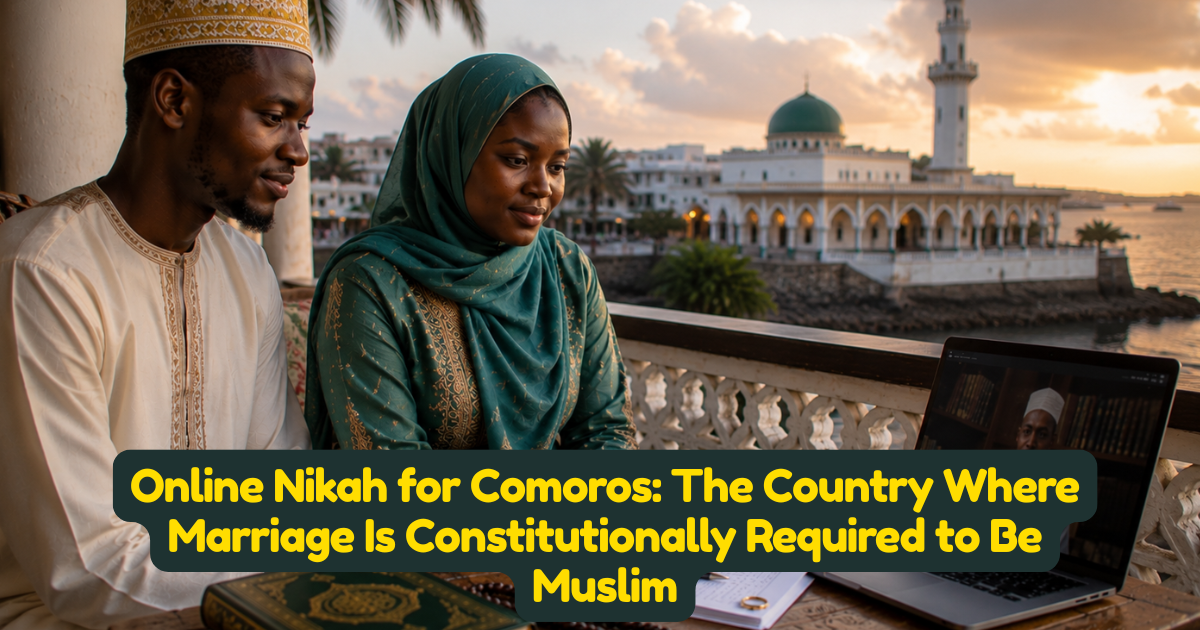
Online Nikah for Comoros: The Country Where Marriage Is Constitutionally Required to Be Muslim
Comoros, an island nation with an overwhelmingly Muslim population, has codified its Islamic identity directly into its marriage law in a way few other countries this series has documented. Its Family Code doesn't simply permit Islamic marriage as one option among several — it establishes Muslim marriage as the required legal default. Understanding this real, specific statutory structure matters for anyone with a Comorian connection planning a Nikah.
The Foundational Statutory Statement
This is the single most direct, distinctive legal statement this series has documented anywhere. Comoros' own official Family Code text states plainly in Article 16: "Le mariage est nécessairement musulman. Il ne peut être conclu qu'entre musulmans" — marriage is necessarily Muslim, and can only be concluded between Muslims, with the code separately setting out the specific substantive conditions required for a mixed marriage where those conditions can be met.
The Witness Requirement: Real, Specific, and Codified in Detail
Comoros' Family Code spells out witness requirements with genuine statutory precision. Article 33 of the official code confirms that "le mariage sera célébré, sous peine de nullité, en présence de deux témoins" — these witnesses must be of the Muslim faith, male, of legal age, and of sound mind — a direct statutory nullity consequence attached to the absence of properly qualified witnesses.
A Genuinely Nuanced, Real Provision on Witness Selection
This is a specific, real, and genuinely thoughtful detail worth understanding directly. Article 34 of the code addresses exactly who chooses the witnesses, and how the bride's own preference factors in: "le choix des témoins instrumentaires appartient au tuteur et à l'époux. Toutefois, il est recommandé de recueillir l'agrément de la femme à ce sujet. Le défaut d'agrément du témoin par la femme n'est pas une cause de nullité du mariage" — the choice of witnesses belongs to the guardian and the husband, though obtaining the wife's agreement on this is specifically recommended, while her lack of agreement on the specific witness choice is explicitly not grounds for nullity. This is a genuinely precise, real statutory balance: encouraging the bride's involvement in witness selection as good practice, while not making that specific input a strict legal requirement for validity.
Consent: A Real, Direct, Codified Requirement
Comoros' Family Code is direct and unambiguous about consent. Article 20 states that consent to marriage must be firm and unconditional — a marriage contracted without the free consent of both spouses, or of either one of them, is void, though the same article specifies this can only be challenged by the spouses themselves or specific others with a direct interest, not by any third party generally.
A Real, Specific Financial Penalty Structure
The code attaches genuine, real financial consequences to specific procedural failures. Comoros' own text confirms a fine ranging from 350,000 to 750,000 Comorian francs applies to certain procedural violations connected to the marriage's celebration — a real, specific, codified penalty structure rather than a vague or discretionary sanction.
The Real, Specific Declaration Deadline
This is genuinely useful, concrete planning information worth understanding precisely. Article 38 of the code confirms that the declaration of marriage must be drawn up, within a period not exceeding five days, by the competent judge who celebrated the marriage, in the presence of two witnesses — a genuinely tight, specific administrative window comparable to the strict deadlines this series has documented in Bangladesh and Ghana.
The Underlying Legal Age Framework
Comoros' broader marriage age framework runs through its 2005 Family Code, worth understanding as context. Detailed guidance confirms the Family Code of 2005 sets the minimum legal age for marriage at 18, though individuals under 18 may marry with judicial consent — with the law requiring mutual consent for marriage and specifically upholding women's autonomy by granting them the right to make independent decisions without an obligation to obey their husbands. The same guidance confirms the marriage process itself may involve village elders, kadis (Islamic judges), or civilian courts, depending on the specific legal framework applicable.
What This Means for Structuring an Online Nikah With a Comorian Connection
Given Comoros' genuinely direct, codified Islamic marriage framework, couples completing an online Nikah with a Comorian connection should ensure two properly qualified witnesses — Muslim, male, adult, and of sound mind — are correctly identified per Article 33's specific requirements, complete the formal declaration within the strict five-day window under Article 38, and, as good practice consistent with the code's own recommendation, involve the bride directly in witness selection even though her specific agreement on this point isn't a strict validity requirement.
Frequently Asked Questions
Does Comorian law require marriage to be between Muslims? Yes — the Family Code states directly in Article 16 that marriage is necessarily Muslim and can only be concluded between Muslims, with specific separate conditions governing mixed marriages.
What are the exact witness requirements under Comorian law? Two witnesses, required under penalty of nullity, who must be of the Muslim faith, male, of legal age, and of sound mind.
Must the bride approve the specific witnesses chosen? It's recommended as good practice, but the code specifically states her lack of agreement on witness choice is not grounds for nullity — the formal choice belongs to the guardian and husband.
Suggested Internal Links
Zainab Butt
Author