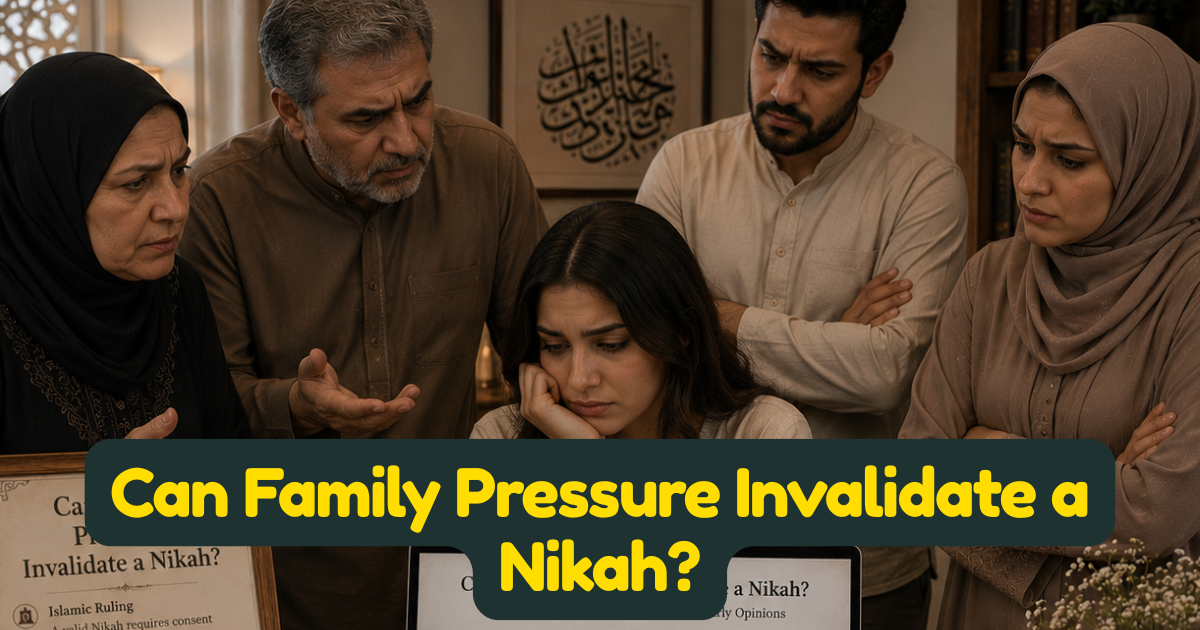
Can Family Pressure Invalidate a Nikah? Consent, Coercion, and Islamic Marriage Law Explained
It does not always look like force. Sometimes it is a father who stops speaking to his daughter until she agrees. A mother who weeps until her child relents. A family that makes clear — without ever raising a hand — that refusal will mean permanent exclusion, financial abandonment, or complete social isolation. Sometimes it is quieter still: a young woman who has been told her entire life that she has no right to choose, who sits through a nikah ceremony believing, sincerely, that her silence counts as consent.
The question of whether a nikah conducted under these circumstances is valid in Islamic law is not a peripheral or theoretical question. It sits at the heart of what Islamic marriage actually is — and what it is emphatically not. And the answer Islamic law gives is one of the most important things a Muslim woman can know.
Because Islam does not merely recommend consent. It makes genuine, free consent a condition of the nikah's validity. Without it — truly without it, not just technically present in the form of a word spoken under duress — there is no valid Islamic marriage.
Consent in Islamic Marriage: Not a Formality but a Foundation
The Islamic position on a bride's consent has been clear since the earliest period of the faith. Multiple authentic hadith establish that a woman's consent is not optional, not symbolic, and not something her guardian can override with his own preference.
The Prophet Muhammad, peace be upon him, is authentically reported to have said: "A previously married woman shall not be given in marriage without her command, and a virgin shall not be given in marriage without her consent." When asked what her consent looks like, he said: "Her silence." This hadith — narrated in both Sahih al-Bukhari and Sahih Muslim, the two most authoritative hadith collections in Sunni Islam — establishes that the bride's consent is a condition the Prophet specifically addressed and specifically protected.
Another hadith, also in Sahih Muslim, records that a woman came to the Prophet and told him her father had given her in marriage against her will. The Prophet gave her the choice to accept or refuse the marriage. She chose to accept — but the significance of the narration is that the Prophet did not dismiss her complaint, did not tell her to obey her father, and did not treat her father's decision as automatically binding. He gave her the choice. The Shariah gives her the choice.
These narrations are not minority opinions. They are foundational texts that classical scholars across all four major madhabs have built their understanding of marital consent around. The disagreements between madhabs on this topic are about the details — not about whether consent is required.
What Coercion Means in Islamic Jurisprudence
Classical Islamic jurists developed a precise understanding of ikrah — coercion — and its effect on legal contracts. Their analysis was sophisticated and addressed not only physical force but the wider spectrum of compulsion that can render a person's stated agreement meaningless.
In Islamic legal theory, coercion that invalidates a contract has been defined as any pressure that removes a person's genuine freedom of choice — that causes them to agree to something they would not have agreed to had they been free from that pressure. Classical scholars identified two broad categories:
Mulji — Compelling Coercion
Ikrah mulji refers to coercion that leaves the person with no real alternative — threats to life, serious physical harm, or destruction of essential livelihood. The classical examples include threats to kill, to gravely injure, or to destroy property so essential that the person's survival depends on it. Scholars across all madhabs agreed that agreements reached under this level of coercion are void — not merely voidable, but fundamentally invalid from the moment of their making.
Ghair Mulji — Non-Compelling Coercion
Ikrah ghair mulji refers to lesser forms of pressure — threats that are serious but do not reach the level of threat to life or limb. The classical examples include threats of imprisonment, financial harm, or lesser physical harm. Scholars debated the precise effect of this category on contracts, with the Hanafi school generally treating agreements under this level of coercion as suspended rather than immediately void — but still not fully valid without subsequent free ratification.
What is critically important — and what many Muslims are never told — is that the classical scholars' framework for coercion was not limited to physical violence. Psychological compulsion, sustained emotional pressure, threats of social exclusion, manipulation of a person's love for their family, and the systematic denial of a person's right to refuse were all understood within the framework of conditions that undermine genuine consent.
A woman who agrees to a nikah because her father has made clear that refusal means permanent estrangement from her family has not given the free, genuine consent that Islamic law requires. Her word was spoken. But the freedom behind it was absent. And Islamic law has always understood the difference.
What the Four Madhabs Say About a Coerced Nikah
The Hanafi Position
The Hanafi school — followed by the majority of Muslims across South Asia, Turkey, and Central Asia — treats a nikah conducted under coercion as suspended and defective rather than immediately and absolutely void. This distinction has practical significance: the Hanafi school holds that if a woman who was coerced into a nikah later freely ratifies it — if she genuinely accepts the marriage of her own free will after the coercive pressure is removed — the marriage becomes valid from that point of ratification.
However, if she does not ratify it freely — if she continues to object once she has the freedom to do so — the Hanafi school holds that the nikah is not binding upon her. She is not trapped in a marriage she never genuinely consented to simply because a word was extracted from her under duress.
The Hanafi school also holds the distinctive position that an adult, sane Muslim woman has independent contractual capacity — meaning that a marriage she genuinely consents to cannot be overridden by her guardian's refusal. The corollary of this position is equally important: a marriage she does not genuinely consent to cannot be imposed by her guardian's desire. Her will is legally relevant in both directions.
The Shafi'i Position
The Shafi'i school takes a clear and consistent position: a nikah conducted without the bride's genuine free consent is not valid. The Shafi'i school's strict requirement for the wali's involvement is explicitly premised on the wali acting in the bride's interests — not overriding them. A wali who compels a bride into a marriage against her genuine will is not fulfilling his role. He is violating it.
Shafi'i scholars have consistently held that the wali does not have the authority to force a bride into a nikah she has not genuinely accepted. A nikah conducted through such force is not valid in the Shafi'i framework, and the woman retains the right to have it annulled through Islamic judicial process.
The Maliki Position
The Maliki school — predominant across North and West Africa — has historically been among the clearest on the protection of women's consent in marriage. Maliki fiqh developed the concept of darar — harm — as a ground for faskh, the dissolution of a marriage, which extends to situations where the marriage itself was contracted in conditions harmful to the bride.
Maliki scholars have consistently held that a woman who can establish that her nikah was contracted without genuine consent has grounds to seek its dissolution. The Maliki school's broader framework of marital harm is particularly protective of women in exactly the coercion scenario — and Maliki judges have historically been willing to annul marriages where coercion was established.
The Hanbali Position
The Hanbali school similarly holds that genuine consent is a condition of a valid nikah. Hanbali scholars have addressed forced marriage — including marriages arranged by fathers for virgin daughters without their consent — and have maintained that the Prophet's hadith establishing the daughter's right to consent cannot be overridden by the guardian's authority. The wali's role does not include the authority to compel.
The Virgin Daughter: A Common Misunderstanding
One of the most frequently misused positions in this area of Islamic law involves the classical scholarly discussion of a father's authority to conduct the nikah of his virgin daughter. Some scholars — particularly within certain Maliki and Shafi'i positions — held that a father could give his virgin daughter in marriage without her explicit verbal consent, with her silence being treated as consent.
This position has been widely misunderstood and misapplied. Several critical clarifications are necessary:
First, the silence-as-consent principle applies only where the woman has had a genuine opportunity to object — where she has been informed of the marriage, given time to consider it, and has genuinely chosen silence rather than being silenced by fear, psychological pressure, or the removal of her realistic ability to refuse.
Second, even the scholars who held this position consistently stated that if the woman expresses unwillingness — through words, tears, distress, or any clear indication of genuine objection — her objection must be respected. Silence under pressure is not consent. Distress is not silence.
Third, the majority of contemporary scholars across all madhabs have affirmed that the silence-as-consent principle cannot be applied in social contexts where a woman's realistic ability to refuse is undermined by family pressure, cultural expectation, or the fear of serious social or personal consequences. In those contexts, silence does not indicate genuine consent — and treating it as if it does produces exactly the injustice the Shariah's consent requirement exists to prevent.
Forced Marriage vs Arranged Marriage: A Distinction Islam Makes Clearly
A critical distinction that Islamic law makes — and that is frequently blurred in both Muslim community discourse and external discussions of Muslim marriage — is the difference between an arranged marriage and a forced marriage.
An arranged marriage, in the Islamic understanding, is one in which the family plays an active and meaningful role in identifying and proposing a suitable match — but in which the bride and groom both retain genuine freedom to accept or refuse. Family involvement, guidance, and even strong encouragement are not coercion. A parent who presents a candidate they believe is suitable, who explains their reasons, who expresses their hopes, and who ultimately respects their child's decision — this parent is playing a role that Islamic tradition affirms and that has been the norm across Muslim cultures for centuries.
A forced marriage is something entirely different. It is one in which the bride — or the groom — does not have genuine freedom to refuse. Where refusal carries serious threatened consequences. Where the ceremony proceeds over expressed objection. Where silence is manufactured by the removal of realistic alternatives rather than being the genuine expression of acceptance. This is what Islamic law prohibits. Not family involvement — but the removal of genuine choice.
The distinction matters because conflating the two produces either the false conclusion that all family involvement in marriage is oppressive, or the equally false conclusion that family pressure cannot constitute coercion. Islamic law has always held both realities simultaneously: family guidance is valued, and genuine free consent is non-negotiable.
What Happens to a Nikah That Was Conducted Under Coercion?
If a nikah was conducted under coercion — whether that coercion involved physical force, sustained psychological pressure, threats of serious consequences, or the systematic undermining of a woman's realistic ability to refuse — Islamic law provides specific remedies. The exact remedy available depends on the madhab and the specific circumstances, but the core principle is consistent: a woman is not permanently bound by a nikah she never genuinely consented to.
Faskh — Judicial Dissolution
Across all four madhabs, a woman who can establish that her nikah was conducted without genuine consent can seek faskh — a judicial dissolution of the marriage — through an Islamic scholar or authority. This is not a divorce. It is an annulment — a declaration that the marriage was not validly contracted in the first place, or that it should be dissolved on grounds of the harm caused by the conditions under which it was made.
In countries without an Islamic judicial system, this function is fulfilled by a qualified Islamic scholar or a recognised Islamic institution — the same wali al-amr framework discussed in the context of guardianship also applies here. A woman in the UK, USA, Germany, or France can approach a qualified Islamic scholar or institution to have her situation assessed and, if the grounds are established, to receive an Islamic dissolution of the marriage.
Khul — The Woman's Right to Seek Release
Where faskh is not the appropriate mechanism — for example where the coercion was real but difficult to formally establish through testimony — a woman also has the Islamic right of khul: initiating the dissolution of the marriage herself, typically by returning the mahr. Khul does not require the husband's agreement once the Islamic authority has reviewed the case and found sufficient grounds.
Ratification or Rejection After Coercion Is Removed
In the Hanafi framework specifically, a woman who was coerced into a nikah has the option of freely ratifying or rejecting it once the coercive pressure is genuinely removed. This provides a path for marriages that began under pressure but which the woman genuinely comes to accept — and equally, it provides a path for marriages she continues to reject once she has real freedom to do so.
What Global Scholarly Institutions Have Confirmed
Dar al-Ifta al-Misriyyah — Egypt's official government fatwa authority — has addressed forced marriage and coercion in Islamic marriage law in multiple detailed rulings. Their position is unambiguous: a nikah conducted without genuine free consent is not a valid Islamic marriage. Dar al-Ifta has specifically addressed the situation of women pressured by family members, confirming that psychological coercion — sustained emotional pressure, threats of social exclusion, and the removal of realistic alternatives — constitutes ikrah sufficient to undermine the validity of the consent given. They have further confirmed that such a woman has the right to seek faskh through a qualified Islamic authority.
Al-Azhar University has consistently and prominently affirmed the centrality of genuine consent in Islamic marriage. Al-Azhar scholars have explicitly rejected the idea that a father's or guardian's authority in marriage extends to overriding the bride's genuine objection. Their institutional position — consistent with the hadith record and the classical fiqh tradition — is that forced marriage is not an Islamic marriage, regardless of the form of the ceremony conducted.
In the United Kingdom, the Muslim Council of Britain (MCB) has taken a strong institutional position against forced marriage in Muslim communities. The MCB has consistently affirmed that forced marriage is un-Islamic — not a cultural practice that Islam tolerates, but a violation of a principle Islam explicitly protects. Their published guidance has specifically addressed the distinction between arranged and forced marriage, and has encouraged British Muslim communities to ensure that nikah ceremonies are never conducted without verified genuine consent.
In the United Kingdom, the UK Government's Forced Marriage Unit — a joint initiative of the Foreign, Commonwealth and Development Office and the Home Office — provides support specifically to individuals at risk of or subjected to forced marriage. The UK Government made forced marriage a criminal offence in 2014 under the Anti-Social Behaviour, Crime and Policing Act. This civil legal framework — operating alongside and independent of the Islamic validity question — provides an additional layer of protection for individuals in the UK whose marriage was or is being conducted without genuine free consent.
In the United States, the Islamic Society of North America (ISNA) has published extensive guidance on Islamic marriage and the central role of consent. ISNA scholars have explicitly confirmed that a nikah conducted without the bride's genuine free consent is not valid under Islamic law — and that imams and Islamic officiants have a responsibility to verify genuine consent before conducting any nikah ceremony. ISNA has also engaged with the practical realities of American Muslim communities where cultural pressure on marriage decisions sometimes undermines this Islamic requirement.
The Islamic Fiqh Academy of the Organisation of Islamic Cooperation (OIC) has addressed women's rights within the Islamic marriage contract in multiple resolutions, consistently affirming that the wife's genuine consent is a foundational condition of the valid nikah. Their resolutions reflect the unanimous scholarly position that coercion — in any form that removes genuine free choice — invalidates the consent upon which the marriage contract depends.
In Europe, the Council of Europe has documented forced marriage as a serious human rights concern across European Muslim and non-Muslim communities alike. Their framework on forced marriage — which includes both civil legal protections and recommendations for community-level engagement with religious institutions — recognises the importance of Islamic scholarly positions in addressing forced marriage within Muslim communities. The Council of Europe has specifically noted that the Islamic scholarly consensus against forced marriage provides a powerful internal religious argument against the practice — one that community leaders and institutions should actively communicate.
In Germany, the Zentralrat der Muslime in Deutschland has publicly and consistently condemned forced marriage as un-Islamic and as a violation of German law. Their institutional position reflects both the Islamic requirement for genuine consent and the German legal framework — under which forcing a person into marriage is a criminal offence under Section 237 of the German Criminal Code (Strafgesetzbuch).
How to Recognise Whether Consent Was Genuinely Free
For women reflecting on their own nikah — or for those preparing for a nikah and uncertain about whether the pressure they are experiencing undermines their consent — the following questions reflect the Islamic scholarly framework for what genuine free consent actually requires.
- Was refusal a realistic option? Not merely technically possible — but realistically available without consequences so severe that agreement was effectively the only viable choice?
- Was there time and space to consider? Genuine consent requires the opportunity to reflect, to ask questions, to seek advice, and to reach a decision without being rushed, pressured, or isolated from sources of independent guidance.
- Were objections dismissed or punished? If expressing hesitation or reluctance resulted in anger, emotional withdrawal, threats, or escalating pressure, the conditions for genuine consent were not present.
- Was silence chosen or manufactured? Silence counts as consent in classical Islamic jurisprudence only where the woman had genuine freedom to speak and chose not to. Silence produced by the fear of speaking is not consent — it is suppression.
- Would agreement have been given without the pressure? The cleanest test of coercion is counterfactual: if the pressure had not existed, would the agreement have been given? If the honest answer is no, the agreement was not genuinely free.
What a Woman in This Situation Can Do
For a Muslim woman who believes her nikah was conducted without genuine free consent — whether recently or in the past — several pathways are available, and none of them requires her to remain permanently in a marriage she did not genuinely choose.
The first and most important step is to speak to a qualified Islamic scholar who has experience in Islamic family law. Not to seek permission to have feelings about her situation, but to receive authoritative guidance on her Islamic rights and the remedies available to her. A qualified scholar can assess whether the grounds for faskh or khul exist, and can facilitate the appropriate Islamic process.
In the United Kingdom, the Forced Marriage Unit (gov.uk/forced-marriage) provides confidential support and can be contacted by anyone who fears they are being forced into marriage or who has already been. Their support is available to people of all faiths and backgrounds.
In countries across Europe and North America, civil legal protections against forced marriage exist independently of the Islamic validity question — and accessing them does not require a woman to abandon her Islamic framework or her religious identity. The civil and Islamic frameworks both, from different directions, reach the same conclusion: a marriage contracted without genuine free consent is not a valid marriage.
How InstantNikah.com Verifies Genuine Consent
At InstantNikah.com, the verification of genuine free consent is built into every ceremony — not as a formality but as a substantive part of the process. Before the nikah proceeds, the presiding qualified online qazi speaks privately with the bride to confirm her consent is genuine, free, and given without pressure. This is not a checkbox. It is a conversation — one designed to give the bride a genuine opportunity to express any hesitation she may not feel able to voice in front of family members.
For women in difficult family situations — including those facing pressure, those marrying without full family support, or those whose circumstances are complex — InstantNikah's approach provides the structured Islamic oversight that ensures the nikah is conducted on the basis of conditions that are genuinely met. Every ceremony results in a full nikah certificate documenting the verified consent, the mahr, the witnesses, and the wali involvement.
For women navigating family opposition to their nikah, seeking to understand their rights around a wali who refuses without cause, or exploring the Islamic guidance on khul and faskh as dissolution options, InstantNikah's resources provide scholarly, compassionate, and practically grounded guidance.
Explore the full process here, read verified reviews from couples worldwide, or book your online nikah with the confidence that every condition — including your genuine free consent — will be properly confirmed.
Admin User
Author