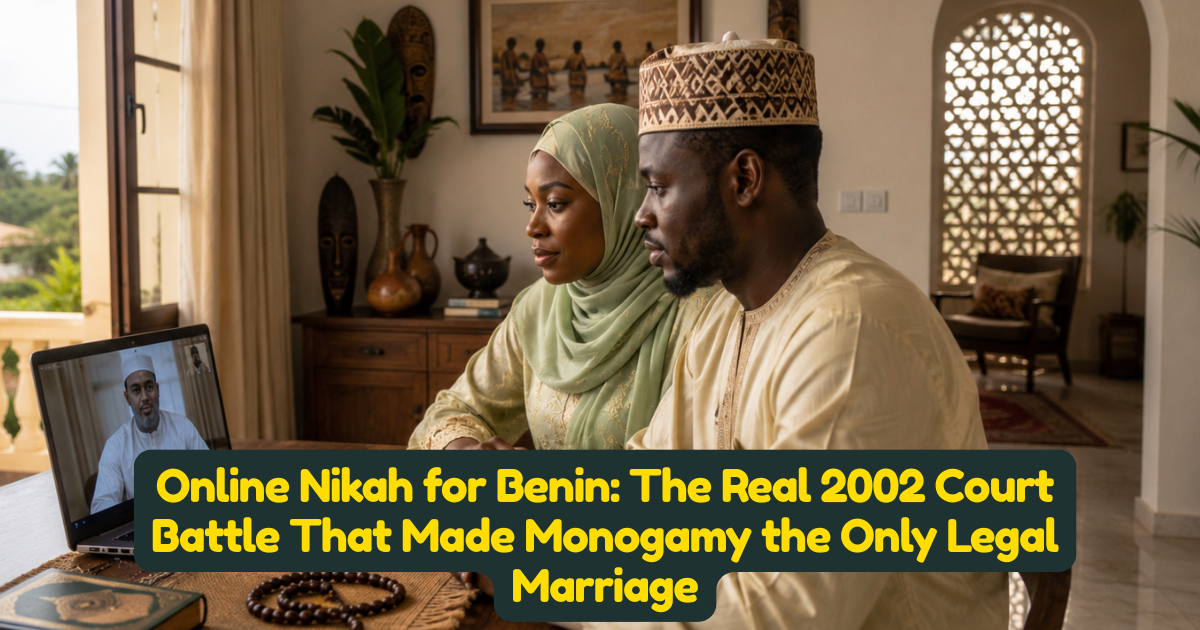
Online Nikah for Benin: The Real 2002 Court Battle That Made Monogamy the Only Legal Marriage
Benin's marriage law reflects a genuinely dramatic, real legislative and constitutional battle — one that ended with the country's highest court striking down a provision its own parliament had voted through. Understanding this real history, and exactly how Benin's current law treats religious marriage as a result, matters directly for anyone with a Beninese connection planning a Nikah.
The Core Legal Principle Today: Civil Marriage Only
This is the clear, current legal position, stated directly by an official Beninese authority. Recent reporting quotes Maître Huguette Bokpè Gnacadja, President of the National Women's Institute, confirming that "C'est le mariage civil qui est considéré légalement comme mariage au Bénin" — it is civil marriage that is legally considered marriage in Benin — with the dowry and religious marriage not producing the same legal effects as civil marriage. A separate, official practical guide confirms this directly: religious marriage, celebrated in places of worship, produces no legal effect if it is not preceded or followed by a civil marriage.
A Genuinely Dramatic, Real Legislative History
This is worth understanding in full, since it's a genuinely remarkable, well-documented episode in Beninese legal history. Detailed advocacy reporting from WiLDAF/FeDDAF-Bénin, a real women's rights organisation directly involved in the events, describes how, after the National Assembly passed the new Code des personnes et de la famille, both the President of the Republic and a member of parliament, Rosine Vieyra Soglo, formally challenged the vote before the Constitutional Court, seeking review of the text's conformity with the Constitution — and on 23 December 2002, the Constitutional Court declared the provisions relating to a married woman's right to keep her own name and to the polygamous marriage option unconstitutional. The same account records real, direct public opposition the organisation encountered during its advocacy campaign, including opponents publicly asking "what more do these women want? Polygamy is one of our traditional values — we will never remove it!"
The Real Outcome: Monogamy as the Sole Recognised Form
Following this constitutional ruling, Benin's law took a firm, direct position. The same detailed account confirms that, as a result, "la monogamie est la seule forme de mariage reconnue" — monogamy is the only form of marriage recognised under Benin's law. This is a genuinely significant, real outcome worth understanding clearly: unlike the polygamy-permitting frameworks this series has documented across most of Benin's regional neighbours, Benin's constitutional court specifically removed the polygamous option that had originally been included in the legislation as passed.
A Real, Honest Tension Worth Understanding
This creates a genuinely real, worth-acknowledging tension for Benin's Muslim community specifically. A separate parliamentary research report on matrimonial status across Francophone Africa documents testimony describing that in certain regions where the Muslim religion is practised by 99% of the population, polygamy is naturally practised and accepted within that society. This means Benin's civil legal monogamy requirement and some Muslim community practice can genuinely diverge in certain regions — a real, honest gap worth understanding directly rather than glossing over, similar in spirit to the documented tensions this series has covered in Ethiopia and elsewhere.
Why This Site's Position Remains Consistent
Given Benin's specific, current civil legal framework, a properly conducted online Nikah with a Beninese connection should be structured around, and paired with, the mandatory civil marriage process — consistent with Benin's current law recognising only monogamous civil marriage, and consistent with this site's own consistent emphasis throughout this series on treating civil registration as the essential companion step to any religious ceremony, regardless of what any individual country's specific substantive marriage rules happen to be.
What the Civil Marriage Process Itself Requires
Beyond the monogamy requirement, Benin's civil marriage process follows a recognisable structure worth understanding. The same official practical guide confirms civil marriage in Benin is a solemn contract concluded between two adults of different sexes before a civil status officer, with the ceremony taking place at a town hall in the presence of an officer authorised to receive the spouses' consent — which must be free, informed, and expressed publicly without constraint. Separately, Article 125 of the Code confirms no one may contract a new marriage before the dissolution of a previous one has been formally noted on the civil status register.
What This Means for Structuring an Online Nikah With a Beninese Connection
Given Benin's specific, real legal history and current framework, couples completing an online Nikah with a Beninese connection should treat the civil marriage process — held before a civil status officer, structured around Benin's current monogamy-only legal position — as the mandatory companion step to the religious ceremony, understanding that the religious ceremony alone carries no legal effect on its own under current Beninese law.
Frequently Asked Questions
Is polygamy legally recognised in Benin? No — following a 2002 Constitutional Court ruling striking down the polygamous marriage option that had originally been in the passed legislation, monogamy is now the only legally recognised form of marriage in Benin.
Does a religious Nikah alone have legal effect in Benin? No — official guidance confirms religious marriage produces no legal effect unless preceded or followed by civil marriage before a civil status officer.
Who challenged Benin's original family code before the Constitutional Court? Both the President of the Republic and a member of parliament, Rosine Vieyra Soglo, formally sought constitutional review of the code as passed by the National Assembly.
Suggested Internal Links
Zainab Butt
Author