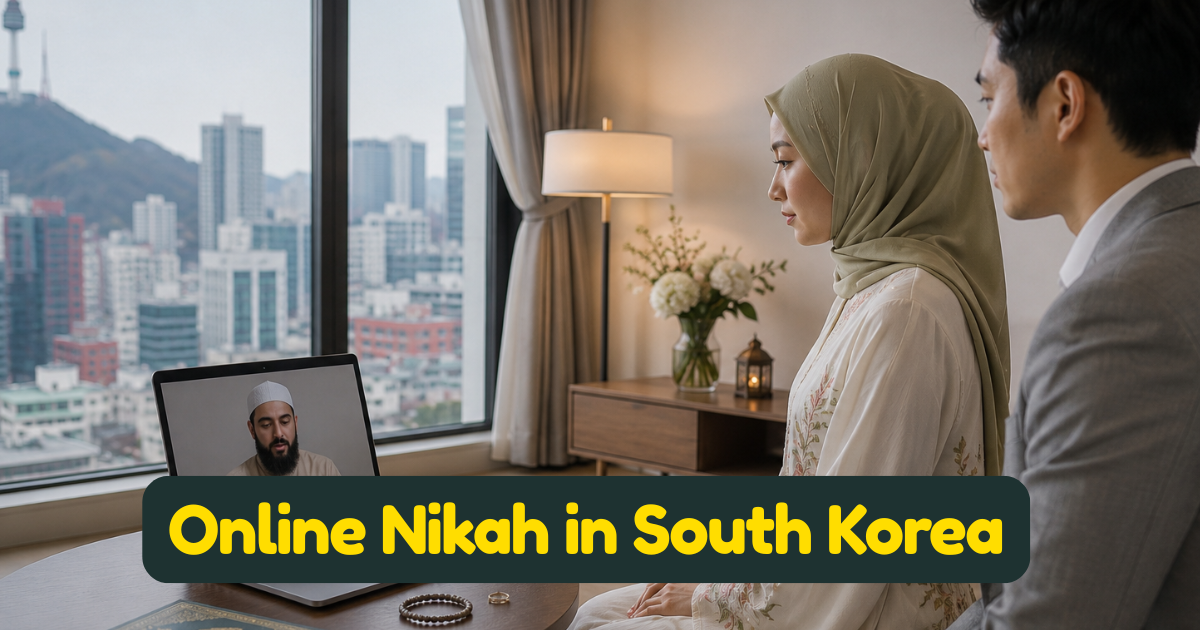
Online Nikah in South Korea: How Muslims Marry Under Shariah When the Law Only Sees a Marriage Report
Climb the hill in Itaewon and the dome of the Seoul Central Mosque comes into view above the rooftops — for many of Korea's Muslims, the closest thing to a spiritual home in a country where they are a fraction of one percent. By most counts there are somewhere between 150,000 and 250,000 Muslims in South Korea, roughly 0.3 percent of the population, and around seventy percent of them are foreign-born, according to figures from the Korea Muslim Federation cited by Arab News. Migrant workers from Indonesia, Pakistan, Bangladesh and Uzbekistan, international students, and a small but growing community of Korean converts known affectionately as "Koslims" make up a faith landscape that the Korean state, by design, barely registers.
That last word is the crux of the problem. In Korea, marriage is something you report, not something you celebrate into legal existence. For a Muslim couple this raises an immediate question: if a wedding ceremony means nothing to the government, how do you actually contract a nikah that is valid in the sight of Allah? This guide answers that, and explains how InstantNikah.com conducts a Shariah-compliant online nikah for couples living anywhere in Korea.
How Marriage Legally Works in Korea
South Korea operates a reporting system rather than a ceremonial one. A couple becomes legally married only when a marriage report — honin singo (혼인신고) — is submitted to the competent district office (the Si, Gu, Eup or Myeon office) and accepted into the national Family Relations Registration System. The Supreme Court of Korea's family registration service is explicit that it is the acceptance of the report, not any wedding, that creates the legal relationship. The Korean courts have consistently held that ceremonies carry no independent legal effect.
The marriage report itself requires the signatures of two witnesses, who may be Korean or foreign as long as they hold a resident card. Identity is confirmed through passports or national IDs. Foreign nationals must additionally prove they are free to marry, which is where most couples encounter the paperwork wall. The Songpa-Gu district office in Seoul sets out how international marriages are recorded, and the official Korean government portal for foreigners outlines the family-registration declarations involved.
For documentary requirements, the United States Department of State's reciprocity schedule for Korea details the certificates the system produces, including the Certificate of Acceptance of the marriage report. The single status requirement is usually satisfied by an affidavit of eligibility to marry issued by your own embassy in Seoul — the Embassy of Singapore in Seoul, for example, publishes exactly such a process, and most embassies follow a similar model. Note that none of this paperwork records religion at all; the Islamic side is entirely your responsibility.
Where the Nikah Fits, and Why Korea Won't Provide It
Because the honin singo is purely administrative, it gives you a legal spouse but nothing Islamic — no wali standing for the bride, no recitation, no witnessing of the contract in the religious sense. A couple who only files the report has registered a marriage in Korean law while remaining unmarried under Shariah. Conversely, a quiet private agreement between two people, with no proper officiant or qualified witnesses, risks failing the conditions Islam attaches to a valid nikah. The two systems simply do not overlap, and serious couples treat them as two distinct steps that both need to be done.
The Conditions a Valid Nikah Must Meet
A nikah is not validated by a venue or a registrar but by a handful of essentials. Understanding them clarifies why a properly run online ceremony can satisfy Islam even when no mosque is involved.
A guardian for the bride
According to the majority of scholars the bride marries through her wali, on the strength of the Prophet's (peace be upon him) words, "There is no marriage without a guardian," reported by Abu Dawud, al-Tirmidhi and Ibn Majah and graded authentic. In Korea, where most Muslims are away from family, this is a live difficulty — and especially so for a Korean convert whose relatives are not Muslim. In that case, recognised scholarship allows a qualified imam or the head of an Islamic centre to act as her guardian, a point worth raising early with whoever conducts the ceremony.
Two witnesses who genuinely hear the offer and acceptance
The offer (ijab) and acceptance (qabul) must be witnessed by two trustworthy Muslims who actually hear and understand them, ideally in a single uninterrupted session. This is the hinge on which remote ceremonies turn. It is not enough for witnesses to be vaguely "on the call"; they must clearly hear the words pass between the parties or their authorised agents. A careful provider treats audio clarity and explicit witness confirmation as non-negotiable rather than as a formality.
An agreed mahr and free consent
The bride's mahr is her right and should be settled and, preferably, written into the contract. Both parties must consent freely, without pressure. None of these three pillars depends on being in the same room, which is precisely why distance does not, in itself, break a nikah.
Is an Online Nikah Actually Valid? What Scholars Say
This is the question couples in Korea ask most, and the honest answer is that scholars differ — but a strong, mainstream position permits it. The fatwa research compiled by IslamQA records that scholars such as Shaykh Ibn Baz considered a marriage contract conducted by phone or internet permissible provided there is no risk of tampering, the identities of the husband and the wali are established, and the two witnesses can hear the proposal and acceptance. A more cautious view, also noted there, prefers appointing a proxy (wakeel) so that the contract is concluded in one physical sitting with witnesses present.
The Islamic Q&A service AboutIslam reaches a compatible conclusion: a marriage by video call is valid so long as the conditions of the contract are met, including the two qualified witnesses hearing the contract. The practical takeaway is that an online nikah is not a grey-area improvisation — it is a recognised method whose validity rests on doing the essentials correctly, particularly the witnessing. Our detailed treatment of the video-call nikah ruling and the related question of a nikah over a voice call walks through the reasoning of each school.
How InstantNikah.com Runs the Ceremony for Couples in Korea
A Shariah-compliant online nikah is a real contract conducted over a secure live video link, with every required role filled by a real person. In practice that means a qualified officiant leads the session, the bride's wali participates (or a suitable wali is appointed where she has none), two valid witnesses are seated on the call and confirm what they hear, the mahr is fixed, the offer and acceptance are recited clearly, and documentation follows.
For Korea's circumstances this flexibility matters. A factory worker on rotating shifts in Ansan and a fiancée still abroad can marry without travel. A student in Busan whose guardian is in Lahore can have the wali join remotely or appoint a proxy. A Korean convert without Muslim family is not left stranded. The substance of the contract is identical to one solemnised in a mosque; only the medium changes.
Documents and Steps for the Korean Civil Registration
Once the nikah is done, complete the legal side so you are recognised as spouses in Korea — important for visas, healthcare, and inheritance. The usual sequence runs as follows:
- Obtain an affidavit of eligibility to marry from your embassy in Seoul, confirming you are free to marry, then have it translated and, where required, notarised in Korean.
- Complete the marriage report (honin singo) at any district office, filling the form in Korean and including the details and signatures of two witnesses who hold resident cards.
- Submit originals of all supporting certificates with a passport or alien registration card for identity verification.
- Collect your Certificate of Acceptance once the report is registered into the Family Relations Registration System — this is your proof of legal marriage in Korea.
For couples married abroad before moving to Korea, or Korean nationals married overseas, the report must generally be filed within three months. A fuller country-by-country breakdown sits in our guide on registering a nikah civilly after the Islamic ceremony.
Who This Helps Most in Korea
Migrant workers form the backbone of Korea's Muslim community and rarely have family nearby; an online nikah lets them marry properly without losing wages or annual leave to international travel. International students, a major driver of the community's growth, can keep a relationship halal within a tight visa window — our piece on online nikah for Muslim students abroad speaks directly to them. Korean converts often face the wali question most acutely, which is why we wrote a dedicated guide on how a convert can find a wali for nikah. And intercultural couples — increasingly common, as research on Korea's Muslim community by the İLKE research institute documents — can use a remote ceremony to bridge two families on two sides of the world.
Quick Answers for Muslims Marrying in Korea
Is an online nikah valid in South Korea? Islamically, yes — if the wali, two hearing witnesses, mahr and free consent are all present, the contract is valid regardless of where you sit. The location does not affect validity.
Does the honin singo count as a nikah? No. The marriage report makes you legally married in Korea but contains nothing Islamic. Treat the nikah and the report as two separate, both-necessary steps.
What if my guardian or partner is in another country? That is one of the most common cases an online nikah is built for, whether through the wali joining the call or appointing a proxy.
Can a Korean convert with a non-Muslim family still marry Islamically? Yes. A qualified imam or Islamic centre can serve as her wali, a long-established practice.
Faith and Law, Both Satisfied
Living as a Muslim in Korea should never force a choice between your deen and the law of the land. A properly conducted nikah secures the religious side; the district-office report secures the legal one. InstantNikah.com handles the religious half with care — qualified officiants, valid witnesses, a guardian where needed, and clear documentation — so that couples from Seoul to Busan can begin married life on solid ground. When you are ready, you can book your online nikah and discuss your exact situation with our team.
Admin User
Author