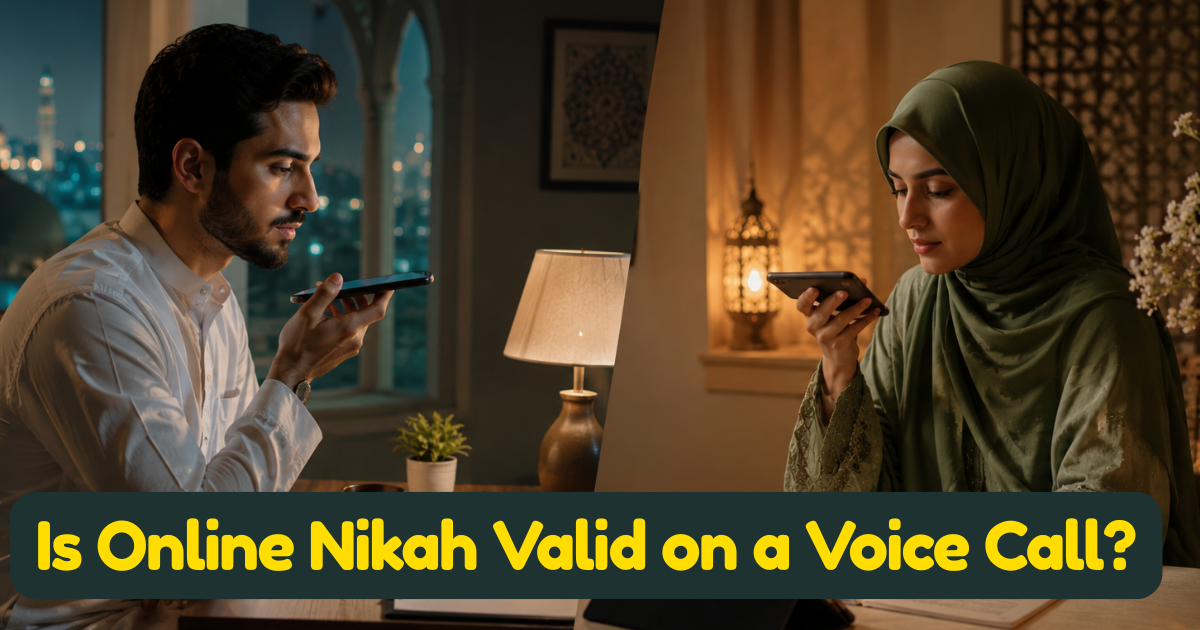
Is Online Nikah Valid on a Voice Call? What Islam and Scholars Actually Say
There is a question that does not get nearly enough serious attention in the online nikah space, and it deserves one. Most of the discussion around remote nikah validity focuses on video calls — whether seeing each other's faces, whether both parties are simultaneously present on screen, whether witnesses can verify identity through a camera. But a quieter, more practically urgent question sits underneath all of that: what if there is no video? What if the nikah happens over a voice call alone?
This is not a hypothetical edge case. There are Muslim couples in situations where video is not possible — a sister whose phone has no front camera, a brother in a rural area with unstable internet, a revert whose circumstances require discretion, or an elderly individual who simply cannot navigate video technology. The question of whether a nikah conducted purely over audio — telephone, WhatsApp voice call, or any similar medium — carries Islamic validity is one that affects real people making one of the most serious decisions of their lives.
This article addresses that question with the depth it deserves, drawing on the positions of classical scholars, contemporary fatwa bodies, and the practical realities that govern remote Islamic marriage today.
The Foundation: What Makes Any Nikah Valid in Islam
Before addressing voice calls specifically, it is necessary to understand what the classical scholars actually required for a nikah to be valid. Across the four major madhabs — Hanafi, Maliki, Shafi'i, and Hanbali — there is strong consensus on the core pillars:
- Ijab and Qabul — the offer and acceptance, expressed verbally in clear, unambiguous terms
- Two adult Muslim male witnesses (with some madhab variation on this requirement)
- The Wali — the bride's guardian, whose role varies between madhabs from obligatory to strongly recommended
- Mahr — a gift from the groom to the bride, which must be agreed upon
- The absence of legal impediments — such as existing marriages that would violate Islamic conditions, prohibited degrees of relation, or other disqualifying factors
What the classical scholars did not specify — because it was not a question they could have anticipated — was the precise communication medium through which ijab and qabul must travel. They spoke in terms of a majlis, a session or gathering, where both parties were simultaneously engaged in the contract. The scholarly debate about voice calls and video calls is essentially a modern extension of the classical debate about what constitutes a valid majlis when the parties are not physically present in the same space.
The Classical Concept of Majlis and What It Means for Remote Nikah
The Hanafi school has historically been the most analytically thorough on the question of nikah conducted through correspondence or absence. Early Hanafi jurists permitted nikah by written letter — where the proposal was written, read aloud in the presence of witnesses, and accepted in that same gathering. The acceptance had to occur within the same majlis as the reading of the letter, not days later.
This creates an interesting opening for modern analysis. If a written letter — where the proposer is not present at all, not even audibly — could constitute a valid basis for nikah when read aloud before witnesses, the question arises: does a real-time voice call, where the proposer is actually present and speaking, carry at least equal if not greater validity?
Many contemporary scholars have argued precisely this point. The principle they invoke is that the essential requirement is simultaneity of communication — that both offer and acceptance occur in an unbroken, shared moment of mutual awareness. A live voice call, by this reasoning, satisfies that principle more fully than a letter ever could, because the communication is instantaneous and bidirectional.
Where Scholars Disagree: The Problem of Identity Verification
The disagreement among contemporary scholars on voice-call nikah does not primarily revolve around whether the words of ijab and qabul are valid when spoken over audio. Most accept that the verbal formula itself is sound. The disagreement centres on something more procedural but no less important: how do the witnesses know who they are actually witnessing?
In a physical gathering, the witnesses can see both parties. They know with certainty that the man accepting the nikah is indeed the intended groom, and that the wali or representative giving the proposal is authorised to do so. On a voice call, witnesses who are physically present with one party cannot directly verify the identity of the person on the other end of the line.
This is not a trivial concern. Classical Islamic marriage law is deeply attentive to the authenticity of consent and identity — the rules around fraud and misrepresentation in nikah (tadlis) reflect a long-standing scholarly awareness that marriages can be manipulated if identity and consent are not properly established.
Several fatwa bodies and contemporary scholars have addressed this by stipulating conditions under which a voice-call nikah may be considered valid:
- The voice must be recognisable and known — at least to the witnesses who can confirm they know the speaker
- No reasonable doubt about identity — the circumstances must make impersonation implausible
- Witnesses must be present with at least one of the parties, hearing the exchange clearly
- Prior verification — the participants should have exchanged documented prior communication confirming identity and consent
What Major Scholarly Bodies Have Said
The question of telephone nikah is not new. Scholars began addressing it as soon as telephone technology became widespread in Muslim communities, which means there is now several decades of scholarly opinion to draw upon.
The Islamic Fiqh Academy of the Organisation of Islamic Cooperation (OIC), one of the most authoritative collective scholarly bodies in the modern Islamic world, has addressed remote nikah on multiple occasions. Their general position, refined over successive sessions, holds that nikah conducted remotely — whether by letter, telephone, or electronic means — can be valid provided the conditions of the nikah are fully met, identity is not in doubt, and witnesses are present to the exchange.
The Darul Uloom Deoband in India, one of the most influential Hanafi seminaries in the world, has issued rulings permitting nikah by telephone under conditions where identity is established and witnesses are present. Their reasoning follows the classical Hanafi position on nikah by correspondence, extending it to real-time audio communication.
However, it is important to note that not all scholars agree. Some Shafi'i and Maliki scholars have maintained that the physical or visual presence of the parties — or at minimum video rather than audio — is necessary for the witnessing requirement to be properly fulfilled. They argue that witnesses must be able to see and identify the parties, not merely hear them.
This divergence of opinion means that a voice-call nikah may be considered valid by some scholars and questionable by others. This is precisely why couples in such situations are strongly advised to seek explicit guidance from a qualified scholar and to use a structured online nikah service that has already navigated these scholarly considerations.
Voice Call Nikah vs Video Call Nikah: A Clear Comparison
For practical understanding, it helps to lay out where these two formats stand in terms of scholarly acceptance and risk:
- Video call nikah — widely accepted by contemporary scholars across multiple madhabs when conducted with proper witnesses, wali, mahr, and a qualified officiant. The visual element addresses the identity verification concern directly.
- Voice call nikah — accepted by many Hanafi scholars and some others under conditions where identity is established and witnesses are present. Carries more scholarly disagreement than video and requires additional care.
The practical recommendation from most qualified nikah officiants and Islamic scholars who work in this space is this: if video is at all possible, use it. Not because voice is categorically invalid, but because video removes a layer of scholarly uncertainty and makes the nikah more robustly defensible from multiple scholarly perspectives simultaneously.
Real Scenarios Where Voice-Only Nikah Comes Up
Understanding why people find themselves in voice-only situations makes it easier to advise them properly. The following are genuine scenarios that arise in practice:
Poor Internet Connectivity in Certain Regions
In parts of rural Pakistan, Bangladesh, West Africa, and Central Asia, mobile internet speeds may support voice calls but not stable video. A couple in this situation may have no practical choice but to use audio. A qualified online nikah service can advise on how to structure the ceremony to maximise Islamic validity under these constraints.
Medical or Physical Limitations
Some individuals — particularly elderly Muslims or those with certain disabilities — may not be able to use video technology comfortably. For them, a voice call may be the most accessible option. Islam is a religion of ease, and the principle of rukhsa (concession under hardship) has genuine application here.
Urgent Circumstances Requiring Immediate Nikah
In situations of genuine urgency — where delaying the nikah would cause clear harm — scholars have historically applied greater flexibility. If a couple is in a situation where they need to complete the nikah immediately and video is not available, a voice call with proper witnesses and a qualified qazi may be the most appropriate course of action, with the understanding that the parties should seek scholarly confirmation promptly.
Privacy and Security Concerns
Some individuals in politically sensitive regions or under surveillance concerns may prefer audio-only communication. While this is a less common scenario, it is not without precedent in the global Muslim community.
The Role of the Qazi in a Voice Call Nikah
One element that significantly strengthens the Islamic validity of any remote nikah — including voice-call nikah — is the presence of a qualified, experienced qazi or Islamic marriage officiant who understands the scholarly conditions and can navigate them properly.
A competent qazi performing a voice-call nikah will typically:
- Conduct prior identity verification of both parties through documentation
- Confirm the wali's identity and authority separately
- Arrange for witnesses to be physically present and able to clearly hear the proceedings
- Ensure the mahr is agreed upon and stated explicitly
- Recite and confirm ijab and qabul in unambiguous terms
- Issue documentation of the ceremony that records all conditions
This structured approach — led by a qualified officiant rather than improvised by the couple alone — is the difference between a nikah that stands up to scholarly scrutiny and one that may be questioned. At InstantNikah.com, every ceremony is conducted by a qualified Islamic scholar who applies precisely this level of care, regardless of whether the ceremony is conducted via video or voice.
Can a Nikah Certificate Be Issued for a Voice Call Nikah?
A nikah certificate is an Islamic document — its validity is determined by whether the nikah itself was Islamically sound, not by whether it was conducted in person or remotely. If a voice-call nikah was conducted properly, with witnesses, a wali, agreed mahr, and clear ijab and qabul overseen by a qualified officiant, a nikah certificate can and should be issued.
The certificate serves as a record of the Islamic marriage contract. It documents the names of the parties, their walis, the witnesses, the mahr agreed upon, and the date and circumstances of the ceremony. For couples whose nikah was conducted by voice, this documentation is particularly valuable because it creates a clear record that all required conditions were met.
You can learn more about what makes a nikah certificate Islamically and legally valid by reading the dedicated guide at InstantNikah.com — What Makes a Nikah Certificate Valid.
Is a Voice Call Nikah the Same as a Phone Nikah?
Technically, yes — a voice call nikah and a phone nikah refer to the same format. The distinction that matters more is between live audio communication (a real-time phone or voice call) and non-simultaneous communication (such as a recorded audio message or a written letter). Islamic marriage law has always required that the offer and acceptance occur in a single, continuous, shared moment. A live voice call satisfies this requirement; a pre-recorded audio message does not.
For a deeper examination of the specific rulings around phone nikah, the article at Is Phone Nikah Valid in Islam covers the scholarly positions in considerable detail.
Protecting Your Nikah: Practical Guidance for Couples Considering a Voice Call Ceremony
If your situation genuinely requires a voice-call nikah and video is not a viable option, the following steps will help ensure your ceremony is as Islamically sound as possible:
- Use a qualified qazi — do not attempt to conduct the ceremony informally. The involvement of a learned, experienced officiant is one of the strongest protections against later questions about validity.
- Arrange witnesses in advance — both parties should have at least one reliable witness present in their physical location who can clearly hear the audio of the call. Confirming this arrangement before the ceremony is essential.
- Verify identity through documents beforehand — share identification documents with the qazi prior to the ceremony so that identity is established through multiple channels, not audio recognition alone.
- Confirm mahr explicitly — state the agreed mahr clearly during the ceremony and have it documented.
- Request documentation — ensure the qazi issues a nikah certificate that records the voice-call nature of the ceremony and confirms all conditions were met.
- Seek scholarly confirmation — after the ceremony, consider having the nikah reviewed or ratified by a local scholar or Islamic centre, particularly if you are in a country where the validity of remote nikah is debated.
A Note on Madhab Differences and Seeking Guidance
One of the genuinely important things about this question is that the answer is not uniform across all schools of Islamic jurisprudence. A couple following the Hanafi madhab may receive more permissive guidance about voice-call nikah than a couple following the Shafi'i madhab. This is not a flaw in Islamic law — it is a reflection of the intellectual tradition of ijtihad and the acknowledgment that scholars of good standing can reach different conclusions on matters not explicitly addressed in primary texts.
What this means practically is that couples should be honest with their qazi about the circumstances and ask specifically which scholarly position their nikah will be conducted under. Transparency between the couple and their officiant removes ambiguity and ensures that everyone involved understands the basis on which the nikah is being contracted.
For questions about nikah validity from multiple angles, the guide at Is Online Nikah Valid in Islam provides a comprehensive foundational overview that addresses many of the connected questions couples have.
The Broader Question of Technology and Islamic Marriage Law
It is worth stepping back for a moment to appreciate the intellectual scope of what scholars are doing when they address questions like voice-call nikah. Islamic jurisprudence has always had to engage with new realities — the arrival of written communication, the printing press, the telegraph, the telephone, and now the internet have each prompted scholars to examine which principles remain constant and which applications must adapt.
The constant principles are clear: consent must be genuine and uncoerced, identity must be established, witnesses must be present, and the verbal formula of offer and acceptance must be clear. The how of satisfying those principles has always evolved with circumstance.
What makes a voice call different from standing in the same room is the medium of transmission — not the nature of the communication itself. The human voice, the words of ijab and qabul, the reality of two people binding themselves to each other in the sight of Allah — these things are not diminished by distance. The question scholars have always had to answer is whether the procedural requirements designed to protect the integrity of the marriage contract can be adequately fulfilled at a distance. The overwhelming weight of contemporary scholarly opinion is that they can be — with care, proper conditions, and qualified supervision.
When to Choose InstantNikah.com for Your Remote Nikah
Whether you need a nikah conducted via video call or are in circumstances where voice-only is more practical, the most important factor in ensuring the validity of your ceremony is working with a service that takes Islamic requirements seriously and has the scholarly grounding to navigate them properly.
InstantNikah.com provides a premium, Shariah-compliant online nikah service conducted by qualified Islamic scholars. Every ceremony — whether via video or voice — is overseen with full attention to the conditions required by Islamic law, and every couple receives proper documentation of their nikah. The service operates across international time zones, supporting Muslims in the UK, USA, Canada, Europe, Australia, and beyond.
To understand the full process, visit the InstantNikah.com Process page, or explore service options at Instant Nikah, Same Day Nikah, and Express Nikah.
If you have specific questions about your situation before booking, the team can be reached through the contact page.
Admin User
Author